Napa and Sonoma Home Theater: Wine Country Estates and Second Homes
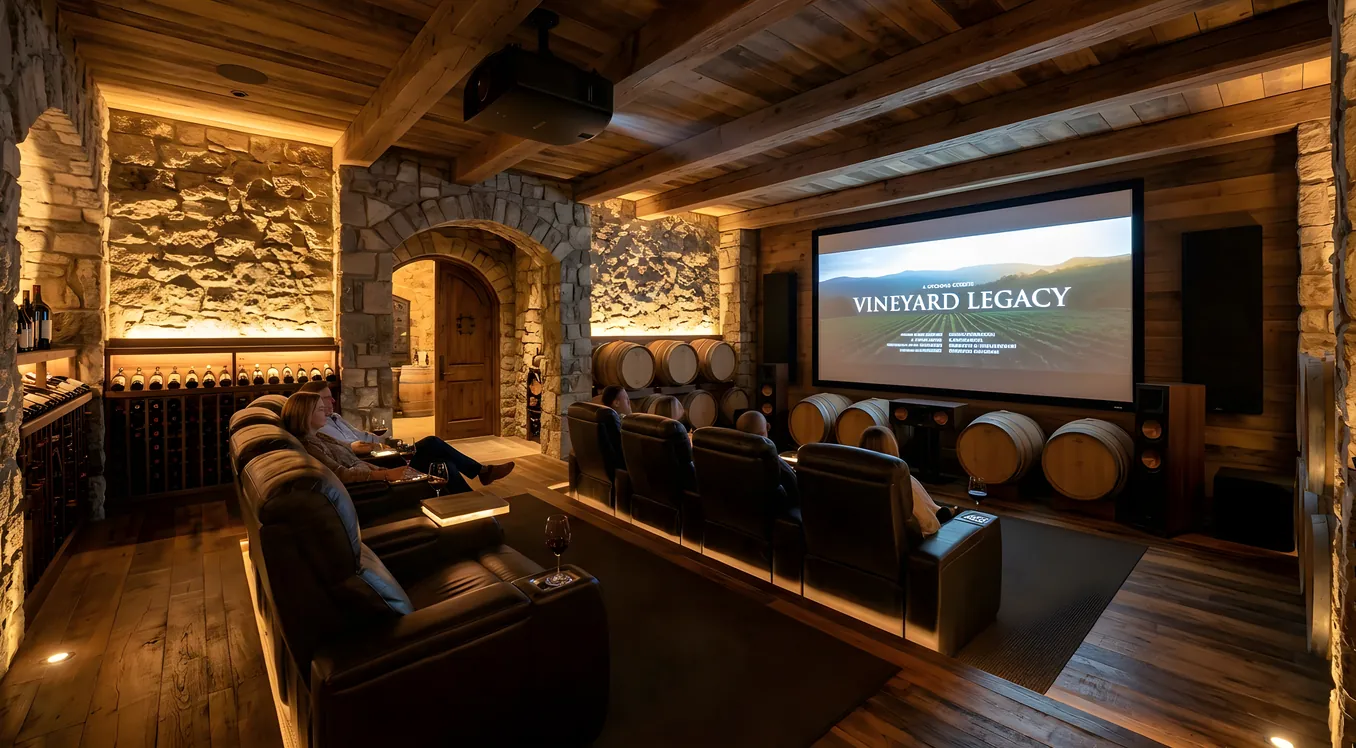
Wine country estates were built for entertaining. The floor plans assume guests, the outdoor spaces assume gatherings, and the cellars assume that someone cares deeply about the experience of sitting with a glass of wine and watching something worth watching. A home theater in Napa or Sonoma is not an add-on. It is part of what the property is for.
That said, these projects carry a specific set of complications that do not show up in a typical Bay Area build. Understanding those complications before you contact an integrator will save you money, time, and a great deal of frustration.
Estate Properties and Purpose-Built Entertainment Spaces
Napa and Sonoma estates increasingly include a dedicated entertainment wing as part of the original design or a major renovation. This is different from carving a media room out of a spare bedroom. When entertainment is part of the architectural intent, the room can be properly sized, the acoustic isolation can be built into the structure, and the equipment closet (or machine room) can land somewhere logical.
Purpose-built rooms also allow for the things that make a real difference: stepped or raked flooring for unobstructed sightlines across multiple rows, a proper projection distance for a 120-inch or larger screen, and dedicated electrical circuits that do not compete with kitchen appliances or HVAC systems. When a room is designed from the beginning for this purpose, the integrator is not solving problems after the fact. They are specifying equipment to fit a space that was built to receive it.
For estates that are remodeling existing structures, a barn conversion is one of the more interesting opportunities in wine country. Post-and-beam structures offer generous ceiling heights, natural separation from the main house, and an aesthetic that lends itself to a certain kind of moody, heavily draped theater space. The acoustic challenges in these buildings are real (large volume, hard surfaces, limited absorption built into the structure), but they are solvable with the right combination of ceiling treatments, wall panels, and a parametric EQ pass during calibration.
Wine Cave and Barrel Room Theaters
The wine cave theater is something of a Wine Country signature project. A carved or constructed cave beneath the estate, already temperature-controlled and humidity-managed for barrel storage, offers an inherently dramatic setting for a screening room. The challenges are distinct enough to warrant their own consideration.
Concrete and stone surfaces reflect sound with no mercy. The cave environment that makes wine storage ideal, stable temperature and controlled humidity, is acoustically hostile until treated. Reverberation times in an untreated cave can run several seconds, which makes dialog intelligibility poor and low-frequency control nearly impossible. The fix is aggressive surface treatment: heavy acoustic panels on walls and ceilings, substantial bass traps at corners, and often a floating floor system to reduce impact transmission from the earth above.
Temperature and humidity management for the theater equipment is a separate concern from wine storage. Wine caves are typically held at 55 to 60 degrees Fahrenheit, which is comfortable for wine but not for humans sitting through a two-hour film. The electronics in a properly designed system generate enough heat in an enclosed space to push the ambient temperature up significantly. Separate HVAC zoning for the seating area, while maintaining the barrel storage temperature elsewhere, is the standard solution. This adds cost but is not optional.
Projectors used in cave environments need to account for humidity. Consumer-grade equipment can be damaged by sustained elevated moisture levels. Most integrators spec commercial-grade projection hardware for these installations, which handles the environmental conditions more reliably and offers the remote management interfaces that a second-home owner needs.
Second Home Realities: What Happens When No One Is There
The defining operational challenge for a Napa or Sonoma home theater is not what happens when you are there. It is what happens when you are not. A primary residence has someone present to notice when a component locks up, an HDMI handshake fails, or the network goes down after a power fluctuation. A weekend home or vacation property may sit unoccupied for weeks at a time.
A system that requires hands-on intervention to recover from routine failures is a system that will disappoint you on the Friday evening you drive up from the city hoping to watch something. The correct response to this is not to buy simpler equipment. It is to specify the right automation platform and the right monitoring configuration from the start.
Control4, Savant, and Crestron all offer cloud-based monitoring and remote management that allow an integrator to diagnose and often resolve a system issue without anyone being physically present. A receiver that has hung on a bad input can be rebooted remotely. A network device that has lost its address can be checked and corrected. A firmware update that broke a driver can be rolled back. This is not a luxury feature for second-home installations. It is the difference between a system that functions reliably across absences and one that does not.
The automation platform also handles the practical basics: powering the system down completely when you leave (not just putting it in standby), cycling equipment in the correct order so nothing is damaged, and confirming via sensors that the room is actually off before you drive away. Scheduled health checks can test connectivity to every device and send alerts if something is offline.
For more on how automation scenes handle power sequencing and one-touch control, that section of the site goes into the mechanics in detail.
Outdoor AV in Wine Country
Entertaining in Napa and Sonoma extends outdoors as a matter of course. The climate, the views, and the lifestyle all push toward patio dining, vineyard gatherings, and pool-side events that go well into the evening. Audio and video need to follow.
Outdoor speakers for wine country estates are typically architectural: in-ground, in-ceiling under covered patio areas, or flush-mounted to post-and-beam structures. The goal is consistent coverage across a large outdoor footprint without visible hardware that competes with the landscape. This requires careful speaker placement planning, in-wall or in-conduit wiring runs that may span significant distances, and amplification designed for outdoor duty cycles.
Outdoor video is more selective. Protected projection setups under deep roof overhangs or dedicated outdoor theater structures work well. Weatherproof displays rated for outdoor use have improved considerably and are a viable option for covered areas that see minimal direct sun. Neither option is suitable for unprotected exposure to the elements, and both require protected equipment enclosures for source components and amplification.
The Napa Valley summer temperature profile matters here. Sustained outdoor temperatures in the 95 to 105 degree range push electronics into stress conditions. Equipment closets and enclosures for outdoor systems need ventilation engineering, not just passive venting. An outdoor media closet that cooks source equipment on a hot August afternoon is a recurring and expensive service call.
Whole-Home Audio and the Wine Country Entertaining Lifestyle
Music is not background in this context. Wine country entertaining is built around it: ambient sound for guests walking through the property, specific zones for the cellar, different moods for the patio versus the great room versus the cave. A whole-house audio system designed for a wine country estate is a room-by-room zoning project as much as it is an equipment project.
The standard approach is a matrix amplifier or a distributed audio platform that allows each zone to play independently from a shared library of sources. Guests in the barrel room hear what is appropriate for the barrel room. People on the terrace hear something different. The host controls all of it from a single interface, usually a tablet application or a dedicated touchscreen at a central location.
Outdoor zones in these installations commonly include four to eight speakers across a property. Speaker cable runs can reach 200 feet or more from the source equipment. At those distances, impedance matching and amplifier headroom both become technical considerations that affect sound quality and system longevity. An integrator who has done this work in wine country understands the difference; one who has only done urban residential work may not.
Climate Requirements for Sealed Theater Rooms
Napa and Sonoma experience genuinely hot summers. Valley floor temperatures from July through September regularly reach the mid-to-upper 90s, and heat spikes into triple digits are not unusual. A sealed, acoustically treated theater room with a high-output projector, a multi-channel amplifier, and a full rack of source equipment generates substantial internal heat load.
The HVAC system for a dedicated theater room in this climate needs to be designed specifically for that room. Oversizing the air conditioning is not the answer. An oversized system short-cycles, which means it runs in short bursts rather than sustained operation, and short-cycling is inefficient, creates humidity problems, and produces more noise (which is audible during quiet passages in a properly treated room). The right answer is a correctly sized dedicated zone with supply and return positioned to avoid noise transmission into the listening area.
For barrel room or cave theaters, the thermal mass of the surrounding stone or earth does significant work in stabilizing temperature, but it does not eliminate the need for cooling. Equipment heat has to go somewhere, and stone walls do not dissipate it efficiently enough on their own.
Integrator Availability and What That Means for Budgets
Napa and Sonoma do not have a deep bench of qualified home theater integrators. A handful of companies serve the area, and the best ones have long waitlists. The more common arrangement is that an East Bay or San Francisco integrator takes on wine country projects and factors travel into their billing.
This is a real cost consideration. Pre-installation site visits, equipment staging, installation days, and post-installation calibration and tuning all carry travel time. A project that might take three days of labor in the East Bay can take four or five days when the integrator is driving to Napa or Healdsburg. Service calls after installation carry the same premium. Factor this into your budget from the start, not as a surprise when the invoice arrives.
For regional options, the Bay Area installers directory covers integrators who serve wine country as part of their territory.
Post-Fire Construction Requirements
The 2017 wildfires reshaped construction requirements in Napa and Sonoma counties. Properties in designated fire hazard zones now face stricter materials requirements for new construction and major renovation, and theater rooms are not exempt. Specific requirements vary by parcel location and local jurisdiction, but common requirements include fire-resistant wall assemblies, ember-resistant venting, and non-combustible exterior cladding on any structure.
For a home theater renovation in a fire hazard zone, this means coordinating with a contractor who understands the local code as it has evolved since 2017. The acoustic treatment products commonly used in theater rooms (fabric panels, foam products, certain bass trap materials) may need to meet fire-rating requirements depending on jurisdiction. An integrator who has worked in these counties post-fire will know which products carry the necessary certifications. One who has not may specify materials that require revision during permit review.
What These Projects Cost
Estate home theater systems in Napa and Sonoma run from roughly $30,000 to $150,000 and above. The range is wide because the scope is wide.
A focused dedicated theater room with good projection, a proper multi-channel audio system, acoustic treatment, and a mid-tier automation platform lands in the $40,000 to $70,000 range for most builds. Add outdoor audio across a large property, a cave theater with acoustic remediation, whole-home audio through eight or ten zones, and full remote management infrastructure, and you are looking at a different number.
The travel premium for integrators who are not locally based adds 15 to 25 percent to labor costs in some cases. Wine cave acoustic remediation, if the space needs significant treatment, can add $10,000 to $20,000 or more depending on the extent of the work. Custom millwork for equipment cabinetry in a high-end aesthetic often costs more than the equipment it houses.
These are not reasons to avoid the investment. Entertainment is genuinely central to what a wine country estate is for. A properly designed system, built to run reliably when no one is there and perform without compromise when everyone is, is appropriate for the property. What it is not is cheap, and the projects that go wrong almost always go wrong because someone tried to close the budget gap with the wrong equipment or the wrong integrator.
Planning the Right System for the Property
The first question for any wine country home theater project is not what equipment to buy. It is what the property actually needs, and in what priority order.
A second home that serves primarily as a weekend retreat for one family needs different emphasis than an estate that hosts events. A property with a wine cave that could become a theater needs to resolve the acoustic and environmental questions before the equipment conversation happens. A home where the owners are absent for months at a time needs the remote management infrastructure built in at the foundation, not retrofitted later.
Start with the use cases. Be specific: who uses it, how often, what they want to be able to do, and what they cannot tolerate going wrong when no one is available to fix it. A good integrator will build a system around those answers. The result will outlast the one built around a feature list.