Whole-House Audio: Distributed Sound Systems for Every Room
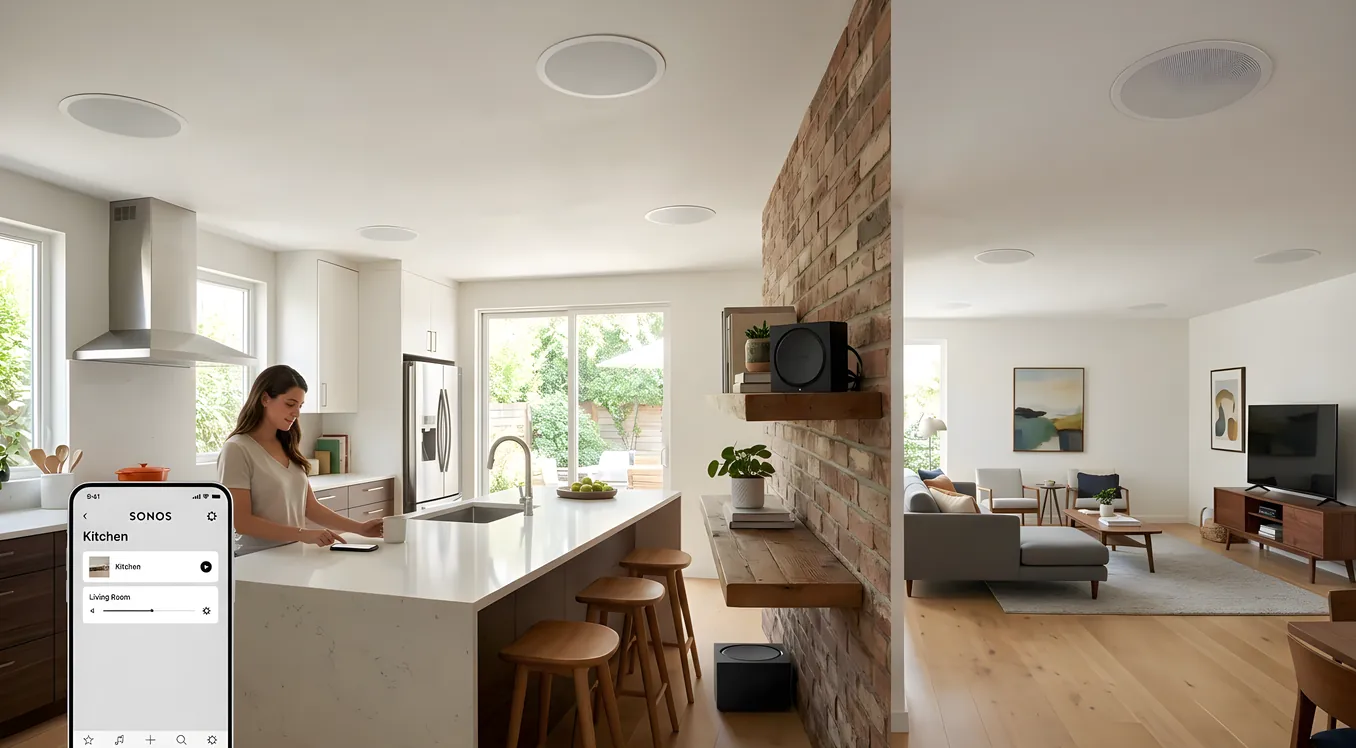
A whole-house audio system puts independent music playback in every room, with separate volume and source control for each zone. That means the kitchen can play the radio at low volume while the living room runs a different playlist at higher volume, and the outdoor patio runs its own source entirely. None of the zones interfere with one another. The concept isn’t new, but the technology for achieving it has split into two very different architectural paths, each with real tradeoffs.
What Whole-House Audio Actually Means
Zone independence is the core definition. A true multi-room audio system lets each zone select its own source, control its own volume, and operate on its own schedule. Turning off the bedroom zone doesn’t affect the kitchen zone. Playing the same source across all zones simultaneously (a party mode) is a common feature, but it’s the exception, not the default behavior.
That distinction matters because it rules out simple whole-home setups like running a stereo amplifier with multiple speaker pairs wired in parallel. Parallel wiring shares a single source and a single volume control. It’s a speaker distribution scheme, not a zone system. Whole-house audio, properly defined, requires a zone controller for each room.
The number of zones a household needs is usually smaller than it sounds. Most installs include 4 to 8 zones: kitchen, living room, master bedroom, one or two secondary bedrooms, a home office, a garage, and an outdoor space. Each zone is an independently powered and controlled speaker pair or set of ceiling speakers, fed from a central amplification point or from a local wireless device.
Centralized Amplifier Architecture
The traditional approach to whole-house audio runs all speaker wire to a central location, usually a mechanical room, utility closet, or AV rack in the main equipment space. A multi-zone amplifier or multi-channel amplifier paired with a distribution matrix lives at that central point, and all zone control flows from there.
A multi-zone receiver handles source selection and amplification in a single unit. Brands like Russound (the CA-Series) and Sonance (the DSP line) build dedicated multi-zone products with 4 to 12 zone capacity, local keypads at each zone, and IR or RS-232 control for integration into home automation. Each zone gets two channels of amplification (a stereo pair) and an independent source selector. Keypads at each room location let occupants adjust volume and switch sources without touching the main unit.
An alternative approach pairs a multi-channel power amplifier with a separate audio matrix switcher. The matrix switcher handles source routing (assigning each zone to whatever source input it should hear), and the power amplifier provides the current for each channel. This setup offers more flexibility and lets you upgrade amplification independently of the distribution logic. It also requires more rack space and more cable.
In either case, the speaker runs are long copper wire pulls from the amplifier location to the ceiling, wall, or in-wall speakers at each zone. Standard recommendation for in-ceiling and in-wall distributed audio speakers is 16-gauge or 14-gauge oxygen-free copper speaker cable. The longer the run, the lower the gauge number you should use to avoid resistance losses. Runs over 50 feet benefit from 14-gauge wire.
For more on how centralized distribution can extend beyond audio to include video zones and control systems, see our whole-home AV distribution guide.
Distributed Wireless Architecture
Wireless multi-room systems replaced centralized audio as the default approach for most homes over the past decade. The reasons are straightforward: no wire pulls required, no central amplifier to install, individual room units handle their own amplification, and the entire network is controlled by a smartphone app.
The four major wireless ecosystems in this space each have distinct characteristics.
Sonos built the category and remains the most widely installed platform. Sonos speakers connect over Wi-Fi, sync playback across zones with low latency, and support a wide range of streaming services natively. The Sonos Era 300 and Era 100 cover most room sizes. The Sonos Amp connects passive speakers (including in-ceiling pairs) to the Sonos ecosystem for rooms where you want the wireless convenience but prefer the speaker type of a wired system. Sonos supports multi-room grouping, whole-home party mode, and individual zone control from a single app. One notable limitation is that Sonos is a closed ecosystem; it doesn’t natively bridge to other audio systems without third-party integration.
HEOS (Denon and Marantz) is the wireless multi-room layer built into Denon and Marantz AV receivers and streaming amplifiers. HEOS works well as an extension of an existing home theater setup: if your main room already runs a Denon AVR, you can add HEOS speakers to secondary zones without installing a separate platform. The HEOS app controls both the main theater zone and the distributed audio zones. HEOS doesn’t have the same breadth of hardware options as Sonos, but it eliminates the need to maintain two separate apps if Denon equipment is already in the house.
MusicCast (Yamaha) works similarly: it’s Yamaha’s multi-room layer, built into their AV receivers and available as standalone streaming speakers. MusicCast handles zone grouping well and supports high-resolution audio through compatible sources. It’s a strong choice for households with existing Yamaha equipment.
BluOS (NAD and Bluesound) targets the audiophile segment. BluOS supports lossless file playback, Tidal Connect, and MQA decoding. The Bluesound NODE streaming player connects to any amplifier or powered speaker with an analog input, making it easy to add BluOS streaming to an existing stereo or to high-end bookshelf speakers without replacing the amplification. BluOS is the best-sounding wireless platform at the software level, and NAD’s BluOS-enabled amplifiers bring that quality to in-ceiling speaker setups.
For a more detailed comparison of how these platforms handle multi-zone audio switching and grouping, see the dedicated multi-zone guide.
Professional Control Systems
Residences with more than 8 zones, extensive automation integration, or performance requirements above what consumer platforms address typically go with professional-grade distribution systems from Control4, Savant, or Crestron.
Control4 audio distribution handles up to 16 or more zones from a single controller and integrates the audio system with lighting, HVAC, shades, security, and video distribution through a unified control interface. An authorized Control4 dealer programs the system to the specific home, which means sources, zone names, and behaviors are configured rather than self-installed. The tradeoff is that professional-grade systems require a professional for initial setup and for most changes afterward.
Savant positions itself above Control4 in terms of interface polish and customization depth. The Savant RCA-66M audio matrix handles up to 6 sources and 6 zones, with Savant’s touchscreen and app interface for control. Like Control4, Savant requires an authorized dealer.
Crestron serves commercial AV installations first, but high-end residential projects use Crestron for its reliability and integration capabilities. Crestron’s ZIDI distributed audio system streams audio over IP, eliminating analog speaker runs entirely in favor of a network infrastructure approach. This makes large-scale deployments cleaner architecturally but increases per-zone cost.
Professional systems are not an appropriate choice for most homes. The installation cost, ongoing dealer dependency, and added complexity are justified only when the home genuinely has the scale, budget, and control requirements that make the investment worthwhile.
In-Ceiling Speaker Selection for Distributed Audio
In-ceiling speakers for a distributed audio system have different requirements than theater speakers. Theater in-ceiling speakers optimize for overhead height channel reproduction, with directional drivers and specific off-axis characteristics. Distributed audio in-ceiling speakers optimize for wide, even coverage of a room from a position above and slightly off-center.
The key spec is dispersion angle. A speaker with 90-degree or wider dispersion angle covers a kitchen or bedroom from a single ceiling location without producing a hot spot directly below the driver. Narrow-dispersion drivers require multiple speakers per room to achieve even coverage, which increases both cost and installation complexity.
Sonance, Origin Acoustics, and Polk Audio each produce in-ceiling lines specifically designed for distributed audio with wide dispersion patterns. Sonance’s M6 series and Origin Acoustics’ Director series both include pivoting tweeters, letting the installer angle the high-frequency driver toward the primary listening position even when the woofer is mounted flush.
For distributed audio, 6.5-inch woofers handle most rooms up to about 250 square feet adequately. Large rooms, open-plan spaces, and kitchens with high ceilings benefit from 8-inch woofers, which move more air and produce better bass response at moderate volume levels. Distributed audio typically runs at background levels, so efficiency (sensitivity rating in dB at 1 watt/1 meter) matters more than raw power handling.
Impedance matching is a practical issue in centralized-amplifier systems. Most multi-zone amplifiers are stable into 4 or 8-ohm loads per zone. If you wire two speaker pairs per zone (for a larger room), use an impedance-matching volume control or a speaker selector with impedance protection to avoid overloading the amplifier.
Outdoor Zones
An outdoor zone has requirements that differ from every indoor zone. Weather tolerance is the obvious one. Outdoor speakers rated for exterior use carry IP ratings for moisture resistance and UV-stabilized enclosures that won’t crack or fade in direct sunlight. Sonance Outdoor, Polk Audio Atrium, and Origin Acoustics Canyon series are common choices for landscape and patio installations.
Volume level is the other practical difference. Open-air listening requires more power and more speakers to produce the same perceived loudness as an indoor room. Outdoor sound disperses in every direction rather than reflecting off walls, so coverage per speaker shrinks. Plan for one stereo pair of outdoor speakers per 300 to 400 square feet of outdoor listening area, rather than the 500 to 600 square feet you might cover with a single pair indoors.
Subwoofer performance outdoors is poor without significant power. Bass frequencies disperse very quickly outdoors. Some homeowners include a weatherized subwoofer for patio spaces, but the results depend heavily on placement (ideally against a wall or in a corner to take advantage of boundary reinforcement). Most outdoor audio setups skip the subwoofer and accept limited bass in exchange for the simplicity.
Outdoor speaker wire runs require either direct-burial-rated cable or conduit protection. Direct burial wire has a UV and moisture-resistant jacket designed for underground runs. If you’re installing conduit, use rigid or flexible PVC and size it for future wire pulls.
Pre-Wire Planning for New Construction
New construction is the best opportunity for a whole-house audio system because the walls are open. Running speaker wire before drywall costs a fraction of what a retrofit installation costs, and you can position speakers and volume controls exactly where they belong rather than where existing access allows.
The planning sequence starts with speaker locations. Mark ceiling speaker locations for each zone before framing is closed. In typical rooms, center the speaker on the ceiling or offset slightly toward the main listening position in the room. Mark runs back to the central equipment location (usually the main mechanical or utility room). Pull speaker cable from each location back to a central termination point, where the wiring will connect to the multi-zone amplifier or distribution matrix.
Run two pairs of 16-gauge or 14-gauge wire to each ceiling location, even if you only plan one speaker pair initially. The second pull allows for a future speaker addition without re-opening the ceiling. Label each run at the termination point with the zone name.
For control keypads or volume controls at each room, run a Cat6 cable from each control location back to the central equipment room. The Cat6 carries low-voltage control signals for most zone keypads and gives you flexibility if the control system changes later.
Conduit stubs from the central equipment location to each floor level are worth adding if budget allows. Conduit allows future wire pulls without opening walls. Schedule with the electrician to coordinate rough-in timing, since speaker and control wire runs happen in the same rough-in phase as electrical.
The network requirements guide covers structured cabling and network infrastructure planning for smart home systems, which intersects with whole-house audio pre-wire planning.
Retrofit Options
Existing homes without pre-run speaker wire have two main paths.
The first is wireless. A distributed wireless system from Sonos, Bluesound, or Yamaha requires no wire pulls at all. You place powered speakers or amplified zones where you want them and connect to the home Wi-Fi network. In-ceiling speaker fans can still be added in individual rooms using a wireless-connected amplifier like the Sonos Amp, which then drives passive ceiling speakers from a local position, minimizing the wire run to just the speaker drop in that room.
The second is fishing wire. For homeowners committed to a centralized wired architecture, experienced low-voltage installers can fish speaker cable through existing walls and ceilings in most construction types. The process is time-consuming and requires access from attics or crawlspaces in most cases. Double-wall construction and fire-blocking frames add complexity. Retrofit wire fishing typically costs two to three times the labor of new-construction rough-in for the same number of zones.
A hybrid is the practical middle ground for most retrofits: wireless distribution for the majority of zones, with a few selected rooms given wired in-ceiling speakers via local wireless amps where aesthetics or performance warrant the added effort.
Cost Ranges
Wireless-only systems ($1,000 to $3,000): A 4-zone Sonos system with Era 100s in each room lands in this range. No installation cost beyond positioning the speakers and connecting them to Wi-Fi. Streaming quality is excellent. Physical speaker aesthetics depend on the room.
Basic wired systems ($3,000 to $8,000): A 4 to 6-zone centralized system with a mid-range multi-zone amplifier, in-ceiling speakers, and basic keypads. Labor costs vary significantly by region and by whether the home has easy attic/crawlspace access. New construction wired systems of this scope often come in under $5,000 installed.
Professional installed systems ($8,000 to $25,000 and above): Full dealer-designed and installed systems using Control4, Savant, or high-end components. This range includes programming, commissioning, integration with other home systems, and ongoing support relationship with the dealer. Large homes with 12 or more zones can exceed the top of this range.
The wireless platforms have made excellent whole-house audio accessible without the installation overhead of traditional systems. A homeowner who is comfortable with technology can build a genuinely good 4 to 6 zone wireless system for well under $3,000 and expand it incrementally as budget allows, adding one zone at a time without replanning the infrastructure.