What to Expect From an AV Consultation: The Process Explained
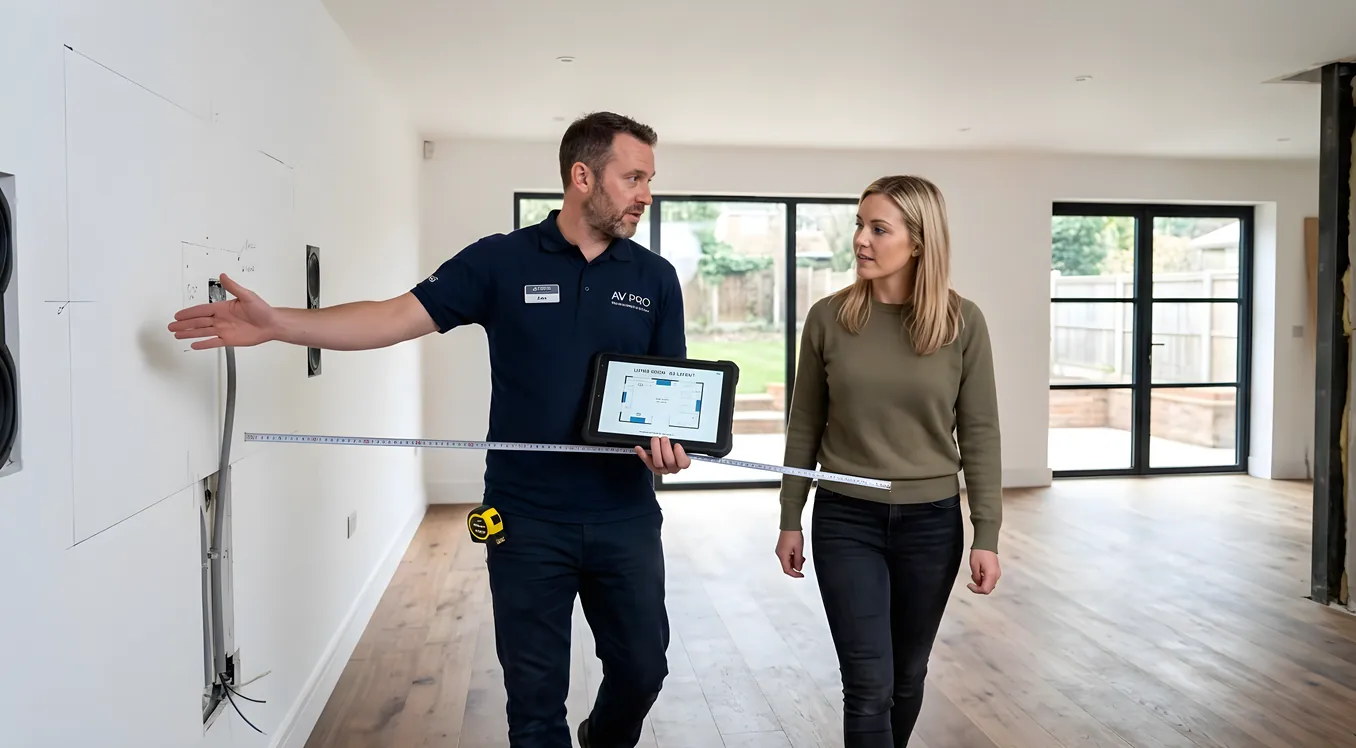
An AV consultation is a site visit where an integrator looks at your room, asks questions about how you use it, and gathers the information needed to design a system that actually fits your space and lifestyle. It is not a product demo, and a good one should not feel like a presentation where someone is working toward a close.
Understanding the process ahead of time helps you prepare, ask better questions, and evaluate whether the integrator in front of you is the right fit.
What a Consultation Is (and What It Is Not)
A consultation is fundamentally a discovery process. The integrator’s job at this stage is to understand your situation, not to sell you anything. That means walking your room, asking about how you watch and listen, understanding the structural realities of the space, and identifying constraints (wiring, acoustics, HVAC proximity, power availability) before any equipment gets recommended.
That’s an important distinction: in a properly structured consultation, equipment recommendations don’t come until after the integrator has gathered enough information to make them meaningfully. If someone walks in and starts pitching a specific projector or speaker brand in the first ten minutes without asking about your room or your habits, pay attention to that pattern.
The consultation is also not a design session. Most integrators need time after the visit to price out equipment, plan the installation scope, and assemble a formal proposal. Expect that to arrive separately, not on the same day.
Before the Visit: How to Prepare
A few things you can do before the integrator arrives will make the visit more efficient and the resulting proposal more accurate.
Know your budget range. You do not need an exact number, but a realistic range helps the integrator calibrate their recommendations. A system designed around a $15,000 budget looks meaningfully different from one designed around $50,000. If you hedge or decline to share a number, the integrator is guessing, and the proposal that comes back may not reflect what you actually want to spend. See our cost breakdown guide for component-level context on what different budget levels actually get you.
Clarify your priorities. Think about what matters most. Is it picture quality in a dedicated darkened room? Flexibility to use the space for gaming and sports, not just movies? Multi-room audio that connects to your outdoor speakers? Having a clear answer to “what would make you most satisfied with this system” saves time during the visit and leads to better recommendations.
List what you watch and listen to most. An integrator designing for a film enthusiast who watches a lot of dark, contrast-heavy cinema will make different choices than one designing for someone whose primary use is live sports and gaming. Both are valid priorities; they just pull toward different equipment and calibration choices.
During the Visit: What the Integrator Is Assessing
When the integrator walks your space, they are not just looking at the room aesthetically. They are gathering specific technical information.
Room dimensions and geometry. The size and shape of the room determine speaker placement, screen size, seating distance, and whether bass modes will be a problem at low frequencies. An irregular room, a room with hard parallel surfaces, or a space with an open floor plan all create different constraints.
Electrical capacity and panel access. High-performance AV equipment, especially high-end projectors, amplifiers, and subwoofers, can draw significant power. The integrator will want to know what’s available and whether dedicated circuits are practical or necessary.
Structural access. In-wall speakers, conduit runs, and projector mounting all depend on what’s accessible. The integrator will often ask about attic access, crawl space, and whether walls are easily opened. In new construction or pre-drywall situations, significantly more is possible.
HVAC and acoustic factors. A noisy air handler, a return vent directly behind the listening position, or an HVAC duct that acts as a sound conduit can undermine even a high-quality system. Good integrators think about this.
Existing wiring and equipment. If you have infrastructure already in place, whether conduit, Ethernet, prior speaker wire, or existing components you want to keep, knowing that early affects the design.
Questions a Good Integrator Should Ask
This is a useful gauge of quality. An integrator who is genuinely working to understand your needs before making recommendations will ask things like:
- How do you primarily use this room? Movies, sports, gaming, music, or some combination?
- Who uses the space? Kids, guests, a single dedicated listener?
- Do you want to control everything with a single remote or app, or are you comfortable managing multiple inputs separately?
- What’s your timeline? Are you working around a renovation, a move-in date, or a more flexible schedule?
- Have you had a home theater or dedicated listening room before, and if so, what did you like and dislike about it?
If an integrator is doing most of the talking in the first thirty minutes, that’s worth noting. The discovery phase should be question-heavy on their end.
What to Show Them
Give the integrator access to everything relevant:
- The room itself, including the adjacent spaces if sound isolation is a concern
- The electrical panel, so they can assess available circuits and distances
- Any existing AV equipment you own and want to keep or integrate
- Access points: attic hatch, crawl space door, mechanical room
If the project involves new construction or significant renovation, share your plans or drawings. The earlier an integrator can see what is being built, the more influence they can have on decisions (rough-in locations, conduit sizing, HVAC placement) that become expensive to change later.
After the Visit: Timeline and What Comes Next
A thorough proposal takes time to assemble. For systems with significant complexity, detailed design work, or construction involvement, a one-to-two-week turnaround is typical. Simpler installs may come back faster.
The proposal you receive should include:
- A system design description explaining the approach, not just a parts list
- An itemized equipment list with model numbers and prices
- Installation scope, broken out by task if the project is large
- A project timeline with phases if applicable
- A payment schedule (commonly split into deposit, pre-install, and completion)
If you receive a quote that is just a number with a few brand names listed, it is reasonable to ask for more detail. Vague proposals make it harder to compare integrators accurately and create ambiguity about exactly what is included.
Consultation Fees
Many integrators offer free consultations. Others charge $100 to $300, particularly for larger projects or longer-distance visits, and typically apply that fee toward the project cost if you move forward.
Paying for a consultation is not a red flag. It can actually be a positive signal: an integrator who charges for their time has a reason to be thorough rather than spending thirty minutes pitching and leaving. That said, a free consultation from a reputable firm is equally valid. Fees vary more by market and firm size than by quality.
Getting Multiple Consultations
Consulting with two or three integrators before deciding is standard practice and any professional integrator will expect it. You are making a significant investment and choosing someone who will be in your home for potentially weeks. Taking time to compare approaches, communication styles, and proposals is the right call.
When comparing proposals, be careful to compare scope, not just price. A lower proposal that excludes acoustic treatment, dedicated electrical, or commissioning time is not always a better deal than a higher one that includes them. Our guide to choosing an installer covers what to weight in that evaluation.
Design Fees for Complex Projects
On projects with significant custom construction, new room builds, or unusual acoustic requirements, some integrators charge separately for detailed design work. These fees typically range from $500 to $2,000 and cover the engineering work of planning speaker placement, room dimensions, isolation design, and system architecture before a single piece of equipment is purchased.
Design fees are most common when the integrator’s recommendations will meaningfully influence the construction itself. If you are building a dedicated theater room from scratch, paying for design work upfront is usually worth it. You get drawings and specifications that your contractor can build to, and any qualified integrator can bid the installation against that design.
Making the Most of Your Consultation
Come with honest answers to two questions: what you want and what you want to spend. The integrator’s job is to connect those two things in the most effective way they know how. The more clearly you can articulate what you are trying to accomplish, the less time both of you waste on proposals that miss the mark.
A good consultation ends with you feeling like someone listened, asked smart questions, and has a clear picture of what you need. If you leave feeling like you just sat through a product presentation, it may be worth scheduling time with someone else.
For a list of specific questions to bring into the consultation, see our installer questions guide.