Home Theater Cost Breakdown: What Each Component Actually Costs
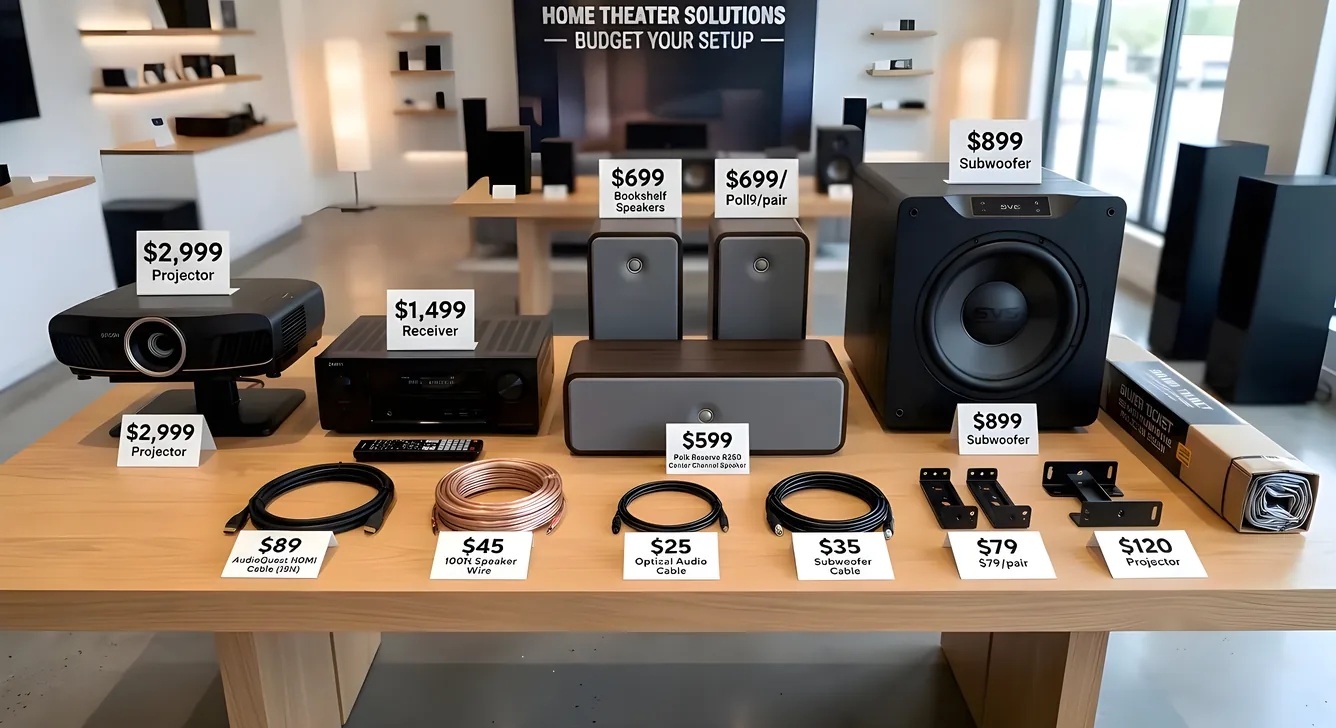
Most home theater guides either quote a vague “$5,000 to $50,000” range or focus on a single price tier. Neither approach helps you budget. This breakdown goes component by component, with honest price ranges at three levels and a clear-eyed look at where cutting costs makes sense and where it comes back to haunt you.
What a Complete Home Theater System Actually Includes
Before the numbers, it helps to know what you are budgeting for. A complete home theater system has eight major component categories, plus the costs of putting them all together in a room that actually works. Each category can be done cheaply, thoughtfully, or lavishly, and the multiplier between those extremes often surprises people.
| Component | Budget | Mid-Range | High-End |
|---|---|---|---|
| Projector | $1,000 - $2,500 | $2,500 - $5,000 | $5,000 - $20,000 |
| Projection Screen | $200 - $500 | $500 - $2,000 | $2,000 - $8,000 |
| AV Receiver | $300 - $600 | $600 - $2,000 | $2,000 - $5,000 |
| Speakers (5.1 set) | $500 - $1,500 | $1,500 - $5,000 | $5,000 - $20,000 |
| Subwoofer | $200 - $500 | $500 - $1,500 | $1,500 - $5,000 |
| Seating (per seat) | $400 - $800 | $800 - $2,000 | $2,000 - $5,000 |
| Acoustic Treatment | $300 - $800 | $800 - $3,000 | $3,000 - $10,000 |
| Automation / Control | $200 - $500 | $500 - $5,000 | $5,000 - $30,000 |
| Room Construction | $5,000 - $15,000 | $15,000 - $40,000 | $40,000 - $100,000+ |
| Installation Labor | $500 - $2,000 | $2,000 - $8,000 | $8,000 - $25,000 |
Total system cost estimates:
- Budget system: $3,000 - $8,000
- Mid-range system: $15,000 - $30,000
- High-end system: $50,000 - $150,000+
These are ranges, not quotes. Exactly where you land within each band depends on your room size, brand choices, and whether you do any of the work yourself.
Projector Costs
A projector is the heart of most dedicated home theaters, and the price spread is enormous because the technology spans several generations.
Budget projectors ($1,000 - $2,500) cover entry-level 4K models and 1080p units from established manufacturers. At this price, you get watchable images in a darkened room. You may accept some color accuracy trade-offs and a lens that lacks zoom flexibility. The lamp life can be short and replacement lamps add ongoing cost.
Mid-range projectors ($2,500 - $5,000) deliver noticeably better black levels, improved contrast ratios, and real 4K resolution with decent HDR. This is where most dedicated home theater builds land because the jump in image quality from budget to mid-range is large.
High-end projectors ($5,000 - $20,000) include laser-based models with long lamp life, wide color gamuts, and the optical quality to fill a 120-inch or larger screen without washing out shadow detail. If you are comparing projected images to OLED panels at the same price, the high-end projectors can match or exceed them.
Projection Screen Costs
A good screen matters more than most people expect. A mediocre screen wastes a quality projector.
Budget screens ($200 - $500) are fixed-frame pull-down or motorized units with basic gain. They work, but they may show color shifts at off-axis viewing angles and have limited ambient light rejection.
Mid-range screens ($500 - $2,000) include tensioned screens that stay flat and materials with controlled gain values suited to your throw distance. Acoustically transparent options at this price point let you place center channel speakers behind the screen.
High-end screens ($2,000 - $8,000) feature high-contrast gray materials for rooms that cannot be fully darkened, ultra-high-gain options for specific projection geometries, and premium motorized frames with masking systems that adjust aspect ratio for different content.
AV Receiver Costs
An AV receiver is the processing and switching hub of your system. It takes signals from sources, processes audio, powers speakers, and routes video.
Budget receivers ($300 - $600) handle the current major audio formats and support at least 5.1 channels. At this price, power output is modest and the internal DACs are acceptable. You will max out these units if you add more speakers or add sources later.
Mid-range receivers ($600 - $2,000) provide noticeably cleaner amplification, support for 7.1.4 and larger configurations, and features like room correction systems that measure your speaker placement and adjust the sound curve accordingly. This is where most serious home theaters end up.
High-end receivers and separates ($2,000 - $30,000+) are a different category. At the upper range, buyers typically split into a separate preamplifier/processor and power amplifier blocks. This separation reduces interference between the processing circuitry and the high-current amplifier stages. The improvement is audible in quiet passages and complex surround material.
Speaker Costs (5.1 System)
Speakers are where the money matters most. Unlike cables or streaming devices, speaker quality translates directly and obviously into what you hear.
A budget 5.1 package ($500 - $1,500) typically includes bookshelf or satellite speakers for front and surround channels plus a modest center channel. These packages can produce good results in a small or medium room, but they struggle at reference volume in larger spaces and often have limited low-end extension before the subwoofer takes over.
A mid-range 5.1 system ($1,500 - $5,000) delivers genuine dynamic range, cleaner dispersion from front speakers, and a center channel that keeps dialogue intelligible at low listening volumes. Buyers often assemble these systems from matched components rather than purchasing a single package.
A high-end 5.1 or expanded system ($5,000 - $20,000+) moves into tower speakers, ribbon tweeters, and multi-driver arrays that fill large rooms with room-correcting accuracy. At this level, the audible difference from mid-range is real, though it requires good acoustic treatment to hear it properly.
For a deeper look at how to build a full system without overspending in the wrong places, the budget home theater guide covers specific component combinations at entry-level prices.
Subwoofer Costs
A subwoofer produces the low-frequency content below about 80 Hz that you feel as much as hear. It is not optional in a theater system.
Budget subwoofers ($200 - $500) are typically ported designs with 8- to 10-inch drivers. They can produce meaningful bass in smaller rooms but run out of capability above modest volumes in larger spaces.
Mid-range subwoofers ($500 - $1,500) include 12-inch sealed designs and ported units with more powerful amplifiers. These reach lower frequencies with greater control and maintain composure at higher output levels.
High-end subwoofers ($1,500 - $5,000+) include double-woofer configurations, servo-controlled designs, and products specifically engineered for room calibration. A well-placed, well-calibrated high-end subwoofer in a treated room produces bass that you feel in your chest without muddiness.
Seating Costs
Theater seating is expensive because the engineering requirements are specific. Seats need to be comfortable at low inclines for extended viewing, recline without blocking sightlines for other rows, and ideally include features like cup holders, power recline, and USB charging.
Budget seating ($400 - $800 per seat) covers manual-recline chairs and lower-tier power recline options. Build quality at this price often shows in two to three years.
Mid-range seating ($800 - $2,000 per seat) includes purpose-built home theater chairs from dedicated manufacturers. At this price, you get real lumbar support, durable upholstery, and power recline that works reliably.
High-end seating ($2,000 - $5,000 per seat) adds features like heating, cooling, massage, and premium leather or fabric upholstery. Some systems include tactile transducers that vibrate in sync with the soundtrack.
Acoustic Treatment Costs
Untreated rooms reflect sound in ways that smear stereo imaging, make dialogue muddy, and create bass buildups in corners. Acoustic treatment is not decoration; it is a functional requirement for a room that sounds as good as it looks.
Budget treatment ($300 - $800) covers a basic package of absorption panels for the front wall and first reflection points. DIY panels using rigid fiberglass or mineral wool wrapped in fabric cost significantly less than retail equivalents.
Mid-range treatment ($800 - $3,000) adds bass traps in corners, diffusion panels for the rear wall, and ceiling cloud panels above the listening position. This level of treatment makes a measurable and audible difference in imaging precision and bass accuracy.
High-end treatment ($3,000 - $10,000+) involves professional acoustic measurement, custom-built panels, and possibly floating construction to isolate the room from structural noise. Custom bass trap arrays are calibrated to the room’s specific resonant frequencies.
The DIY vs professional comparison covers which parts of acoustic treatment are realistic DIY projects and which ones benefit from professional involvement.
Automation and Control System Costs
Control systems determine how you operate your theater: powering up sources, adjusting lighting, switching inputs, and managing all the other components from a single interface.
Budget control ($200 - $500) covers universal remotes, smart switches, and app-based control through a streaming device. You are essentially using your phone or a sophisticated universal remote to manage components manually.
Mid-range control ($500 - $5,000) includes entry-level dedicated control systems with touch panels, programmed macros that launch scenes (“Movie Mode” powers on projector, drops screen, dims lights, selects correct input in a single press), and integration with smart home platforms.
High-end control ($5,000 - $30,000+) is professional control system territory. These systems manage not just the AV equipment but also HVAC, lighting, shading, security, and other house systems from custom touch panels or mobile interfaces. The programming and commissioning cost is a significant portion of the total.
Room Construction Costs
A dedicated theater room performs better than a converted spare bedroom, but construction is where costs scale fastest.
A budget room conversion ($5,000 - $15,000) typically covers drywall work to isolate the room acoustically, basic electrical upgrades, a drop ceiling for acoustic purposes, and new flooring. You are working with an existing room footprint.
A mid-range dedicated build ($15,000 - $40,000) adds proper isolation wall construction using staggered stud framing or room-within-a-room techniques, a custom tiered floor for elevated rear rows, better HVAC routing, and a higher-quality finish package.
A high-end theater build ($40,000 - $100,000+) is a substantial interior construction project. It includes STC-rated assemblies that prevent sound from traveling to adjacent spaces, dedicated electrical circuits, custom millwork, star-ceiling lighting, and architectural finishes that match the performance of the equipment inside.
For a system-level view of what a complete mid-range build looks like assembled, the mid-range home theater guide covers component selection within a $15,000 to $30,000 budget.
Installation Labor Costs
Unless you are building a simple single-room setup with accessible outlets and no in-wall wiring, installation labor is part of the budget.
Budget installation ($500 - $2,000) covers a straightforward speaker and receiver hookup, projector mounting, and basic cable management.
Mid-range installation ($2,000 - $8,000) includes in-wall speaker wiring, projector and screen installation, equipment rack build-out, basic rack wiring and management, and system calibration with measurement tools.
High-end installation ($8,000 - $25,000+) is a professional integration project. It includes conduit runs, structured wiring, rack engineering with proper ventilation and cable labeling, control system programming, and thorough acoustic calibration using measurement microphones and analysis software.
The Hidden Costs Most Budgets Miss
Several line items do not appear in any component list but show up reliably during the build:
Electrical work: A dedicated theater circuit, separate from general household circuits, is standard practice. If your panel is near capacity or the room is far from the panel, electrical costs rise. Budget $800 to $3,000 for a dedicated circuit and any necessary panel work.
Permits: Structural modifications, electrical upgrades, and new HVAC runs typically require permits. Permit costs vary by jurisdiction but add $200 to $1,500 in most cases, plus the cost of inspections.
HVAC modifications: Projectors and electronic equipment generate heat. A theater room needs supply and return air, and you often need to add or relocate ductwork to serve a room that was not originally designed as an equipment room. Budget $1,000 to $5,000 for HVAC modifications.
Drywall repair and paint: Any in-wall wiring requires opening walls, which requires patching and repainting. If you are doing a full room, this is part of the construction budget, but partial installs often underestimate the repair scope. Budget $500 to $2,000 for any wiring project that goes through existing walls.
Projector alignment and calibration: A projector that is not professionally calibrated does not produce the color accuracy it is capable of. Professional calibration costs $300 to $600 and makes a visible difference on any mid-range or high-end unit.
Where to Spend and Where to Save
Not all components contribute equally to the experience. These priorities hold across all three budget tiers:
Spend on speakers. The jump from a $500 speaker package to a $2,000 one is the single most audible improvement you can make in a home theater build. Speakers convert electrical signals to sound waves in your physical room, and the quality of that conversion is immediately apparent.
Spend on acoustic treatment. A $3,000 speaker system in an untreated room sounds worse than a $1,500 system in a treated room. Treatment changes the room itself, which every component benefits from.
Save on cables. There is no audible or measurable performance difference between a $15 HDMI cable and a $150 one for home theater use. Spend on cable management and proper routing instead.
Save on streaming sources. The difference between a $100 streaming device and a $500 one is minimal for most content. The decoder and display hardware matter far more.
Match projector to screen. A projector above your screen’s quality ceiling wastes money. A screen below your projector’s capability limits what it can show. Buy these together, with the same tier in mind.
The high-end home theater guide covers where high-end spending produces returns worth the cost, and where it crosses into diminishing territory.
Getting to a Real Number for Your Build
The total system cost estimates at the top of this guide are deliberately wide ranges because the variables are real. Room size changes speaker requirements, which changes amplifier requirements. A room with no existing electrical infrastructure costs more to wire than one with accessible conduit paths. Labor rates vary significantly by market.
The most useful number is the one based on your specific room and component choices. Start with the component table, pick a tier for each category, and add 15 to 20 percent for the items that almost always get missed in initial estimates: permits, small electrical work, unexpected structural issues, and calibration services.
A well-built home theater in any tier outperforms a loosely assembled one at the tier above it. The planning work is where the money goes farthest.