High-End Home Theater ($15,000 to $50,000): Custom Design Territory
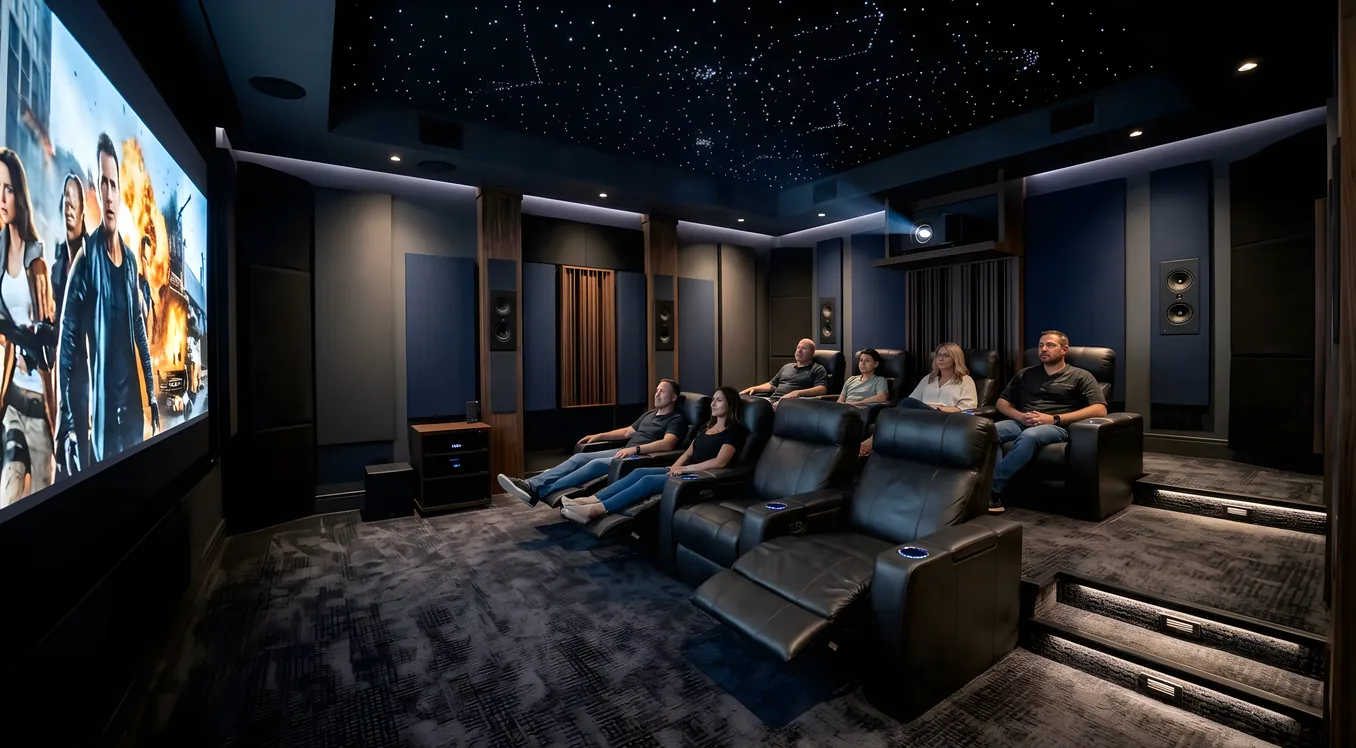
At the $15,000 to $50,000 level, home theater stops being a consumer electronics purchase and becomes a design and construction project. You are not shopping for components at a big-box retailer. You are working with an AV integrator who will draw plans, model acoustics, specify equipment, coordinate construction, and commission the finished system.
The results justify the process. A professionally designed high-end home theater delivers reference-quality picture and sound in a room that was purpose-built to receive it. Every dollar spent from $15K upward does compounding work, because the gear, the room, and the calibration all reinforce each other. Mediocre gear in a bad room sounds mediocre. Reference gear in an acoustically tuned room sounds like nothing you have heard at a showroom.
This guide walks through what your budget actually buys at each step, with real equipment examples and real numbers so you can enter integrator conversations with a grounded picture.
What $15,000 to $25,000 Buys
At the lower end of this range, the money goes into the core imaging and sound chain: a native 4K projector, a premium acoustic screen, a high-current amplification stack, reference-class speakers, dual subwoofers, and professional acoustic treatment.
Projection and screen account for roughly $10,000 of a well-built $25,000 system. JVC’s DLA-NZ7 (around $7,000) is the value standard in native 4K e-shift projection at this tier, producing genuine 8K-processed output with deep blacks that plasma-era viewers will recognize. Paired with a Stewart Filmscreen Cima Neve ($3,000), which provides gain-optimized reflection for projector-lit rooms, the imaging system alone exceeds what any flat panel can deliver at twice the screen size.
Amplification and processing take the next $4,000. A separates approach, pairing an Anthem AVM 70 processor with an Emotiva XPA-5 amplifier, gives you clean DSP headroom, room correction via Anthem Room Correction (ARC), and enough channel power to drive demanding speakers without compression artifacts at reference volume.
Speakers and bass round out the core system. A Klipsch RP-8000F II 7.2.4 configuration ($5,000) provides the sensitivity and horn-loaded dynamics that high-efficiency projector content rewards. Dual REL S/510 subwoofers ($3,000) handle bass extension to 20Hz with the speed and articulation that single subwoofers cannot match. At this screen size and volume, two subs are not a luxury, they are the difference between bass you feel in the right seat and bass you feel in every seat.
Acoustic treatment ($2,000) and professional installation ($1,000) complete a $25,000 build. First-reflection absorption panels, a rear diffusion array, and a bass trap installation in the primary corners are minimum requirements for a dedicated or semi-dedicated room. Without treatment, even the best speaker systems fight their own room reflections, and calibration can only compensate for so much.
For a detailed look at how costs break down across each component category, the cost breakdown guide shows where money compounds and where it reaches diminishing returns.
What $30,000 to $50,000 Adds
The $40,000+ tier is where theater becomes a room, not just a system. The imaging and audio core scales up, but the meaningful additions are automation, construction, and dedicated infrastructure.
Control4 or Savant automation ($5,000) replaces nine remotes with a single interface that manages projector warm-up and masking, lighting scenes, motorized shading, HVAC setback, and streaming selection in a single button press. Lutron Caseta or RadioRA lighting keeps flicker-free, cinema-grade dimming on every circuit. Motorized masking on the screen changes aspect ratios automatically when the source changes from 16:9 to scope format. These are not convenience features, they are what makes the system usable by every person in the household, not just the person who configured it.
Premium seating ($4,000 for a two-row, six-seat configuration) accounts for viewing geometry in ways most consumers ignore. Riser-mounted second-row seating at the correct height and rake angle preserves sightlines to the full screen for every seat, which matters as much as speaker placement.
Acoustic construction takes two forms at this tier. A star ceiling installation ($2,000) provides ambiance that defines the room’s identity as a theater rather than a converted space. Soundproofing ($3,000) addresses both transmission loss, so the theater does not disturb the rest of the house, and room isolation, so mechanical noise does not contaminate the listening environment. Dedicated electrical circuits ($1,500 typically, included in broader construction costs) eliminate ground loop noise and ensure amplifiers draw from clean power.
Dedicated room construction at $6,000 covers wall framing, riser construction, in-wall cable infrastructure, conduit for future upgrades, and finish work. This is the investment that separates a theater that was designed from day one from a room that has equipment in it.
A $40,000 build with all of these elements represents an assembled total of roughly $40,000: the $25,000 core system above, plus Control4 ($5,000), premium seating ($4,000), star ceiling ($2,000), soundproofing ($3,000), and dedicated room construction ($6,000).
Why Professional Design Matters at This Tier
A consumer putting together a $2,500 receiver-and-soundbar system can reasonably do so without professional help. A consumer spending $25,000 on separates, acoustic treatment, and a projector-screen system cannot, practically speaking, get the same performance from self-installation that a calibrated, professionally designed system delivers.
AV integrators at the high-end tier provide three things that online forum advice cannot replicate. First, CAD drawings and acoustic modeling before a single piece of equipment is specified, so speaker placement, screen size, throw distance, and riser height are all calculated against the actual room dimensions and not borrowed from a generic YouTube setup guide. Second, equipment specification that accounts for how components interact, not just how each component performs in isolation. Third, post-installation commissioning that includes ISF-certified display calibration, bass management, room correction tuning, and automation programming.
The difference between a self-installed $25,000 system and a professionally designed and calibrated $25,000 system is measurable at the measurement microphone and audible at the listening position. Skipping professional design at this spend level is the highest-cost mistake available to high-end theater buyers.
When you are ready to select an integrator, the guide to choosing an installer covers what certifications matter, what questions to ask, and how integrator contracts should be structured.
Equipment Specifications and Performance Expectations
Projectors at this tier are native 4K, not pixel-shifted 4K upscaling. JVC’s NZ7 and NZ8 use e-shift technology that writes 8K-resolution paths across native 4K panels. Sony’s VPL-XW5000 and XW7000 use Sony’s SXRD panels with native 4K resolution and broad color volume. Both approaches deliver HDR10 and Dolby Vision performance that flat panels in the $5,000-$10,000 consumer range cannot match for screen sizes above 100 inches.
Screens at this tier are specified acoustically as well as optically. An AT (acoustically transparent) screen allows speakers to be placed behind the screen, delivering correct dialogue imaging from screen center regardless of speaker placement limitations in the room. Stewart Filmscreen, Screen Innovations, and Elite Screens’ reference lines all offer AT options in the $2,500-$8,000 range depending on size and gain.
Speaker systems at the high-end tier shift toward horn-loaded and high-sensitivity designs, not because horn loading is inherently superior, but because projector-matched rooms tend toward larger square footages where efficiency enables reference levels without amplifier stress. Klipsch, JBL Synthesis, and Focal all offer configurations designed for dedicated theater use at this tier.
Subwoofer integration in dual or quad configurations follows a managed multi-sub approach that places subwoofers to cancel room mode nodes. This is not a set-and-forget wiring decision, it requires measurement and adjustment. Done correctly, bass response across all seating positions flattens to within 3dB across the listening area, which a single subwoofer in any position cannot achieve.
The Gap Between $25,000 and $50,000
The performance gap between a $25,000 professionally installed theater and a $50,000 one is less about picture and sound quality than about completeness. At $25,000, you have an excellent imaging and audio system in a treated room. At $50,000, you have a room that was built to be a theater from the walls out, with automation that makes it effortlessly usable, seating that makes it comfortable for two-hour films, and isolation that makes it compatible with normal household life.
Both are high-end home theaters. The $25,000 version earns that description from its equipment and calibration quality. The $50,000 version earns it from everything else the room becomes around that equipment.
If you are planning a build at either end of this range, the reference home theater guide covers what the tier above $50,000 looks like and where the spending goes when budget is no longer the primary constraint.
Starting the Process
The correct first step for a high-end home theater project is not researching equipment, it is finding an integrator and defining the room. Equipment specifications follow from room dimensions, seating positions, screen size targets, and acoustic goals. An integrator who designs the system first and specifies components second will produce a more coherent and better-performing result than any self-assembled component list, regardless of how well-researched that list is.
Budget $1,000 to $3,000 for the design and engineering phase before any equipment is purchased. This is not a fee to be avoided, it is the document that tells you whether the $25,000 build you are planning can actually fit the room you have, and what compromises, if any, the room requires.
High-end home theater at the $15,000 to $50,000 level is the range where results stop depending on compromises and start depending on decisions. Make them with someone who has built a hundred rooms before yours.