Reference Home Theater ($50,000+): What Elite Systems Look Like
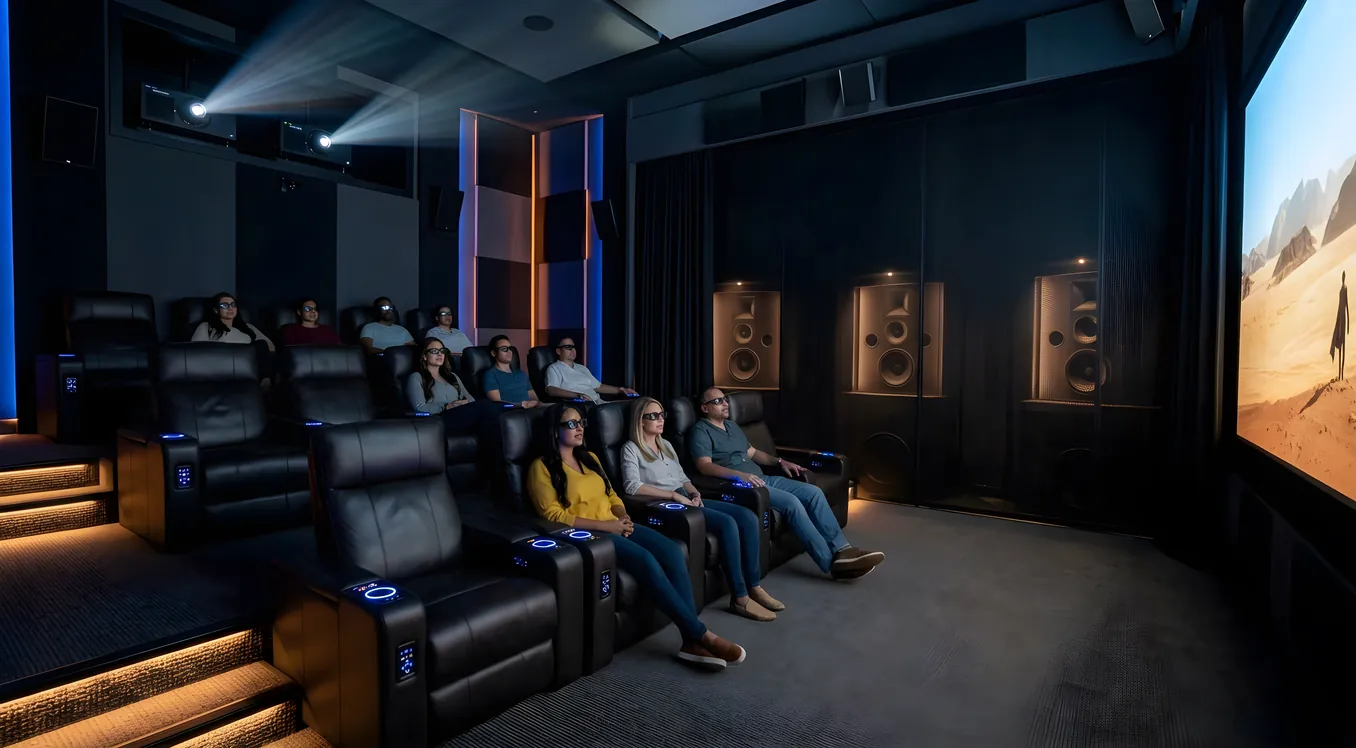
A reference home theater is not simply an expensive one. The term has a specific meaning in professional AV circles: a system calibrated to meet Dolby, THX, or DCI cinema standards, capable of reproducing source material at the resolution and dynamic range the content creators intended. The equipment is premium, but the distinguishing factor is that every component, from the projector to the acoustic panels to the electrical system, has been engineered together to eliminate the gap between what’s on the disc and what you hear and see.
Systems in this category run $50,000 at the low end. Serious builds land between $150,000 and $300,000. Extreme custom installs can exceed $500,000. The investment reflects not just hardware costs but the engineering time, acoustic modeling, construction work, and integration labor required to make the hardware perform to specification.
This guide covers what a reference system actually contains and what it takes to build one correctly.
Reference-Grade Image: What the Projector Has to Deliver
The projector is the most visible investment in any reference theater, and the gap between prosumer and reference-grade units is not subtle.
JVC’s DLA-NZ9 sits at the top of JVC’s residential lineup. It uses a native 4K D-ILA panel with an 8K e-shift process, a laser light source rated for 3,300 lumens, and a dynamic contrast ratio specification that places it in striking distance of commercial cinema projectors. More practically, it handles HDR grading accurately because it has enough light output to place the peak white level where a HDR10 or Dolby Vision master actually places it. Projectors with insufficient lumens compress the top of the HDR range, which is where most of the intended image information lives.
Sony’s VPL-GTZ380 takes a different approach. It’s a native 4K SXRD projector with a dual-laser light source and 10,000 lumens, which means it can drive very large screens at reference brightness without compromise. Street price runs above $30,000. It’s the residential projector most commonly specified for large dedicated theaters where the screen width exceeds 160 inches and ambient light control is not absolute.
Barco Residential brings commercial cinema projector pedigree into home installations. Barco builds projectors for actual movie theaters, and their residential division translates that engineering for private rooms. The resulting systems are calibrated to DCI-P3 color gamut and uniform light output across the image plane, the same standards applied to commercial screens. SIM2 occupies a similar position in the European custom AV market, with a longstanding reputation for color accuracy and build quality in dedicated spaces.
Screen selection at this level is as consequential as projector choice. Stewart Filmscreen’s Director’s Choice is the specification most frequently used when a room is being engineered to a reference standard. The gain, uniformity, and black levels are characterized to a degree that allows for predictable, repeatable calibration. Screen Innovations’ Black Diamond material addresses rooms where ambient light elimination is imperfect, rejecting ambient light through a specialized optical coating while maintaining gain and color neutrality.
Cinemascope 2.35:1 format with motorized masking is standard in rooms designed at this level. Fixed-ratio screens waste screen real estate on films mixed in scope format, and the black bars introduced by letterboxing are not optically inert. Motorized masking panels that expand to fill the image area for each aspect ratio eliminate that problem and look considerably better in a finished room.
Audio: Processor, Amplification, and Speaker Systems
Reference audio starts with the signal processor. Consumer AVRs, regardless of price, share an architecture built around cost efficiencies that a reference installation does not accept.
Trinnov’s Altitude series is the processor specified in most reference theaters. The Altitude 16 handles up to 16 channels of amplified output; the Altitude 32 handles 32. Both run Trinnov’s Optimizer room correction, which uses a sophisticated multi-point measurement microphone and custom DSP to address not just level and delay but speaker directivity, room modes, and the interaction between loudspeakers and boundaries. The correction is audibly superior to the consumer room correction found in any mass-market receiver. For a full comparison of receiver-versus-separates architectures, the fundamental tradeoffs in signal path are covered in detail.
Amplification is separated entirely from processing at reference level. Choices at this tier include McIntosh units, which offer power output specifications that remain stable into low-impedance loads and a build quality that reflects the long service life expected from this class of investment. ATI builds amplifiers used in professional monitoring and cinema installations. Bryston provides a 20-year transferable warranty, which matters when an amplifier will be integrated into a room-within-a-room construction that makes replacement a significant undertaking.
Speaker systems at reference level are purpose-engineered for fixed-position cinema use. JBL Synthesis offers horn-loaded systems derived directly from commercial cinema products, capable of high sensitivity and uniform dispersion into large rooms. Procella focuses on reference cinema installations and offers subwoofer systems that produce accurate, extended bass at cinema levels without the mechanical distortion that limits most residential subwoofers. Meyer Sound is used in professional mixing studios and large-scale commercial installations; when specified for residential use, the result is a speaker system calibrated to the same standards a post-production facility would use.
Speaker configuration at this level typically involves at least 9.1.6 (nine speaker channels, one or more subwoofers, six height channels), with some builds reaching 13.1.6 or larger. Speakers are positioned behind acoustically transparent perforated screens so that dialog and front-channel audio appear to originate from the image itself rather than from speaker grilles beside it. Surround and rear speakers are fully in-wall or in-ceiling, appearing in the finished room as flush-mounted grilles. The result is a room where there are no visible loudspeakers and the audio appears to come from everywhere and nowhere at once.
Subwoofer design at this level treats bass as a room-filling pressure problem rather than a point-source problem. Distributed subwoofer arrays, often using four or more subwoofer units placed at positions mathematically calculated to minimize room modes, produce bass that is even throughout the listening area. The alternative is the bass hot spots and dead spots that single-subwoofer systems always produce.
Kaleidescape: The Reference Media Source
Content quality matters as much as playback quality, and the gap between streaming and reference media is audible and visible to anyone who has heard and seen both.
Kaleidescape is the storage and playback system used in reference theaters because it provides the highest-quality digital source currently available outside a commercial post-production environment. The Strato player reads Blu-ray and 4K Blu-ray discs and stores rips in a lossless format that preserves all the original audio and video data without the compression artifacts that cloud streaming requires. Streaming services re-encode content at bitrates their infrastructure can support; Kaleidescape delivers the full disc bitstream.
Entry pricing for a Kaleidescape server and initial movie library investment runs from $10,000 upward, with per-title purchases in the $20-$40 range for 4K Dolby Vision content. The premium over a disc player reflects the quality of the source signal and the operational reality of a finished theater: in a room designed to this standard, the owner presses a single button on a touch panel, the lights fade, the masking panels adjust, and the movie begins. There is no disc to find, no physical media to store, and no interruption of the experience.
Acoustic Design and Room Construction
Hardware performance is bounded by the room it’s in. A $200,000 projector and speaker system in an acoustically poor room will perform worse than a $40,000 system in a properly treated space. At reference level, the room is engineered before any equipment is specified.
Professional acoustic modeling using EASE (Enhanced Acoustic Simulator for Engineers) software allows the acoustic designer to model the room before construction begins, predicting reverberation times, reflection patterns, and frequency response based on room dimensions, surface materials, and speaker placement. The output of that modeling drives specific decisions about surface angles, absorption placement, and diffuser positions that are built into the room rather than applied as corrections after the fact.
Soundproofing targets an STC (Sound Transmission Class) rating of 60 or higher in reference builds. STC 60 means that a 100-decibel sound in the theater (which is moderately loud cinema playback) produces roughly 40 decibels in the adjacent room (which is quiet background noise). Achieving STC 60+ requires a room-within-a-room construction method: a second structural layer of walls, floor, and ceiling is built inside the outer shell of the house, with the two structures decoupled by resilient isolation mounts that prevent vibration from transferring through the building. The outer shell sees vibration from inside and reduces it significantly before it reaches the rest of the structure.
HVAC is isolated on the same principle. Standard forced-air systems introduce audible noise into a theater, ranging from the sound of air moving through ducts to the compressor sound from an outdoor unit transmitted through the building structure. Reference theaters use decoupled duct runs, lined with sound-absorbing material, sized to deliver adequate air volume at very low velocity, which reduces turbulence noise. The HVAC equipment itself is mounted on vibration isolators.
Electrical supply is separated from the household circuit panel. A dedicated electrical panel for the theater feeds each major piece of equipment on its own circuit and provides a single, stable ground reference. Multiple circuits sharing a panel introduce low-level ground loops that add measurable noise floors to audio equipment sensitive enough to reveal them. High-quality power conditioning addresses line noise from other appliances on the same supply.
Control Systems and Automation
A reference theater without sophisticated control integration produces an operation sequence that requires the owner to interact with six separate pieces of equipment in the correct order before a film can begin. That is not how rooms at this investment level operate.
Crestron and Savant are the two platforms used in installations where control reliability is non-negotiable. Both support custom programming, 10-inch or larger touch panels, app-based control on mobile devices, and biometric access for rooms where the equipment requires controlled access. The difference between the platforms lies primarily in programming philosophy, integrator ecosystem, and support infrastructure rather than in raw capability. For a more detailed breakdown of residential control options, the Crestron overview covers the platform’s architecture and the categories of installation where it’s typically specified.
A properly programmed control system handles: scene lighting that transitions during playback, projector warm-up sequencing, screen masking adjustment for each aspect ratio, audio preset selection, shading control for windows, and HVAC adjustment for the duration of playback. The owner interacts with a single button labeled with the movie title. The room handles the rest.
Design, Integration, and Who Builds These Rooms
A reference theater is a collaboration between disciplines. The interior designer determines the visual experience: seat selection (often custom reclining units covered in premium leather with integrated cup holders and lighting), millwork for equipment racks and acoustic elements, finishes, and themed design elements when the owner wants something more specific than a black box. The AV integrator specifies and installs the equipment and programs the control system. The acoustician models and engineers the room treatment. The general contractor executes the room-within-a-room construction under the direction of the other specialists.
The organizations that credibly execute this work are CEDIA{rel=“noopener nofollow”}-member custom integration firms. CEDIA (Custom Electronic Design and Installation Association) maintains a professional membership and education framework for the custom AV industry. THX-certified installers have passed specific training and installation quality standards tied to THX’s cinema calibration specifications. Both credentials are a reasonable starting filter when selecting an integrator for a project at this investment level.
What These Rooms Cost
A functional reference theater on the lower end of the category runs $50,000 to $75,000. That typically means a JVC or Sony laser projector, a quality fixed-format screen in the 120-140 inch range, a Trinnov processor with quality amplification, a well-executed 7.2.4 or 9.2.4 speaker system, Kaleidescape source, basic control integration, and appropriate acoustic treatment applied to an existing room with average sound isolation characteristics.
Builds in the $100,000 to $200,000 range generally include purpose-built room construction with STC 60+ soundproofing, comprehensive acoustic design, premium speaker systems from JBL Synthesis or Procella, custom lighting and millwork, and full Crestron or Savant control integration. This is the most common range for serious dedicated theater projects commissioned through CEDIA integrators.
Extreme builds exceed $300,000 and in some cases approach or exceed $500,000. At that level, you’re typically looking at commercial-class projectors, custom speaker systems designed specifically for the room, Barco or high-end Sony projection, acoustically complex architectural elements integrated into the room design, and a level of finish work that competes with high-end commercial spaces. These projects are engineering commissions that happen to produce a room for one person.
For a grounding point on what the tier below this looks like, the high-end home theater overview covers the $20,000 to $50,000 range where many of the same components appear in more straightforward configurations.
Before You Commission a Build
The most common mistake in reference theater projects is specifying equipment before the room is designed. Acoustic modeling, room dimensions, and soundproofing goals should be established first, because they determine what’s possible in the space and constrain equipment choices. A projector specified for a 180-inch screen in a room that can only support STC 40 soundproofing is an expensive mistake.
The integrator conversation should include: a site visit to the actual room before any specifications are written, a discussion of the acoustic targets and whether room-within-a-room construction is feasible in the location, a clear scope of work that separates construction, equipment supply, installation, and calibration, and a calibration standard the system will be measured against at completion. Reference theaters are commissioned to a measurable standard. If the integrator can’t name that standard, the process isn’t reference-grade regardless of the equipment list.