AV Receiver vs Separates: When to Split Your Pre-Amp and Amplifier
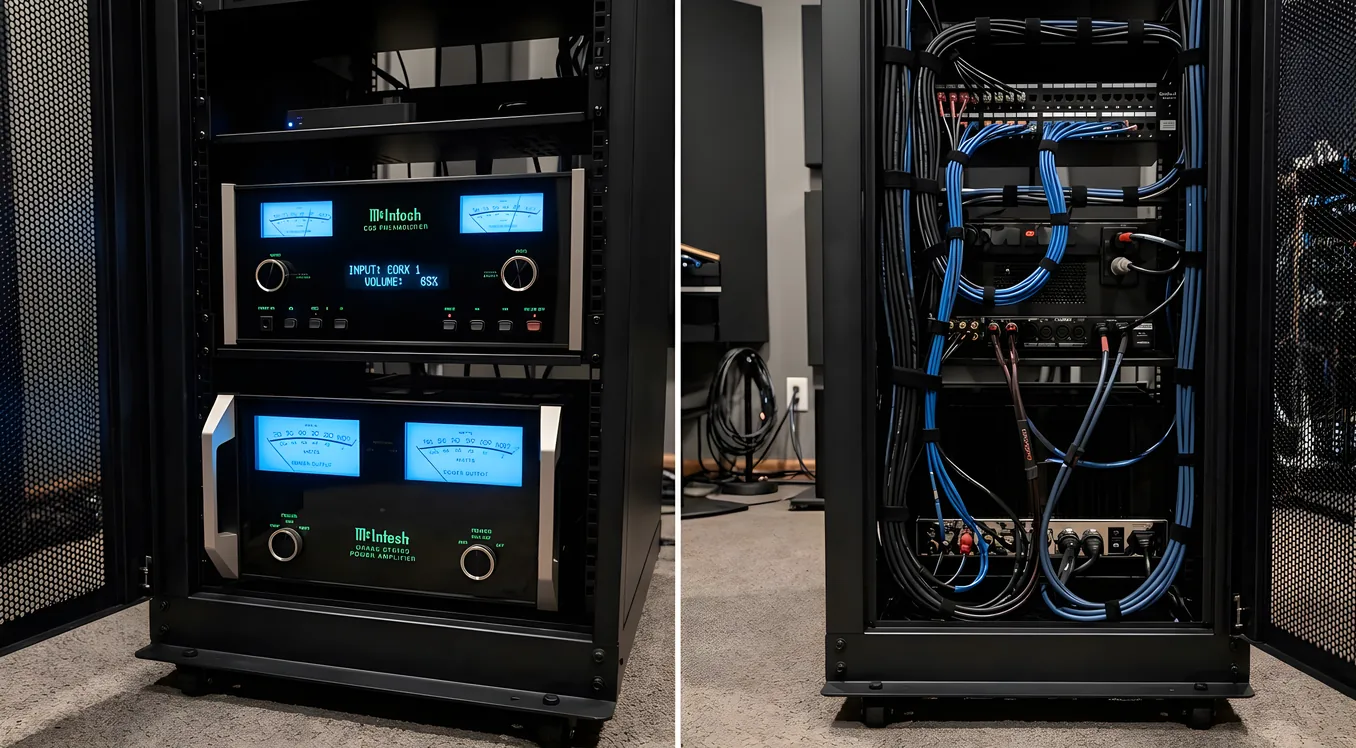
Most home theater systems run on a single AV receiver, and for the majority of rooms, that’s the right call. A receiver packages an AV processor (the pre-amp/processor stage) and multichannel amplifier into one chassis, shares a power supply between them, and fits in a standard equipment rack for $500 to $3,000. The question of separates only becomes relevant when that integrated package starts leaving performance on the table, and there are specific, measurable conditions where it does.
This article covers those conditions: the room size thresholds where receiver amplification starts to compress dynamics, the speaker loads that reveal power supply limitations, the channel counts where the benefits of a dedicated processor become tangible, and the cost reality of going that route. It also covers the middle path, using the receiver’s pre-amp outputs to drive an external amplifier on the front channels, which solves the most common amplifier limitation without the full cost of separates.
What Separates Are: AV Processor and Standalone Amplifiers
A separate system replaces the single receiver chassis with two or more dedicated units. The AV processor (sometimes called the pre-amp/processor or SSP) handles everything the receiver’s pre-amp stage does: HDMI switching, audio decoding (Dolby Atmos, DTS:X), room correction, bass management, and signal routing. It outputs a line-level signal to one or more power amplifiers, which then drive the speakers directly.
The processor has no amplification stages. The amplifiers have no decoding or switching. Each unit’s power supply, circuit board, and chassis are dedicated to a single function, which eliminates the compromises that arise when an integrated receiver tries to share resources between both roles.
The cost of this architecture is immediate. A processor and a matching multichannel amplifier together cost significantly more than a receiver at the same performance level. The benefit is that each component can be upgraded or replaced independently as technology or requirements change.
When Separates Make Sense
Large Rooms and High Speaker Loads
Room volume is the clearest indicator of whether a receiver’s amplifier section will be adequate. As a general threshold, rooms above approximately 3,000 cubic feet (roughly 25 feet x 18 feet x 8-foot ceiling) demand sustained amplifier output that most receivers cannot maintain without clipping or thermal throttling.
The issue is not peak wattage. Most AV receivers advertise 100 to 150 watts per channel, but those figures are typically measured into 8-ohm loads at a single channel driven, with low distortion requirements relaxed. Real-world multichannel playback into typical home theater speakers produces a different picture: rated power often drops 30 to 40 percent when all channels are driven simultaneously, and speakers with 4-ohm nominal impedances can draw double the current of an 8-ohm load, stressing the shared power supply further.
Speakers with 4-ohm nominal impedance or impedance that dips below 3 ohms in the bass region put the most stress on receiver amplifier sections. A receiver rated at 100 watts into 8 ohms might deliver 140 watts into 4 ohms if its power supply is robust, or it might throttle output to protect itself. Standalone power amplifiers, with dedicated power transformers and larger filter capacitors, handle these loads with consistent current delivery across all channels simultaneously.
Low-sensitivity speakers compound this. A speaker rated at 85 dB sensitivity (1 watt, 1 meter) requires four times the amplifier power to achieve the same volume as an 89 dB speaker, and sixteen times the power to match a 93 dB speaker. Pairing low-sensitivity, low-impedance speakers with a receiver in a large room is the combination most likely to expose amplifier limitations.
High Channel Counts (9.2.4 and Beyond)
A 5.1 or 7.1 system is well within the capability of a mid-range receiver. Once the channel count climbs to 9.2.4 for Dolby Atmos or 11.2.6 for more ambitious object-based configurations, the receiver either runs out of built-in amplification or must use less capable amplifier circuits to fit all channels into the chassis.
Many receivers handle 9 or 11 channels by using Class D amplifier modules for the height channels, reserving the more capable Class AB circuits for the main surround channels. The result is audible differences between the height channel tonality and the main channels, particularly with the same speaker model installed throughout. A separate processor with a dedicated multichannel amplifier eliminates this inconsistency by driving all channels from the same amplifier topology.
Processing quality also improves at the high end of the separate processor category. Trinnov Audio builds proprietary 3D room correction into its Altitude series that goes beyond what Audyssey or Dirac Live implementations in receivers offer, including acoustic measurement and correction that accounts for speaker directionality in three dimensions. For installations with difficult acoustics or multiple subwoofers, this level of processing has a measurable impact.
Upgradeability and Future-Proofing
HDMI standards and audio codec updates have shortened the lifespan of AV receivers. HDMI 2.1 compatibility with 4K/120Hz passthrough, eARC, and VRR support required hardware revisions that made many receivers from 2018 to 2021 partially obsolete. Owners of those receivers who want full HDMI 2.1 bandwidth face replacing the entire unit.
With separates, the processor handles HDMI and decoding. When the next HDMI standard arrives, replacing only the processor preserves the amplifier investment. Power amplifiers are effectively durable goods: the physics of amplifying a signal to drive a speaker has not changed, and a quality amplifier from 2010 remains fully competitive today. This separation of concerns is one of the genuine long-term advantages of the separates architecture, particularly for buyers who intend to keep a system for ten or more years.
Processor Brands Worth Knowing
The AV processor market is small compared to the AV receiver market. A handful of brands account for most of the serious installations.
Anthem AVM 90 sits at the mid-to-high end of the processor category at approximately $3,500 to $4,000. It includes Anthem Room Correction (ARC Genesis), HDMI 2.1 inputs with 8K/60Hz and 4K/120Hz passthrough, Dolby Atmos and DTS:X Pro decoding up to 15.4 channels, and Dirac Live as an optional addition. It is a common pairing choice with Anthem’s own MCA series multichannel amplifiers.
Marantz AV 10 targets a similar price point, typically $4,000. It offers 15.4-channel processing, Audyssey MultEQ XT32 room correction, HDMI 2.1 inputs, and the Marantz HDAM discrete amplifier circuits for its analog output stage, which audiophiles note for low noise floor. The AV 10 pairs naturally with Marantz’s own MM8077 seven-channel amplifier for a complete front end.
StormAudio ISP products start around $8,000 and scale up from there. StormAudio targets custom installation and commercial-grade reference systems. The ISP MK3 includes native Dirac Live Bass Control for multi-subwoofer management and processes up to 32 channels. For rooms with more than four subwoofers or distributed audio zones alongside a theater, StormAudio addresses configurations that purpose-built brands handle more capably than general consumer processors.
Trinnov Altitude series, starting around $9,000 for the Altitude16, represents the upper end of the processor category. Trinnov’s proprietary 3D microphone and Optimizer room correction software has become the reference standard in high-end theater design. Altitude processors support up to 36 channels and object-based audio rendering that accounts for actual speaker positions in three-dimensional space, not just the standard channel assignments Dolby Atmos and DTS:X specify.
Amplifier Brands Worth Knowing
The standalone power amplifier market has clearer performance tiers than processors, with power output, noise floor, and build quality as the primary differentiators.
Emotiva occupies the value end of the multichannel amplifier category without genuine compromise in output quality. The XPA Gen3 series includes seven-channel configurations at around $1,200 to $1,500, rated at 200 watts per channel into 8 ohms with all channels driven simultaneously. For buyers coming from a receiver who want to improve front channel performance without a large amplifier budget, Emotiva offers measurable performance gains at accessible prices.
ATI amplifiers are a professional-grade option used in both custom home theater installations and commercial cinema previewing rooms. The AT52x series produces 200 to 350 watts per channel depending on configuration, with high-current output stages that handle low-impedance and reactive speaker loads reliably. ATI builds in the United States and offers a ten-year warranty. Prices run $2,000 to $4,000 for multichannel configurations.
Parasound Halo A51 and A31 are the most commonly cited separates amplifiers in the audiophile home theater space. The A51 delivers 250 watts per channel into 8 ohms across five channels, with output sections designed by John Curl, the same engineer behind several legendary audiophile amplifiers. The A51 handles 4-ohm loads without current limiting and maintains low distortion at high output. Price is approximately $4,000. The tradeoff is size: the A51 weighs 65 pounds and requires a dedicated equipment shelf.
McIntosh amplifiers occupy the premium tier, with the MC8207 seven-channel amplifier at approximately $9,000. McIntosh uses autoformer output technology that provides consistent power delivery at 2, 4, and 8-ohm loads without the impedance-dependent power variations that affect conventional solid-state designs. For buyers where visual presentation and long-term investment matter as much as measurable output, McIntosh is the reference in that segment.
The Cost Reality
A complete separates system costs two to four times more than a comparable integrated receiver at the same processing specification, and often more when the amplifier quality is taken seriously.
A strong receiver in the $2,500 to $3,000 range (Denon AVR-X6800H, Marantz Cinema 40) includes room correction, HDMI 2.1, and competent amplification for most rooms. A separates system with equivalent or better processing starts with the Anthem AVM 90 at $3,500 to $4,000 for the processor alone, then adds an amplifier. An Emotiva XPA seven-channel at $1,500 brings the total to approximately $5,000 to $5,500. Stepping up to Parasound Halo or ATI amplification pushes the front end above $7,000 to $8,000 before speakers, cables, or any other system component.
The cost calculation changes over time because of the independent upgradeability point. A buyer who starts with an Anthem AVM 90 and an Emotiva amplifier at $5,500 can upgrade the amplifier in three years without replacing the processor, or replace the processor when a new HDMI standard arrives without discarding the amplifier. The receiver buyer who spends $2,500 today will likely replace the entire unit in five to seven years as codec and connectivity standards evolve.
The Hybrid Approach: Receiver as Pre-Amp with External Amplification
The path that makes financial sense for most buyers who feel limited by their receiver’s amplifier is not a full separates system. It is using the receiver’s pre-amp outputs to drive an external stereo or multichannel amplifier on the front channels.
Nearly every receiver above $800 includes pre-amp output jacks for the front left, front right, and often the center channel. Connecting a two-channel or three-channel external amplifier to those outputs lets the receiver continue handling decoding, room correction, HDMI switching, and surround amplification, while the external amplifier handles the front stage with better current delivery and lower noise.
A two-channel amplifier like the Emotiva BasX A2 at around $250, or the Parasound 2125 at approximately $900, connected to a $1,500 receiver produces a front stage that genuinely outperforms most receivers in the $3,000 range for music listening and wide-dynamic-range film content. The center channel can remain on the receiver’s built-in amplifier, or a three-channel amplifier can cover the entire front soundstage.
This approach preserves the receiver’s convenience features and does not require a separate processor. The room correction system in the receiver applies to the processed signal before it reaches the pre-amp outputs, so Audyssey or Dirac calibration continues to function normally. The only limitation is that the pre-amp output quality of the receiver sets the noise floor ceiling for the external amplifier, and some receivers have higher-impedance output stages that benefit from careful matching to amplifier input sensitivity.
For buyers with 4-ohm or low-sensitivity speakers, a large room, or demanding listening habits, the hybrid approach closes most of the performance gap between an integrated receiver and a full separates system at a fraction of the cost. It is worth considering before committing to the full cost of a dedicated processor.
Choosing the Right Path for Your Room
The decision framework follows from room volume, speaker characteristics, and channel count.
Rooms under 3,000 cubic feet running 5.1 or 7.1 with speakers rated at 86 dB or above sensitivity and 6-ohm or higher impedance are served well by a quality AV receiver. The AV receivers guide covers receiver selection for those configurations in detail. The additional cost of separates in this context pays for capability the room and speakers cannot use.
Rooms above 3,000 cubic feet, or systems with 4-ohm, low-sensitivity speakers, benefit from the hybrid approach as a first step. Adding a two-channel external amplifier for the front stage solves the most audible limitation before spending on a separate processor.
Full separates systems make sense for rooms above 4,000 cubic feet, high channel counts (9.2.4 and above), speaker systems where impedance dips below 3 ohms, and buyers planning a system intended to last fifteen or more years without a full replacement cycle. For Dolby Atmos in a dedicated theater, the speaker placement guide at Dolby Atmos speaker placement addresses the channel layout decisions that interact with amplifier channel count.
If the system is intended for a high-end home theater build where the room, acoustics, and long-term investment are all serious considerations, starting with a processor gives the amplifier path room to evolve. A Trinnov or Anthem processor paired with quality amplification is a ten-year-plus foundation. The receiver path, by contrast, tends to restart with each major standard change.
Making the Decision
The practical dividing line is this: if the speakers you want to run are 86 dB or above and 6-ohm or above, and the room is under 3,000 cubic feet, a receiver handles the job. If the speakers are demanding or the room is large, add a two-channel amplifier to the pre-amp outputs of the receiver you already have before spending on a separate processor. If the room is genuinely large, the channel count is high, or the long-term investment matters, a processor and amplifier combination produces results that a receiver cannot replicate because the physics of a shared chassis prevent it.
The cost difference is real. So is the performance difference, in the right room. Matching the approach to the actual room and speaker combination determines which side of that tradeoff matters to you.