AV Receivers Explained: What They Do and How to Choose One
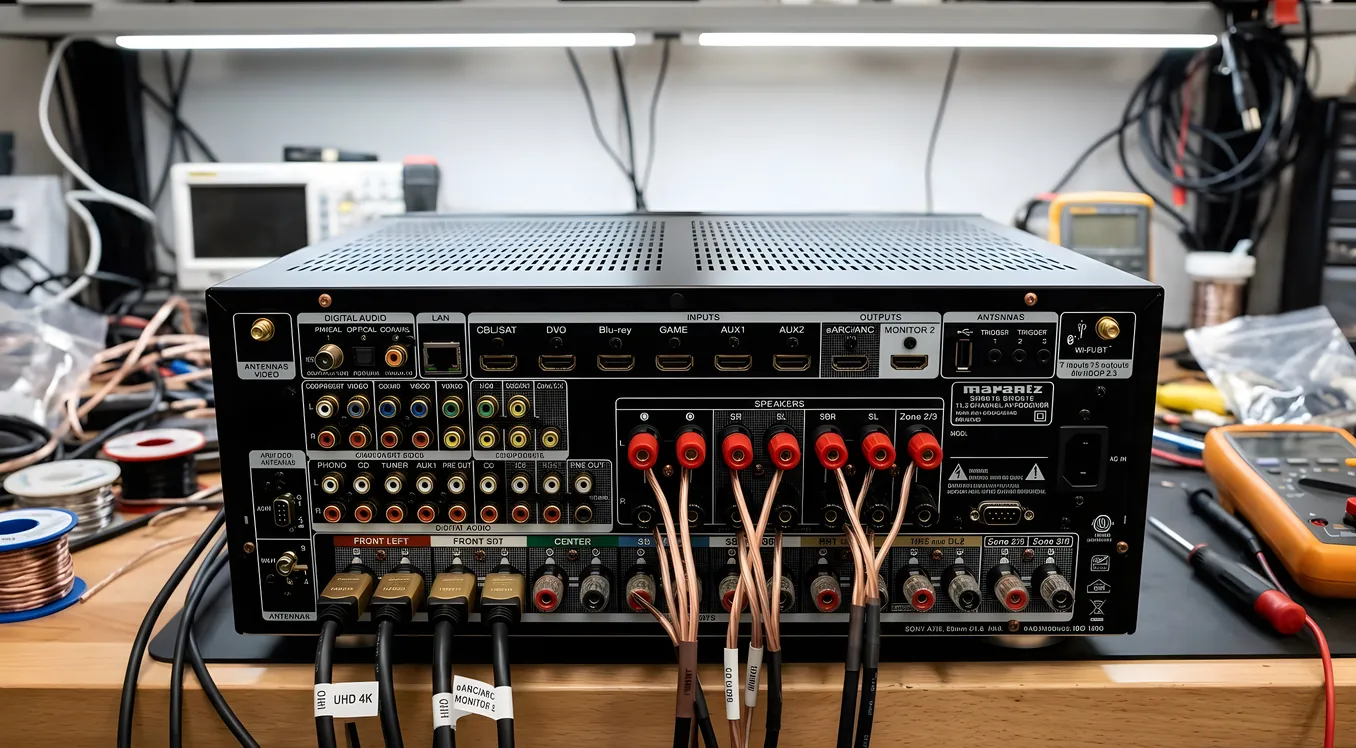
An AV receiver is the nerve center of a home theater. It accepts signals from every source you own, routes them to your display, decodes the audio, amplifies it, and sends it to every speaker in your room. Without one, you have a pile of boxes that don’t talk to each other. With one, you have a system.
This guide covers how receivers work, what separates a $400 unit from a $4,000 one, and how to match specifications to the room you’re building.
What an AV Receiver Actually Does
The job of an AVR breaks into four distinct functions, each of which matters on its own.
Video switching takes HDMI inputs from your Blu-ray player, streaming box, game console, and cable source, and routes the selected one to your TV or projector. Most receivers handle this passively, adding minimal processing. The receiver isn’t doing anything to the picture; it’s acting as a smart switch that also passes audio.
Audio decoding is where the receiver earns its keep. A compressed Dolby Atmos or DTS:X bitstream arrives from your source, and the receiver unpacks it into discrete audio channels. This requires licensed decoding hardware, which is why format support varies by model tier and why firmware updates sometimes add new formats.
Amplification takes the decoded audio signal and increases it to speaker-driving voltage. Every channel that feeds a speaker passes through an amplifier stage inside the unit. The quality of those amplifiers, and the amount of headroom they have, determines how the system sounds under load.
Room correction uses a calibration microphone to measure how sound behaves in your specific room, then applies digital signal processing to compensate for reflections, bass buildup in corners, and distance mismatches between speakers. A receiver without room correction ships a single, one-size guess at equalization. A receiver with good room correction listens to your actual room.
Channel Counts: What the Numbers Mean
A receiver’s channel designation follows a consistent pattern: the first number is the speaker channels, the second is the subwoofer outputs, and a third number (when present) designates height or overhead speaker channels.
5.1 is the standard two-channel-surround configuration: front left, center, front right, surround left, surround right, and one subwoofer. This works in most rooms and covers everything up to conventional Dolby Surround.
7.1 adds two additional surround speakers, placed at the sides or behind the listening position. Whether the extra pair makes an audible difference depends entirely on room size. A 12-by-14-foot room rarely benefits; a room 20 feet long usually does.
7.2 means the same seven speaker channels, but with two discrete subwoofer outputs. Running two subwoofers placed asymmetrically in the room smooths bass response far more effectively than any EQ can. For rooms larger than 300 square feet, dual subs are worth considering seriously.
9.2 and 11.2 add height channels for object-based audio formats like Dolby Atmos and DTS:X. Heights can be dedicated overhead speakers (requiring ceiling work), upward-firing Atmos modules placed on existing speakers, or front-height speakers placed above ear level. Object-based audio places sounds at positions in three-dimensional space rather than in fixed channels, so height information is not cosmetic. For Dolby Atmos explained, the dedicated guide covers the encoding model in detail.
HDMI 2.1: What to Prioritize
HDMI 2.1 support has become the sorting mechanism between current and previous-generation receivers. The specification adds several features that matter in different ways.
4K/120Hz passthrough matters if you own a PlayStation 5, Xbox Series X, or a gaming PC connected to a 4K 120Hz display. Without 2.1 support, the receiver becomes a bottleneck, forcing the signal to drop to 60Hz or bypass the receiver entirely.
8K/60Hz is largely theoretical for most buyers. Content is sparse, and few panels support it at price points typical home theater buyers reach. It appears on spec sheets but shouldn’t drive purchasing decisions today.
eARC (Enhanced Audio Return Channel) carries Dolby Atmos and DTS:X audio from your TV back to the receiver over the same HDMI cable connected to the TV’s ARC port. Without eARC, you’re limited to the compressed Atmos passthrough that basic ARC handles, which loses quality. If your TV serves as the source hub for any streaming audio, eARC matters.
VRR (Variable Refresh Rate) and ALLM (Auto Low Latency Mode) both address gaming specifically. VRR syncs the display’s refresh rate to the GPU’s output rate to eliminate screen tearing. ALLM tells the TV to drop into game mode automatically when a game console is active. Neither affects movie or music playback.
Not all receivers with “HDMI 2.1 ports” support every 2.1 feature on every port. Read the spec sheet carefully. Many units have one or two ports capable of 4K/120Hz passthrough and others limited to 4K/60Hz.
Audio Format Support
The major object-based audio formats each have characteristic strengths, and a serious receiver should handle all of them.
Dolby Atmos is the most widely distributed format. It encodes audio as objects with position data rather than as fixed channels, allowing playback systems to place sounds anywhere in the room, including overhead. Content is available on 4K Blu-ray, streaming services including Netflix and Apple TV+, and broadcast in some markets.
DTS:X takes the same object-based approach from DTS and offers one practical advantage: it adapts to whatever speaker layout you have without requiring the specific configuration DTS was mixed for. Like Atmos, it’s available on physical media and some streaming services.
Auro-3D uses a different spatial audio approach that adds height layers above the traditional surround plane rather than treating sound as free-floating objects. It’s supported by fewer titles and a narrower set of receivers, primarily Denon and Marantz units. For enthusiasts who prioritize classical music and concert content, where Auro-3D’s height rendering tends to work particularly well, it’s worth seeking out.
IMAX Enhanced is a certification program covering both audio (DTS:X with IMAX-specific tuning) and video mastering standards. Titles carrying IMAX Enhanced certification are growing, particularly through streaming platforms. Receiver support is becoming more common in mid-tier and premium models.
Room Correction Systems
Room correction is one of the most audible differences between receiver tiers. The hardware in two $800 receivers might be similar; the room correction system is often where the real gap lives.
Audyssey MultEQ XT32 is Denon and Marantz’s primary room correction engine. XT32 uses 512 filter points per channel (versus 64 in the base XT) to apply far more precise equalization corrections. At mid-level price points, it’s one of the best-performing systems available. Audyssey’s app unlocks editing capability and lets you apply a target curve after calibration, which is valuable because Audyssey’s default curve cuts too much bass for most listeners’ preferences.
Dirac Live appears in Arcam, NAD, and some StormAudio units, and is available as a paid add-on for some receivers from other brands. It differs from Audyssey by correcting both frequency response and impulse response (time domain), which produces tighter bass and better stereo imaging. Full Dirac Live costs more but outperforms XT32 in most controlled comparisons, particularly in bass management. For a detailed comparison of these systems, see room correction systems.
YPAO (Yamaha Parametric Room Acoustic Optimizer) comes in standard and R.S.C. (Reflected Sound Control) variants. The R.S.C. version, available on Yamaha’s CX-A processor and premium AVR lines, analyzes reflected energy in addition to direct sound. Standard YPAO is competitive with Audyssey XT at similar price points.
One important note on all room correction systems: they’re tools, not magic. They fix frequency response problems and timing alignment, but they don’t change speaker quality, room acoustics, or amplifier performance.
Power Ratings and What They Mean
Amplifier power ratings in receiver specifications are consistently the most misleading numbers in audio. Understanding what they actually represent prevents expensive mistakes.
Rated output is always measured at a specific impedance (usually 8 ohms) and a specific distortion level (usually 1% THD). Some manufacturers measure at 0.08%, some at 1%, and some don’t disclose it. A receiver rated at 90 watts into 8 ohms at 0.08% THD is making a more conservative claim than one rated at 100 watts into 8 ohms at 1% THD, even though the first number is smaller.
The 8-ohm versus 4-ohm specification matters because many speakers, particularly tower speakers from European manufacturers, present 4-ohm loads to the amplifier. An amplifier rated at 100 watts into 8 ohms should double to 200 watts into 4 ohms if it has adequate power supply capacity. Most entry-level receivers do not double; they often increase by 20-30%. Premium and separates-class amplifiers typically approach the doubling ratio.
For most home theater applications in rooms under 3,000 cubic feet, 80-100 watts per channel into 8 ohms is enough if your speakers have sensitivity ratings above 87dB/1W/1m. Where power matters more is in large rooms, with inefficient speakers, or when the listening level regularly reaches 95-100dB.
A common miscalculation: assuming all channels will never play simultaneously. In practice, during action sequences, all channels do draw significant current simultaneously, which stresses a receiver’s power supply. Underpowered receivers clip under these conditions; clipping is both audible and hard on tweeters. If your listening levels are high or your room is large, budget accordingly or consider receiver vs separates for the amplification stage.
Brands and Tiers
The market breaks into roughly four tiers based on features, build quality, and sonic performance.
Entry to mid-range (Denon, Yamaha)
Denon’s AVC-X3800H (street price around $1,100) sits at the upper edge of the accessible tier with 9 amplified channels, Audyssey MultEQ XT32, HDMI 2.1, Dolby Atmos, DTS:X, and HEOS built in. Below it, the AVC-X2800H (around $800) handles 7 channels and drops XT32 for the standard MultEQ XT. Both represent good value for the feature set.
Yamaha’s RX-V8A (around $1,000) covers 9.2 channels with YPAO, Dolby Atmos, DTS:X, IMAX Enhanced, and MusicCast. Yamaha’s processing tends to sound slightly different from Denon’s, with less midrange warmth and more precise stereo imaging, making it a preference call as much as a technical one.
Mid to premium (Marantz)
Marantz models share hardware lineage with Denon but typically include more refined output stages, higher-quality capacitors, and a more musically tuned voicing. The Cinema 40 (around $1,500) offers 9.4-channel amplification, full HDMI 2.1, and Audyssey MultEQ XT32 with the Audyssey app. The Cinema 50 (around $2,200) steps up to an 11.4-channel configuration.
The Marantz difference is most audible on two-channel music content, where the more conservative amplifier tuning pays off. In a system that will regularly be used for stereo listening as well as movies, the price premium is easier to justify.
Premium (Anthem)
Anthem’s MRX 740 (around $2,700) and MRX 1140 (around $4,500) are built on a different philosophy than consumer-market Japanese receivers. Anthem uses discrete amplifier stages, higher damping factors, and Dirac Live as the room correction standard. The MRX 740 handles 7 amplified channels; the 1140 handles 11. Both are rated conservatively and measure well under load.
The primary argument for Anthem over similarly priced competition is Dirac Live’s impulse response correction and the amplifier’s 4-ohm stability. For rooms with demanding speaker loads or subwoofer configurations that require precise bass management, the investment holds up.
Premium (Arcam)
Arcam’s AV41 processor paired with external amplification, or the integrated AVR30 (around $4,000), represents the high end of mainstream AVR pricing. Arcam’s products include Dirac Live (full version, not the bass management-only limited edition), Class AB amplification built to tighter tolerances than mass-market alternatives, and a measured, accurate sonic character preferred in more critical listening environments.
Streaming and Multi-Room Audio
Most current receivers include network audio platforms that handle streaming independently of a connected TV or source device.
HEOS is Denon and Marantz’s platform. It integrates with Spotify, Tidal, Amazon Music, and internet radio, and allows grouping multiple HEOS devices for synchronized playback. HEOS is functional but has historically had stability issues with app updates that temporarily break connectivity.
MusicCast is Yamaha’s equivalent. It covers similar streaming services and handles multi-room grouping. MusicCast’s app has generally received better reviews for stability and interface than HEOS.
AirPlay 2 appears across Denon, Marantz, and Yamaha’s current lineups and is largely transparent to use. If you’re in an Apple ecosystem, AirPlay 2 is the lowest-friction way to stream audio to the receiver from a phone or Mac.
Roon Ready certification means the receiver appears as a Roon endpoint and can receive audio directly from a Roon core. This matters to audiophiles using Roon as their library manager. Anthem receivers are Roon Ready; Arcam models vary by generation.
None of these platforms affect surround processing quality. They’re relevant only for casual listening and multi-room scenarios.
Choosing the Right Receiver
The shortest version of the decision process: start with room size and speaker load, then add the format support you actually need, then check room correction tier.
For rooms under 2,000 cubic feet with speakers rated at 8 ohms and 87dB sensitivity or better, entry-level receivers from Denon or Yamaha handle the job. Audyssey XT (not XT32) is adequate for straightforward speaker layouts.
For rooms between 2,000 and 4,000 cubic feet, or with 4-ohm speakers, mid-range Denon or Marantz with XT32 and a stable HDMI 2.1 implementation is the more defensible choice. Dual subwoofer output becomes worth having.
For rooms above 4,000 cubic feet, demanding speaker loads, or systems where music matters as much as movies, Anthem or Arcam with Dirac Live Full addresses the performance gap that mass-market room correction leaves.
For any configuration, compare surround sound configurations against your actual room layout before committing to a channel count. Buying an 11-channel receiver for a room where you can only place 7 speakers wastes amplifier stages you’ll never use.
The receiver market rewards patience. Models release on a predictable yearly cycle, and previous-generation flagships regularly drop 20-30% in price when their successors ship. If a model from last year covers your channel count and format requirements, the discount often outweighs the incremental gains in the new version.