5.1 vs 7.1 vs 7.1.4 vs 9.1.6: Choosing Your Channel Layout
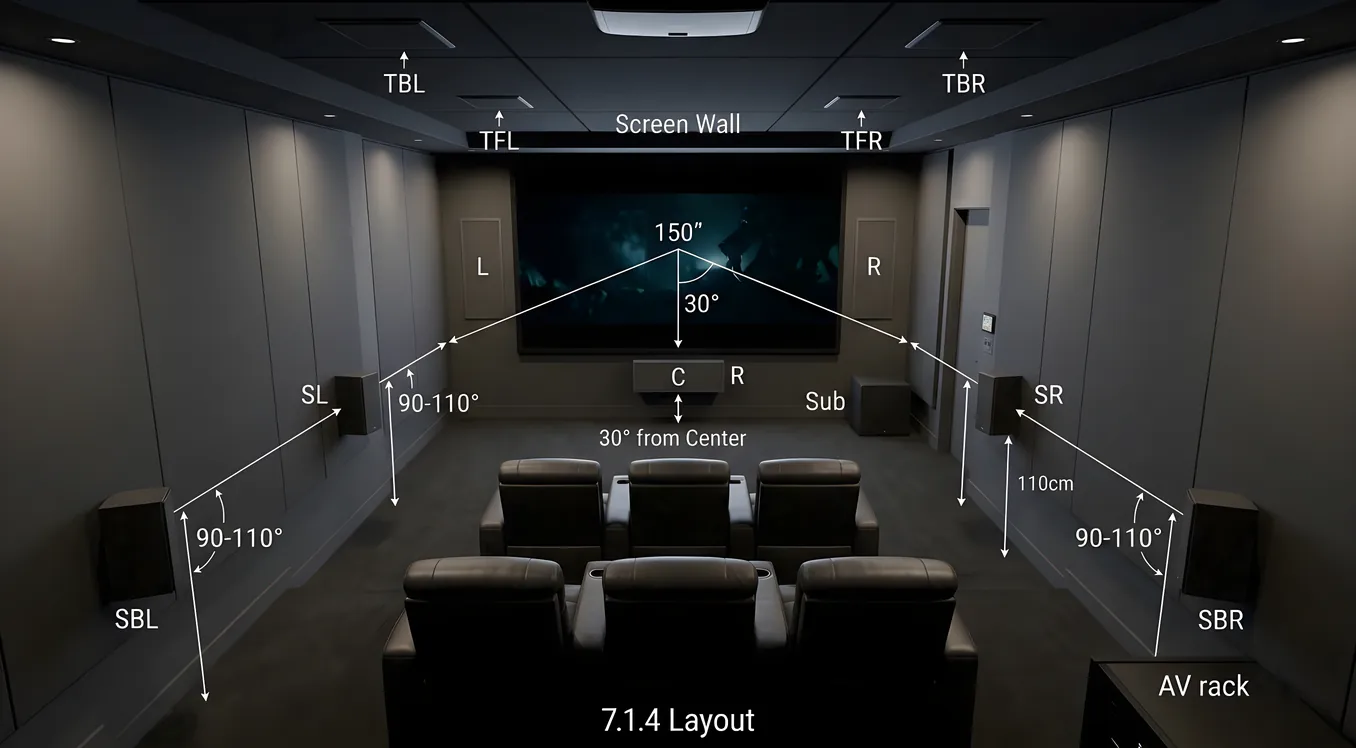
The number string on a surround sound configuration tells you exactly what you are buying: main speakers, subwoofers, and height channels. A 7.1.4 system has seven full-range speakers, one subwoofer, and four height channels. A 5.1 system has five full-range speakers and one subwoofer, with no height layer at all. Every configuration traces back to that same three-part logic.
Understanding what those numbers mean in practice, and which configuration makes sense for a specific room, is what separates a satisfying build from one that either underperforms its space or costs money for channels that will never work properly.
What the Numbers Actually Mean
The three-number format works as follows. The first number is the count of full-range, ear-level speakers. The second is the subwoofer count. The third, when it appears, is the count of height or overhead channels used for object-based audio formats like Dolby Atmos.
A two-number format like 5.1 or 7.1 has no height layer. The format predates object-based audio and was designed for discrete channel surround from DVD and Blu-ray. These configurations are still capable of excellent surround sound; they simply cannot reproduce height cues the way a three-number system can.
The height channels in a three-number configuration are typically handled by speakers mounted in or near the ceiling, or by upward-firing drivers in a floor-standing or bookshelf speaker designed to reflect sound off the ceiling. How you handle that third number matters quite a bit, covered more fully in the guide to Atmos speaker placement.
2.1 and 3.1: Before You Reach Surround
A 2.1 layout, two main speakers plus a subwoofer, is stereo with bass reinforcement. It is the right choice for a bedroom, home office, or any space where the listening position is close to the speakers and true surround sound is not the goal. The subwoofer handles low-frequency content below roughly 80 Hz, relieving the main speakers and allowing them to be sized appropriately for the room without sacrificing bass impact.
A 3.1 layout adds a center channel to that foundation. The center is the most-used speaker in a movie soundtrack; dialogue, the majority of on-screen action, and the sonic anchor of a scene all run through it. In a TV room where the screen is the primary source of entertainment and a two-channel separation between left and right feels too diffuse, a 3.1 layout gives considerably better dialogue clarity without requiring side or rear speaker placement. It is a practical compromise when the room layout or furniture arrangement rules out true surround positioning.
5.1: The Baseline for Real Surround Sound
Five-point-one is where surround sound as most people understand it begins. The configuration places speakers at the left front, center, right front, left surround, and right surround positions, plus a subwoofer. The two surround speakers sit to the sides of the listening position, typically at ear height, covering roughly the 90-to-110-degree arc on each side.
This is the format that standard Blu-ray soundtracks, streaming content, and most broadcast television are mixed to deliver. A 5.1 system reproduces those mixes exactly as intended. It works well in rooms between roughly 150 and 300 square feet, and the surround speakers are flexible enough in placement that most living rooms and dedicated media rooms can accommodate them.
The five-channel format also has the most established receiver support, the widest range of compatible speaker packages, and the lowest total cost of any configuration that produces genuine surround sound. It is the practical starting point for a home theater build and a capable endpoint for rooms where the size or budget does not justify going further.
7.1: Adding Rear Surrounds for Larger Rooms
A 7.1 configuration keeps the 5.1 speaker positions and adds two rear speakers, called surround back channels, positioned directly behind the listening position. Where the side surrounds in a 5.1 system handle the full 180-degree arc from the sides and rear, a 7.1 system divides that responsibility: side surrounds handle the lateral positions, and rear surrounds handle the space directly behind the listener.
The difference is most apparent in larger rooms, generally 300 square feet and above, where the listening position sits far enough from the side surrounds that the rear soundstage can feel diffuse or thinned out. Adding rear channels fills that gap and sharpens the sense of being inside the sound field rather than adjacent to it.
In a smaller room, the effect is less clear, and poorly placed rear speakers in a tight space can create comb filtering and muddy imaging rather than improving it. Room dimensions matter here, and a conversation about acoustics belongs alongside any 7.1 planning. The guide on room dimensions covers what to measure and how those measurements affect speaker layout decisions.
5.1.2 and 5.1.4: Entry Points for Height Channels
A 5.1.2 configuration takes the standard 5.1 base and adds two height channels, typically positioned above and slightly in front of the listening area at roughly the 45-degree overhead angle specified in Dolby’s Atmos layout guidelines. This is the minimum configuration that qualifies as a true Atmos system and the most accessible way to hear what height channels add to a soundtrack.
Two height channels are enough to establish the overhead dimension: the sound of rain falling, a helicopter banking overhead, ambient environment signals that originate above ear level. Atmos soundtracks use object-based metadata to position these sounds, and even two channels give the renderer meaningful placement information to work with.
A 5.1.4 system adds two more height channels, usually a pair of front heights and a pair of rear or side heights rather than two front-only positions. Four height channels give the renderer more precision in placing moving overhead objects and reduce the gap in coverage between front and rear height positions. The improvement over 5.1.2 is noticeable on content mixed specifically for four height channels, less so on general streaming content.
7.1.4: The Enthusiast Sweet Spot
The 7.1.4 configuration is widely considered the most complete practical home theater layout for dedicated rooms. It combines full surround coverage at ear level through seven channels with four height channels, giving the Atmos renderer the full input it needs to place objects anywhere in the three-dimensional space around the listener.
Most Dolby Atmos and DTS:X content is mixed with a 7.1.4 playback target in mind. A receiver with a 7.1.4 channel count, running a proper speaker type mix of tower or bookshelf mains with dedicated ceiling or upward-firing heights, can reproduce those mixes as the mixing engineers intended.
The room requirement for 7.1.4 is real: you need both the floor space for seven ear-level speakers and the ceiling access or acoustic geometry for four height positions. In practice, this means a minimum of roughly 250 to 350 square feet, adequate ceiling height (eight feet is the bottom of the practical range; ten feet or higher is better), and the ability to run speaker wire to ceiling positions or mount upward-firing modules at the correct angles.
A 9-channel AV receiver handles 7.1.4 directly. Eleven-channel receivers allow the same layout with additional bass management flexibility or biamplification of the front channels. Cost for a complete 7.1.4 system including receiver and speakers spans a wide range, from around $1,500 for an entry-level build to $10,000 or more for separates and high-performance drivers.
7.2.4: Dual Subwoofers for Smoother Bass
The second number in any configuration can be higher than one. A 7.2.4 system is a 7.1.4 system with two subwoofers instead of one.
Bass in a rectangular room does not distribute evenly. Room modes, the acoustic resonances created by the room’s dimensions, cause certain frequencies to stack up at particular positions and cancel at others. A listener who moves three feet forward or backward in many rooms will hear a measurable difference in bass weight and extension.
Two subwoofers placed at different positions in the room excite different modes and cancel fewer of them. When positioned correctly, often in opposite corners or mid-wall positions on opposing walls, dual subwoofers produce significantly more even bass response across the listening area than a single subwoofer can. For a dedicated home theater room where acoustic performance is a priority, the step from 7.1.4 to 7.2.4 is often more audible than the step from 5.1.4 to 7.1.4.
9.1.6: Reference-Grade Configuration
A 9.1.6 system is at the upper boundary of practical home theater design. Nine ear-level channels add a pair of wide channels positioned at roughly 60 degrees from the center, filling the gap between the front left/right and the side surrounds. Six height channels cover front, side, and rear overhead positions, giving the renderer maximum precision for object placement anywhere in the three-dimensional space.
This is the Dolby Atmos reference configuration for professional mixing studios, adapted for a home environment. Content mixed in a 9.1.6 studio reproduces with the fewest compromises in a 9.1.6 room. The difference between a 7.1.4 and 9.1.6 playback of the same Atmos-mixed film is not dramatic for most content, but for listeners who want the closest possible correspondence to the mixing stage, the additional channels are meaningful.
The room requirement for 9.1.6 is substantial. Wide channels need lateral space to sit at the correct angle without crowding the front left and right positions. Six height channels require either six ceiling speaker positions or a combination of ceiling and upward-firing drivers. A room below 400 to 500 square feet will struggle to place nine ear-level speakers at correct angles. A 13-channel AV receiver or a two-unit processor-plus-amplifier configuration handles channel count; total system cost for a competent 9.1.6 build typically starts around $5,000 and scales considerably from there.
Comparison at a Glance
| Configuration | Speakers | Room Size | Receiver Channels | Starting Cost |
|---|---|---|---|---|
| 2.1 | 3 | Any | Stereo | $200+ |
| 3.1 | 4 | Any | 3 ch | $300+ |
| 5.1 | 6 | 150-300 sq ft | 5 ch | $400+ |
| 7.1 | 8 | 300+ sq ft | 7 ch | $600+ |
| 5.1.2 | 8 | 200-350 sq ft | 7 ch | $800+ |
| 5.1.4 | 10 | 250-400 sq ft | 9 ch | $1,200+ |
| 7.1.4 | 12 | 300-600 sq ft | 11 ch | $1,500+ |
| 7.2.4 | 13 | 350-700 sq ft | 11 ch + ext sub | $2,000+ |
| 9.1.6 | 16 | 400+ sq ft | 13 ch | $5,000+ |
Cost figures are for the receiver and speaker system combined, using quality mid-range components. They do not include room treatment, cabling, or installation.
Choosing Based on Your Room
The room is the primary constraint. A large configuration in a small room does not produce a proportionally larger experience; it produces a congested one. Speakers placed too close together at incorrect angles muddy imaging and can introduce phase problems that no amount of receiver processing will fully correct.
A 5.1 system in a properly sized and treated room with good speakers will outperform a 9.1.6 system crammed into a space too small to accommodate the speaker angles. Starting with the room dimensions and working outward to the configuration is the right order of operations. Work up to the configuration the room can support, choose speakers and a receiver that fit the budget for that layout, and the result will be accurate at every stage of that process.
For rooms in the 150-to-250-square-foot range, 5.1 or 5.1.2 is the practical ceiling. Rooms from 250 to 400 square feet support 7.1 or 7.1.4 well. Rooms above 400 square feet can support 7.1.4, 7.2.4, or 9.1.6 depending on the geometry and listener position. The ceiling height and the ability to place height channels at the correct overhead angles are the constraining variables once the floor space is sufficient.
Where to Go From Here
The configuration you choose defines your receiver requirements, your speaker count, and the structural work you may need to run cables or mount ceiling speakers. A 5.1 build requires far less advance planning than a 9.1.6 installation. Getting the configuration right before purchasing anything saves considerable cost and rework.
The practical path for most builds is to start with the room, confirm the realistic speaker positions, match a configuration to those constraints, and then select components. A 7.1.4 system executed well in an appropriate room will satisfy far more than a 9.1.6 system built around compromises in placement or room size.