Home Theater Room Dimensions: Ratios, Ceiling Height, and Golden Rectangles
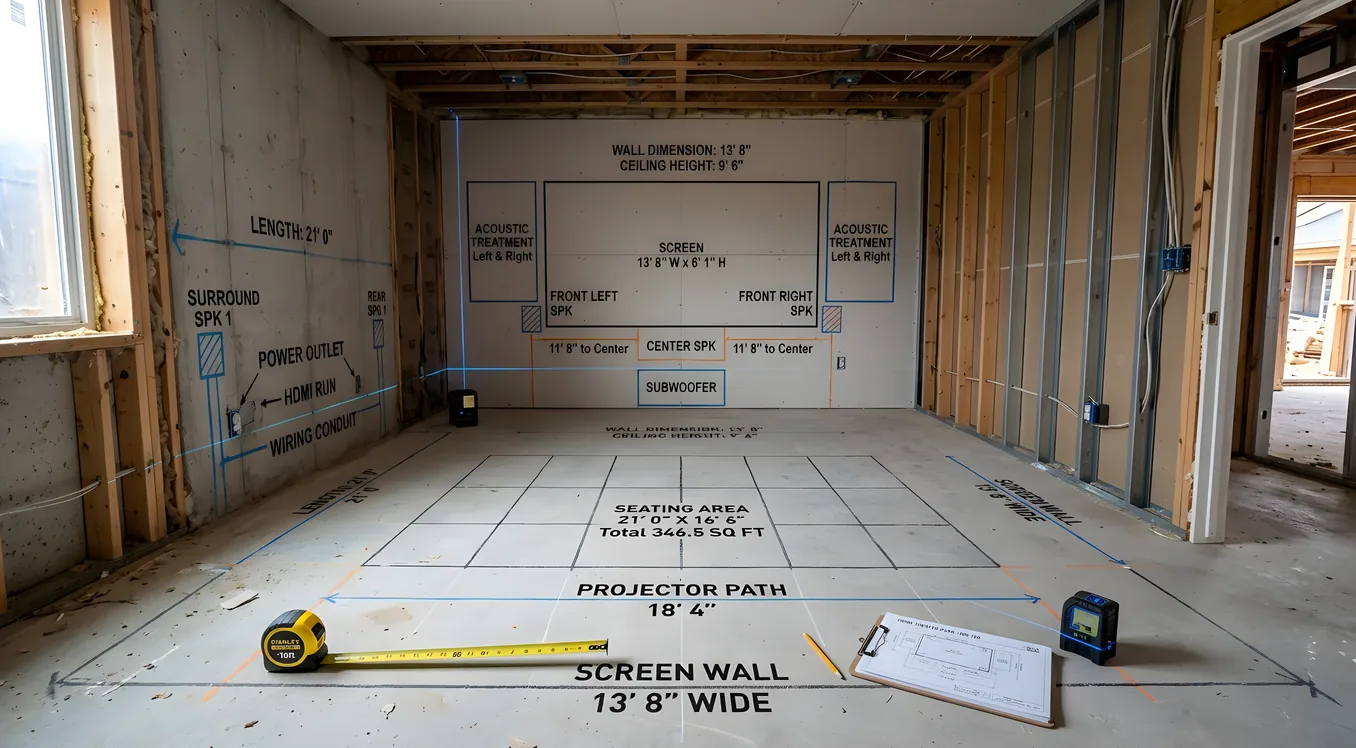
The single biggest predictor of how your home theater will sound has nothing to do with your speakers or receiver. It’s the ratio of your room’s length to its width to its height. Get those proportions right, and your audio foundation is solid before you spend a dollar on equipment. Get them wrong, and no amount of acoustic treatment fully compensates.
This guide covers the acoustic physics behind room ratios, which dimension combinations to avoid, industry-recommended ratios, and what to do when you can’t change the room you have.
Why Dimensions Determine Sound Quality
Sound waves reflect off walls. At specific frequencies, reflections arriving from opposite walls align in phase and reinforce each other, creating pressure buildup at certain points in the room. These are called room modes, or standing waves, and every rectangular room has them.
The frequencies where room modes occur are determined entirely by the room’s physical dimensions. For each dimension, modes appear at the frequency where the wavelength equals twice that dimension, and at every integer multiple of that frequency. A room that is 12 feet long develops an axial mode at approximately 47 Hz (the speed of sound, roughly 1,130 feet per second, divided by twice the room length: 1,130 / 24 = 47 Hz). That mode then repeats at 94 Hz, 141 Hz, and so on up the frequency range.
Width and height each generate their own independent set of axial modes. The problem arises when those frequencies overlap or share common multiples, which causes certain frequencies to be dramatically louder at specific listening positions while adjacent frequencies disappear almost entirely. The result is a bass response that sounds uneven no matter where you sit: boomy in one spot, thin in another.
For a deeper look at how sound behaves in enclosed spaces, see our guide to acoustics 101.
The Ratios You Must Avoid
Certain dimension relationships guarantee severe modal problems. These should be ruled out when choosing or designing a room.
Cube rooms (1:1:1) are the worst-case scenario. Every mode in every dimension falls at exactly the same frequency. Bass buildup is extreme and corrections are nearly impossible.
Double-cube rooms (2:1:1), where one dimension is exactly twice another, share modal frequencies between the doubled axis. A room that is 8 feet tall, 8 feet wide, and 16 feet long falls into this category.
Integer-multiple relationships are the broader problem. Any time two dimensions are exact multiples of each other (height 8 feet, width 16 feet; or length 10 feet, height 5 feet), modes align in ways that produce severe coloration. Odd-number ratios between dimensions are far less problematic.
Recommended Dimension Ratios
Several research-backed ratio systems have emerged to help designers avoid coincident modes.
IEC 60268-13 recommendations provide specific ratios derived from research into room acoustic behavior. The standard calls for ratios of 1 : 1.28 : 1.54 (height : width : length). Starting from a ceiling height of 8 feet, this yields a room approximately 10.25 feet wide by 12.3 feet long. At 9 feet ceiling height, the recommended room is 11.5 feet wide by 13.9 feet long.
The Bolt area is a graphical method developed by R.H. Bolt that plots width-to-height ratios against length-to-height ratios and identifies a region where mode distribution is acceptably even. Ratios falling inside the Bolt area avoid the worst coincidences without requiring perfect precision. Most rooms with dimension ratios of 1 : 1.1-1.5 : 1.4-2.5 fall within acceptable range.
The golden ratio room (approximately 1 : 1.618 : 2.618) appears frequently in home theater design discussions. It distributes modes without integer relationships and sounds good in practice, though the resulting proportions can be impractical. A room with an 8-foot ceiling would need to be 13 feet wide and 21 feet long to satisfy these ratios exactly. For dedicated theaters with flexible budgets, this works; for basement conversions and spare bedrooms, it rarely fits.
Calculating Practical Room Dimensions
For most builders and renovators, the math works in reverse: you have a rough space available, and you need to know whether the dimensions are workable and how to adjust if not.
Take an available space of 10 feet wide by 12 feet long by 8 feet tall. The ratios are 1 : 1.25 : 1.5. This falls close to the IEC recommendation (1 : 1.28 : 1.54) and within the Bolt area. It is a good candidate.
A 10 x 14 room with 8-foot ceilings gives ratios of 1 : 1.25 : 1.75. The length-to-height relationship approaches an integer double (14 is 1.75x the ceiling height, not exactly 2x but trending that direction). Serviceable, but the 14-foot length will produce a bass mode around 40 Hz that may need treatment.
A 12 x 12 room with 8-foot ceilings gives ratios of 1 : 1.5 : 1.5. Width and length are identical, so their modal sets stack. This room will have problematic side-wall reflections and needs significant broadband absorption on opposing walls.
Minimum Room Sizes by Surround Configuration
Different speaker configurations require minimum room volumes to perform correctly. These are practical minimums, not ideals.
5.1 surround needs at least a 10-foot-wide by 12-foot-long room. Surround speakers in this format fire from the sides and require enough distance from the primary seating to establish a convincing surround field. Cramming 5.1 into anything smaller pushes surround speakers directly beside listeners rather than to the sides and behind, eliminating the spatial effect.
7.1 surround works properly at 12 feet wide by 15 feet long at minimum. The additional rear surround speakers require space behind the primary seating row. In shorter rooms, the rear speakers end up adjacent to or directly behind the main seats, collapsing the rear soundstage.
7.1.4 Atmos needs at minimum a 14-foot-wide by 18-foot-long room, and ideally more. Overhead channels in Atmos require sufficient ceiling height to establish height separation from ear level. In rooms shorter than 18 feet front-to-back, the in-ceiling Atmos speakers cluster too close to the listening position to produce convincing overhead imaging.
For guidance on configuring specific surround setups, see our overview of surround sound configurations.
Ceiling Height: The Most Overlooked Dimension
Floor-to-ceiling height is often treated as a fixed constraint, but it has more acoustic and practical impact than most builders realize.
8-foot ceilings are the standard residential code minimum in most jurisdictions. They are functional for home theater but represent the floor of acceptable performance. At 8 feet, first-reflection ceiling bounce arrives quickly enough to muddy speech intelligibility, and there is limited vertical separation between seated ear level and the ceiling.
9-foot ceilings are significantly better. The extra foot pushes the first ceiling reflection later in time, reducing its interference with direct sound. Nine-foot ceilings also allow more vertical separation for in-ceiling Atmos speakers, which need to be perceived as “above” rather than “adjacent.”
10-foot and higher ceilings are the standard in dedicated home theater design. At this height, Dolby Atmos height channels achieve convincing overhead separation, bass modes from ceiling-to-floor distance drop to lower frequencies where they are easier to manage with bass trapping, and the overall acoustic character of the room becomes easier to control. Purpose-built theaters often target 11 to 12 feet specifically.
If you are framing a new room, the ceiling height decision is permanent once framing is complete. Budget for the extra materials and labor to add a foot of height during initial construction rather than working around an 8-foot limit forever.
Room Volume and Subwoofer Sizing
Room volume (length x width x height in cubic feet) directly determines how much subwoofer output you need to pressurize the space and achieve reference-level bass.
A 10 x 12 x 8 room has 960 cubic feet. A single 12-inch subwoofer with 500 watts of amplification handles this comfortably. A 14 x 18 x 9 room has 2,268 cubic feet. The same subwoofer will reach acceptable volume at moderate listening levels but will compress and clip under heavy load at reference levels. That room benefits from dual subwoofers or a single high-output 15-inch unit.
General subwoofer sizing guidance by room volume:
- Under 1,500 cubic feet: single 10- or 12-inch subwoofer, 300-500 watts
- 1,500-2,500 cubic feet: single 12- to 15-inch, 500-1,000 watts, or dual 12-inch
- 2,500-3,500 cubic feet: dual 12-inch or 15-inch, 1,000+ watts total
- Over 3,500 cubic feet: multiple high-output subs or professional-grade horn loading
Volume also affects how bass traps must be deployed. Larger rooms accumulate more bass energy at corner boundaries and require proportionally more treatment to achieve flat low-frequency response.
Using REW and Online Calculators to Check Your Room
Before building or committing to a space, run the numbers through a room mode calculator. Room EQ Wizard (REW) is free software that includes a dedicated room modes calculator. Enter your dimensions and it maps out every axial mode between 20 Hz and 200 Hz, highlighting frequencies where modes from different dimensions coincide.
To use REW’s mode calculator: open the software, select “Room Sim” from the tools menu, enter your room dimensions in feet or meters, and review the mode plot. Modes appearing in isolation are manageable. Modes from two or three dimensions stacking at the same frequency show up as tall peaks on the plot and indicate a dimension relationship you should adjust if possible.
Several online calculators replicate this function without requiring a software install. They accept length, width, and height and return a mode frequency chart. The most useful ones also show the Bolt area overlay so you can see at a glance whether your ratios fall within recommended range.
When You Cannot Change the Dimensions
Most rooms are not purpose-built. You are working with a basement, a spare bedroom, or a converted garage, and the walls are where they are. Imperfect ratios are the norm rather than the exception.
The tools available to you are acoustic treatment and room correction software.
Bass traps are the highest-priority treatment for problem rooms. Thick, dense absorbers placed in corners (where pressure buildup is greatest) reduce the amplitude of problematic modes. They cannot eliminate a mode entirely, but they can reduce a 15 dB peak to something manageable. Four to six broadband corner traps (4 inches thick minimum, 8-12 inches preferred) represent a meaningful improvement in any small room.
First-reflection control addresses the early ceiling and side-wall reflections that reduce clarity. Panels at reflection points tighten imaging and improve dialog intelligibility without significantly affecting bass.
Room correction software built into modern AV receivers (Audyssey, YPAO, MCACC, Dirac) applies digital EQ to flatten the measured frequency response at the listening position. It works for mid and high frequencies quite well, and modern implementations handle bass correction reasonably. But EQ cannot recover energy that is genuinely missing at a null, and it cannot fully suppress a severe resonance without introducing audible artifacts. Treat the room first, then use correction software to handle what remains.
Seating position also matters. The worst seat in most rectangular rooms is along the center of the rear wall, which sits at the pressure maximum of the lowest length-mode. Moving the primary seat to 38% of the room’s length from the front wall places it near the first modal null rather than the peak, and moving it off-center to the side avoids the width-mode pressure maximum simultaneously.
Your choice of home theater seating will influence how many positions you can actually evaluate for modal avoidance, since fixed rows give you less flexibility than individual recliners or modular sectionals that can shift position.
Getting the Dimensions Right from the Start
Home theater room dimensions reward planning done before framing begins. The acoustic constraints are physics-based and not negotiable: integer-multiple dimension relationships produce severe modal problems, while ratios in the range of 1 : 1.2-1.5 : 1.4-2.0 distribute modes acceptably. Ceiling height of 9 feet is a meaningful upgrade over 8 feet, and 10 feet opens up Atmos height channels and better bass management.
Run your proposed dimensions through a mode calculator before committing. If you are working with a fixed space, bass traps in the corners plus digital room correction from your receiver will handle the practical consequences of imperfect geometry. The math is straightforward, and the investment in getting it right pays off every time you sit down to watch.