Home Theater Seating: Recliners, Risers, and Room Layout
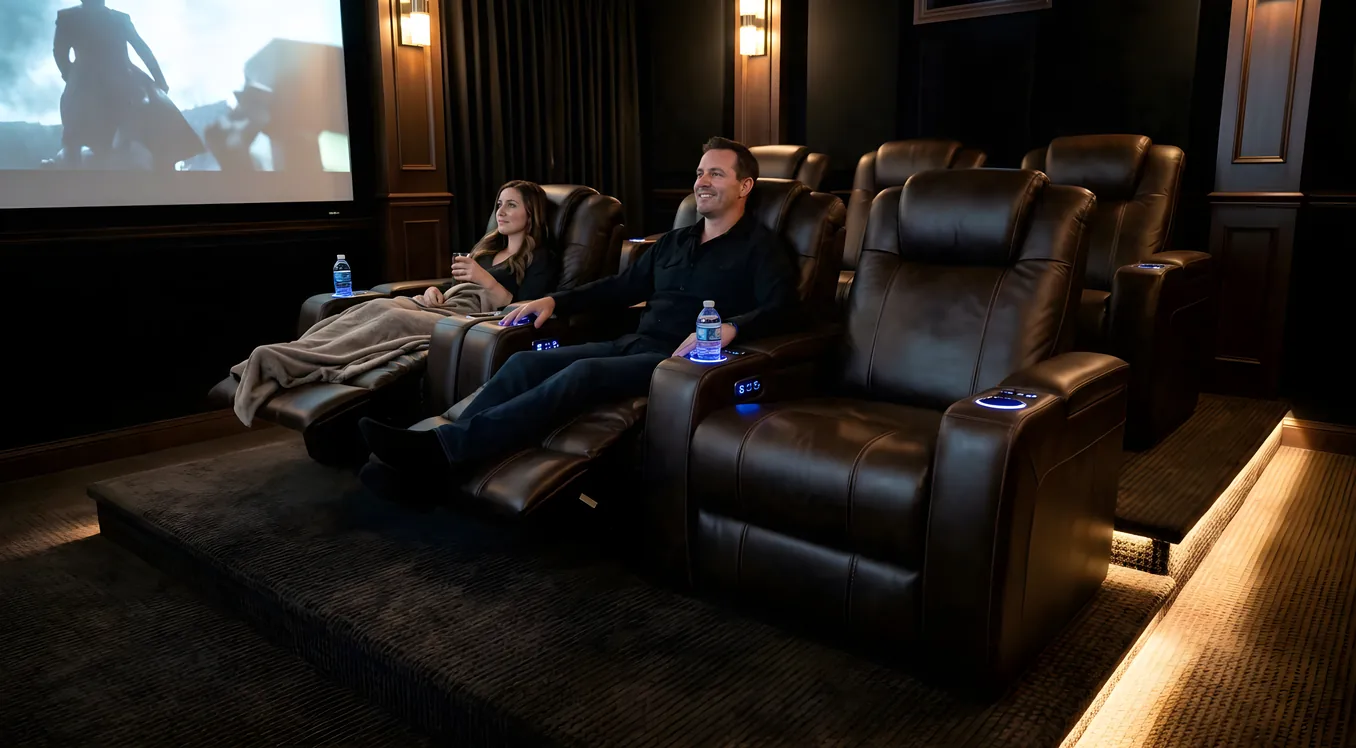
Most home theater mistakes happen before a single seat is purchased. People fall in love with a chair at a showroom, buy eight of them, and discover that the back row can’t see over the front row’s headrests. Or they choose leather for its looks and spend the next decade listening to every creak and rustle during quiet scenes.
Seating is where comfort, acoustics, and room geometry converge. Getting it right means working through the math before you open your wallet.
Seat Types and Where They Work
Theater Recliners
Power recliners are the default choice for dedicated home theaters, and for good reason. They let every viewer find a position without disturbing neighbors, and they look the part. The tradeoff is depth: a fully extended power recliner adds 18 to 24 inches to its footprint. A seat that measures 36 inches deep in the upright position can reach 54 to 60 inches when fully reclined. This has direct consequences for row spacing, covered in more detail below.
Manual recliners cost $400 to $800 per seat on the budget end and offer the same basic experience with fewer mechanical parts to fail. The absence of a motor also means less low-frequency noise during whisper-quiet movie passages.
Brands worth knowing in this category: Octane Seating makes some of the most widely reviewed mid-range power recliners in the $900 to $1,800 per seat range. Valencia Theater Seating occupies similar territory, with a reputation for thick padding that holds up over time. Fortress Seating and Row One sit higher in the premium tier ($2,000 to $5,000+ per seat), where you get tighter tolerances, better motor mechanisms, and more material options. Salamander Designs is better known for custom configurations and modular systems, often used when odd room shapes need creative solutions.
Loveseat Configurations
Two-seat loveseats with a shared center console are common in rows that seat four or six. The console typically holds two cup holders, a USB port, and storage for remotes or blankets. The benefit over individual chairs is that couples often prefer them; the drawback is that you lose per-seat recline independence.
Single Seats and Dedicated Club Chairs
For premium front-row positions or when the room is narrow, single seats with full arms on both sides give each viewer their own domain. Some dedicated home theater chairs from Fortress and Row One include massage motors and extendable leg rests built into the footrest assembly.
Bar Stools for a Back Row Riser
A back-row riser elevated 14 to 18 inches above floor level can support either standard recliners (most common) or a pub-height bar with stools. The bar-stool configuration is less common but works well in rooms that double as entertainment spaces: you get informal seating for sports nights and the elevated position covers sightlines. The downside is that bar-height seating is uncomfortable for movies lasting more than 90 minutes. If the room has a single, clear primary purpose (films), stick with recliners on the riser.
Features That Matter
Power vs. Manual Recline. Power recline is worth paying for in a dark room where fumbling for a lever disturbs neighbors. Look for whisper-quiet motors; cheaper mechanisms are audible at low listening volumes.
Adjustable Headrests. Motorized adjustable headrests let viewers with different heights dial in the neck support angle independently. They matter most in long sessions.
Cup Holders and Storage. Cup holders are standard. The ones worth having are smooth-sided and deep enough to hold insulated tumblers (most cheap versions were sized for 12-oz cans). Chilled cup holders exist at the premium end and pull from a refrigeration circuit built into the base.
LED Ambient Lighting. LED rope lighting under seats and along the row base is more useful than it sounds: it provides enough light to navigate without ruining night-adapted vision. Most theater-grade seats include a strip channel; some add color-changing capability via remote.
USB Charging. USB-A and USB-C ports in the armrest are expected at mid-range and above. Check that they’re rated for at least 5V/2A; low-spec ports won’t charge a tablet during a three-hour film.
Acoustic Fabric vs. Leather. This is a real tradeoff. Leather reflects high-frequency sound rather than absorbing it. In a room with hard surfaces, leather seating can brighten the sound signature in ways that push your acoustic treatment requirements up. Fabric (particularly dense microfiber or velvet) absorbs a meaningful amount of high-frequency energy and stays quieter when people shift positions. For rooms targeting accurate sound reproduction, fabric seats are the better technical choice. Leather wins on maintenance and liquid resistance.
Riser Design
A riser is a raised platform that lifts the back row (or rows) so that seated viewers can see over the heads in front of them. It is almost always worth building unless the room is designed for a single row.
Height Requirements
The standard guidance is 12 to 18 inches of riser height per additional row. For a two-row setup, one riser at 14 to 16 inches works for most seat heights and viewing distances. For three rows, the second riser needs to be 14 to 16 inches above the first, meaning the third row sits 28 to 32 inches above the floor. At that height, ceiling clearance becomes the constraint: you need at least 7.5 feet of ceiling clearance for comfortable seated headroom on the highest platform.
The right height depends on the seats you choose. A chair with a seated eye height of 44 inches (typical for a mid-recline recliner) combined with a 16-inch riser puts viewers’ eyes at roughly 60 inches. The front row’s seated eye height needs to fall below that line for clear sightlines. Measure your specific chairs before committing to riser dimensions.
Structural Requirements
Risers carry a lot of concentrated weight. Six fully occupied recliners at 300 lbs per person plus the weight of the seats themselves means a riser platform in a six-seat back row needs to support 2,000 to 2,500 lbs reliably. The standard construction method is a framed plywood platform:
- 2x6 or 2x8 lumber framing on 16-inch centers
- 3/4-inch plywood subfloor, glued and screwed to the frame
- Second layer of 3/4-inch plywood for a 1.5-inch total subfloor thickness
- Carpet or flooring finish on top
The total riser height is achieved by adjusting the lumber height or stacking concrete masonry units as a base before framing. Hollow-core riser construction resonates audibly, so fill the interior cavities with fiberglass batt insulation or rigid foam before closing the top.
Room Layout Options
Single Row
The simplest layout: one row of seats positioned at the viewing distance that the room dimensions and screen size dictate. In a room 12 to 14 feet wide, a single row of three to four seats is typically the maximum without crowding. No riser needed. All attention goes to the screen-to-seat distance and seat width.
Double Row
The most common layout for dedicated theaters. Front row at floor level, back row on a riser 14 to 16 inches high. Works in rooms that are at least 16 to 18 feet deep (to allow adequate front-row distance from the screen, space for the front row’s reclining footprint, the riser itself, and back-row depth).
Row-Plus-Bar
Front and middle rows are standard recliners; the back elevation supports bar-height seating at a counter. Works in multipurpose spaces but imposes ergonomic compromises. If you go this route, specify counter-height stools with back support (not backless bar stools) and keep bar-session use to content under two hours.
L-Shaped
Side seating perpendicular to the main rows, used in very wide rooms or when the screen is large enough to be visible from oblique angles. L-shaped layouts work better for sports viewing than films, where center positioning matters more. Acoustic considerations are significant: the side seats often end up in a poor position relative to the surround speaker array. Plan speaker placement in conjunction with seating, as covered in the theater aesthetics section.
Seat Count and Spacing Math
Width Per Seat
A comfortable theater seat requires 36 to 42 inches of width per person including armrests. Budget seating often compresses to 34 inches, which feels tight over a three-hour film. Premium seats with full double armrests run 44 to 48 inches per position.
To calculate seats per row: (Usable room width in inches) / (seat width) = seat count. Round down. In a 14-foot-wide room with 1-foot walls on each side, usable width is 144 inches. At 40 inches per seat: 144 / 40 = 3.6, so three seats per row.
Row Depth (Leg Room)
For non-reclining or manual-reclining seats: 36 to 40 inches of row-to-row depth is adequate. For power recliners: you need 48 to 60 inches of row-to-row depth when seats are fully extended. A common mistake is sizing the room based on upright seat dimensions. Measure full extension before finalizing the room layout.
Walkway Clearance
Leave at least 18 inches of clearance at the sides of each row for people to pass. In a room where the row runs wall to wall, there’s no aisle, and viewers must navigate between seats. For rows of more than three seats, a center aisle or side walkways are recommended.
Price Reference
| Tier | Price per Seat | What You Get |
|---|---|---|
| Budget | $400 to $800 | Manual recline, basic cup holders, limited material options |
| Mid-range | $800 to $2,000 | Power recline, USB charging, LED base lighting, better motor quality |
| Premium | $2,000 to $5,000+ | Whisper motors, adjustable headrests, chilled cup holders, premium leather or custom fabric, warranty programs |
For a mid-range home theater build in the $15,000 to $40,000 range, mid-tier seating is the standard choice. Premium seats tend to appear in purpose-built rooms with full acoustic treatment where the long-term commitment to the space justifies the per-seat cost.
Putting It Together
Before you order seats, lock down three numbers: seat width (determines seats per row), full-recline depth (determines row spacing), and seated eye height (determines riser height). Write them down, draw the room to scale, and place the seats on paper before placing an order. Returning eight power recliners is expensive and painful.
The best seating decisions start with the room, not the catalog.