Mid-Range Home Theater ($5,000 to $15,000): The Sweet Spot
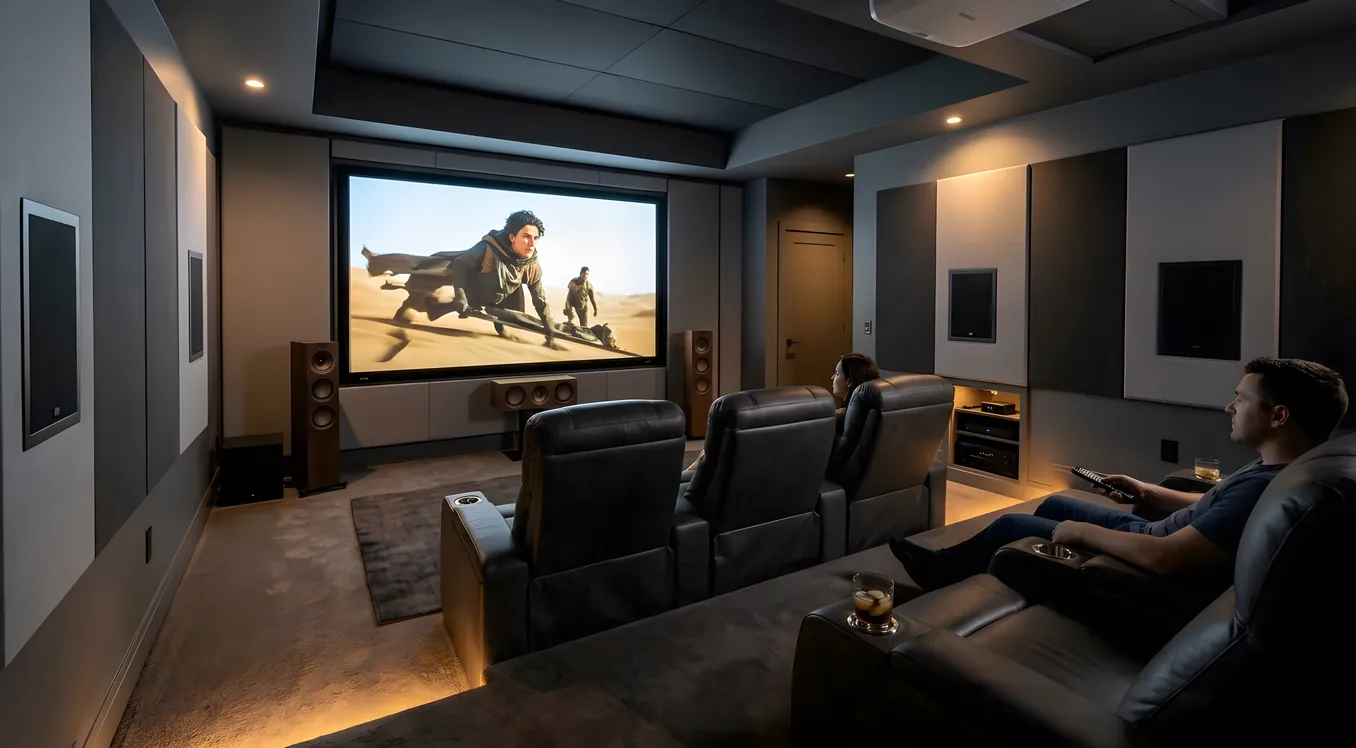
A mid-range home theater budget sits between two distinct failure modes. Below $5,000, the compromises accumulate in ways that show every time you watch something: flat, thin bass, a projector that looks good in a pitch-black room but washes out the moment anyone opens a door, speakers that can play loud but not cleanly. Above $15,000, the gains become real but marginal relative to the added cost. An $8,000 projector is better than a $4,000 one, but it’s not twice as good, and the room it sits in has far more influence on the final result than the price difference between those two boxes.
The $5,000 to $15,000 range is where home theater becomes genuinely cinematic. It’s where Dolby Atmos stops sounding like a gimmick and starts placing sounds above and behind you with enough precision that you turn your head. It’s where bass stops rattling and starts pressurizing the room. The jump from a budget system to a properly assembled mid-range setup is audible, visible, and measurable.
This guide walks through three builds at different points in the range, explains where the money matters most, and covers the decisions that separate a system that sounds impressive on paper from one that performs in the room you actually have.
Why This Price Range Outperforms Either Extreme
The budget market tops out at around $3,000 to $4,000 for a complete system. At that ceiling, you’re buying the best available versions of compromised components. The projector has usable brightness and acceptable color accuracy. The receiver handles all the right formats. The speakers cover the frequency range. But “handles” and “covers” describe minimum competence, not performance.
At the mid-range floor, those compromises resolve. A $2,500 projector produces calibrated color accuracy and brightness that a $900 unit cannot. The speaker crossovers are designed with better components. The receiver has enough amplifier headroom that the system doesn’t compress dynamically during loud passages.
At the top of this range, you’re approaching the level where additional spending produces real but smaller gains. A $20,000 speaker system sounds better than a $2,500 one, but the room treatment, seating placement, and calibration account for more of the final result than the price delta between the speakers. At $15,000 total, you can afford excellent components and still have budget left for treatment and calibration. That combination consistently outperforms a system that puts all the money into components and nothing into the room.
See the full cost breakdown for home theaters for a category-by-category analysis of where price affects performance most.
The $8,000 Build
This configuration targets strong performance across every dimension without stretching into territory where the room becomes the limiting factor.
Projector: Epson LS12000 ($2,500). The LS12000 uses laser light and 3LCD technology to produce 2,700 lumens of calibrated brightness, which is enough to maintain picture quality with modest ambient light. It covers 100 percent of the DCI-P3 color space and includes a motorized lens with full 2.1:1 zoom ratio, making throw distance flexible. Lens shift range is generous enough to handle rooms where the projector can’t be centered on the screen axis.
Screen: 120” Screen Innovations Zero-G ($1,200). Paired with a flat-gain screen in this size, the LS12000 produces a 120-inch image that holds up under the projector’s brightness output. The Zero-G is an ambient light rejecting screen, which matters if the room has light management challenges.
Receiver: Marantz Cinema 50 ($1,500). An 11-channel pre/pro in receiver form, the Cinema 50 handles Dolby Atmos, DTS:X, and Auro-3D. It includes Dirac Live room correction, which outperforms the legacy Audyssey implementation in previous Marantz generations. HDMI 2.1 on all inputs. This is the component that has the most downstream effect on the rest of the system, because its room correction calibration determines how accurately every speaker performs.
Speakers: KEF Q Series 5.1.2 ($2,000). The Q Series uses KEF’s Uni-Q driver array, which places the tweeter in the center of the midrange cone. The result is a point-source dispersion pattern that makes off-axis listening positions sound more similar to the sweet spot. For rooms where the seating row isn’t narrow, that characteristic matters. The 5.1.2 configuration covers two height channels for Atmos, using KEF Q50a upward-firing modules.
Subwoofers: Dual SVS SB-2000 Pro ($1,200 for the pair). Two sealed subwoofers outperform one ported sub at this price point in most rooms. The SB-2000 Pro extends to 19 Hz at -3dB in-room, covers up to 270 watts of amplification, and integrates with DSP control via app. Placing them asymmetrically (front-left and right-rear, for example) smooths bass response across the seating area more effectively than EQ can achieve with a single unit.
Room treatment ($600). At this budget level, GIK Acoustics panels on the first reflection points and rear wall significantly reduce slap echo and comb filtering. Six to eight panels cover the most critical surfaces. Acoustic treatment at this level costs less than any component upgrade but produces audible improvement that any component upgrade would struggle to match.
The $12,000 Build
This configuration moves up in image quality and speaker resolution while maintaining a room treatment budget.
Projector: Sony VPL-XW5000ES ($4,000). Sony’s native 4K SXRD technology produces an image with no pixel-shifting artifacts. The XW5000ES delivers 2,000 ANSI lumens from a laser light engine with a 2,000:1 dynamic contrast ratio in native mode. Where the Epson benefits from higher brightness output, the Sony wins on black level and shadow detail. For a light-controlled room, that’s the more relevant advantage.
Screen: Stewart StudioTek 130 ($2,000). The StudioTek 130 is a 1.3-gain screen used in professional screening rooms. It’s gain-neutral enough that a properly calibrated projector reads accurately against it, and rigid enough in construction that it doesn’t develop surface irregularities over time. This is a reference-grade screen at a non-reference price point.
Receiver: Anthem MRX 540 ($2,000). Anthem’s ARC Genesis room correction is among the most accurate implementations available in any receiver. The 540 handles 5 channels of amplification internally and includes pre-outs for additional channels. Its HDMI 2.1 implementation is consistent across all inputs. For a build at this budget, the ARC Genesis calibration is the primary reason to choose Anthem over alternatives at similar prices.
Speakers: Paradigm Monitor SE 7.1.4 ($2,500). The Monitor SE series uses Paradigm’s aluminum cone drivers with a controlled directivity tweeter. Moving to a 7.1.4 layout adds two additional surround channels and two more height channels compared to 5.1.2, which improves the sense of envelopment in wider rooms and creates more accurate Atmos object placement overhead.
Subwoofer: REL T/9x ($1,000). The REL T/9x uses REL’s high-level input connection alongside the standard LFE connection, which allows it to receive the same signal the main amplifier sends to the front speakers. This integration method produces bass that feels more continuous with the rest of the soundfield rather than arriving from a separate box. For music listening alongside films, the difference is significant.
Treatment and wire ($500). At this tier, wiring quality matters less than wiring cleanliness. Good speaker cable terminated properly, routed without sharp bends, and dressed into wall raceways performs identically to premium cable at multiples the cost. Budget accordingly.
The $15,000 Build: Adding the Room
At $15,000, the system above expands to include the environmental factors that determine whether the equipment performs as intended.
GIK Acoustics panel package ($1,500). A complete treatment scheme covers first reflection points on both side walls, the ceiling at the reflection point, the rear wall behind the listening position, and the front wall behind the screen. GIK’s 244 Bass Traps in the corners handle the modal buildup that makes bass sound boomy in most rectangular rooms. This level of treatment is the single most cost-effective upgrade available in a home theater at any budget.
Lutron Caseta lighting ($500). Motorized dimmers on the theater lighting allow the room to transition from bright for seating to dim for trailers to fully off for the main feature, controlled from a remote or the same app that runs the subwoofers. Caseta is the Lutron line designed for retrofit installation without requiring a neutral wire, making it compatible with most existing electrical boxes.
Dedicated theater seating ($2,000). Row seating with fixed-height headrests positions every listener at the same ear height, which matters for both surround and height channel imaging. Motorized recline at this price point is attainable from Seatcraft and similar manufacturers. Proper seating height places the listener’s ears at the acoustic center of the room rather than at a height determined by whatever furniture was repurposed.
For context on how a $15,000 build compares to entry-level and full reference installations, see the comparison between budget home theater systems and high-end home theater setups.
Dolby Atmos at This Tier
Atmos becomes standard practice in mid-range systems rather than an add-on. A 5.1.2 configuration (five main speakers, one subwoofer, two height channels) is the minimum for coherent Atmos playback. A 7.1.4 layout significantly improves overhead object placement and allows the mixing of overhead sources to separate into distinct positions rather than collapsing into a single height layer.
Height speakers at this budget can be upward-firing Atmos modules placed on top of the front and surround speakers, or in-ceiling speakers installed above the listening position. In-ceiling installations require coordination with the room’s construction, but they produce more accurate height localization because the sound originates from above rather than from a reflected channel. At the $12,000 build level, ceiling installation is worth planning for if the room permits it.
Dual Subwoofers
One subwoofer placed in a room corner will excite some bass modes while leaving others unaddressed. The result is bass that sounds strong at certain frequencies and weak at others, with response that changes significantly depending on where you sit. Equalization can partially compensate, but it can’t add output at frequencies where room cancellations reduce bass to near zero.
Two subwoofers placed asymmetrically work with multiple room modes simultaneously. The standard approach puts one unit at the front and one at the rear, which smooths response at the primary listening position better than any other placement option. The SVS PB-2000 Pro and REL T/9x both include DSP controls that allow phase and level matching when running two units together.
At this budget range, dual subwoofers are a better investment than a single more expensive sub. Two $600 sealed units outperform one $1,200 sealed unit in typical home theater rooms.
Professional Calibration
A calibrated system is not the same as a system with room correction enabled. Room correction software adjusts speaker levels, delays, and frequency response based on microphone measurements. Professional calibration goes further: a certified ISF or THX calibrator measures the projector’s gray scale tracking, adjusts the color management system for accurate primaries and secondaries, verifies gamma response matches the content mastering target, and validates that the picture being produced matches what the director of photography intended.
The cost runs $300 to $500 for a thorough calibration session that covers both video and audio. At the mid-range build level, where the projector and speakers are resolving enough to benefit from accurate calibration, this is not an optional expense. A $4,000 Sony projector performing to factory default specifications is leaving image quality on the table. The same projector calibrated to the BT.2020/HDR10 standard looks measurably different.
Audio calibration from a professional goes beyond running the receiver’s built-in room correction. A trained calibrator verifies crossover settings, checks subwoofer integration by ear and by measurement, adjusts high-frequency absorption if the room is over-damped, and validates that the system plays at reference level (85dB per channel) without compression.
DIY Installation vs. Professional Integration
DIY installation at the mid-range level is realistic for most homeowners with time and a tolerance for running speaker wire. The equipment is standardized enough that manufacturer setup guides cover the primary steps. The receiver’s room correction handles the bulk of what a professional would otherwise spend hours configuring manually.
The savings from DIY installation run $2,000 to $5,000 depending on system complexity and local installer rates. That savings is real and worth capturing if the owner is comfortable with the physical installation work: running wire through walls, mounting the projector, terminating speaker connections, and managing cable routing.
What DIY installation cannot replace is professional calibration for the video side. The receiver’s room correction handles audio calibration adequately. Video calibration requires equipment (spectrophotometers, pattern generators) and trained interpretation that DIY approaches cannot substitute. Of all the services available in a home theater installation, professional video calibration has the clearest return relative to cost.
Where Room Treatment Sits in the Priority Order
In a mid-range build, room treatment competes directly with equipment for budget allocation, and treatment consistently wins on return. A $1,500 room treatment package in a properly designed system improves the listening experience more than upgrading from $2,000 speakers to $3,500 speakers in an untreated room.
The reason is physics. Speakers project sound into the room, and the room reflects, absorbs, and diffuses that sound before it reaches the listener’s ears. A high-performance speaker in a reflective room with significant bass modal buildup delivers its specifications into those reflections, and what reaches the listener is the sum of the direct sound and everything the room added to it. Acoustic panels reduce the amplitude of those reflections. Bass traps reduce the modal buildup in corners. Both changes make the sound closer to what the speakers actually produce rather than what the room does to it.
A treatment budget of $1,000 to $3,000 is proportionate to a mid-range system. GIK Acoustics, RealTraps, and Acoustimac all offer panels at price points that allow meaningful coverage without custom manufacturing costs. Starting with six to eight panels at the primary reflection points and adding corner bass trapping produces the largest gains per dollar spent.