Budget Home Theater ($2,000 to $5,000): What You Can Build
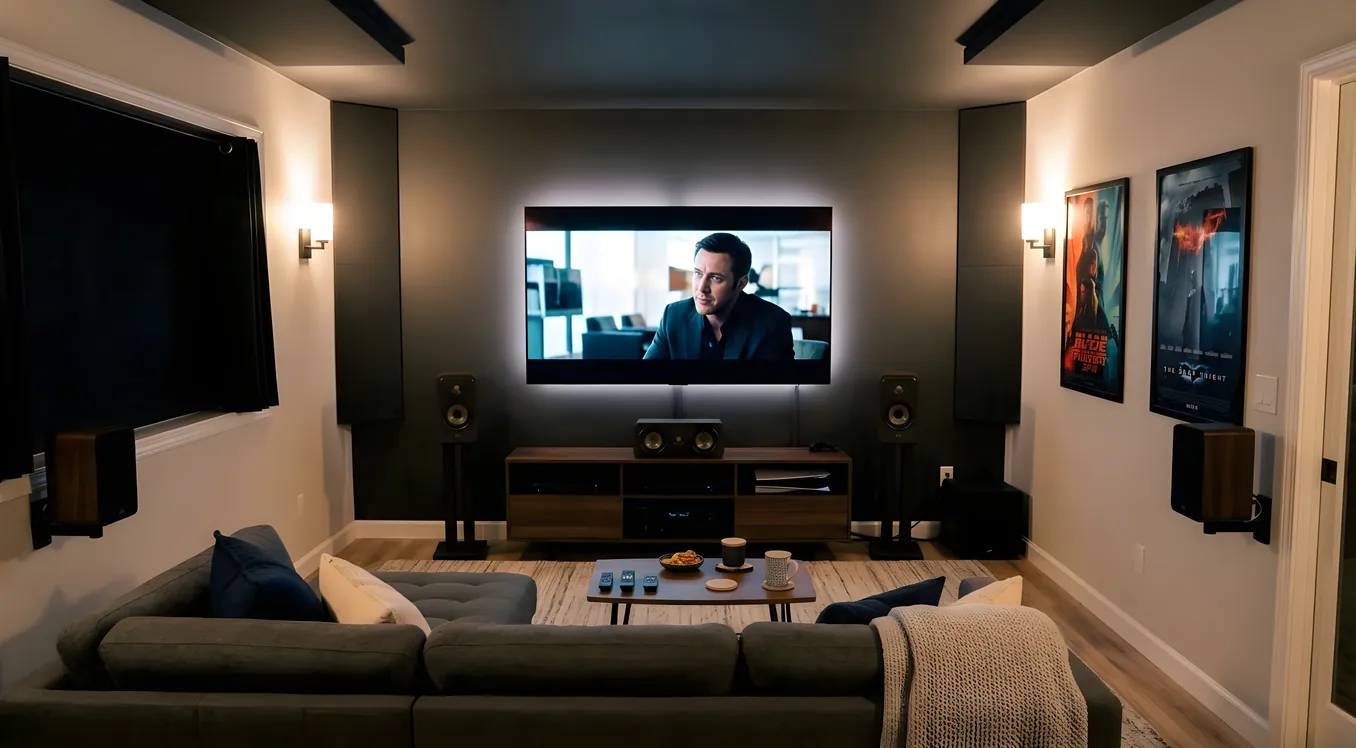
A $2,000 to $5,000 budget gets you something a soundbar and flat-panel TV combination will never deliver: a genuine surround sound system with a real subwoofer, a wide soundstage, and the kind of bass you feel in your chest. The gap between a soundbar setup and even a modest dedicated system is not subtle. It’s the difference between hearing a movie and experiencing it.
This guide covers three complete budget home theater builds at $2,000, $3,500, and $5,000. Each includes specific component recommendations, cost breakdowns, and honest trade-offs. You’ll also find guidance on where to put your money for the biggest quality improvement and where to save without hurting the result.
What $2,000–$5,000 Actually Buys
The most important thing to understand before choosing components: at this price range, audio is where your money works hardest. A pair of quality tower speakers and a capable subwoofer will outperform any soundbar, period. Your display matters, but a good 65-inch TV at $500 is entirely watchable. There is no TV at $500 that sounds good.
For a detailed look at how costs break down across different budget levels, see our cost breakdown guide.
The $2,000 Build: A Real Surround System Without Breaking the Ground Floor
This build prioritizes proven components, a dedicated subwoofer, and actual 5.1 surround. Nothing here is exotic. Everything is available, well-reviewed, and will outperform the all-in-one systems that cost twice as much at big-box stores.
Component list:
| Component | Model | Cost |
|---|---|---|
| Display | 65” mid-range LED TV | ~$500 |
| AV Receiver | Denon AVR-S770H | ~$350 |
| Speakers (5.0) | Jamo S 803 system | ~$250 |
| Subwoofer | SVS SB-1000 Pro | ~$500 |
| Stands and wire | Generic/Monoprice | ~$100 |
| Acoustic panels | Basic room treatment | ~$300 |
Total: approximately $2,000
The Denon AVR-S770H handles Dolby Atmos and DTS:X, has eight HDMI inputs, and includes Audyssey room correction. At $350, it punches above its weight class. The Jamo S 803 set covers front left, center, right, and two surrounds at a price point that leaves room in the budget for the subwoofer, which is the right priority.
The SVS SB-1000 Pro is where this build earns its money back. SVS specializes in subwoofers. This unit is compact (sealed box), goes deep, and is tunable via a free app. A $150 subwoofer from a big-box store cannot compete. Spending $500 on the sub and $250 on the satellite speakers is the right ratio for this tier.
Basic acoustic panels on the side and rear walls reduce flutter echo and clean up bass buildup in corners. At $300, you can cover the most important positions with panels from Amazon or treated fabric wrapped around rockwool boards if you want to DIY.
The $3,500 Build: A Projector System That Changes the Room
At $3,500, you can move from a TV to a projector and screen setup that fills a wall. The visual impact is significant. A 100-inch image in a dim room is a different experience than even a large television.
Component list:
| Component | Model | Cost |
|---|---|---|
| Projector | BenQ HT2060 | ~$700 |
| Projection screen | 100” Silver Ticket | ~$200 |
| AV Receiver | Denon X1800H | ~$500 |
| Speakers (5.1) | Emotiva B1+ / C1+ / surrounds | ~$800 |
| Subwoofer | HSU VTF-2 MK5 | ~$550 |
| Wire, mounts, panels | Various | ~$750 |
Total: approximately $3,500
The BenQ HT2060 is a 1080p projector with a short-throw lens that works in rooms with some ambient light. It is not a 4K projector. At $700, it is an honest, well-regarded product in the enthusiast community. The Silver Ticket screen pairs with it reasonably; a fixed-frame screen at this size holds the image flat and installs cleanly on any wall.
The Emotiva lineup replaces the Jamo set here. Emotiva designs and prices speaker systems for enthusiasts on a budget. The B1+ bookshelves and C1+ center channel are more refined than the Jamo, and at this budget tier the receiver can do them justice. The Denon X1800H adds HDMI 2.1 ports and better room correction calibration.
The HSU VTF-2 MK5 is a ported subwoofer (the SB-1000 Pro is sealed), which means it can go louder and deeper in larger rooms. HSU Research is a mail-order subwoofer specialist with a strong reputation for value. Like SVS, they are not a brand you will find in a retail store, which is exactly why the price-to-performance ratio holds up.
The $750 accessories line at this tier covers quality speaker wire (Monoprice), wall mounts for surrounds, HDMI cables (again, Monoprice), and acoustic treatment for the front wall behind the screen and the first reflection points on the side walls.
The $5,000 Build: Laser Projection and Reference-Grade Speakers
At $5,000, the constraints on component quality largely disappear. This build uses a laser projector, a larger screen, a more capable receiver, and a speaker set that audiophiles recognize as a step above the budget tier.
Component list:
| Component | Model | Cost |
|---|---|---|
| Projector | Epson LS11000 | ~$1,500 |
| Projection screen | 120” Elite Screens | ~$400 |
| AV Receiver | Denon X3800H | ~$1,200 |
| Speakers (5.1) | Klipsch RP-600M II system | ~$1,200 |
| Subwoofer | SVS PB-1000 Pro | ~$600 |
| Accessories | Cables, treatment, misc | ~$100 |
Total: approximately $5,000
The Epson LS11000 is a 4K laser projector. Laser light sources last significantly longer than lamp-based projectors, produce better contrast, and reach operational brightness faster. At $1,500 it is the most expensive single component in any of these builds, but it is the component that sets this build apart visually. The 120-inch Elite Screens fixed-frame screen is well-regarded at this size.
The Denon X3800H is a serious 9-channel receiver with HDMI 2.1 across all ports, Dirac Live room correction (available as an upgrade), and headroom for adding Atmos height channels later. The Klipsch RP-600M II bookshelf speakers are efficient, dynamic, and pair well with Denon amplification. Klipsch speakers are known for sensitivity, meaning the receiver does not need to work hard to achieve high volume levels.
The SVS PB-1000 Pro is the ported sibling of the SB-1000 Pro from the $2,000 build. It is larger, plays louder, and extends lower. In a room at this budget level, a ported sub with room to breathe makes a real difference.
Where to Spend and Where to Save
Spend on the subwoofer. Bass is the hardest part of the audio spectrum to reproduce well and the part most listeners notice first when it is wrong. A cheap subwoofer rattles, sounds boomy, and does not integrate with the mains. A quality sub from SVS, HSU, REL, or Rythmik makes every other speaker in the system sound better. If the budget is tight, move money from the receiver or the TV to the subwoofer before anywhere else.
Spend on the speakers. Speaker quality is permanent. Receivers and projectors can be upgraded over time as prices fall. Speakers last decades if well-made. Buying the best speakers the budget allows and then adding a better receiver in two years is a sound strategy.
Save on cables. The premium cable industry is, politely, a profitable mythology. Monoprice HDMI cables, speaker wire, and optical cables perform identically to cables priced ten times higher in blind tests conducted by audio measurement communities. Buy Monoprice, keep the savings for speaker stands or acoustic treatment.
Save on mounts and stands. Amazon Basics and similar house-brand products handle speaker stands and TV mounts at a fraction of the price of branded alternatives. The only mounts worth spending more on are projector ceiling mounts where precision alignment matters. Even then, mid-range units from Peerless-AV at $60-80 are sufficient.
Consider used for projectors and receivers. AV receivers depreciate quickly. A three-year-old Marantz or Denon with HDMI 2.0 and Audyssey sells for $150 to $200 on the used market and is entirely capable for 5.1 surround at 1080p. Projectors similarly drop in price when new models release. If a $700 projector is one generation old, the previous model often sells used at $350 to $400 with light hours on the lamp. Speakers and subwoofers are the exception: buy new or from a trusted source where you know the condition and the driver history.
Common Budget Mistakes
Spending everything on the display. A 77-inch OLED television at $2,500 paired with a $150 soundbar is a common and miserable configuration. The display looks excellent. The audio sounds like a conference room speaker. The budget theater community calls this the “big TV problem,” and it is the single most common error at this price range.
Skipping the subwoofer entirely. Some buyers purchase a 5.0 system (no sub) thinking they can add one later. Subwoofer-less home theater sounds thin and produces no low-frequency impact. Budget for the sub or the system is incomplete.
Buying an AVR with too few HDMI inputs. Modern living rooms have gaming consoles, streaming sticks, Blu-ray players, cable boxes, and game systems. A receiver with three or four HDMI inputs fills up immediately. Buy a receiver with at least six, preferably eight.
Ignoring room treatment. Acoustic panels are not optional at this budget tier. Flutter echo from bare walls turns even a quality speaker system into a confusing sonic mess. Six to eight panels at the first reflection points and the front wall behind the screen make a larger improvement than many component upgrades.
The Upgrade Path
When budget allows, here is the recommended order:
- Subwoofer first. If you started with a modest sub, this is the upgrade with the most audible impact.
- Main speakers second. Moving from bookshelf to tower speakers or upgrading to a higher-efficiency model transforms the soundstage.
- Display third. If you started with a 1080p projector, upgrading to 4K laser is a meaningful visual improvement. If you started with a TV, moving to a projector changes the experience entirely.
- Receiver last. The receiver is the workhorse of the system. Unless you need more channels for Atmos or have genuinely outgrown the amplification headroom, upgrade other components first.
For a comparison of what the next tier of spending buys, see the mid-range home theater guide.
Building It Yourself vs. Hiring Help
At this budget level, most of the work is component selection and cable management. Wall-mounting a projector and running speaker wire through walls is the part where professional help is worth considering. If you are comfortable with basic tools and are willing to follow the Denon AVR calibration wizard, you can run a successful room correction session without a professional installer.
For a full look at where the line between DIY and professional installation makes financial sense, see the DIY vs. professional guide.
Getting the Most From Any Budget
Every build here outperforms a soundbar. The $2,000 build delivers genuine cinematic impact. The $3,500 build fills a wall with image. The $5,000 build approaches performance levels that cost significantly more even three or four years ago. The throughline is the same at every tier: invest in acoustic fundamentals, buy a quality subwoofer, and let the room treatment work. The components are a starting point. The room is the variable.