Home Theater Aesthetics: From Cinema Replica to Modern Minimalist
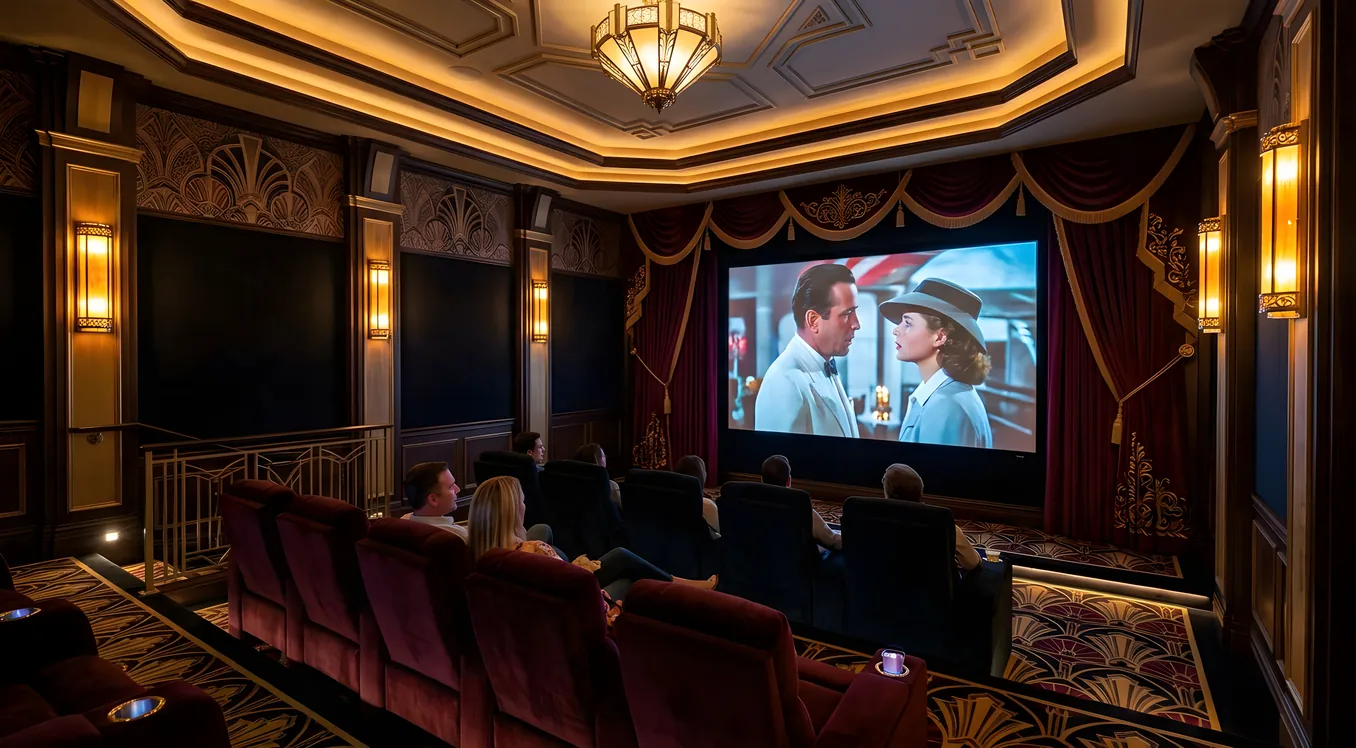
Home theater room design ideas fall into four reasonably distinct categories: classic cinema, modern minimalist, industrial, and luxury custom. The differences are not superficial. Each style implies a specific relationship between the equipment and the room, a particular approach to acoustic treatment, and a set of construction decisions that are difficult to reverse. Choosing the wrong aesthetic before the walls are finished is an expensive mistake.
The design questions and the technical questions are not separate. How you handle the screen wall determines whether speakers need to be visible. Ceiling treatment choices determine how you address reflections. Wall treatments that double as acoustic panels determine whether you need a separate acoustic contractor. The aesthetic you want shapes the construction sequence. Get the look right first on paper, before a single panel goes up.
Classic Cinema: Column Sconces, Velvet, and Marquee Signs
The classic cinema look draws from 1930s and 1940s movie palace architecture: art deco geometry, warm amber and red color palettes, velvet drapery, column sconces, and an unapologetic commitment to the idea that watching a film is a formal event. This style works best in dedicated rooms where the theatrical intent is the whole point, not something to hide.
The defining element in a classic cinema room is the screen surround. Velvet curtains flanking the screen on motorized tracks are the signature move: they open when the film starts and close when it ends, replicating the theatrical ritual. The curtain panels need enough width to stack without obscuring the screen at full open, which means planning for at least 18 to 24 inches of curtain-clear space on each side of the frame. Velvet is used for the same reason cinemas use it: the pile surface absorbs a significant amount of high-frequency sound, which makes the curtains functional as well as decorative.
Column sconces on side walls are the other defining element. In rooms with structural columns, wrapping those columns in decorative millwork and mounting uplighting or point-source sconces at mid-height gives the room its distinctive rhythm. In rooms without columns, false columns built from framed drywall or MDF can be added specifically to carry the sconces, though this costs square footage in a room that may already be tight. The sconces themselves need to be on a dedicated dimmer circuit that goes to black during playback; even a low-level amber glow affects perceived contrast on screen.
A marquee sign or illuminated title board above the entry door is a popular accent in this style. These range from simple lighted letter panels to fully custom neon fabrications. Their contribution to the room’s character is high; their structural cost is low relative to everything else. If there is a place to spend on personality in a classic cinema room without affecting acoustic or optical performance, this is it.
Star ceiling fiber optics suit this style well. A fiber optic star field uses a single illuminator unit with dozens of fiber strands woven through dark fabric or black-painted drywall, creating a ceiling that reads as a clear night sky. The system does not generate meaningful heat at the ceiling surface (the illuminator lives in a closet or equipment rack), and with all fiber diameters set appropriately, individual points of light are not bright enough to affect projector contrast. A twinkling effect, achieved with a wheel in the illuminator that alternates fiber bundles, is standard and adds to the cinema atmosphere without requiring separate control programming.
For lighting design in a classic cinema room, the typical control scheme uses four zones: the star ceiling on its own dimmer, the column sconces on a second, cove lighting behind crown molding on a third, and aisle LED strips at floor level on a fourth. The cove lighting behind the molding provides indirect fill during pre-show and intermission, then dims to off during playback. The floor-level aisle strips stay at minimal levels throughout to provide exit illumination without introducing stray light into the image.
Modern Minimalist: Hidden Equipment, Flush Walls, Zero Visual Clutter
The modern minimalist approach is the opposite of the cinema replica in almost every way. The goal is a room where nothing visible hints at the technology inside it. Equipment disappears into walls, ceilings, and dedicated equipment closets. The screen appears to float on a featureless wall. The speakers are behind the screen or inside the walls. The room could be mistaken for a high-end living room until the system activates.
Achieving this look is more technically demanding, not less, than the cinema replica. Hiding equipment well requires planning its physical home before the room is framed. An equipment closet or dedicated rack room adjacent to the theater space is the cleanest solution: all amplifiers, processors, disc players, and streaming devices live in a ventilated equipment room and are connected to the theater via in-wall cable runs. The viewing room contains no visible electronics at all, just a screen and seating.
Acoustically transparent screens are the key technology that makes the minimalist look possible. These screens use a perforated or woven material that allows sound to pass through with minimal attenuation, so the left, center, and right speakers can be mounted behind the screen surface and remain completely invisible. The acoustic effect of the screen material itself introduces some frequency response variation at high frequencies that needs to be corrected in the processor’s EQ, but this is a solved problem with current room correction software. The visual benefit is that there are no visible speaker cabinets below or beside the screen, and the front wall can be a single clean surface.
Flush walls in a minimalist theater require surface-mount acoustic panels to be concealed, typically behind stretched fabric walls. The fabric is mounted on a frame system that stands a few inches off the drywall, with acoustic material in the cavity. From the front, the wall looks like a single flat surface in the chosen fabric color. Behind it, the acoustic treatment is doing its work invisibly. This approach costs more per square foot than visible panel mounting but eliminates the need for any visible acoustic hardware.
The color palette for minimalist home theater room design ideas typically runs dark: charcoal, deep navy, matte black walls, or very dark gray. These colors serve both the aesthetic and the optical function, minimizing light reflection off side walls and ceilings that would degrade contrast. A minimalist room in white or off-white requires much more aggressive anti-reflective treatment to achieve the same image quality.
Industrial: Exposed Ductwork, Concrete, and Metal Accents
The industrial aesthetic began in converted warehouse and loft spaces where the architecture made hiding mechanical systems impractical, and it has since moved into purpose-built spaces as a deliberate design choice. In a home theater context, industrial means embracing structural and mechanical elements rather than concealing them: painted black exposed ductwork, concrete or polished cement floors, raw or treated wood, and metal hardware throughout.
The acoustic challenge in an industrial aesthetic room is significant. Exposed ductwork, concrete floors, and hard wall surfaces are acoustically hostile. Hard, parallel surfaces create flutter echo; concrete floors and hard ceilings compound it. An industrial theater that sounds as bad as it looks good is a common failure mode.
The correction is to use the soft and porous elements that the style already includes as deliberate acoustic tools. A large area rug over concrete flooring does real acoustic work: a thick rug over a concrete slab absorbs high-frequency energy and reduces flutter echo significantly. Exposed ceiling beams, when wood is part of the design, function as diffusion elements if they have sufficient dimension and irregular spacing. Upholstered seating with high, thick seat backs provides absorption at ear level.
Where additional acoustic treatment is required, the industrial aesthetic accommodates it unusually well. Fabric-covered panels mounted on black metal standoffs are both acoustically effective and visually consistent with the design language. Perforated metal facing over acoustic infill gives panels an industrial texture while providing broadband absorption. Bass traps built into corner frames using expanded metal with acoustic fill are visible but read as intentional design elements rather than afterthoughts.
The screen wall in an industrial theater often uses a borderless or thin-bezel fixed frame screen on a wall finished in matte black paint or wrapped in dark fabric. The projector, rather than being concealed in a ceiling enclosure, may be mounted on an exposed ceiling rail or beam, with cables running in metal conduit that matches the room’s hardware palette. This makes the equipment a visible feature rather than something to hide, which is consistent with the industrial design philosophy.
For flooring, exposed concrete with a matte sealer is the reference look, but it creates two problems: acoustic reflection, addressed above with rugs, and cold and hard seating areas if viewers sit on the floor. Stained concrete or scored concrete with a pattern gives more character to the floor while maintaining the industrial texture.
Luxury Custom: Millwork, Fabric Walls, and Automated Everything
High-end custom home theaters represent what happens when budget is not the primary constraint. The defining characteristic is that every surface is purpose-designed for the space: custom millwork panels on every wall, fabric-wrapped panels in coordinated colorways, integrated lighting that is part of the millwork rather than added to it, and control automation that operates the entire room from a single trigger.
Custom millwork in a luxury theater typically means MDF or solid wood panels with routed profiles, paint or lacquer finishes, and integrated channels for LED cove lighting. The panels serve a design purpose, but they are also structural: they provide the framework for acoustic treatment, hide cable runs, and support sconces, light fixtures, and decorative hardware. A room done in custom millwork panels looks nothing like a room with drywall and acoustic tiles; the whole space has a consistent, designed character.
Fabric-wrapped walls are standard in high-end builds. The same stretched fabric system used in the minimalist theater appears here, but with a wider range of fabric choices: Guilford of Maine acoustic fabric, commercial velvet over acoustic batting, or woven textiles with enough porosity to provide absorption while still being appropriate for a formal room. The fabric color and texture selection is typically done by an interior designer working alongside the AV integrator, ensuring that the acoustic requirements and the aesthetic preferences are resolved together rather than sequentially.
Automated control in a luxury theater goes further than a single scene trigger. A full automation system handles the projector and screen, motorized blackout shades if any windows are present, the lighting control zones (which may be eight or more circuits in a complex room), the HVAC setpoint for the room (reducing fan speed during playback to minimize noise floor), and the AV system power sequencing. A single “Movie” scene trigger from a wall keypad or touchscreen handles the entire sequence. A well-programmed automation system is invisible during use; a poorly programmed one is a persistent source of frustration that no amount of design quality compensates for.
Seating in a luxury custom theater is almost always purpose-built or manufacturer-customized. Home theater seating for high-end builds typically uses full-grain leather, power recline with lumbars and headrests, integrated USB charging, and ambient lighting in the seat base. Rows are arranged with a riser for the second row and sometimes a third, with each riser height calculated to maintain sightlines over the occupants in front. The riser faces are finished in the same material as the room’s millwork.
The Screen Wall
The screen wall deserves specific attention regardless of design style, because the decisions made there affect both aesthetics and audio performance in ways that interact.
A masking system adjusts the visible area of the screen to match the aspect ratio of the content: opening to full width for 1.78:1 (16:9) content and pulling in to reveal a wider 2.35:1 (Scope) frame for widescreen film. Anamorphic lens systems pair with Scope screens to fill the entire width of the screen even with 16:9 native projector output, requiring the projector to be on a motorized lens carrier or sled that adjusts position between formats. Masking systems use motorized side panels or top/bottom panels, depending on the scope format, that move between presets programmed into the control system.
The visible LCR (left-center-right) speaker configuration, where speaker cabinets are placed below and beside the screen frame rather than behind it, is the alternative to an acoustically transparent screen. This configuration is more acoustically straightforward: no screen material in the signal path means no high-frequency roll-off to correct. The tradeoff is visual. Speaker cabinets below a large screen add height to the screen wall and change the proportions of the room. In a classic cinema aesthetic, visible speakers in a traditional horizontal center channel mount below the screen are expected and consistent. In a minimalist or luxury build, visible speaker cabinets are typically considered a negative aesthetic element.
Ceiling Treatments
The ceiling in a dedicated theater has three competing requirements: acoustic performance, lighting infrastructure, and, in many design styles, aesthetic character.
Tray ceilings with cove lighting are the most common solution for combining all three requirements. A tray ceiling steps down from the perimeter, creating a recessed center section. LED strip lighting in the perimeter trough provides indirect cove illumination that is warm during setup, dims to ambient during playback, and blackens entirely during peak viewing. The center section of the tray can be treated with acoustic panels, fiber optic star field material, or finished in dark paint or fabric.
Acoustic panels on the ceiling are not optional in a high-performance theater. The ceiling reflection above the primary seating position is one of the most damaging acoustic problems in small rooms. The panel dimensions and placement need to be calculated based on the distance from the speakers to the reflection point, which is done with a mirror or a ray tracing calculation. A panel that misses the reflection point by 12 inches is significantly less effective than one placed correctly. Fabric-covered panels in a ceiling can be made to look architectural rather than utilitarian if they are flush-mounted in a ceiling frame with a reveal edge and finished in a fabric that complements the wall treatment.
In a star ceiling configuration, the field typically covers the entire ceiling above the seating area, stopping at the screen wall edge. The perimeter cove provides the functional lighting infrastructure while the star field above handles the aesthetic. This combination is associated almost exclusively with the classic cinema style but appears occasionally in luxury custom builds with a more theatrical brief.
Wall Treatments
Wall treatments in home theaters serve the same dual role as ceiling treatments: they manage acoustics, and they define the room’s character.
Acoustic fabric panels mounted on frames are the standard technical solution for side wall treatment. The panels need to address the first reflection points on each side wall, which are at the mirror-point positions between the front speakers and the primary seating row. Beyond those specific positions, additional absorption is applied based on the room’s measured RT60 (reverberation time): rooms with too much high-frequency decay add more porous absorption, rooms with excessive low-frequency energy need corner bass traps.
The design integration question is how these panels relate to the rest of the wall. In a classic cinema room, large fabric panels in a bold color mounted in millwork frames with decorative borders read as intentional architectural elements. In a minimalist room, stretch fabric walls unify the entire wall surface in a single material. In a luxury build, coordinated fabric panels in varied sizes and profiles are specified by the interior designer as part of the overall millwork package. In all cases, the acoustic function and the visual result need to be resolved together, not in sequence.
Wainscoting with fabric upper walls is a common treatment in rooms that want a traditional residential feel alongside acoustic performance. The lower section of the wall, typically from the floor to a chair rail at 32 to 42 inches, is finished in painted MDF wainscot panels, painted wood, or wallcovering. Above the chair rail, a stretch fabric system provides the acoustic treatment and the warmer upper wall material. The chair rail provides a clean transition line and structural support for the fabric frame’s lower edge.
For an in-depth look at how specific color schemes interact with projected images and lighting zones in each design style, the color decisions deserve more space than this article can give them. The short version: dark saturated colors on side walls and ceilings reduce reflectance and preserve contrast; light or neutral colors require ALR-type management to avoid washing out the projected image.
Equipment Visibility: Concealed Versus Displayed
How equipment is handled visually is as much a design decision as a practical one.
A fully concealed equipment approach uses an equipment closet or rack room adjacent to the theater, with all active electronics housed and cooled in that separate space. Cable runs through the wall carry video and audio signals to the theater. In the theater itself, nothing with a power light or a screen is visible. This approach requires planning the cable routes and the rack room location before the walls are framed.
A glass-door equipment rack in the room is the alternative for installers and enthusiasts who want the equipment visible as a design element. Rack systems in brushed aluminum or black steel with illuminated interiors and glass doors treat the equipment as a display. This works particularly well in an industrial or modern high-tech aesthetic and requires no additional room infrastructure, but it means that the equipment room is the theater room, with all associated thermal management and fan noise considerations.
Budget-conscious builds often split the difference with a recessed rack alcove: a section of the side or rear wall that is recessed 18 to 24 inches and fitted with rack rails, then covered with a door or curtain when not in use. This gives cleaner organization than freestanding furniture without the cost of a separate equipment room.
Budget-Friendly Aesthetic Upgrades
Not every aesthetic improvement requires construction. Several changes deliver significant visual impact relative to their cost.
Repainting the room is the highest-return single investment for an existing space. Switching from white or beige walls to a dark matte color (deep charcoal, dark navy, or black) immediately changes the character of the room and improves the optical environment for projection. Flat or matte paint finish matters: eggshell or satin sheens reflect more light and are harder to manage around a projector.
Adding column sconces to an existing room requires only drywall work and electrical rough-in: a receptacle or junction box at the desired height, a sconce bracket, and the fixture itself. For a room without columns, a pair of sconces flanking the screen on the front wall, at approximately two-thirds of the wall height, gives the room more presence than bare walls.
LED strip lighting in cove or tray ceiling details, or along stair risers and aisles, is a wiring project that pays off aesthetically far beyond its cost. Warm white LED strips at 2700K in a crown molding cove, on a dimmer at very low levels, transforms the ambiance of a room during pre-show setup. Addressable RGBW strips allow color temperature adjustment across scenes.
Acoustic panels in fabric and frames that match the room’s palette do double work: they improve sound quality and add visual texture to bare walls. A set of four or six panels at the first reflection points and above the seating adds character to a room that would otherwise read as a plain box with chairs in it.
Getting the Sequence Right
The consistent mistake in home theater room design is making aesthetic decisions after technical ones are already locked in. The sequence matters: define the design style, then determine how acoustic treatment will be integrated into that style, then specify equipment in the context of both. A room where the acoustic panels were chosen without a design style produces a space that looks like a recording studio that someone put seats in. A room where the design style was finalized before the acoustic requirements were understood produces a beautiful room that sounds poor and takes expensive retrofitting to fix.
The screen wall treatment, ceiling approach, and wall treatment system are the three areas where aesthetic and acoustic decisions intersect most directly. Those three elements drive the visual character of the room more than any other single choice. Get those three right, in the right sequence, and the furniture, lighting, and decorative details are relatively straightforward to resolve.