Bass Traps Explained: Controlling Low Frequency Buildup in Theaters
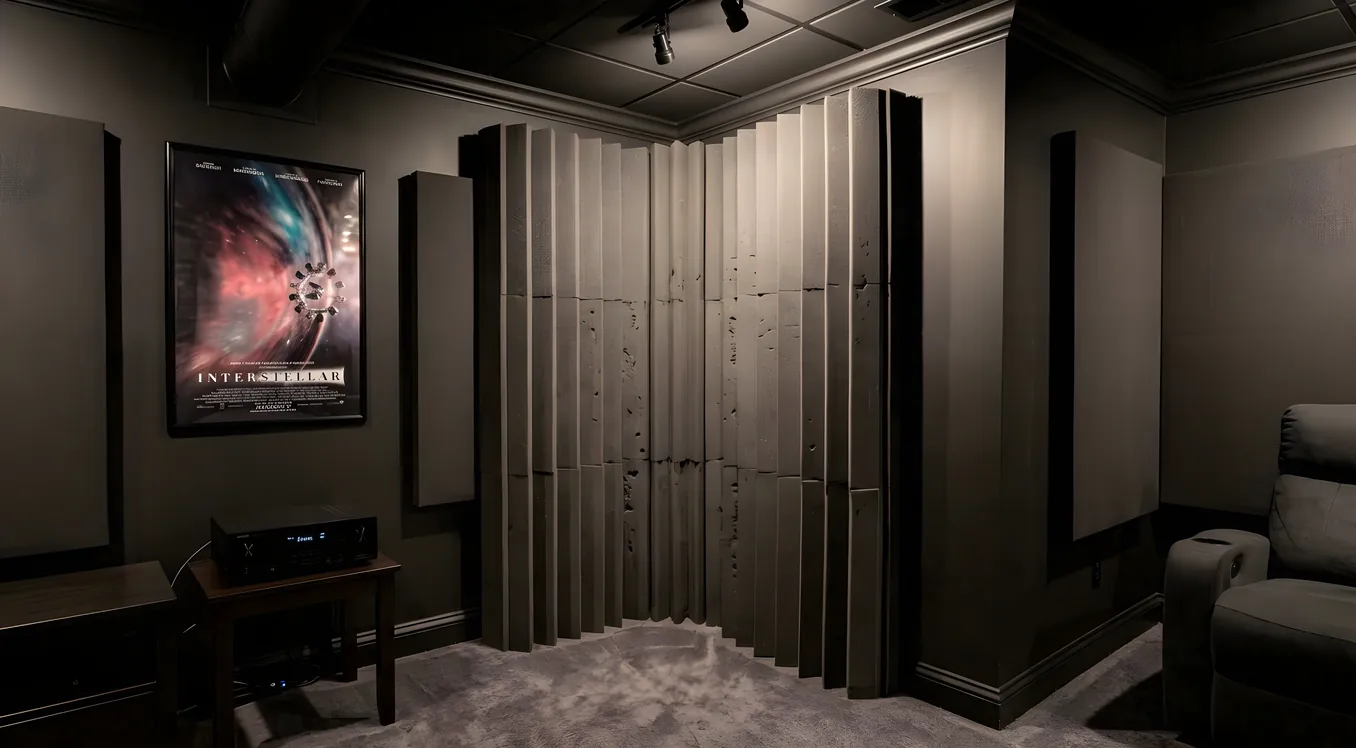
Bass is the hardest problem in home theater acoustics, and the reason comes down to physics. A 40 Hz tone has a wavelength of roughly 28 feet. A 60 Hz tone stretches about 19 feet. These waves are enormous relative to the room they’re playing in, and they behave nothing like the mid and high frequencies that standard acoustic panels handle well.
Thin foam or fabric-wrapped panels can absorb frequencies above 500 Hz without much trouble. But throw a 60 Hz bass note at a 2-inch panel and the wave passes right through it, bounces off the wall, and comes right back. To stop low-frequency energy, you need mass and depth, and you need to treat the right locations in the room.
Why Bass Accumulates in Corners
Room corners are pressure zones. When bass waves traveling along different axes of a room collide at a corner, they reinforce each other. The result is dramatically elevated low-frequency energy concentrated in those spots. This is called corner loading, and it explains why a subwoofer placed in a corner sounds louder and boomier than the same sub placed along a flat wall. The corner amplifies it.
The most powerful pressure zones are tri-corners: the places where two walls and a floor (or two walls and a ceiling) all meet at once. Bass energy accumulates there more intensely than in any two-surface corner. Your treatment plan should prioritize those eight tri-corners before anywhere else.
Understanding the fundamentals is easier if you’ve read our acoustics 101 overview, which covers how sound waves interact with surfaces and why room dimensions determine which frequencies become problematic.
Types of Bass Traps
Not all bass traps work the same way. The three main categories differ in how they absorb energy, how broad a frequency range they address, and how complex they are to build or buy.
Broadband chunk traps are the most practical option for most home theaters. These are thick sections of dense acoustic material, typically 4 to 8 inches of rigid fiberglass (like Owens Corning 703 or 703 HD) or mineral wool (like Rockwool Safe’n’Sound or Acoustic Mineral Wool 60). Unlike foam panels, these materials are dense enough to absorb wavelengths in the 80 to 300 Hz range with meaningful efficiency. Stack them deep enough (6 to 12 inches in a corner) and they’ll reach into the 60 to 80 Hz zone too, though very deep bass below 50 Hz is difficult to address with passive absorption alone without filling most of the room.
Membrane or panel traps work differently. Instead of absorbing energy through the material itself, they use a flexible panel that resonates at a tuned frequency, converting acoustic energy to heat through flexion. A membrane trap built to resonate at 80 Hz will absorb a narrow band around 80 Hz far more efficiently than a broadband chunk trap of the same size. The tradeoff: they’re frequency-specific. If your room has problems at 65 Hz and 110 Hz, you’d need separate membrane traps tuned to each frequency. This makes them a supplement to broadband treatment, not a replacement.
Helmholtz resonators work on the same tuned principle but use a different mechanism. An enclosed air cavity connected to the room through a port resonates at a frequency determined by the cavity size and port dimensions. Helmholtz resonators are best suited for very specific, severe room modes, and they’re typically found in professional or semi-professional installations rather than residential home theaters.
For most home theater builds, broadband chunk traps do the heavy lifting, with membrane traps added later to address stubborn peaks identified through measurement.
Commercial Options Worth Knowing
GIK Acoustics builds some of the most respected bass trap products in the enthusiast market. Their Monster Bass Trap is a stacked fiberglass panel system that ships in 2-inch sections and can be combined to reach 4, 6, or 8 inches of depth. Corner placement is the design intent, and GIK provides detailed instructions for building corner columns. The 244 Bass Trap is a slightly thinner option (4 inches) suited for wall placement or moderate corner treatment. For more aggressive treatment at the tri-corners, their Soffit Trap mounts into the corner junction and provides extremely dense coverage at the critical pressure zone.
These products are manufactured options, but the performance-per-dollar argument for DIY is compelling for anyone willing to put in the work.
DIY Bass Trap Construction
Building your own corner columns from rigid mineral wool or OC 703 is a well-established practice in the home theater community. The materials are available at most commercial insulation suppliers, and the construction is straightforward.
The basic approach is to cut 24x48-inch boards of OC 703 (2-inch thickness) and stack them 3 to 6 layers deep. Frame the stack with 1x4 lumber, wrap the assembly in breathable fabric (guilford of maine or similar), and stand the finished column in a tri-corner. A 6-inch-deep column using three layers of 2-inch OC 703 will provide meaningful absorption from roughly 80 Hz upward.
Rockwool-based columns work similarly. Safe’n’Sound or the denser Acoustic Mineral Wool 60 can be cut and stacked the same way. Some builders prefer Rockwool for its lower density variation and slightly better low-frequency reach per inch of material.
One practical note: standing columns work well at floor-to-ceiling tri-corners. For the upper corners where two walls meet the ceiling, hanging a wedge-shaped trap (a triangle in cross-section, with the point facing into the corner) provides better air-gap coverage than a flat panel pressed flat against the junction.
How Many Bass Traps You Actually Need
Four corner traps is the recognized starting point for a treated home theater room. This addresses the four floor-to-ceiling vertical corners, where two walls meet along their full height. For a typical 12x14-foot room, four substantial corner columns will reduce modal ringing and bass buildup noticeably compared to an untreated room.
Eight traps is the target for serious treatment: the four vertical corners plus the four upper tri-corners where the walls meet the ceiling. Treating those upper tri-corners addresses what broadband panels on the walls simply cannot reach. Room dimensions that create severe modal problems in the 60 to 100 Hz range sometimes require additional treatment across the full length of the front wall behind the screen, but for most rooms the eight-corner baseline is sufficient.
More treatment is not always better without measurement. Overtreating a small room can leave it feeling acoustically dead and introduce response irregularities of its own. This is why measurement comes before any final verdict on how much treatment is enough.
Measuring Results with REW
Room EQ Wizard (REW) is free software that, combined with a calibrated measurement microphone, allows you to visualize exactly which frequencies are elevated or ringing in your room. The UMIK-1 from miniDSP and the calibrated versions sold by Cross-Spectrum Labs are common choices.
The process: run a sweep tone through your system and REW generates a frequency response curve showing peaks and valleys across the audible spectrum. Ringing at 80 Hz shows up as a sustained decay in the spectrogram view. Treat the corners, run the sweep again, and compare. Effective bass traps will show reduced peak amplitude and faster decay time at problem frequencies.
Measurement also tells you what room correction tools can and cannot fix. EQ can tame a 6 dB peak at 80 Hz reasonably well. A 20 dB peak at the same frequency, or a severe null caused by destructive interference, is largely beyond what any DSP correction will solve without physical treatment first. Our room correction guide covers how to interpret REW results and where digital correction fits into the treatment workflow.
How Bass Traps and Subwoofer Placement Work Together
Bass trap placement and subwoofer positioning are connected problems. Your subwoofer placement choices determine which room modes get excited most aggressively, which in turn shapes where your treatment needs to work hardest. Placing a subwoofer at the midpoint of a wall (rather than in a corner) excites fewer modes. Combining better sub placement with corner treatment at the tri-corners typically produces better low-frequency response than either approach alone.
The goal is not to create a perfectly flat response in isolation. It’s to reduce the worst peaks and shorten the decay time of resonant modes so that your room correction software, if you’re using it, has a manageable starting point and your bass sounds clear rather than one-note and slow.
Getting Low Frequencies Right
Low-frequency acoustics rewards methodical work. Measure the room, treat the corners with substantial material, measure again, and adjust. The investment in four to eight corner columns, whether commercial or DIY, addresses the category of problem that no amount of electronic correction fully solves on its own. Getting the room to behave is the foundation everything else in the system builds on.