Home Theater Subwoofers: Size, Power, and Placement
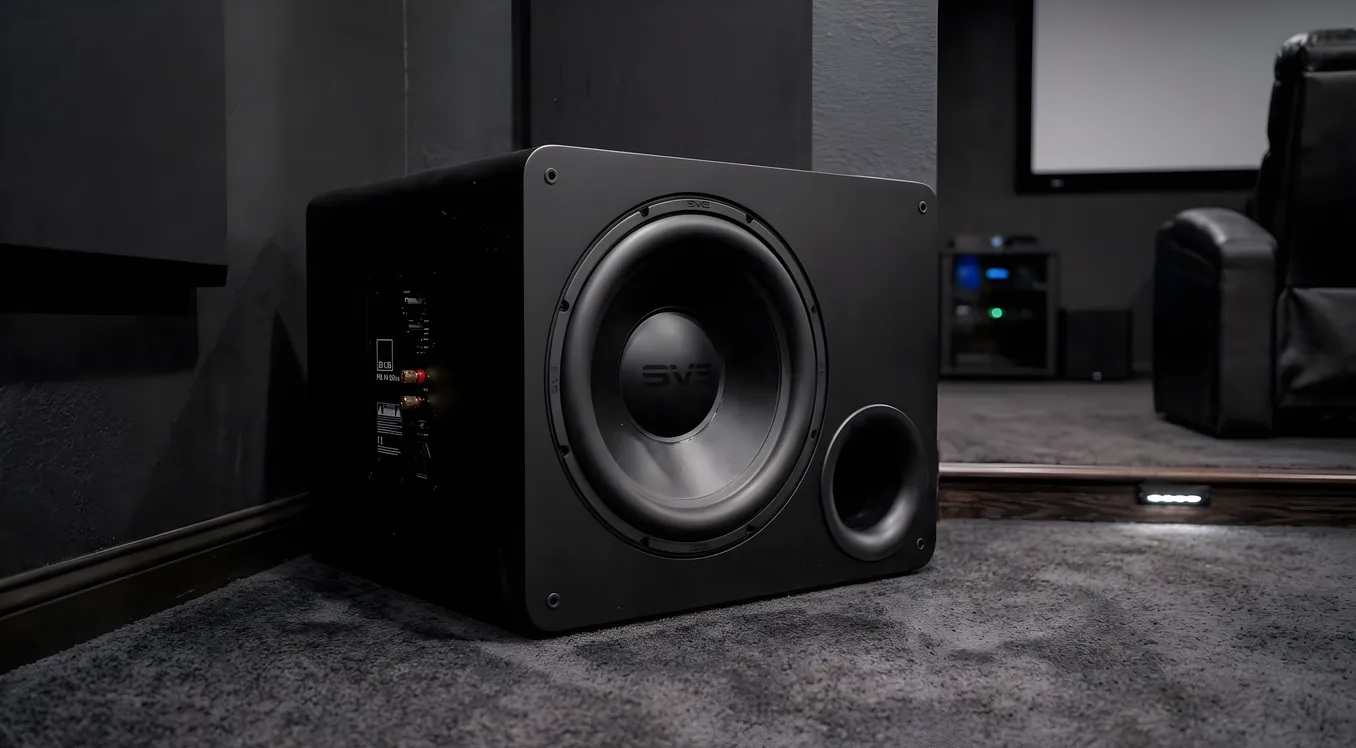
Bass is the part of a home theater system that most people feel before they consciously hear it. A well-matched subwoofer fills out the bottom end of a film’s soundtrack in a way that no full-range speaker can replicate without a dedicated woofer section. It also frees your main speakers to operate in their most accurate range, typically above 80 Hz, rather than straining to reproduce frequencies they were never designed to handle.
This guide covers everything that determines whether a subwoofer fits your room and system: driver size, cabinet design, amplifier output, frequency extension, placement strategy, and how to integrate the sub once it’s positioned.
Driver Sizes: What Each Range Delivers
Subwoofer driver diameter is the single biggest factor in how much air the driver moves, and air movement is what creates deep bass pressure. A larger driver can move more air per cycle without over-excursion, which is the technical way of saying it can reproduce low frequencies at higher volumes without distorting or bottoming out.
8-inch drivers suit smaller rooms, typically under 1,500 cubic feet, and secondary systems. They can reach 30 to 35 Hz with reasonable output, and their compact footprint makes them easy to place. At high playback levels or in larger rooms they will compress or distort, because there simply isn’t enough driver surface to move enough air. For a living room system or a dedicated two-channel music setup in a small space, an 8-inch sub from a quality manufacturer performs well within its limits.
10-inch drivers represent a practical step up in output capacity without a dramatic jump in cabinet size. Most 10-inch subs extend solidly to 25 to 30 Hz in ported designs and work well in rooms up to around 2,500 cubic feet. The SVS SB-1000 Pro and the Rythmik L12 are 10-inch subs that consistently appear in recommendations for this segment because they offer clean, controlled bass without the room-pressurizing output of larger drivers.
12-inch drivers are the most common choice for dedicated home theater rooms in the 2,000 to 4,000 cubic foot range. A well-designed 12-inch sub, properly positioned, can reproduce the full 20 to 120 Hz range that the LFE (Low Frequency Effects) channel carries in film soundtracks. This is where the catalog expands significantly. SVS, REL, HSU Research, and Rythmik all produce multiple 12-inch models at different price points.
15-inch drivers are serious tools for larger rooms or listeners who want reference-level output from a single sub. A single 15-inch sub can pressurize a room in ways that multiple smaller subs cannot. The SVS PB-3000 and PB-4000 are 15-inch ported designs that get recommended for large dedicated theaters, home cinemas, and situations where the listening position is far from the subwoofer. The tradeoff is cabinet size. A 15-inch ported sub is a large piece of furniture.
18-inch drivers are at the outer edge of consumer subwoofer design and into prosumer territory. They appear primarily in custom home theater builds where the room is large (5,000+ cubic feet) and the owner wants tactile bass reproduction at lower listening levels, or where the goal is truly extreme output. Most residential buyers do not need an 18-inch sub. For the rare application that calls for it, brands like PSA and HSU Research offer them at prices that reflect the engineering involved.
Cabinet Designs: Sealed, Ported, and Passive Radiator
The driver size tells you the potential. The cabinet design tells you how that potential is shaped into real-world frequency response, output, and character.
Sealed cabinets enclose the driver in an airtight box. The air pressure inside the box acts as a restoring force on the driver, which gives sealed subs a tighter, more controlled bass character. The frequency response rolls off at 12 dB per octave below the tuning point, which is a gentler slope than ported designs. Sealed subs also tend to behave more predictably in rooms with bass room modes, because they lack the port resonance that can interact with room problems. For music listening, sealed designs are widely preferred. They sacrifice some maximum output and deep extension compared to ported designs at the same driver and amplifier size, but they trade that output headroom for accuracy and transient speed.
Ported cabinets use a tuned port (a tube or slot in the cabinet) to couple the air volume inside the box to the external environment at specific frequencies. Below the port tuning frequency, the port contributes significant additional output. This means a ported sub of the same driver and amplifier size as a sealed design will typically play louder and reach lower in-room frequencies. The tradeoff is that below the port tuning frequency, the driver is essentially unloaded and can over-excur without warning. Ported subs also have a steeper roll-off below their tuning point, at 24 dB per octave, so very low extension comes at a cost in terms of protection requirements. For cinema playback with heavy LFE content, ported subs are the dominant choice.
Passive radiator designs use one or more passive cones (woofer cones with no motor, just a surround and spider) that radiate in response to internal cabinet pressure. They function acoustically like a ported design but without the port noise, chuffing at high volumes, or the slot or tube in the cabinet. Passive radiators allow ported-like output characteristics in a sealed-looking cabinet. The Rythmik F12 and several REL models use passive radiator designs to get the best characteristics of both approaches.
Amplifier Power: RMS, Peak, and What the Numbers Mean
Every sealed or ported subwoofer includes a built-in amplifier. The power figures printed in specifications require more interpretation than they appear to.
RMS power (Root Mean Square) is the continuous power the amplifier can deliver across the audio spectrum. This is the useful number. A 500W RMS amplifier genuinely delivers 500 watts continuously under measurement conditions. It represents the sustained performance of the amplifier.
Peak power is the maximum output the amplifier can achieve for brief transients, often one or two cycles of a bass note. Manufacturers who list only peak power (sometimes labeled “dynamic power” or “maximum power”) are presenting a flattering number that does not represent continuous capability. A “1,000W peak” amplifier may have an RMS output of 250 to 300W. This is not fraud, but it is optimistic specification practice. When comparing subs, look for RMS figures and compare those.
The relationship between watts and perceived loudness matters here. Every doubling of power yields an increase of approximately 3 dB in maximum output. To gain 10 dB of output (which is perceived as roughly twice as loud), you need 10 times the power. This is why a jump from 300W to 500W RMS is a meaningful improvement, but going from 500W to 600W is barely audible. Driver efficiency, cabinet volume, and tuning frequency all interact with amplifier power to determine real-world output. A 1,000W amplifier driving a poorly designed cabinet will underperform a 500W amplifier in a well-designed one.
Frequency Response and Extension: Reading the Specs
Subwoofer frequency response is typically specified with a reference point that determines how useful the number actually is. The most honest specification format is the -3 dB point, which indicates the frequency at which the sub’s output has rolled off by 3 dB from its reference level.
A sub rated to extend to 20 Hz at -3 dB means that at 20 Hz, output is 3 dB below the mid-bass reference. That’s a genuine 20 Hz extension. A sub rated to 20 Hz with no reference point may be measuring at -10 dB or even -20 dB, meaning actual output at 20 Hz is extremely weak. The difference between a sub that reaches 20 Hz at -3 dB and one that reaches it at -10 dB is audible.
What does 20 Hz extension actually mean in practice? The lowest audible frequency for most listeners is around 20 Hz. Cinematic LFE content regularly uses frequencies in the 18 to 25 Hz range for scenes involving explosions, impacts, and large mechanical systems. A sub that rolls off steeply above 25 Hz will not reproduce these sounds at adequate level. Instead, you’ll hear the midrange portion of those effects, but not the physical pressure that makes them feel real. A subwoofer with genuine deep extension reproduces these frequencies at output levels that cause the listening seat to vibrate slightly. That tactile element is not an accident. It’s the intended experience of cinema playback.
Matching Sub Size to Room Volume
Room volume is the starting point for sub sizing. These are rules of thumb rather than precise engineering formulas, because room shape, construction materials, furnishings, and placement all modify effective in-room response significantly.
- Under 1,500 cubic feet: a single 10-inch or 12-inch sealed or ported sub is typically sufficient
- 1,500 to 3,000 cubic feet: 12-inch to 15-inch, or a pair of 10-inch to 12-inch subs
- 3,000 to 5,000 cubic feet: 15-inch or 18-inch, or multiple 12-inch to 15-inch subs
- Over 5,000 cubic feet: multiple large subs are the only realistic path to even bass coverage
Rectangular rooms with hard surfaces reinforce bass at specific frequencies determined by room dimensions, creating peaks and nulls in the bass response at the listening position. These room modes don’t go away by adding a larger sub. They can be addressed through bass traps in corners and along boundaries, through room correction processing, or through using dual subwoofers that average out the modal distribution across the room.
The implication for sub sizing is that a smaller sub placed and tuned well in a well-treated room often outperforms a larger sub in an untreated one. Get placement and integration right before concluding that you need to upgrade driver size.
Placement: Corner Loading, Front Wall, and the Subwoofer Crawl
Bass frequencies are non-directional above approximately 80 Hz, but room modes create peaks and nulls that vary dramatically by position. Moving a sub six inches in a problem room can shift a 6 dB peak into a 4 dB null. Placement is not a secondary concern.
Corner loading refers to placing a subwoofer in a room corner, where two walls and the floor meet. A corner-loaded sub gets acoustic reinforcement from all three boundaries, which can add 6 to 9 dB of low-frequency output compared to free-space placement. This extra efficiency comes with a cost: corner placement reinforces room modes severely. If your room already has a strong 40 Hz mode, corner loading will exaggerate it further. Corner placement works best when the listening room has been treated to reduce modal peaks, or when room correction software can equalize the result.
Front wall placement puts the subwoofer along the same wall as the main speakers, typically between or flanking the left and right channel. This integrates well acoustically, because the bass arrival time is close to the main channel arrival time, which reduces phase problems. Many home theater integrators place subs in the front wall position as a default because it simplifies crossover and delay alignment.
The subwoofer crawl is a practical technique for finding the best placement in a real room without measurement equipment. Place the subwoofer at the primary listening position and play bass-heavy music or a test tone at the frequency range you want to optimize (typically 40 to 80 Hz). Then walk slowly around the room’s perimeter and along the front and side walls, listening for where the bass sounds fullest and most even. That location is where bass energy is most uniformly distributed. Place the sub there. It sounds counterintuitive to sit where the sub normally goes and walk where the sub normally sits, but the room has the same acoustic response regardless of which position holds the driver and which holds the ear.
Brands: Performance and Product Lines
The subwoofer market has a tier of direct-sale manufacturers who offer exceptional performance-per-dollar compared to retailer-sold brands.
SVS (Sound Vision Supply) sells direct and offers two primary cabinet types. The SB series (SB-1000 Pro through SB-4000) are sealed designs known for tight, accurate bass. The PB series (PB-1000 Pro through PB-4000) are ported designs with higher maximum output and deeper extension. The numbering loosely tracks driver size: 1000 series use 10 to 12-inch drivers, 2000 series use 12-inch, 3000 and 4000 series use 13-inch and 15-inch drivers. SVS publishes detailed specifications including -3 dB extension figures, which is why they appear so often in comparisons. All SVS subs include an iOS/Android app for adjusting crossover, phase, and EQ from the listening position.
REL Acoustics takes a different philosophy. REL subwoofers connect through both a high-level input (connected to your amplifier’s speaker terminals) and a low-level LFE input. The high-level connection allows the sub to receive the same signal as your main speakers, which REL argues produces better integration by matching the amp’s character and room correction processing. The T/i series (T/5i through T/9i) covers medium-sized rooms at attainable prices. The S series (S/510 through S/812) is the performance tier for larger rooms and more demanding systems. REL is a particular choice when music listening is as important as cinema, because of the high-level input approach.
HSU Research is a Southern California direct-sale manufacturer with an engineering focus and competitive pricing. Their ULS-15 Mk2 is a dual-driver sealed design that consistently outperforms its price in independent measurements. HSU allows customers to purchase a sealed-only or ported version of the same cabinet, a practical way to match cabinet type to listening preference without buying an entirely different sub.
Rythmik Audio is a smaller direct-sale manufacturer that produces extended throw servo-controlled woofers, a design that uses feedback to correct driver position errors in real time. The F12, F12G, and FV15HP are frequently referenced in enthusiast communities because the servo feedback approach reduces distortion at high output levels more effectively than conventional designs at equivalent price points.
Monolith by Monoprice occupies the value tier for larger driver subs. The Monolith 15-inch THX-certified subwoofer offers verified output at a price substantially below comparable competitors. The THX certification requires the sub to meet specific output and distortion benchmarks, which makes it a more meaningful specification than typical marketing claims.
Music vs. Movies: Matching Sub Design to Listening Priority
The sealed versus ported question maps directly onto the music versus movies question for most buyers.
Sealed subs are faster in the sense that they have better transient response, meaning a bass drum hit starts and stops cleanly rather than ringing or blooming after the initial impact. Music reproduction rewards this accuracy because the timing relationships between bass notes and the rest of the frequency spectrum matter perceptually. Sealed subs also tend to integrate better with main speakers at higher crossover frequencies (100 to 120 Hz), because their gradual roll-off avoids abrupt transitions.
Ported subs trade some of that transient precision for output capability and deeper measured extension. For cinematic content, which prioritizes output level and deep extension over precise timing, this is often the right tradeoff. An action film’s LFE channel is not asking for the same thing as a jazz recording’s upright bass. If home theater is the primary use case and music is secondary, a ported sub is the conventional choice.
If you listen seriously to both music and films, a sealed sub from the upper portion of a manufacturer’s range often serves both better than a ported sub from the lower portion. The sealed design’s accuracy benefits music, and a high-quality sealed sub at adequate power has sufficient output for cinema.
Integration: Crossover, Phase, and Gain
Adding a subwoofer creates an acoustic division of labor between the sub and the main speakers. Making that handoff smooth requires setting three parameters correctly.
Crossover frequency is the point where the subwoofer takes over from the main speakers. The most common starting point is 80 Hz, which is the THX specification and a reasonable default for most systems. Speakers that roll off above 80 Hz (many compact bookshelf models) benefit from a higher crossover, typically 100 to 120 Hz. Full-range tower speakers may integrate better at 60 to 80 Hz. The crossover setting on your AV receiver or processor handles the high-pass filtering of the main speakers and the low-pass filtering of the sub simultaneously when you set speaker size to “small” in the receiver’s speaker management.
Phase alignment is the one adjustment that most people skip and that causes the most integration problems. When the sub and mains are producing overlapping frequencies near the crossover point, they add together or cancel depending on their relative phase. Most subs offer a 0/180 degree phase switch and some offer continuous phase control from 0 to 360 degrees. Set the sub to whatever phase setting produces the most bass in the listening position at the crossover frequency. Playing a test tone at the crossover frequency and switching between phase settings while listening will make the difference immediately apparent: one setting sounds thin, the other sounds full. Choose the fuller one.
Gain matching means setting the subwoofer’s volume to blend with the main speakers at the listening position rather than to dominate or disappear. Room correction software such as those available through room correction systems can set this automatically with a calibration microphone. If setting manually, use the AV receiver’s reference level calibration tones and match the subwoofer’s output to the receiver’s target level (typically 75 dB SPL measured at the listening position with a calibrated SPL meter). Erring too high makes bass heavy and fatiguing. Erring too low wastes the subwoofer’s capability.
Getting the Foundation Right
A subwoofer is the part of a home theater system that most directly determines whether the room sounds like a theater or a living room with a big screen. Driver size, cabinet design, and amplifier power establish the ceiling on what’s possible. Placement and integration determine how much of that ceiling you actually reach in your specific room.
The common mistake is purchasing the largest or most powerful sub available and then doing minimal placement and integration work. A 12-inch sealed sub from SVS or Rythmik, positioned with the subwoofer crawl method and integrated with a calibration tone at 80 Hz, will outperform an 18-inch ported design dropped in a corner and left at default gain settings. The physics are in the details, not just the specs.
Start with a sub sized for your room’s cubic footage, match the cabinet design to your primary listening content, and treat the placement and integration phases with the same care as the purchase decision.