Dual Subwoofers: Why Two Subs Sound Better Than One
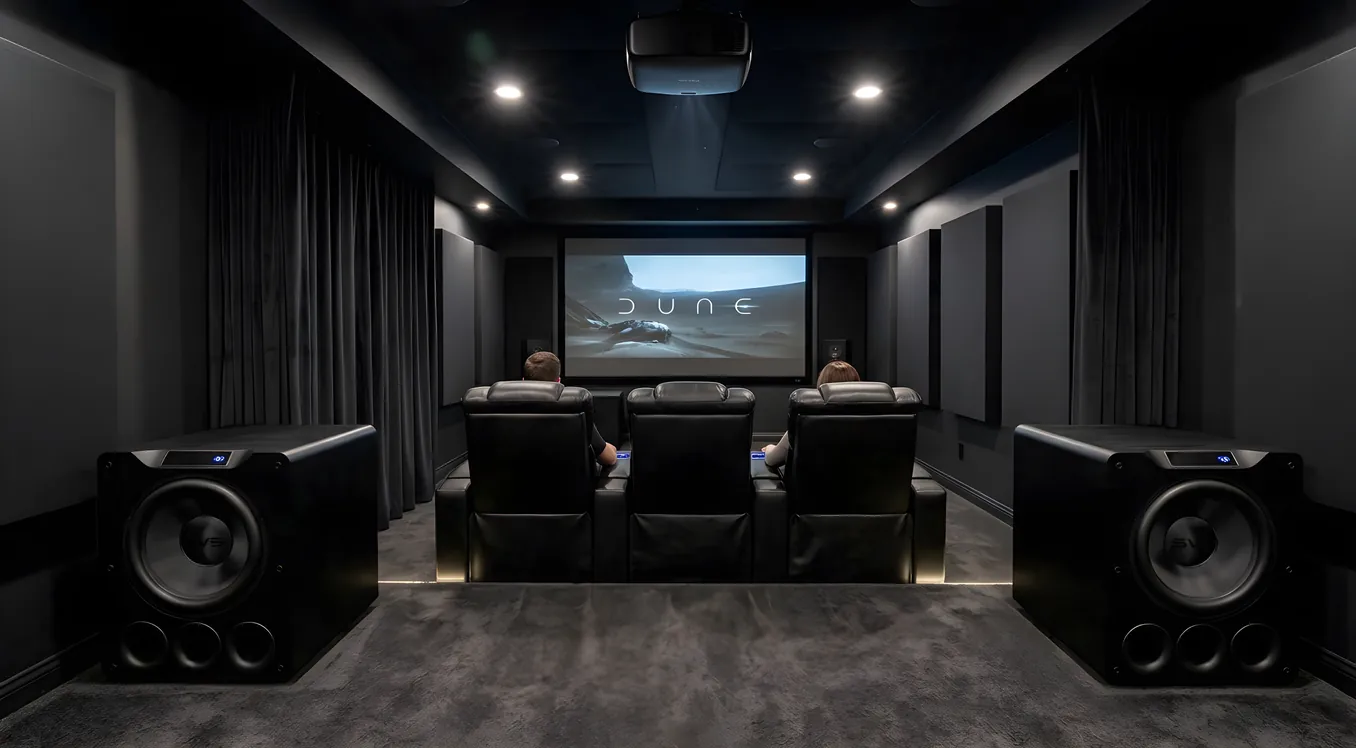
One subwoofer puts bass in your room. Two subwoofers distribute bass evenly across your room. That distinction sounds simple, but the practical difference between them is significant enough that it’s changed how most serious home theater builders think about bass.
The argument for a dual subwoofer setup isn’t about volume or raw output. It’s about the physics of how low-frequency sound behaves in a rectangular room, and why placing a single driver in one location makes that problem worse rather than better.
Room Modes and Why One Sub Always Loses
Every room has resonant frequencies determined by its dimensions. At those frequencies, bass waves reinforce themselves at certain points (pressure peaks) and cancel each other at others (nulls). These are called room modes, and they’re unavoidable in any enclosed space.
In a typical 12 by 20 foot room, the axial mode along the 20-foot dimension falls around 28 Hz. At that frequency, bass energy piles up at the front and rear walls while nearly disappearing at the midpoint. A single subwoofer placed in a corner at the front wall excites these modes with maximum efficiency. The person in the front row hears boomy, exaggerated bass. The person in the middle hears almost nothing at certain frequencies. The person in the back wall hears something different again.
Room correction software (covered in more depth at room correction systems) can reduce the severity of peaks, but it can’t restore energy at true nulls. You can’t EQ your way out of a null. The subwoofer has to be producing energy at that location for correction to have anything to work with.
Two subwoofers positioned correctly generate two different sets of room modes. Those modes partially cancel each other’s peaks and fill each other’s nulls. The result is a smoother frequency response at more listening positions with less reliance on correction filters to do the heavy lifting.
The Harman Research Case
Harman International’s researcher Dr. Todd Welti published work in the early 2000s that has since become the standard reference on subwoofer placement and quantity. Welti’s analysis of room mode behavior showed that a single subwoofer positioned at one wall excites modes in a largely predictable and unfavorable pattern. Two subwoofers placed on opposing walls, or at the midpoints of opposing walls, produce a much more uniform low-frequency response across the listening area.
Welti’s simulations and measurements quantified this: moving from one subwoofer to two typically reduces seat-to-seat variation in bass response by 6 to 12 dB depending on room geometry. Moving from two to four reduces it further, but the gains diminish sharply. Four subwoofers performed better than two in Welti’s models, but two performed dramatically better than one. For most home theaters, the two-sub configuration is where the cost-to-benefit ratio peaks.
The implication is practical. In a five- or seven-seat theater, a single subwoofer will never produce consistent bass across all seats regardless of how good it is or how sophisticated the DSP correction. Two subs, placed strategically, fundamentally change the modal pattern rather than trying to compensate for a bad one.
Placement Strategies That Actually Work
The goal of any dual subwoofer placement is to excite room modes in a pattern that averages out well at the primary listening positions. Four configurations are worth knowing.
Opposing walls (front and rear): Place one sub on the front wall and one centered on the rear wall. This is the most common two-sub arrangement and works well in rooms with a defined front screen wall and a back wall behind the seating. It directly addresses the strongest axial mode along the room’s length.
Midpoints of opposing walls: Place each sub at the midpoint of one of the two long side walls. This arrangement targets lateral modes rather than front-to-back modes and tends to produce particularly good uniformity for multiple rows of seating. It’s less common because cable runs can be inconvenient, but the acoustic results are often excellent.
Front wall asymmetric: Both subs on the front wall, positioned off-center at one-third and two-thirds of the wall width. This is the easiest arrangement to implement in a room where rear placement isn’t practical. It won’t address front-to-rear modes as effectively as opposing-wall placement, but it’s still meaningfully better than a single sub in a corner.
Diagonal: One sub in a front corner, one in the diagonally opposite rear corner. This position excites multiple modal axes simultaneously and often produces reasonable uniformity without requiring the subs to be centered on their walls. It’s a pragmatic choice when room layout constrains placement options.
For a deeper look at how room geometry affects bass, the acoustics 101 guide explains pressure zones, corner loading, and first-reflection treatment.
Two Smaller Subs vs. One Larger Sub
The cost comparison here is closer than most people expect. A pair of SVS SB-2000 Pro subwoofers retails around $1,100 combined. A single SVS SB-3000 retails around $900. The pair costs more, but it’s not a dramatic gap, and you’re getting better in-room performance for the premium.
The two smaller subs will also produce more total output (more combined driver area and amplifier power) while solving the room mode problem that the single larger sub cannot. The SB-3000 is a more capable subwoofer than either SB-2000 Pro alone. But two SB-2000 Pros in opposing positions will outperform the SB-3000 for most listeners in most rooms, not because each driver is better, but because the mode distribution is better.
This changes the math on subwoofer shopping. If your budget is $1,000 to $1,500, the right question isn’t “what’s the best single sub at this price?” It’s “what pair of subs fits this budget, and where can I place them?”
Two matched compact sealed subs also offer more placement flexibility than one large ported sub. A sealed 12-inch enclosure is genuinely easier to position in a room corner or against a wall than a large ported sub that needs clearance from the wall for the port to breathe properly.
Matching Matters: Identical Pairs vs. Mismatched Units
The conventional advice to use identical subwoofers is correct, and the reasons are worth understanding rather than just accepting.
Two subs with the same driver size, amplifier, and enclosure tuning have matched frequency response curves. When you set them to the same gain and the same phase angle, they combine predictably. The modal benefits of dual placement add together cleanly.
Mismatched subwoofers introduce variables. Different low-frequency rolloff slopes mean the two subs are emphasizing different parts of the bass range. One may peak around 60 Hz while the other peaks around 45 Hz. Those peaks and the phase relationships between them become difficult to manage with standard AVR controls. Room correction software can address some of this, but it’s compensating for a problem you created rather than working from a clean baseline.
The practical exception is upgrading an existing setup. If you already own one subwoofer and want to add a second without replacing both, adding a unit from the same manufacturer and the same product line is better than mixing brands. If the two units are within one product tier of each other, room correction can usually handle the alignment. Mixing a budget sub from one brand with a high-end unit from another creates more problems than it solves.
Configuration: AVR Outputs, Phase, and Room Correction
Most modern AV receivers have two dedicated subwoofer output jacks labeled Sub 1 and Sub 2. Connect one subwoofer to each output. Both outputs carry the same LFE signal by default on Dolby Atmos and DTS:X content, and both carry the bass redirected from small satellites in a standard surround setup.
Set the gain (volume) on each subwoofer using your receiver’s calibration system first, then fine-tune by ear if needed. The goal is to match the two subs so they’re contributing equally to the low-frequency field. An SPL meter or a calibration mic (if your AVR supports room correction) makes this more precise than guessing.
Phase alignment between the two subs is where most of the work happens. If the subs are on opposing walls, they’re physically out of phase with each other relative to the listening position. Most modern room correction systems (Audyssey MultEQ XT32, Dirac Live, YPAO) handle this automatically during calibration, measuring the arrival time and phase from each sub and adjusting delays accordingly. If you’re running the subs without room correction, set one sub’s phase dial to 0 and the other to 180 degrees as a starting point, then adjust until you hear the fullest bass at the primary listening seat.
Run room correction with both subs active and in their final positions. The calibration is measuring the combined output of the system, not the individual subs. Moving a sub after calibration means running calibration again.
Real Cost of Going Dual
Budget $500 to $800 per subwoofer for a quality sealed or ported unit that performs well in a dedicated listening room. That puts a matching pair at $1,000 to $1,600. For comparison, a single subwoofer at that performance tier runs $1,000 to $1,500 for a 13- or 15-inch driver with a 500 to 1,000-watt amplifier.
The additional cost of going dual is roughly $100 to $500 over a single high-performance sub, depending on which models you compare. That’s a reasonable premium for the acoustic benefits. At the budget end of the market, two $300 subs will outperform one $600 sub in a multi-seat room for the same reasons the physics work at every price tier.
Factor in cable runs if the second sub is going to a rear or side-wall location. A 25- to 30-foot RCA cable from the AVR to a rear-wall sub costs $20 to $40 and runs easily along a baseboard. It’s not a meaningful barrier.
What you get for the additional spend is consistent bass at every seat, reduced reliance on EQ correction to compensate for modal problems, and the option to cross each sub over slightly higher since the combined output handles headroom more easily. For a room with more than two seats, this is the right investment to make before spending on room treatments or an upgraded single sub.
Getting the Most from a Dual Setup
Running two matched subwoofers in well-chosen positions is the single highest-leverage acoustic improvement available in most home theaters, ahead of room treatment and well ahead of upgrading amplifiers or cables.
The setup process rewards patience. Place the subs, run calibration, listen to familiar content, then adjust phase and gain if the bass feels uneven across seats. Most dual setups take two or three calibration passes to dial in properly. The subwoofers guide covers crossover settings, driver types, and sealed vs. ported design tradeoffs that apply to both single and dual configurations.
Once both subs are calibrated and positioned, the difference compared to a single sub is audible from every seat, not just the sweet spot.