Dolby Atmos Explained: How Object-Based Audio Changes Home Theater
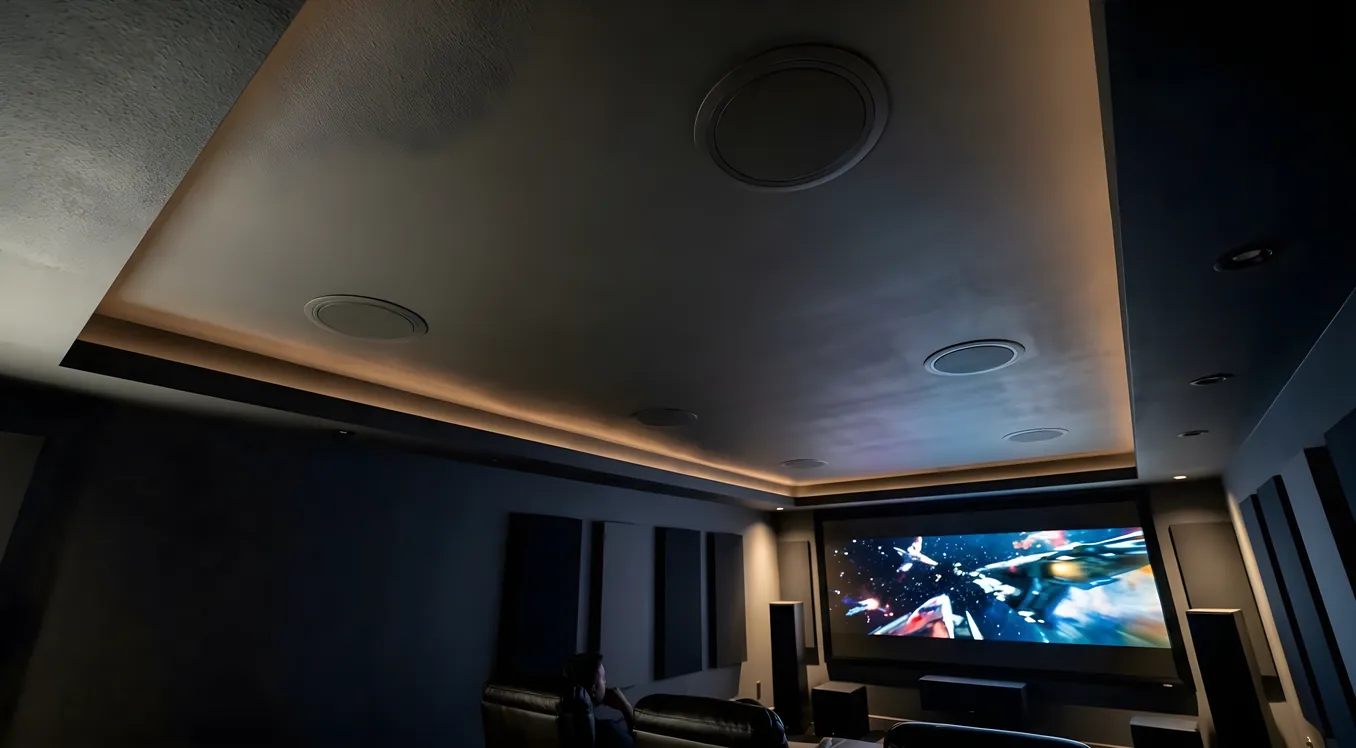
Dolby Atmos home theater systems produce sound that moves through three-dimensional space rather than snapping between fixed channels. That single shift changes how movies, music, and games are mixed, how speakers are placed, and which receivers you need to buy. Here’s what the technology actually does and how to implement it correctly.
Channel-Based vs. Object-Based Audio
Every surround sound format before Atmos assigned sound to a specific speaker channel. A Dolby Digital 5.1 mix tells your center channel to play dialogue, your left surround to play a passing car, your subwoofer to play explosions. The mixer works against a fixed map of six channels (or eight in 7.1), and the receiver reproduces that map faithfully.
The problem with channel-based audio is that it doesn’t translate across different speaker configurations. A 5.1 mix played back on a 7.1 system either ignores the extra speakers or uses upmixing algorithms that guess at how to fill them. There’s no authorial intent behind the additional channels.
Atmos changes the authoring model. A sound designer places audio events as objects with positional metadata (X, Y, Z coordinates in a 3D space) rather than assigning them to channels. When your Atmos processor decodes the stream, it calculates which physical speakers in your actual room should reproduce each object at any given moment. A helicopter passes overhead because the metadata describes its arc across the ceiling, not because a specific channel was panned.
This approach has two practical consequences. First, an Atmos mix sounds more precise and immersive than a channel-based mix of equivalent quality. Second, the same Atmos master renders accurately on a 5.1.2 system and a 9.1.6 system, because the renderer adapts to the speaker layout it detects. The mixer doesn’t author different versions for different configurations.
Bed Channels and Objects: The Atmos Architecture
An Atmos stream consists of two layers. The first is a bed of up to 9.1 channels (seven surround channels, one LFE/subwoofer, and overhead channels treated as a group). The bed handles ambient material that should envelope the room consistently, like crowd noise, reverb tails, and environmental atmosphere.
On top of the bed, Atmos supports up to 128 simultaneous audio objects in theatrical mixes and up to 24 objects in the home Blu-ray and streaming implementation. Each object carries its own audio waveform plus the positional and size metadata the renderer uses to place it. A rain effect might spread across the entire ceiling as a large, diffuse object. A single gunshot might be a precise, point-source object that tracks through a specific quadrant.
The renderer in your AVR combines the bed and objects against the speaker array it knows about. If you have in-ceiling height speakers at 45-degree front and rear positions, the renderer can produce convincing overhead localization. If you’re using Atmos-enabled upfiring modules (discussed below), the renderer accounts for the physics of reflected sound instead.
Speaker Configurations
Atmos configurations follow a three-number format: bed speakers, subwoofers, and height speakers. The bed count uses the same 5.1 or 7.1 convention you already know.
5.1.2 places two height speakers above the front left and right positions. This is the entry point for Atmos and produces a noticeable improvement in overhead imaging compared to a flat 5.1 system. With only two height channels, the renderer has limited resolution for objects moving front-to-back across the ceiling.
5.1.4 adds two rear height speakers, giving the renderer four height positions to work with. Front-to-back overhead movement becomes accurate, and objects that pass completely overhead can be tracked along their full path. This is considered the minimum configuration for taking full advantage of Atmos-encoded content.
7.1.4 extends the bed to seven channels with dedicated left-center-right surround and side surround positions, plus four height speakers. The improvement in surround envelopment is substantial. This configuration matches the capability of the Denon AVR-X3800H, which processes 11.4 channels simultaneously (7 bed + 4 height plus two subwoofer outputs). Most serious Atmos installations settle here.
7.2.4 indicates dual subwoofers in the configuration. Two subwoofers placed at different room positions reduce bass nulls caused by room acoustics, producing tighter and more even bass response across the listening area. This is the practical ceiling for mid-tier receivers.
9.1.6 requires a higher-end processor and amplification for the additional nine bed channels and six height positions. The Marantz Cinema 40 handles 7.2.6 processing (seven bed channels, six height positions, two subwoofer outputs), and the Anthem MRX 1140 processes up to 11 channels with its onboard amplification, supporting 9.1.4 and similar configurations when paired with external amplifiers.
For most rooms and most listeners, 7.1.4 is the point of diminishing returns. Height channel count matters more than bed channel count for the Atmos rendering difference specifically.
Height Channel Options
Three physical implementations exist for height channels, and they perform very differently.
In-ceiling speakers are the correct approach. Installed directly overhead and angled toward the primary listening position, they reproduce height objects as genuine overhead sound sources. The Dolby speaker placement guide specifies mounting height, dispersion angle, and distance ratios relative to listening position for each configuration (see our Atmos speaker placement guide for specifics). In-ceiling speakers require fishing speaker wire through walls and ceiling, which is the only real downside. The performance advantage over the alternatives is significant enough that they’re worth planning for in new construction or major renovation.
Atmos-enabled upfiring modules sit on top of your front left/right speakers and fire sound toward the ceiling, which reflects it back down to simulate overhead sources. They work on the physics principle that the reflection arrives at your ears with a slight delay and from a different angle than direct sound, which the auditory system sometimes interprets as height. The practical result varies considerably with ceiling height, ceiling material, and ceiling angle. Flat ceilings at 8 to 9 feet produce the best results. Vaulted ceilings, textured ceilings, and open-plan spaces with obstructions perform poorly. Upfiring modules are a reasonable compromise for renters or situations where in-ceiling installation is impossible. They are not a direct equivalent.
On-wall height speakers mount high on the front wall, typically above the main left and right speakers. This is a compromise between the two options above. The height impression is better than upfiring modules because the speaker is an actual distinct source separated from the main speaker, but worse than in-ceiling because the sound comes from the wall plane rather than from above.
Content Availability
Atmos content requires an Atmos-encoded source and a decoder in your signal chain.
4K Blu-ray is the highest-quality Atmos source format. Discs carry Dolby TrueHD with Atmos object metadata embedded in the stream. Bitrates reach 18 Mbps or higher, and the lossless TrueHD core means the bed channels are bit-perfect with the studio master. Every major Hollywood studio releases new titles with Atmos on 4K Blu-ray. The disc stays the reference format for audio quality, regardless of what streaming services offer.
Netflix encodes Atmos in Dolby Digital Plus (DD+) rather than TrueHD. DD+ Atmos is a lossy format, typically encoded at 768 kbps for Atmos titles. At high bitrates, DD+ Atmos sounds excellent for streaming, but it doesn’t match the quality ceiling of TrueHD. Netflix Atmos requires a 4K UHD subscription tier and a compatible device. Not all Netflix titles available in 4K carry Atmos tracks.
Disney+ and Apple TV+ both deliver Atmos content at DD+ bitrates comparable to Netflix. Apple TV+ in particular has a strong Atmos library and has been aggressive about Atmos availability across its original programming. Both services require Atmos-capable streaming hardware: Apple TV 4K, NVIDIA Shield Pro, and Amazon Fire TV Stick 4K Max are the most common options that pass Atmos audio correctly to an AVR.
Tidal pioneered lossless and Atmos streaming for music. Tidal’s “Dolby Atmos Music” tracks are a distinct authoring format from Atmos for film. They are streamed at CD-quality lossless rates with Atmos spatial metadata rather than movie-style surround object panning. Dolby Atmos Music on Tidal requires a compatible device that outputs Atmos: the Apple TV 4K with Apple Music Atmos or Tidal, supported Fire TV devices, and selected Android hardware.
Gaming support for Atmos is available via Xbox (Series X and Series S support Atmos natively in supported titles) and PC gaming with a Dolby Atmos for Gaming subscription. PlayStation 5 does not currently support Dolby Atmos natively, instead offering Sony’s Tempest spatial audio system. For a full comparison with competing immersive audio formats, see our coverage of DTS:X.
Receiver Requirements
Atmos decoding requires a receiver or processor that includes the Atmos rendering engine. Any AVR marketed as “Dolby Atmos compatible” includes the renderer, but the number of channels the receiver can drive simultaneously determines which speaker configurations you can actually use.
The Denon AVR-X3800H processes 11.4 channels: eleven amplifier channels onboard plus four subwoofer outputs. This supports 7.1.4 and equivalent configurations without an external amplifier. HDMI 2.1 inputs allow 4K/120Hz passthrough for gaming. At its price point it represents the most capable discrete implementation for a 7.1.4 system without moving to pre/pro territory.
The Marantz Cinema 40 handles 7.2.6 processing natively, making it one of the few AVRs that supports six height channels to a full 7.2.6 configuration. Marantz and Denon share the same HDAM amplifier topology and Audyssey MultEQ XT32 room correction, so the sonic character is similar. The Cinema 40 is the right choice if a 7.2.6 configuration is your target and you want to avoid separates.
The Anthem MRX 1140 processes 11 channels and pairs those with Anthem Room Correction (ARC Genesis), which is widely regarded as among the best automated room correction systems available at any price. The MRX 1140 handles a 9.1.4 system internally and supports external amplification for additional channels. The premium is in the room correction and build quality, not in Atmos decoding specifically. Anthem also targets a less compressed, more neutral house sound than Denon or Marantz.
For a comprehensive review of receiver options across price points and channel configurations, see our AV receivers guide. For configuration context with different room sizes and seating positions, the surround sound configurations guide covers how speaker layouts translate to specific rooms.
Atmos Music vs. Atmos for Movies
The Dolby Atmos brand covers two genuinely different use cases that share a rendering engine but are authored for different purposes.
Atmos for film places sound in three-dimensional space around a listener at a fixed point. The reference point is a theater seat or a home listening chair. Sound objects move through the room, come from overhead, pass behind the listener. The spatial language is cinematic and directional.
Atmos Music takes a different approach. Rather than placing instruments in a simulated concert hall, Atmos Music engineers typically use height and width to create a sense of immersion that doesn’t correspond to any physical venue. Instruments may appear to surround the listener or occupy the space above without any attempt to simulate a realistic acoustic environment. The format is as much about mood and texture as about positioning.
Atmos Music on headphones (delivered via Apple Music’s spatial audio, Tidal, or Amazon Music HD) uses binaural rendering to simulate the speaker experience through two-channel headphone output. The Apple AirPods Pro and AirPods Max support dynamic head tracking, which rotates the soundfield as your head moves to maintain the impression that sound sources are stationary in space rather than moving with you. This produces a different and sometimes more convincing spatial effect than static binaural.
On a speaker system, Atmos Music plays through your full speaker array the same way a film Atmos track does. The quality difference between a well-mixed Atmos Music album on Tidal and a standard stereo version of the same album is audible and substantial on a 7.1.4 or larger system. The format is still maturing; catalog depth on any service remains limited compared to standard stereo.
Making the Right Atmos Decision
Atmos delivers its full benefit in a 5.1.4 or larger configuration with in-ceiling height speakers and a receiver capable of decoding the full channel count from a 4K Blu-ray source. Below that minimum, the returns diminish. Two upfiring modules on a 5.1 system produce some overhead sense but not the precise object tracking that distinguishes Atmos from conventional surround.
The budget priority order for a new Atmos installation: subwoofer and main speakers first, receiver second, height speaker implementation last. A correctly tuned 5.1 system with great main speakers beats a 7.1.4 system with mediocre ones. Add height channels when you have physical installation access and budget for in-ceiling speakers specifically.
If you’re planning speaker placement for an Atmos installation, the Atmos speaker placement guide covers Dolby’s published reference angles and the practical adjustments most rooms require.