Home Theater Speaker Types: Towers, Bookshelf, In-Wall, In-Ceiling
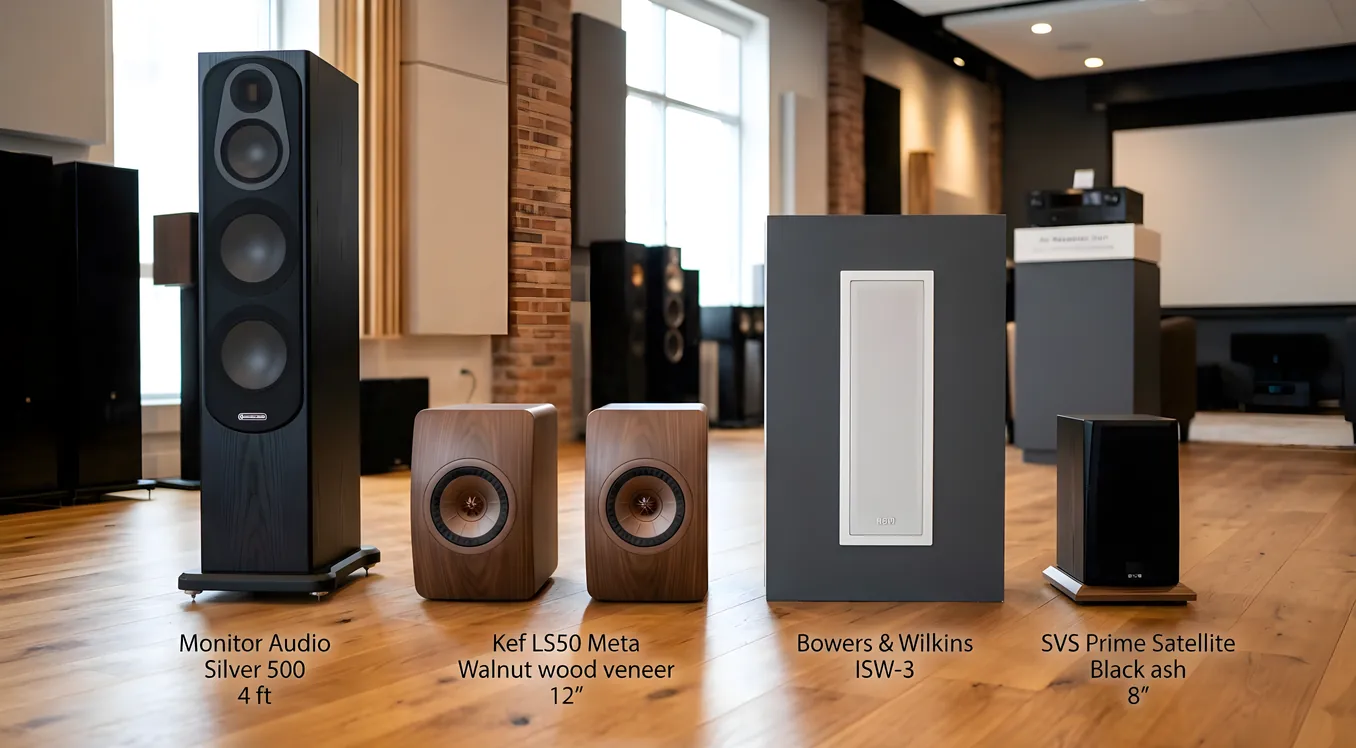
Home theater speaker types fall into five main categories: tower (floorstanding), bookshelf (stand-mount), in-wall, in-ceiling, and soundbar. Each has a distinct physical form, installation method, and set of acoustic tradeoffs. Choosing the right type is partly about sound performance and partly about room constraints, budget, and how permanent you want the installation to be.
This guide covers how each type works, what it does well, where it falls short, and how to match speakers across your system so the combined result holds together.
Tower Speakers: Output, Bass Extension, and Sensitivity
Tower speakers, also called floorstanding speakers, stand directly on the floor without stands or mounts. They’re tall, typically 36 to 55 inches, and house multiple drivers in a single enclosure: a woofer or multiple woofers for bass, a midrange driver, and a tweeter. Some designs add a separate subwoofer chamber integrated into the cabinet.
The acoustic advantage of a tower speaker is straightforward. Larger cabinet volume allows longer, deeper bass extension without requiring a separate subwoofer. A tower rated to 35 Hz in-room can fill a typical home theater with natural bass from music and moderate movie effects without help. For cinematic low-frequency impact below 30 Hz, like the bass in large action sequences, you still want a dedicated subwoofer. However, towers relieve the subwoofer of crossover duties above 40 to 80 Hz, giving the subwoofer less work to do and often producing tighter, more accurate bass overall.
Sensitivity is the other major tower advantage. Sensitivity measures how loud a speaker plays per watt of amplifier power (expressed in dB at 1 meter with 1 watt input). Towers typically range from 89 to 99 dB sensitivity. Higher sensitivity means a receiver with modest power reserves can drive the speaker to reference levels. The Klipsch Reference Premiere line is a good example: the RP-8000F measures around 98 dB sensitivity, meaning it plays loud with relatively little power and pairs well with mid-grade receivers rather than demanding a high-powered amplifier. The KEF R11, the SVS Ultra Tower, and the Paradigm Founder 100F sit in the 89 to 92 dB range with more neutral tonal balance, requiring more amplifier headroom but offering tighter, more accurate imaging.
The main liabilities of towers are space and cost. Towers require floor area in front of the wall (typically 10 to 18 inches of clearance from the back wall for optimal placement), and they’re visually prominent. In a dedicated theater room they’re unremarkable; in a living room shared with furniture, a partner with opinions, or both, they’re often a sticking point.
For left and right main channels, towers are the default choice when the room allows. The physics favor them. For surround channels, towers are oversized for the job and impractical to place correctly at most seating positions. That’s where other speaker types take over.
Bookshelf and Stand-Mount Speakers: Versatility and Imaging
The term “bookshelf speaker” is somewhat misleading. The category includes speakers sized to sit on a shelf (roughly 6 to 13 inches tall), but the best performers in this group are stand-mounted at ear height rather than placed on shelves where boundary reflections and restricted airflow color the sound.
Bookshelf speakers house one or two drivers: a tweeter and a mid-bass woofer, sometimes with a port on the rear or bottom for additional bass extension. Cabinet volume is limited, which restricts deep bass. A typical bookshelf speaker rolls off around 50 to 80 Hz, compared to 35 to 40 Hz for a good tower. This means either crossing over to a subwoofer at a higher frequency or accepting less bass weight in the system.
Where bookshelf speakers earn their place is imaging and placement flexibility. A small two-way enclosure, well-designed, can produce extremely precise stereo imaging. The KEF LS50 Meta is a frequently cited example: a compact standmount that many listeners prefer over floor-standing alternatives twice the price for stereo music listening, partly because its coaxial driver arrangement (tweeter centered in the woofer cone) creates a coherent point source. The DALI Oberon 1 and Monitor Audio Silver 100 serve the same function at more accessible price points. The ELAC Debut B6.2 sits below all of them in price while delivering honest, full-range (for its size) performance.
For home theater, bookshelf speakers work well in several specific roles. As surrounds in a 5.1 or 7.1 system, stand-mounted at ear height beside or slightly behind the listening position, they produce diffuse, enveloping sound with less localization than directional in-ceiling options. As front left and right speakers in smaller rooms where floor space is genuinely limited, they pair with a subwoofer (or two) to fill the bass range. As height channels in Dolby Atmos or DTS:X setups when in-ceiling mounting is not possible, angled upward from stands behind or beside the listening position, they serve as an Atmos alternative (though with compromises compared to true ceiling placement; see Atmos speaker placement for specifics).
The tradeoff for using bookshelves as front channels is bass management. Your receiver or processor must cross over to a subwoofer, typically at 80 Hz, which adds configuration requirements and means the subwoofer’s placement matters more because it’s handling a wider frequency range.
In-Wall Speakers: Architectural Integration
In-wall speakers mount flush with the drywall surface. The wall cavity behind the speaker acts as an enclosure (or the speaker ships with its own sealed back enclosure that installs into the wall). From the front, only a thin grille is visible. The speaker disappears into the room architecture.
This is the primary appeal: in-wall speakers preserve the aesthetic of a room that isn’t designed to look like a home theater. Living rooms, master bedrooms, and media rooms that double as functional spaces are common installation targets. When a homeowner wants surround sound without visible cabinets or speaker stands, in-wall is the category to consider.
Acoustic performance from in-wall speakers has improved substantially. The cavity-mounting approach used to introduce unpredictable bass resonance from studs, insulation, and irregular cavity volumes. Current premium designs from Sonance, Origin Acoustics, Bowers & Wilkins (CI series), and Klipsch (PRO series) include sealed back enclosures that decouple the driver from the wall cavity, producing more consistent, measurable bass. Klipsch PRO-18RW models add a rear-facing subwoofer element inside the enclosure; Origin Acoustics Director and Composer series incorporate LCR-specific voicing for center-channel applications.
The installation is semi-permanent. Cutting drywall, pulling wire through walls, and painting or mudding the opening is real work. In new construction or during a remodel, in-wall installation is straightforward; in a finished room with insulation in the walls, it requires more effort and sometimes a contractor. The commitment matters: repositioning an in-wall speaker after installation means patching drywall.
For surround channels in a room where the seat-to-wall distance allows speaker placement at or behind the listening position, in-wall is a strong choice. For front left and right, the fixed mounting position limits placement options. Most in-wall speakers perform best with some toe-in angle, and manufacturers offer adjustable tweeters (rotating 5 to 30 degrees) to aim the high-frequency response toward the listening position. That adjustability covers most rooms, but exact positioning flexibility is less than with a freestanding speaker.
In-Ceiling Speakers: Height Channels and Whole-House Audio
In-ceiling speakers mount flush with the ceiling surface and fire downward. They share installation characteristics with in-walls (drywall cutout, wire runs, semi-permanent placement) but have a specific acoustic application in home theater: Dolby Atmos and DTS:X height channels.
The Atmos speaker placement guide covers the geometry in detail, but the short version is this: height-channel speakers should fire directly down at the listening position, ideally at or near the intersection of the front and rear seating zone. A 5.1.2 Atmos system adds two ceiling speakers; a 7.1.4 system adds four. These speakers carry the overhead audio information that Dolby’s object-based mixing uses to place sounds above the listener, whether that’s rain, a helicopter, or spatial music cues. In-ceiling placement delivers this effect more accurately than the alternative (Atmos-enabled upfiring speakers sitting on top of floor-standing towers), because the sound genuinely comes from above rather than bouncing off the ceiling.
The same speaker categories that supply in-wall products supply in-ceiling: Sonance, Origin Acoustics, Bowers & Wilkins CI, Klipsch PRO, and HTD (Home Theater Direct) offer in-ceiling models designed for home theater applications. Speaker selection for height channels should follow the same impedance and sensitivity matching principles as the rest of the system; mismatched impedance or very low sensitivity in height channels can create audible level imbalances even after processor calibration compensates.
In-ceiling speakers also cover the whole-house or multi-zone audio use case, where the goal is background music in a kitchen, bedroom, bathroom, or outdoor patio rather than cinematic performance. These applications prioritize wide dispersion and installation ease over imaging precision. Performance requirements here are different, and many in-ceiling speakers are designed with this use case in mind (wide cone angle, consistent coverage over large areas) rather than for critical home theater listening.
Mixing home theater and whole-house use in the same speaker is generally a poor compromise. Theater ceiling channels need accurate dispersion and controlled directivity to the listening seat. Whole-house speakers need wide, even coverage across a room. These are opposing design goals. Systems with both applications are better served by purpose-selected speakers for each.
Soundbars: When They Work and When They Don’t
A soundbar is a single enclosure housing multiple drivers arranged horizontally, often with a separate subwoofer. It connects to a television via HDMI ARC or optical and provides two-channel to simulated 5.1 or 7.1.2 audio from one or two boxes.
Soundbars do one thing well: they deliver meaningfully better sound than a flat-panel television’s built-in speakers with minimal setup, no receiver required, and no visible speaker cables or floor-standing enclosures. For an apartment, a bedroom television, or a living room where a discrete surround system isn’t practical, a premium soundbar from Sony, Samsung, or Sonos provides a real audio improvement with almost no complexity.
What soundbars don’t do is replicate a discrete speaker system for home theater. Simulated surround sound from a soundbar, regardless of processing or virtual channel count, does not place sounds at specific lateral and overhead positions the way discrete speakers do. Physics is the constraint. Psychoacoustic processing can create some sense of spaciousness, but a listener with a calibrated ear will localize most directional information to the front of the room. Soundbars with rear satellite speakers (like some Sonos Arc configurations) come closer, but still rely on fewer, less-optimally-placed drivers than a purpose-built 5.1 or 7.1 system.
The honest recommendation is to treat soundbars as a separate category rather than a stepping stone. If the room, budget, or installation constraints rule out a discrete speaker system, a premium soundbar is a valid choice. If you’re reading about tower speakers and Atmos configurations, you’re probably past the point where a soundbar is the right answer.
Speaker Sensitivity, Impedance, and Frequency Response
Three spec-sheet numbers appear on nearly every speaker listing. Understanding them makes the difference between a system that works and one that overloads a receiver or leaves channels mismatched.
Sensitivity is measured in dB at 1 watt (or 2.83 volts), 1 meter. An 88 dB speaker plays 88 dB at that test condition; a 98 dB speaker plays 98 dB. That 10 dB difference means the lower-sensitivity speaker needs ten times more amplifier power to reach the same volume. This matters at the system level. Mixing an 88 dB sensitivity center channel with 98 dB front mains means the receiver must run its center channel at significantly higher gain to match levels, which can stress the amplifier section and create calibration headaches. Matching sensitivity within about 3 dB across the main channels is a practical target.
Impedance describes how much electrical resistance the speaker presents to the amplifier. Most home theater speakers are rated at 8 ohms nominal; many dip lower in specific frequency ranges. A speaker rated at 8 ohms nominal with minimum impedance of 3.5 ohms is harder for a receiver to drive than one holding stable at 6 ohms minimum. Check both the nominal and minimum impedance ratings. Receivers rated at 6 ohm minimum can handle most of these loads. Receivers rated at 8 ohms only may clip or engage protection circuits with low-impedance speakers at high volume.
Frequency response tells you the range of audio frequencies the speaker reproduces. A listing of “40 Hz to 20 kHz ±3 dB” is more informative than “40 Hz to 20 kHz” with no tolerance specified. The ±3 dB qualifier means the speaker’s output stays within 3 dB (relatively flat) across that range. Without the tolerance, the manufacturer can technically claim any frequency where the speaker produces any output, even at -20 dB below rated level. When comparing frequency response specs, look for the tolerance qualifier. A speaker rated to 50 Hz ±3 dB crosses over to a subwoofer more cleanly than one rated to 40 Hz with no tolerance.
Timbre Matching Across Channels
Timbre matching means selecting speakers for all channels from the same product family, or at minimum, from speakers that share similar driver materials, crossover design, and tonal character. When a sound pans across the front soundstage from the left speaker through the center to the right, you should not hear a change in tonal quality. If the left and right speakers use silk dome tweeters and the center uses a metal dome, the pan will have an audible shift in high-frequency character.
This is why speaker manufacturers sell system packages and why single-brand front arrays are the standard recommendation. The center channel, which handles 50 to 70 percent of all movie dialogue and is the acoustic anchor of the front soundstage, should share driver materials and voicing with the left and right fronts. A center channel from a different manufacturer or family, even a more expensive one, can introduce tonal discontinuity that’s immediately obvious on speech and music.
The center channel’s role is covered in more detail at center channel speakers, including horizontal driver placement considerations and why the traditional three-across-a-shelf arrangement causes off-axis comb filtering. For now: match your center to your mains, and treat it as the starting point for front channel selection rather than an afterthought.
Surround speakers have more latitude. At lateral and rear positions, the ear is less sensitive to precise tonal matching. Bookshelf surrounds that share driver lineage with your front towers are ideal, but a slight voicing difference is less audible at the surround position than it would be if that same speaker were the center channel.
Subwoofers and Low-Frequency Integration
No coverage of home theater speaker types is complete without noting that most systems benefit from at least one dedicated subwoofer, regardless of whether you choose towers or bookshelves as mains. Towers extend bass further than bookshelves, but cinematic content routinely includes sub-30 Hz material that requires a large-excursion woofer in a purpose-built enclosure to reproduce accurately.
A subwoofer crossed over at 80 Hz (the THX standard and the receiver default for most configurations) takes low-frequency duty away from the main speakers, lets those speakers operate in a more linear range, and allows the main amplifier channels to work less hard at high volumes. The subwoofers guide covers enclosure types (sealed vs. ported), placement principles, and integration with receiver calibration systems.
Surround sound configuration choices, including how many speakers a given room and content type actually benefit from, are covered in surround sound configurations.
Selecting Speaker Types for Your Room
The practical selection framework follows from room constraints first, then acoustics.
In a dedicated home theater room with no competing aesthetic requirements, tower speakers for front left, center, and right (if the room is large enough for a center tower) paired with in-ceiling height channels and in-wall or bookshelf surrounds forms a highly capable system. The towers deliver bass extension and sensitivity, in-ceiling speakers provide accurate Atmos imaging, and the system has no aesthetic compromises to make.
In a living room with furniture, other occupants, and limited tolerance for visible speaker hardware, in-wall surrounds, in-ceiling height channels, and bookshelf or compact tower fronts on low-profile stands becomes the workable configuration. The front speakers stay visible and audibly superior to in-wall options at the front of the room, while surrounds and height channels disappear into the architecture.
In a bedroom or second room with a modest screen and casual viewing expectations, a soundbar or a simple 2.1 system with bookshelf speakers and a compact subwoofer covers the use case without overbuilding.
The most common planning mistake is buying speaker types without accounting for receiver capability. Each speaker channel requires one amplifier channel; an 11-channel Atmos system requires an 11-channel receiver or an external amplifier for the additional channels. Sensitivity and impedance matching between the receiver’s output spec and the speakers’ requirements determines whether the system plays at reference levels cleanly. Get the speaker types right first, then verify the receiver can drive them.