Why the Center Channel Is the Most Important Speaker in Your System
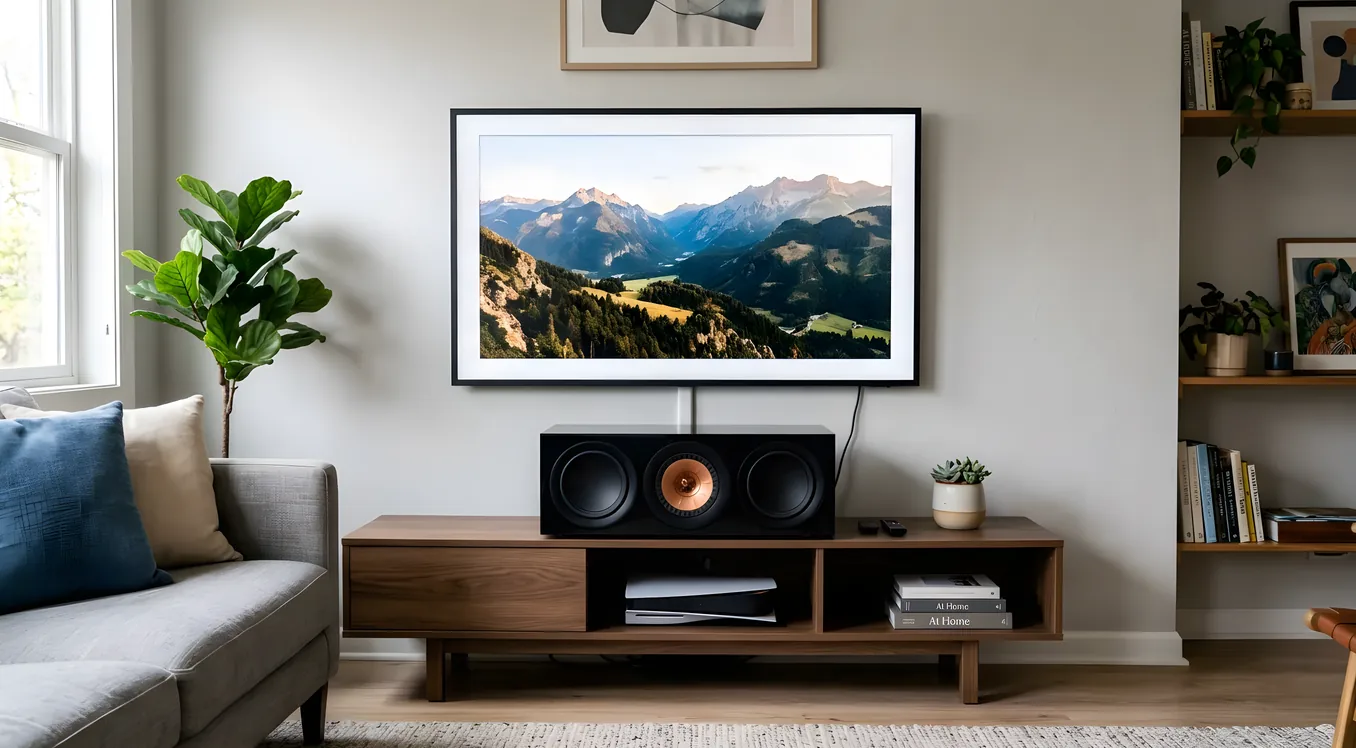
Most home theater buyers obsess over floor-standing towers. They compare woofer counts, sensitivity ratings, and cabinet finishes while treating the center channel as an afterthought. That’s backward. The center channel carries 50 to 70 percent of everything you hear during a film: every line of dialogue, most foley effects tied to on-screen action, and much of the musical score that’s anchored to picture. If your center channel fails you, the entire mix collapses into mush regardless of how much money sits on either side of it.
Understanding speaker types helps, but the center channel deserves its own focused treatment. No other driver in a 5.1 or 7.1 system is asked to work as hard or as consistently.
What Goes Through the Center Channel
Surround sound mixes are built around the concept of phantom imaging, where the processor places sounds at precise locations in three-dimensional space. The center channel exists specifically to lock dialogue and on-screen action to the screen. Without it, speech would blur across the left and right mains, drifting with listener position. Sit a foot off-axis from the sweet spot and voices become disconnected from the actors producing them.
Dolby Atmos, DTS:X, and even older Pro Logic mixes all route speech to center as a default. The LFE channel handles bass. The surround channels handle ambience and off-screen effects. Your towers handle music and wide soundstage elements. That leaves somewhere between half and two-thirds of the active mix sitting on one horizontal cabinet under your screen.
MTM, 2-Way, and 3-Way: What the Driver Layout Actually Means
Center channel speakers are sold in three primary configurations, and the difference matters more than most buyers realize.
A 2-way center uses one tweeter and one or two mid-bass drivers. It’s the most common and affordable format. At moderate listening volumes and typical living-room distances, a well-designed 2-way center performs well. The limitation is output: a single mid-bass driver has finite excursion, and when you push the speaker hard, compression creeps into the upper midrange where voice intelligibility lives.
An MTM design (mid-tweeter-mid) places the tweeter between two matched midrange drivers in a symmetrical array. The arrangement narrows vertical dispersion while broadening horizontal dispersion, which sounds like a tradeoff until you consider where center channels live. They sit horizontally under televisions and must throw sound across a wide seating area without beaming. MTM layouts handle that geometry better than asymmetrical 2-way designs, and the dual drivers share the excursion load so compression sets in later.
A 3-way center adds a dedicated midrange driver, handing voice frequencies to a smaller cone purpose-built for that range. The result is cleaner, more intelligible dialogue at high levels because the midrange driver isn’t also trying to reproduce bass information. Premium centers from KEF, SVS, and Martin Logan use 3-way designs for this reason. They cost more, require more cabinet volume, and are heavier, but the clarity difference at reference listening levels is audible.
Horizontal Mounting and the Off-Axis Problem
Every center channel is mounted horizontally, which creates a physics problem that manufacturers work hard to manage. When a midrange driver fires sound in a horizontal arc, it crosses its own output from the woofer at the crossover frequency. Those signals interfere with each other, producing a comb-filtering pattern where certain frequencies cancel off-axis. Anyone not sitting directly in front of the speaker hears a thinned-out, hollow version of dialogue.
MTM designs reduce this by keeping the tweeter and both mids in a tight vertical cluster, which shifts the comb-filtering into the vertical plane where it causes less damage. Some manufacturers use coaxial drivers (a tweeter mounted concentrically inside a midrange cone) to eliminate the off-axis issue almost entirely. KEF’s Uni-Q array, used in the KEF R2c, is the best-known implementation of this approach.
The practical takeaway: if your seating extends more than a few feet off-center axis, pay close attention to the horizontal dispersion measurements in reviews. A speaker that measures flat at 0 degrees but collapses at 30 degrees will punish anyone not sitting exactly in the middle of the room.
Why a Small Center Paired with Large Towers Fails
A common budget move is to buy large floor-standing towers, buy a receiver that stretches the budget, and then fill the center position with whatever inexpensive cabinet fits under the TV. The result is a mismatched system where the towers can play clean and loud and the center becomes the bottleneck.
The problem isn’t just volume. It’s timbre. Tower speakers reproduce the full frequency range with a particular character shaped by their cabinet, crossover, and drivers. The center channel has to reproduce voice at the same tonal character, or every time dialogue is present alongside music or effects (which is most of the time), the voices seem to come from a different speaker because they do. The sonic discontinuity is subtle at low volumes and glaring at high ones.
Practical sizing guidance: if your mains are capable of playing into the low 40 Hz range before rolloff, your center should reach at least the upper 70 Hz range on its own before the subwoofer takes over. Larger mains demand a larger center. A 5-inch woofer center paired with 8-inch tower woofers will always be the weakest link in the chain.
Timbre Matching: Why Same-Line Purchases Matter
Speaker manufacturers voice their product lines to share a common tonal character. Crossover slopes, driver formulations, and cabinet tuning are all calibrated so that when you pan a sound from left to right across the front soundstage, the transition is continuous and invisible. Buy your center from a different manufacturer or a different product tier, and that continuity breaks.
The AV receiver can apply EQ corrections that flatten frequency response differences, but EQ cannot fix driver character differences. A horn-loaded tweeter and a soft-dome tweeter have different transient behavior that EQ cannot reconcile. Klipsch speakers use horn-loaded tweeters throughout the Reference Premiere line for exactly this reason: the RP-504C II center matches the horn signature of the RP-8000F towers it’s designed to accompany.
When budget forces a compromise, stay within the same brand’s product family even if you can’t stay within the same line. A KEF Q Series center with KEF R Series towers is a better match than a random center from a different brand at the same price.
Real Models Across the Price Spectrum
Klipsch RP-504C II ($499): Dual 5.25-inch woofers in an MTM-adjacent layout around a 1-inch titanium tweeter in a Tractrix horn. The horn loading gives it high sensitivity (96 dB/1W/1m) and effortless output at high volumes. Designed to pair with the RP-8000F or RP-6000F towers.
KEF R2c ($800): A 3-way design using KEF’s 12th-generation Uni-Q coaxial driver. The coaxial arrangement means point-source behavior regardless of listening angle, which solves the horizontal center dispersion problem at a fundamental level. This is a specialist’s choice for rooms with wide seating spread.
SVS Ultra Center ($799): SVS designed this as a true reference-grade center at an accessible price. It uses a 6.5-inch mid-bass driver flanking a 1-inch tweeter, with a 6.5-inch passive radiator to extend bass output from its sealed cabinet. The SVS Ultra Center matches the Ultra Tower for those building a full SVS front array.
Martin Logan Motion C2 ($1,699): Martin Logan’s folded-motion tweeter reproduces high frequencies with dramatically lower distortion than conventional dome designs because the diaphragm moves a fraction of the distance for the same output. The Motion C2 is a 3-way design with 5.5-inch aluminum-cone midrange and dual 5.5-inch bass drivers. For critical listeners who prioritize dialogue clarity above all else, this is a top-tier reference point.
Where to Place the Center Channel
The center channel should be as close to ear level as possible, which in practice means as close to the screen centerline as you can get it. Vertical offset between the center channel and the listener’s ears introduces comb-filtering at the crossover frequency, and steep vertical angles cause off-axis coloration for the entire seating row.
Under-screen placement is the standard configuration for most rooms. The speaker sits on a shelf or the equipment rack directly below the television, with the tweeter as high as the cabinet allows. If the speaker is noticeably below ear level, angle it upward using speaker spikes, rubber wedges, or purpose-built tilting mounts. Most center channel cabinets have chamfered tops or built-in angle options for this reason.
Above-screen placement is sometimes necessary with projector screens or large TV installations where there’s no shelf space below. The same vertical alignment principles apply. Above-screen mounting tends to produce more noticeable comb-filtering for listeners in the front rows of multi-row setups.
Behind an acoustically transparent screen is the reference standard for dedicated home theaters. The center sits on a stand or mount directly behind a perforated or woven screen, aligned with the screen centerline. Dialogue appears to come from exactly where the actor’s mouth is on screen because it does. Acoustically transparent screens have their own considerations, which the acoustics 101 guide covers in detail. This placement eliminates every vertical placement compromise, but it requires a projector-based system and a screen specifically designed for it.
Budget Reality: What $300 Buys Versus What $1,500 Buys
Usable center channel performance starts around $300. The Klipsch RP-404C, SVS Prime Center, and similar options in this range produce acceptable dialogue clarity at moderate levels and will outperform any soundbar or the factory TV speakers they’re replacing.
The $500 to $800 range is where things get serious. MTM and 3-way designs at this price point offer meaningfully better off-axis performance, higher clean output, and the driver quality to match premium tower speakers. For most buyers building a system around $1,500 to $3,000 worth of front three speakers, this is the appropriate center budget.
Above $1,000, you’re buying diminishing but real returns: wider dispersion from coaxial arrays, lower distortion from specialized tweeter technology, better cabinet bracing that keeps the enclosure from coloring the output. The Martin Logan Motion C2 at $1,699 and the KEF R2c at $800 represent two different philosophies at the upper end of the practical range, both of which justify their prices for listeners who use their system at reference levels regularly.
The number to hold in your head: your center channel budget should be roughly 25 to 30 percent of your total front speaker budget. If you spend $2,000 on towers, spend $500 to $600 on the center. The ratio matters more than the absolute number.
Building the Front Soundstage Right the First Time
The single most common home theater regret is mismatching the center channel to the rest of the system and then replacing it later. Tower speakers are an obvious purchase. The center channel is invisible until you turn on a movie and realize every voice sounds like it’s coming from a different room than the rest of the mix.
Buy the center from the same line as your mains, give it enough cabinet volume to keep up with them, and place it as close to screen centerline as your room allows. Those three decisions, made correctly once, are what separate a home theater system that sounds like a cinema from one that sounds like a very expensive television.