Red Flags in AV Proposals: What Bad Installers Do Differently
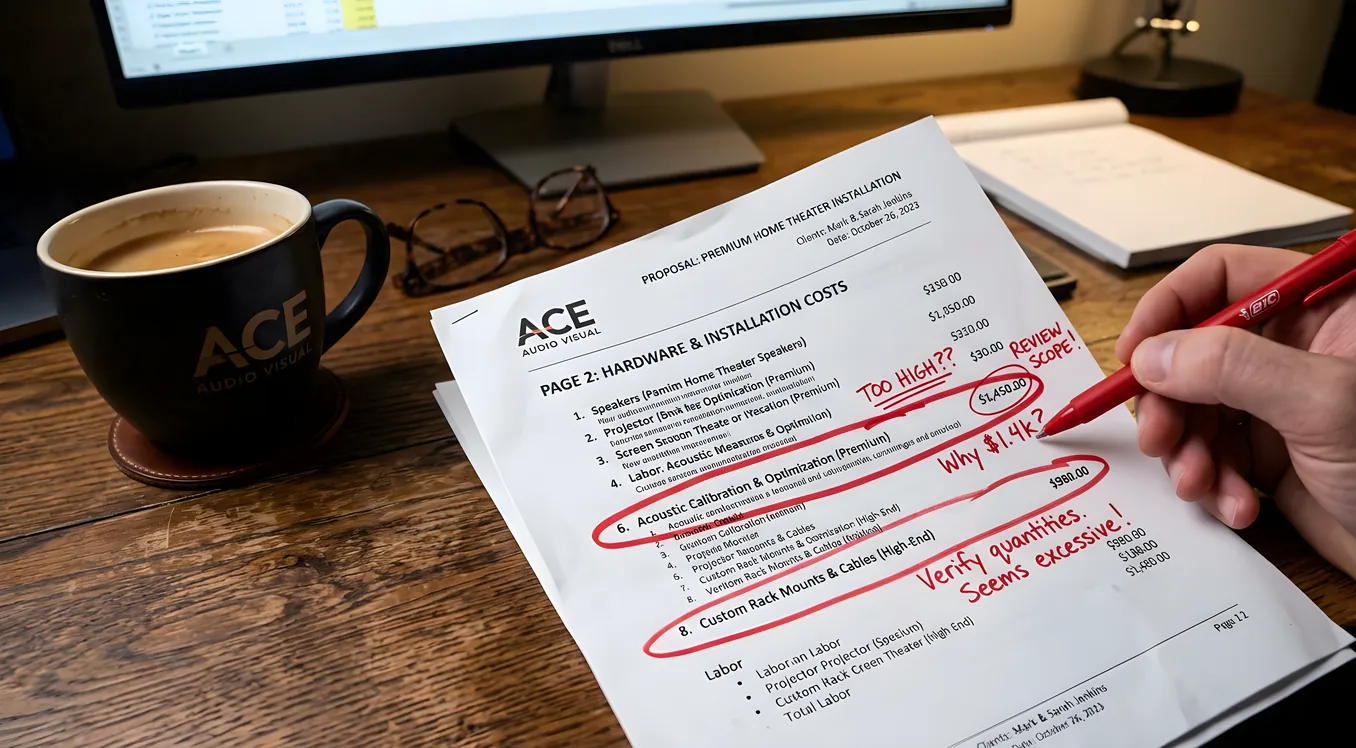
A home theater or whole-home AV system is a significant investment. The difference between a great outcome and a years-long headache often comes down to one thing: whether you read the proposal carefully before signing. Most homeowners skip that step. Most regrets trace back to that skip.
This guide covers twelve things that consistently appear in bad AV proposals, plus what a good proposal actually looks like so you know what to hold out for.
They Quote Without Seeing Your Room
Any installer who sends you a price without visiting the space is guessing. Room dimensions, ceiling height, acoustic materials, existing wiring runs, window placement, furniture layout, seating position relative to the screen, ambient light sources: all of this determines what equipment will work and how it should be installed. None of it shows up in a photo.
A walk-through isn’t just a formality. It’s the foundation of the design. Skip it, and the installer is pricing a generic system for a generic room, not yours. When the equipment arrives and something doesn’t fit or perform as expected, that site-visit shortcut is where the problem started.
Good installers schedule an in-home consultation before they put a number on anything. Some charge for that consultation. That’s fine. It means they’re serious about the design.
The Quote Is Verbal
If there’s no written proposal, there’s no accountability. A verbal quote is a handshake on an understanding that you and the installer may not actually share. When the final invoice comes in higher, or a promised feature isn’t there, you have no document to point to.
A written proposal forces the installer to commit. It also forces clarity: they have to name the equipment, describe the scope, and state what’s included. That process exposes vagueness they’d otherwise leave unspoken. Before you move forward with any AV installer, get everything in writing.
Equipment Is Listed as “Or Equivalent”
This phrase transfers all purchasing decisions to the installer after you’ve signed. “Or equivalent” sounds like flexibility. What it actually means is: the installer can substitute cheaper gear if their preferred brand is backordered, if they get a better margin on something else, or if they simply decide to.
Every component in a well-designed system should be specified by make, model, and model number. If the installer proposes a specific receiver, that receiver should be named. If the screen is a specific model with specific throw specs, it should be named. “Or equivalent” on a line item is an open door to cost-cutting you won’t find out about until installation day.
No Timeline in the Contract
A contract without dates is a contract without pressure. Good AV installers are busy. Without a written timeline, your project will get scheduled around whatever else is going on, and delays compound fast: equipment lead times, subcontractor availability, permit timelines (if applicable), and competing jobs.
A legitimate contract specifies a start date and a completion date. It may include milestone dates for equipment delivery, rough-in, and final calibration. It should also address what happens if the installer misses those dates. If the proposal has no dates, ask for them before signing. If the installer resists putting dates in writing, that tells you something.
They Push One Brand Without Explanation
Some installers have genuine reasons to favor a specific manufacturer: authorized dealer status, deep familiarity with the platform, strong local service support. Those are legitimate reasons and a good installer will tell you what they are.
When an installer pushes one brand without explaining why, you’re likely looking at one of two things. Either they’re a dealer who earns margin incentives on that line (nothing wrong with that, but you deserve to know), or they don’t have broad enough experience to work with alternatives. Neither scenario means the equipment is wrong for your space. It does mean you should ask pointed questions. What’s the manufacturer warranty? Who handles service calls in your area? What happens if that brand discontinues this model?
The questions to ask your installer before signing should include brand rationale. A good installer answers that question confidently.
No Calibration Mentioned
Installation and calibration are not the same thing. An installer who hangs a display, mounts a projector, runs cables, and leaves has completed roughly 80% of the job. The other 20% is what determines whether the system sounds and looks the way it should.
Display calibration sets accurate color, brightness, and contrast for your room’s actual light conditions. Audio calibration accounts for your room’s acoustic properties, speaker placement, and listener position. Skipping these steps doesn’t just leave performance on the table. It often means the system sounds and looks noticeably worse than it should, and the homeowner doesn’t know it because they’ve never heard or seen the system properly set up.
Any proposal for a serious home theater should mention calibration by name. If it doesn’t, ask. If the installer says calibration is “included” without specifying what that means, get specifics. ISF or THX-certified display calibration is a real service. A quick menu adjustment is not.
The Price Is Suspiciously Low
Significantly underbidding competitors is almost always a signal, not a deal. The three most common explanations are: hidden costs that appear after signing (change orders, “upgrades,” installation fees not included in the original quote), subcontractors doing the work instead of the company you hired, or corners cut on cable, connectors, and labor that you won’t notice for months.
Quality cabling, proper cable management, and adequate labor time cost money. So does the experience to do the job right the first time. When a proposal comes in 30-40% below the field, ask yourself what’s not in it. An AV consultation with two or three installers will give you a realistic price range for your project. Anything well below that range deserves a close look.
No References or Portfolio
Home AV installation is a craft. A skilled installer has a body of work and is happy to show it. Photos of completed installations, contact information for past clients, and video walkthroughs of finished theaters are reasonable things to expect from any experienced installer.
If an installer can’t point you to references or portfolio photos, there are two possible reasons: they’re new to the work, or they’ve done it poorly enough that they don’t want you talking to past clients. Either scenario is worth weighing before you hand them access to your home and your budget.
References are worth actually calling. Ask specifically about timeline adherence, how problems were handled, and whether the finished system performs the way it was described.
No Licensing or Insurance
Depending on your state and the scope of the work, AV installation may require electrical, low-voltage, or general contractor licensing. Unlicensed work can create problems with homeowners insurance claims, future home sales, and simple code compliance.
Beyond licensing, any installer working in your home should carry general liability insurance and workers’ compensation coverage. If a technician is injured on site without coverage, the liability can fall to you. Ask for certificates of insurance before work begins and verify that the coverage is current. A legitimate installer provides this without hesitation.
Full Payment Required Upfront
The industry standard for AV installation is a deposit at signing (typically 50%) and the balance due at project completion. Some installers collect a mid-project payment when equipment is delivered. Full payment before work starts is not standard.
Requiring full payment upfront removes the installer’s financial incentive to complete the work on time and correctly. It also means you’ve lost your primary negotiating point if the work is incomplete or wrong. A request for full upfront payment is either a cash flow problem on the installer’s side or a deliberate structure that protects them and not you. Either way, hold the balance until the work is done and the system is running.
They Discourage You From Getting Other Quotes
A confident installer who knows their work stands up to comparison won’t discourage you from shopping. Resistance to competitive quotes is almost always a sign that the installer knows their pricing or quality won’t hold up to scrutiny.
Getting two or three quotes isn’t disloyal. It’s basic due diligence on a project that can easily run five figures. Any installer who makes you feel guilty for doing it is applying social pressure that should itself be a disqualifier.
They Never Asked How You’ll Use the Space
A well-designed AV system starts with how you actually live in the room. A couple watching films in a dedicated theater with controlled lighting has different requirements than a family room that doubles as a gaming space and a place to watch the game with eight people. A music listener has different priorities than a cinephile.
An installer who prices your job without asking about use cases is selling you a default configuration, not a designed system. The best installers ask questions: Who uses the room? How many people typically watch at once? Is audio or video performance the priority? Do you want smart home integration? Will the room be used in daylight?
If you made it through an entire conversation and the installer never asked how you’d use the space, you were being sold to, not designed for.
What a Good Proposal Looks Like
A complete, trustworthy AV proposal covers the following without prompting: a documented site visit, exact equipment specifications with make and model numbers, a clear scope of work describing what is and isn’t included, a project timeline with start and completion dates, calibration as a named deliverable, payment terms split between deposit and completion, licensing and insurance documentation, and references available on request.
It may not be the lowest number you see. That’s usually fine. The proposal that costs you the least over the life of the system is rarely the one that looked cheapest on paper.
When you’re comparing proposals, look past the total price and read the line items. What’s specified? What’s vague? What’s missing entirely? Those omissions tell you more about the installer than the number at the bottom.