Diffusion vs Absorption: Balancing Acoustic Treatment in a Theater
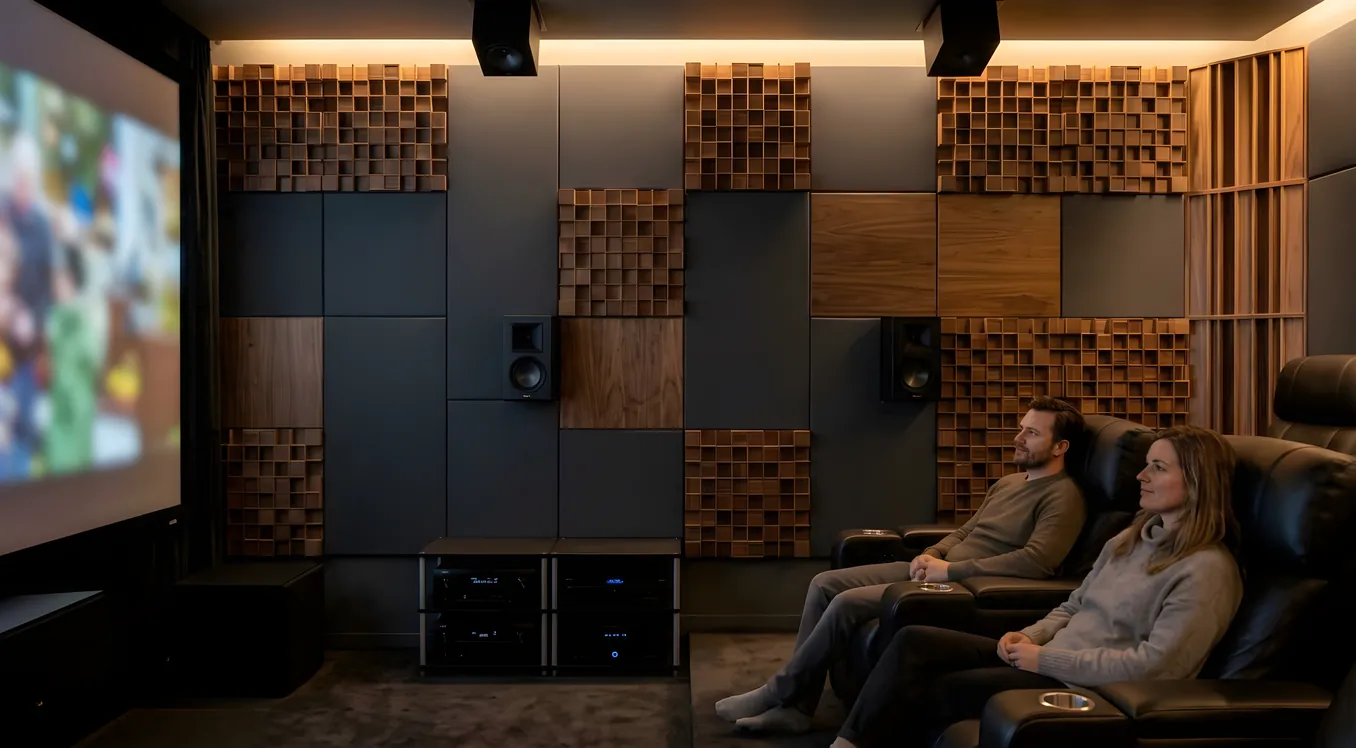
Most home theater acoustic treatment guides push absorption: cover the walls, kill the reflections, and the room will sound better. That advice is not wrong, but it is incomplete. A room that has been treated only with absorption develops its own set of problems, and understanding why requires knowing what each treatment type actually does.
Absorption removes acoustic energy from a room by converting sound waves into heat through friction within a porous material. Diffusion does not remove energy. It scatters sound waves in multiple directions, redirecting them rather than eliminating them. The distinction matters because a well-balanced theater room needs both: absorption to control early reflections and reduce unwanted reverb, diffusion to preserve the sense of spaciousness that makes a listening space feel alive rather than suffocating.
Why Over-Treated Rooms Sound Wrong
A room with too much absorption feels unnatural, and there is a perceptual reason for this. Human hearing evolved in environments with some reverb. Rooms with extremely short decay times, approaching the conditions of an anechoic chamber, produce fatigue. Dialogue loses intelligibility because the consonants that provide clarity are absorbed along with the reflections. Music loses its body. The room stops contributing to the experience and instead works against it.
The measurable parameter here is RT60: the time it takes for a sound to decay by 60 dB after the source stops. In a professionally designed home theater, target RT60 values typically fall between 0.2 and 0.4 seconds across the 250 Hz to 4 kHz range. Rooms smaller than 2,000 cubic feet tend to fall in the 0.2 to 0.3 second range; larger rooms in the 0.3 to 0.4 second range. Below 0.2 seconds, the room starts sounding dead. Above 0.5 to 0.6 seconds, dialogue intelligibility suffers.
You can measure your room’s RT60 with Room EQ Wizard (REW), a free measurement and analysis tool. REW uses a calibrated measurement microphone, available for around $100, to capture impulse response data and calculate decay curves by frequency band. This gives you an objective baseline before you add any treatment, and lets you verify the effect of each panel or diffuser you install.
Absorption: Material Types and Placement
Acoustic absorption panels work because porous materials like open-cell foam, rockwool, fiberglass, and fabric-wrapped mineral wool allow sound waves to penetrate and lose energy to friction as they travel through the material. The thickness of the absorber determines which frequencies it treats effectively. A two-inch panel begins to absorb meaningfully at around 500 Hz. For effective low-mid absorption down to 250 Hz, you need four inches. True bass trapping, targeting frequencies below 100 Hz, requires either very thick panels (8 to 12 inches of mineral wool) or corner placement where two or three room boundaries reinforce pressure buildup.
The locations where absorption matters most are well-established. First reflection points on the side walls, the spots where sound from the left and right speakers bounces off the wall and arrives at the listening position slightly after the direct sound, should be treated. You can find these points with a mirror: sit in the listening position, have someone slide a mirror along the side wall, and mark anywhere you can see a speaker reflected. The ceiling above and slightly in front of the listening position is the second critical location. A ceiling cloud of absorption there eliminates the strong early reflection that competes with the direct sound from the front speakers.
Front wall treatment, behind the screen or front speakers, controls unwanted sound energy that would otherwise bounce back into the room and create comb filtering with the direct signal. In a properly designed theater, the front wall and the area behind the screen are typically heavily absorbed. Read more about the full spectrum of panel options in our guide to acoustic panels.
Bass traps belong in the four vertical corners of the room, and in the two horizontal corners where walls meet the ceiling and floor on the front and rear walls. These are the pressure accumulation zones where low-frequency energy builds up disproportionately and creates the bass peaks that make certain notes boom while others disappear. Thick floor-to-ceiling corner treatment is more effective than any equalization fix, though DSP correction through the receiver or a Dirac Live implementation can address what treatment misses.
Diffusion: Types and How They Work
Where absorption removes energy, diffusion redirects it by breaking up a coherent wavefront into multiple reflected angles. A flat reflective wall sends a single strong reflection back at a predictable angle. A diffuser breaks that same reflection into many weaker reflections traveling in different directions, which the ear perceives as spaciousness rather than a discrete echo.
There are three diffuser types relevant to home theater installations.
Quadratic residue diffusers (QRDs) are the most mathematically rigorous option. QRD panels consist of a series of wells of varying depths, calculated from quadratic residue sequences, that cause sound waves to scatter across a wide angle. The bandwidth of effective diffusion depends on well depth and the period width of the pattern. QRD calculators are freely available online; you input your target frequency range and the tool produces the well depth sequence. This makes them a viable DIY project for builders comfortable with accurate woodworking. The primary commercial sources include GIK Acoustics (whose Gotham diffuser is a popular QRD-based panel in the home theater market) and Vicoustic, which offers a range of QRD products with varying frequency coverage.
Skyline or cityscape diffusers extend QRD geometry into two dimensions, scattering sound in both horizontal and vertical planes simultaneously. They appear as a field of rectangular columns of varying heights. The two-dimensional scatter makes them effective for rear walls, where you want broad diffusion that does not favor a particular axis. They are more expensive than flat QRD panels and more visually complex, but they outperform flat QRDs for rear-wall applications where the reflection geometry is less predictable.
Polycylindrical diffusers are curved panels, typically with a circular arc cross-section built from a thin facing over a rigid frame. They scatter sound along one axis and have a broad effective bandwidth without the precision engineering of a QRD. They are simpler to build but scatter less uniformly than QRDs. RPG Diffusor Systems, which holds many of the foundational diffuser patents, offers polycylindrical and arc-based products alongside QRD designs.
An underappreciated option already present in many rooms: a bookshelf filled with books of varying sizes and depths acts as a broadband diffuser. The irregular surface of book spines, stacked at different depths, scatters sound across a wide frequency range. It is not as effective as a purpose-built QRD at any specific frequency, but it contributes real diffusion without added cost. We cover room dimensions and their acoustic implications in more detail in room dimensions for home theaters.
The Front-Absorb, Rear-Diffuse Pattern
Professional theater designers follow a consistent placement philosophy that balances the two treatment types within the room. The front half of the room (from the screen wall to just behind the listening position) is treated primarily with absorption. The rear half relies primarily on diffusion.
The reasoning is straightforward. Sound from the speakers travels toward the listening position. Early reflections, the ones that arrive at the ear within 20 to 30 milliseconds of the direct sound, reduce imaging clarity and dialogue intelligibility. Absorption at the first reflection points and front wall eliminates these reflections before they cause problems.
The rear wall is a different situation. Sound that has already passed the listening position and continues to the rear wall returns from behind the listener. These late reflections contribute to the sense of envelopment and spaciousness. Absorbing them entirely removes that contribution and makes the room feel smaller and less engaging. Diffusing them instead sends that energy back in scattered directions and arrival times, which the auditory system interprets as ambient information rather than a discrete echo.
The rear corners behind the seats are a hybrid zone. Bass traps in the lower corners handle the low-frequency accumulation, while diffusion panels address the mid and high frequencies above the bass trap coverage range. Some rooms place absorption high on the rear wall and diffusion panels lower, targeting the most direct return path from the rear wall to the seated ear height.
Side walls in the rear half of the room follow a similar logic: primary diffusion with some absorption if the RT60 measurements indicate the room is still too live.
Measuring Results with REW
Setting up Room EQ Wizard requires a calibrated measurement microphone (the MiniDSP UMIK-1 is the most common choice at around $75 to $100), a laptop or desktop in the theater room, and REW itself, which is free. The process involves generating a test sweep through the room’s speakers, capturing the response at the listening position, and analyzing the resulting impulse response data.
The measurement that matters most for treatment evaluation is the RT60 graph, shown in REW as a frequency-resolved decay curve. You are looking for values that stay in the 0.2 to 0.4 second range across the primary frequency bands, without large peaks at specific frequencies that would indicate untreated reflective surfaces or pressure buildup. Bass frequencies will typically show longer decay times than mid and high frequencies, which is expected. A strong peak at 80 to 120 Hz with a normal decay at 500 Hz indicates a first-order room mode that treatment alone may not fully resolve, and where DSP bass management correction becomes necessary.
Take measurements before adding any treatment to establish a baseline. Then measure after each significant addition. Diffusers often produce counterintuitive results in REW data because they do not shorten decay time, they redistribute it. A room with good diffusion can show the same RT60 as an untreated room but sound dramatically better because the energy is scattered rather than focused. Measurement tools confirm treatment placement but do not fully capture the perceptual difference between scattered and specular reflections. Trust both the numbers and the listening test.
Putting It Together: Treatment Sequence
The practical sequence for treating a home theater room starts with measurements, moves to bass trapping, then absorption at first reflection points, then front wall absorption, and finally rear wall diffusion. Treating in this order lets each measurement cycle show you what the previous step accomplished and where the remaining problems are.
Budget planning follows the same priority order. Bass trapping is where cost tends to be highest because effective low-frequency treatment requires mass and volume. A floor-to-ceiling corner filled with 4-inch rockwool bats (in a fabric-wrapped frame) costs more per corner than a 2-inch absorption panel but addresses a more problematic acoustic issue. Mid and high-frequency first reflection panels can be built for modest cost with standard 703 fiberglass in a fabric wrap, or purchased commercially from GIK Acoustics, which offers fabric-covered panels at reasonable price points. Rear wall diffusers, whether purchased QRDs from Vicoustic or DIY builds from a QRD calculator, are typically the last addition because the room will not benefit from them until the more significant absorption problems are resolved.
Our acoustics 101 guide covers the underlying physics in more detail if you want the foundational theory before making treatment decisions. The practical takeaway here is that diffusion and absorption solve different problems, and a theater room that applies only one of them leaves performance on the table. The front-absorb, rear-diffuse framework gives you a starting point; RT60 measurements give you the data to refine it for your specific room dimensions and materials.