East Bay Home Theater: Walnut Creek, Danville, Lafayette, and Concord
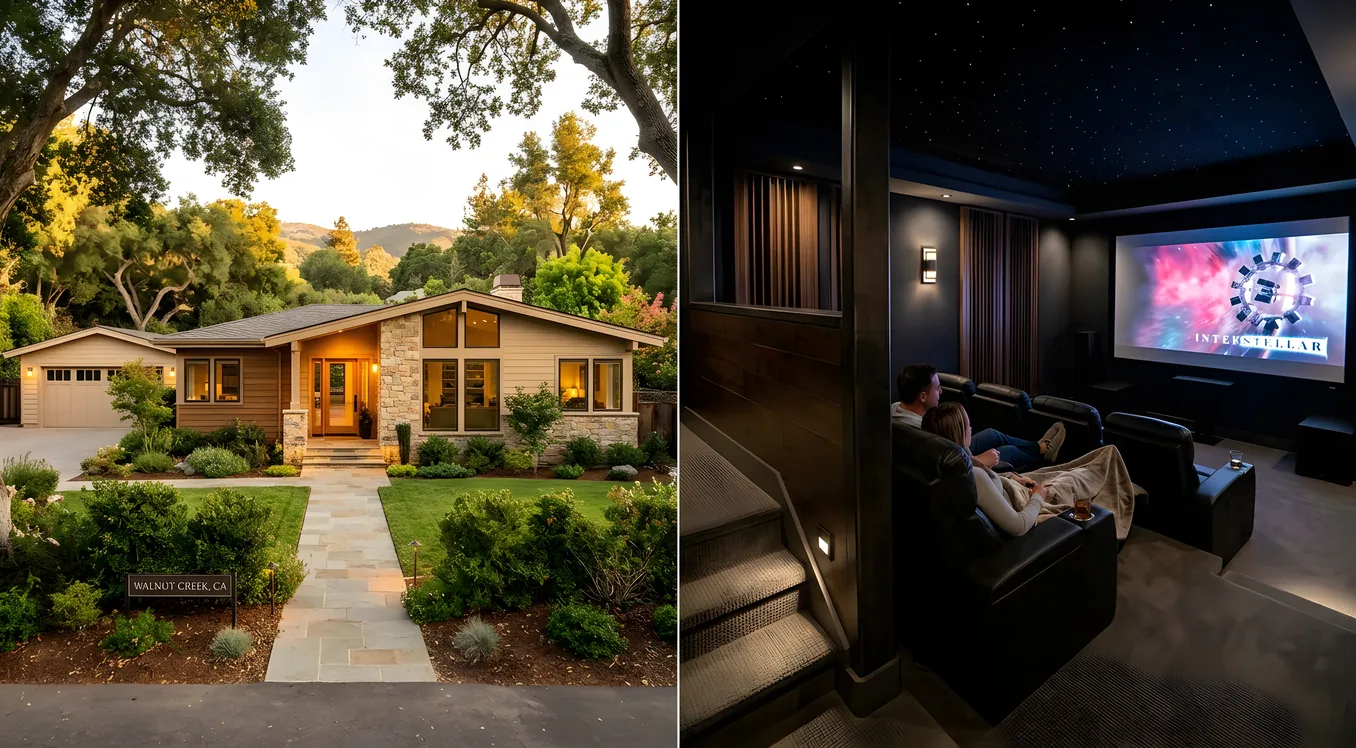
The East Bay sits in a different position than San Francisco or the Peninsula when it comes to home theater. Larger lots, more square footage per house, and a higher proportion of new construction with pre-wire capability make dedicated room builds genuinely common here. Where a San Francisco homeowner is often fitting a theater into a repurposed closet or small bedroom, an East Bay homeowner in Danville or Lafayette is frequently starting with a 400-square-foot bonus room, a walkout basement, or a three-car garage and asking how to use it.
That advantage is real, but it doesn’t mean the planning is simple. Each part of the East Bay has its own housing stock, lot geometry, and climate conditions that shape what a theater installation actually looks like. A Lamorinda home from 1970 has different candidates and different constraints than a San Ramon tract home built in 2005.
The Lamorinda Advantage: Older Homes With Larger Footprints
Lafayette, Moraga, and Orinda sit in the first range of hills east of Berkeley, and the housing stock reflects a development era when lots were larger and floor plans were more generous. Most homes in Lamorinda were built between the 1950s and the 1990s, and the ranch-style and split-level construction common to that period creates some of the best natural theater candidates in the Bay Area.
Ranch homes in Lamorinda often have a dedicated family room separated from the main living area by a hallway or step-down configuration. That separation provides structural acoustic isolation without any additional framing. The room is already enclosed, often has a door, and typically sits at the rear of the house away from street noise. With proper acoustic treatment and HVAC work, these rooms convert to dedicated theaters without major construction.
Split-level homes present a different opportunity. The lower level, which often houses a family room or recreation room, sits partially below grade. The below-grade mass from the hillside adds acoustic isolation, and the separation from sleeping areas on the upper level is built into the floor plan. These spaces benefit from the same baseline advantages as a basement home theater: concrete or hillside soil provides natural sound attenuation that a framed wall cannot match.
Lot sizes in Lamorinda also accommodate accessory structures. A detached guesthouse, pool house, or workshop with enough square footage is a legitimate theater candidate, and detached construction eliminates the acoustic compromise of shared walls entirely. Owners of these structures have converted them to theaters with results that outperform many purpose-built rooms in newer construction, simply because the physical separation from the main house is absolute.
Budget for a dedicated room conversion in Lamorinda typically runs $25,000 to $50,000 for construction and $15,000 to $40,000 for equipment, depending on room size and specification level. The higher land costs in the area are matched by homeowner investment in the interior, and premium installations with custom millwork, tiered seating platforms, and 4K laser projection systems are common.
Walnut Creek: New Development Meets Established Neighborhoods
Walnut Creek has been adding new construction consistently for the past decade, and that creates two distinct populations of home theater projects within the same city. Established neighborhoods near downtown Walnut Creek and in the surrounding hills tend toward older homes with converted rooms, bonus spaces, and the occasional finished basement. Newer developments on the eastern and northern edges of the city offer something different: the opportunity to wire a theater before the walls close.
New construction pre-wiring is one of the highest-value decisions a homeowner can make during the build phase. Running HDMI, speaker wire, conduit for video projection, and low-voltage cable during rough-in costs a fraction of what pulling wire through finished walls requires later. A 500-square-foot media room that costs $2,000 to wire at rough-in costs $8,000 to $15,000 to retrofit after drywall. Buyers purchasing new construction in Walnut Creek’s active communities should negotiate the pre-wire scope into the base contract.
In established Walnut Creek neighborhoods, the theater candidates vary. Two-story homes built in the 1980s and 1990s often have a ground-floor family room with good separation from the bedrooms above. Homes near Shell Ridge and the Tice Valley area tend to have larger footprints with more flexible interior layouts. The challenge in older construction is almost always the same: electrical capacity requires a panel upgrade, and HVAC for a sealed theater room requires a dedicated mini-split rather than attempting to extend an undersized existing duct run.
The mix of income levels in Walnut Creek creates a wide range of project budgets. Entry-level dedicated room builds with off-the-shelf components start around $15,000 installed. Higher-end projects with acoustic design, premium seating, and whole-home integration run $60,000 and above. Finding a local integrator who works across that range, rather than specializing only at one end, is worth the time to research.
Danville and San Ramon: The Bonus Room Belt
Danville and San Ramon represent the East Bay’s most concentrated population of purpose-ready theater spaces. Suburban construction from the 1990s through the 2010s in this corridor was built around family floor plans that included bonus rooms, media rooms, and in many cases walkout basements or daylight basements that are rare elsewhere in the Bay Area. A developer marketing a 3,500-square-foot home in San Ramon in 2003 needed to justify the square footage, and “media room” or “bonus room” was a standard feature.
These spaces are usually already roughed in for use as media rooms: a dedicated room off the garage or above the garage, often with a door, sometimes with conduit roughed in but not pulled. The conversion from builder-grade media room to a genuine theater involves three main categories of work.
Acoustic isolation is the first. Builder-grade construction uses standard single-layer drywall on regular framing, which provides minimal sound isolation. Running a subwoofer at real output in a room like this transmits low frequencies through the framing and into adjacent bedrooms. Adding a second drywall layer with Green Glue compound between the layers, or using resilient channel decoupling on the ceiling, brings the room’s performance to a level appropriate for a dedicated theater.
HVAC is the second, and it is non-negotiable in this part of the East Bay. Danville and San Ramon see summer highs of 90 to 100 degrees Fahrenheit on a regular basis. A sealed theater room with four to eight people, a projector generating 300 to 500 watts of heat, and an AV rack with multiple amplifiers can push the room temperature 20 degrees above ambient within an hour. The existing HVAC system, already taxed by the main house, cannot reliably condition a sealed bonus room under those loads. A dedicated mini-split is the correct solution, typically a 12,000 to 18,000 BTU single-zone system sized for the room. This is not an optional upgrade.
Electrical is the third. Bonus rooms in this era of construction typically have one or two 15-amp circuits. A proper theater installation requires dedicated 20-amp circuits for the AV rack and amplifiers, a separate circuit for the projector, and another for general convenience. Budget for a panel assessment and at least two to three new dedicated runs when planning the project.
For homes with walkout basements, Danville and San Ramon offer something genuinely rare in the Bay Area: below-grade construction with good access. A walkout basement in these neighborhoods is usually 600 to 900 square feet with 9-foot ceilings, natural light from the walkout side, and full separation from the main living areas. This is the configuration covered in detail in the basement home theater guide, and it applies directly to much of this area’s housing stock.
Concord and Pleasant Hill: More Affordable Entry Points
Concord and Pleasant Hill offer home theater opportunities at lower price points, but with trade-offs that require different planning approaches. The housing stock here skews older, with more construction from the 1950s through the 1970s, and the lots are often larger than their age suggests. Ranch homes on 6,000 to 10,000-square-foot lots with attached or detached garages are common, and garage conversions in this area have become one of the more practical theater paths.
Garage conversion economics in Concord look different than in Danville. Land values are lower, so the math of spending $20,000 to $35,000 converting a two-car garage into a theater is more defensible as a percentage of home value. The same conversion in Danville is a smaller proportional investment on a higher-value home, but the absolute cost is similar. Permits, HVAC, insulation, electrical, and finish work are roughly the same regardless of zip code. The garage theater conversion guide covers the construction sequence in detail, but the East Bay-specific consideration is insulation: summer temperatures in Concord and Pleasant Hill regularly exceed 95 degrees, which means an uninsulated concrete block or wood-frame garage that is merely warm in San Francisco becomes genuinely hot in Concord. R-19 in the walls and R-30 in the ceiling are realistic minimums for a garage conversion in this climate, with a mini-split required.
Older homes in Concord and Pleasant Hill sometimes have unusual room candidates that newer construction doesn’t: a finished basement under a 1960s ranch, a detached workshop, or a second structure on an oversized lot. These are worth evaluating before assuming a garage conversion is the only path. A finished basement, even at modest size, offers better natural acoustic performance than a converted garage because below-grade mass handles low-frequency isolation in ways that above-grade framing cannot replicate without significant expense.
Budget expectations in Concord and Pleasant Hill are the most accessible in the East Bay. An entry-level dedicated room conversion using a well-suited existing space, basic acoustic treatment, and mid-tier equipment is achievable around $15,000 total. This is meaningfully below what the same scope of work runs in Lamorinda or Danville, both because labor costs reflect local markets and because homeowners in this area are generally working with more practical budgets.
Dublin and Pleasanton: Tract Homes and New Communities
Dublin and Pleasanton anchor the southern end of the East Bay with large-scale tract development that continues actively today. The housing stock here is predominantly two-story suburban construction from the 1990s onward, with the newest communities in Dublin being built right now. The theater opportunity in this area is primarily bonus rooms and new-construction pre-wire.
Tract home floor plans in Dublin and Pleasanton frequently include a “loft” or “bonus room” above the garage. These spaces are accessible, enclosed, and often already wired for cable and a single power circuit. The square footage is typically 200 to 350 square feet, which is sufficient for a theater serving a row or two of seating. Acoustic isolation is the main project, since these rooms share a wall or floor with bedrooms in the same structure. Achieving meaningful sound isolation in this configuration without structural work is limited, and homeowners who want to run serious audio levels will need to address the framing before assuming installed equipment will perform as expected.
For buyers in new construction communities in Dublin, the negotiation at contract signing is the right time to specify a media room package. Builders in this market have standard add-ons that include conduit roughed to the ceiling for projection, speaker wire run in walls, and dedicated electrical circuits. These packages cost $3,000 to $8,000 at rough-in and save substantially more in retrofit labor if added later.
East Bay Climate and Theater Design
The entire East Bay faces summer heat in a way that the coast and the bay shore do not. The marine layer that keeps San Francisco at 65 degrees in July loses its influence as you move east of the hills. Walnut Creek, Danville, Concord, and Dublin can sit at 90 to 105 degrees on summer afternoons when San Francisco is foggy and cool.
This matters for theater design in two ways. First, every sealed theater room in the inland East Bay requires a dedicated HVAC solution. There is no version of a functional home theater in this climate that relies on a cracked door, a window unit, or a hope that the central system will cope. A room sealed for acoustic performance is also a room sealed against heat exchange, and projector heat combined with body heat and ambient temperature can make a theater unwatchable without independent climate control. Mini-split heat pumps, sized correctly for the room volume and equipment load, are the standard solution.
Second, equipment selection should account for the temperature range. Equipment racks in unconditioned or partially conditioned spaces need adequate ventilation, and some components have operating temperature limits that matter in this climate. AV receivers and amplifiers generate heat; an enclosed rack in a room that gets to 85 degrees before the HVAC catches up is a recipe for thermal shutdowns. Ventilated rack enclosures with forced air fans are worth budgeting for in any East Bay installation.
Working With East Bay Integrators
The East Bay theater market is served by integrators who range from small owner-operated businesses focused on single-room installations to multi-crew operations handling full custom integration projects with smart home systems, lighting control, and whole-home audio. The Bay Area installers directory has local resources, but a few considerations are worth noting before making contact.
Integrators in the East Bay tend to be familiar with the bonus room and garage conversion scenarios that define this market, which means their approach to pre-construction planning is often more developed than in markets where custom new construction is the dominant project type. Ask specifically about their experience with sealed room HVAC coordination, because the thermal management question is where East Bay projects most often go wrong. An integrator who treats HVAC as someone else’s problem is leaving the most important system variable in the hands of an HVAC contractor who may not understand theater heat loads.
Budget transparency varies significantly across this market. Some integrators work on a fixed-price contract basis; others bill time and materials with equipment at MSRP or below. For a dedicated room project in the $20,000 to $50,000 range, a fixed-price proposal with defined scope is worth insisting on. The scope should specify acoustic treatment, electrical requirements, HVAC coordination, equipment, installation, and calibration as separate line items so you can evaluate what you are actually getting.
For cost context before those conversations, the Bay Area home theater costs guide covers what typical projects run across the region, with East Bay-specific notes on how the inland climate affects scope.
Choosing the Right Room in an East Bay Home
The choice of room is the single most consequential decision in a home theater project. A well-chosen room with adequate acoustic isolation and good geometry will outperform a poorly chosen room regardless of equipment budget.
In the East Bay housing stock, the rooms worth evaluating first are: a dedicated ground-floor family room with a door and no adjacent bedroom sharing the primary wall; a basement or below-grade space with 8-foot or better ceiling height; a bonus room over the garage that is separated from bedrooms; and a garage or accessory structure with the square footage to support a proper seating arrangement.
The rooms that require more scrutiny are: a bedroom repurposed as a theater, which almost always shares walls with other bedrooms; an open loft that cannot be sealed without major construction; and any room where the only HVAC option is a window unit that cannot be integrated cleanly.
Measuring ceiling height, checking the electrical panel for available capacity, and assessing the existing HVAC for what it can actually deliver in an East Bay summer are the three pre-planning steps that determine whether a project is straightforward or complicated before a single piece of equipment is purchased.