Home Theater Costs in the Bay Area: What Bay Area Pricing Looks Like
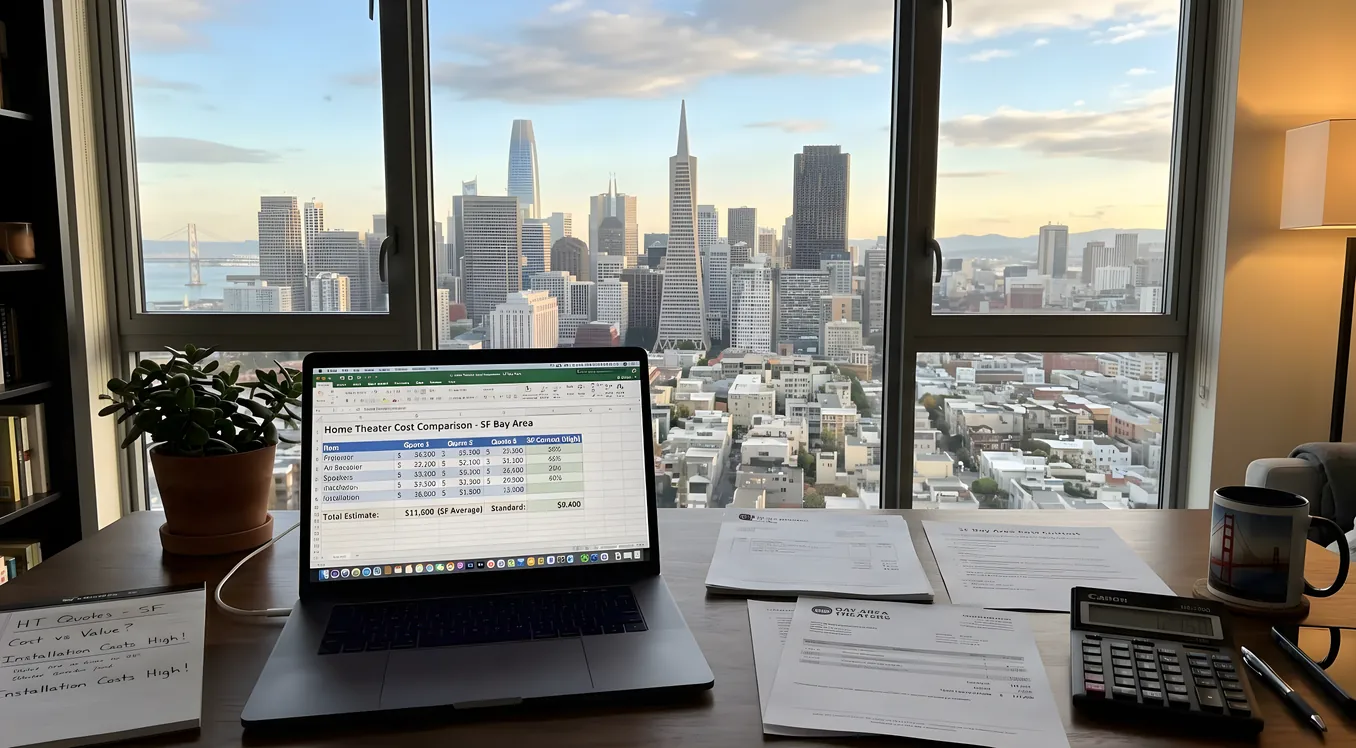
Home theater costs in the Bay Area follow the same basic logic as any other major project in an expensive metro: equipment prices are roughly the same as anywhere in the country, but labor, permits, and construction run 30 to 50 percent above national averages. A project that costs $20,000 in Phoenix or Nashville might land at $28,000 to $30,000 here, not because the projector or receiver costs more, but because the people installing it, pulling the permit, and running the dedicated circuits do.
This guide breaks down where that premium actually comes from, what realistic budgets look like at each tier, and where you have room to save.
Why Bay Area Home Theater Projects Cost More
The short answer is labor. Bay Area AV technicians typically bill $100 to $200 per hour, compared to a national range of roughly $75 to $125 per hour. Electricians, who are often required for dedicated circuit work, run $120 to $200 per hour in the Bay Area. General contractors handling dedicated room build-outs charge $200 to $400 per square foot for finished theater space, a number that reflects both wage rates and the cost of doing business in a high-cost metro.
Permits add another layer. San Francisco building permit fees for a residential AV or electrical project can run $1,500 to $5,000 or more depending on scope, particularly when electrical work triggers a full inspection cycle. San Mateo County and Contra Costa County are generally more predictable, with permit fees in the $500 to $2,000 range for most residential theater projects, though complex builds with significant structural work will push higher. The permit process itself takes longer here than in most markets, which adds to installer scheduling costs.
There are also logistical charges that homeowners in other markets rarely encounter. San Francisco properties frequently generate parking and access fees for installers: metered time, citation risk, or paid permits for work vehicles. Multi-story buildings with restricted service elevator access can add hours to a basic equipment delivery and mount. These aren’t line items on a formal quote in most cases, but they get absorbed into the total.
Equipment is the one place where Bay Area buyers pay roughly what everyone else pays. A 4K projector, an AV receiver, a speaker package, or an acoustic panel kit ships to Fremont the same way it ships to Fresno. Buy from an authorized dealer and the pricing is set by the manufacturer’s distribution structure, not your zip code.
Cost Tiers for Bay Area Home Theater Projects
Entry Level: $5,000 to $10,000
This tier covers equipment-only or near-DIY projects. You’re buying a quality display (a large 4K TV or an entry projector with a fixed or motorized screen), a mid-range AV receiver, a 5.1 speaker package, and basic cabling. Installation at this level is either DIY or a single-day professional install covering mounting, connection, and calibration.
What you’re not getting: acoustic treatment, dedicated circuits, any construction, or automation integration. If your room is already purpose-suitable (a finished basement with minimal light intrusion, for example), this tier can produce a genuinely good result. If the room needs work, this budget won’t cover it.
Bay Area reality check: a professional install day at $150 per hour runs $1,200 to $1,500 before any materials. That’s a meaningful share of a $7,000 budget. Many buyers at this tier do their own mounting and cabling, hiring a technician only for calibration.
Mid-Range: $15,000 to $30,000
This is where most serious Bay Area home theater projects land. The budget covers quality equipment (a dedicated projector or large-format display, a capable receiver, a full 7.1 or 7.2 speaker setup), professional installation, basic acoustic treatment (bass traps, broadband absorbers, diffusers), and potentially a dedicated electrical circuit if one isn’t already available.
Room darkening, seating, and minor cosmetic work can fit at the upper end of this range. A full dedicated circuit from panel to room with a licensed electrician will add $800 to $2,500 depending on distance and access. Acoustic treatment done properly, with professional measurement and panel placement, adds $2,000 to $6,000 depending on room size.
At this tier, most of the labor and treatment work can be budgeted fairly accurately before the project starts. The risk factors are discovery items: old wiring that doesn’t meet current code, unforeseen structural elements behind walls, or conduit runs that are longer or harder than expected.
High End: $30,000 to $75,000
This tier involves a dedicated theater room, which typically means construction. You’re looking at soundproofing (decoupled walls, resilient channels, mass-loaded vinyl), a properly treated acoustic environment, premium equipment (projectors in the $5,000 to $20,000 range, separates for amplification, in-wall speakers from established brands), and full automation via a control system.
The construction scope drives most of the variance. A 200-square-foot dedicated room in a Bay Area home runs $40,000 to $80,000 in general contractor costs when you include framing, insulation, drywall, electrical, HVAC, and finish work. Theater-specific work (the acoustic elements, equipment, and integration) sits on top of that. At this tier, the theater design and the construction have to be planned together, not sequenced separately.
Reference Level: $75,000 to $200,000 and Up
Reference-tier projects are custom builds designed around specific equipment and acoustic targets. The room is engineered, not just treated: proper RT60 targets, bass mode management, calibrated listening positions. Equipment includes high-end projectors (Sony SXRD or comparable), Dolby Atmos configurations with 12 or more speaker channels, reference-grade amplification, and full control integration via Crestron or Savant.
These projects involve an AV designer or custom integrator from the start, often alongside the architect and general contractor. Labor and design fees alone can run $30,000 to $50,000. The equipment list for a true reference system starts around $40,000 and has no upper ceiling.
Where Bay Area Projects Cost More Than Expected
Permits in San Francisco. The SF Department of Building Inspection is thorough and slow. Electrical work for a home theater almost always requires permits, and the permit process can add weeks to the timeline and thousands to the budget. Contra Costa County is more contractor-friendly; Marin and San Mateo fall somewhere in between.
Old home retrofit discoveries. The Bay Area has a lot of housing stock from the 1920s through 1960s. Opening walls for speaker wire runs or HDMI conduit frequently reveals knob-and-tube wiring, inadequate panel capacity, or framing that makes clean cable routing impossible. A project budgeted for a clean two-day install can turn into a two-week remediation.
Multiple installer visits. Because permit inspections and subcontractor scheduling are harder to compress in a high-demand market, Bay Area projects often require more site visits than the same project would in a less congested metro. Each visit at $150 per hour adds up.
Parking and access in SF and dense East Bay. In neighborhoods with restricted parking, installers may build access charges into quotes or simply work it into their hourly rate. It’s worth asking directly.
Where You Can Save
Equipment is the most obvious lever. A projector bought from an authorized online dealer ships to your door at the same price as it would to anyone else. The same goes for receivers, speakers, cables, and screen materials. Doing your own research, buying equipment directly, and handing it to your installer for deployment can save $2,000 to $8,000 on a mid-range project, since the installer markup on equipment is real.
Smart trade selection matters too. Not every task in a home theater project requires an AV technician. An electrician can run dedicated circuits and leave the AV work to a specialist. A handyperson can do wall patching after cable runs are complete. Breaking the project into trade-appropriate pieces rather than handing everything to a single AV integrator can reduce the total labor bill significantly.
For more on budget allocation across project components, the cost breakdown guide covers equipment-to-labor ratios in detail. If you’re weighing how much of the project to handle yourself, the DIY vs. professional comparison outlines which tasks benefit most from professional involvement.
Bay Area Geography and Cost Variation
Labor rates and permit friction vary by county. San Francisco is the most expensive and most bureaucratically complex. The San Francisco home theater guide covers the city-specific considerations in detail.
The East Bay (Oakland, Berkeley, Walnut Creek, Fremont) generally offers slightly lower labor rates and more contractor availability, which can reduce scheduling delays and costs on mid-range projects. Contra Costa County permits are notably more straightforward than SF’s, which makes a meaningful difference on projects that require electrical inspection.
Peninsula and South Bay markets (San Mateo County, Santa Clara County) fall in the middle: labor rates comparable to SF, permit processes that are easier to navigate. Marin is expensive and access-limited in the same ways SF is.
Getting an Accurate Quote
The range in home theater quotes, even for nominally similar projects, is wide. A $20,000 estimate and a $35,000 estimate for the same room are both plausible depending on assumptions the installer made about existing electrical capacity, acoustic treatment scope, and equipment selection.
To get a quote you can actually compare:
- Specify the room dimensions and current condition (finished, unfinished, existing electrical)
- Identify whether you’re supplying equipment or having the installer source it
- Confirm what permit responsibility looks like (some Bay Area integrators handle permits, many don’t)
- Ask explicitly about travel, parking, and access charges
Quotes that don’t address these items will be hard to compare. An all-in bid from an SF-based integrator who knows the permit process is often worth more than a lower number from someone who hasn’t priced in the inspection cycle.