Home Theater Installation in San Francisco: Victorian Homes and Tight Spaces
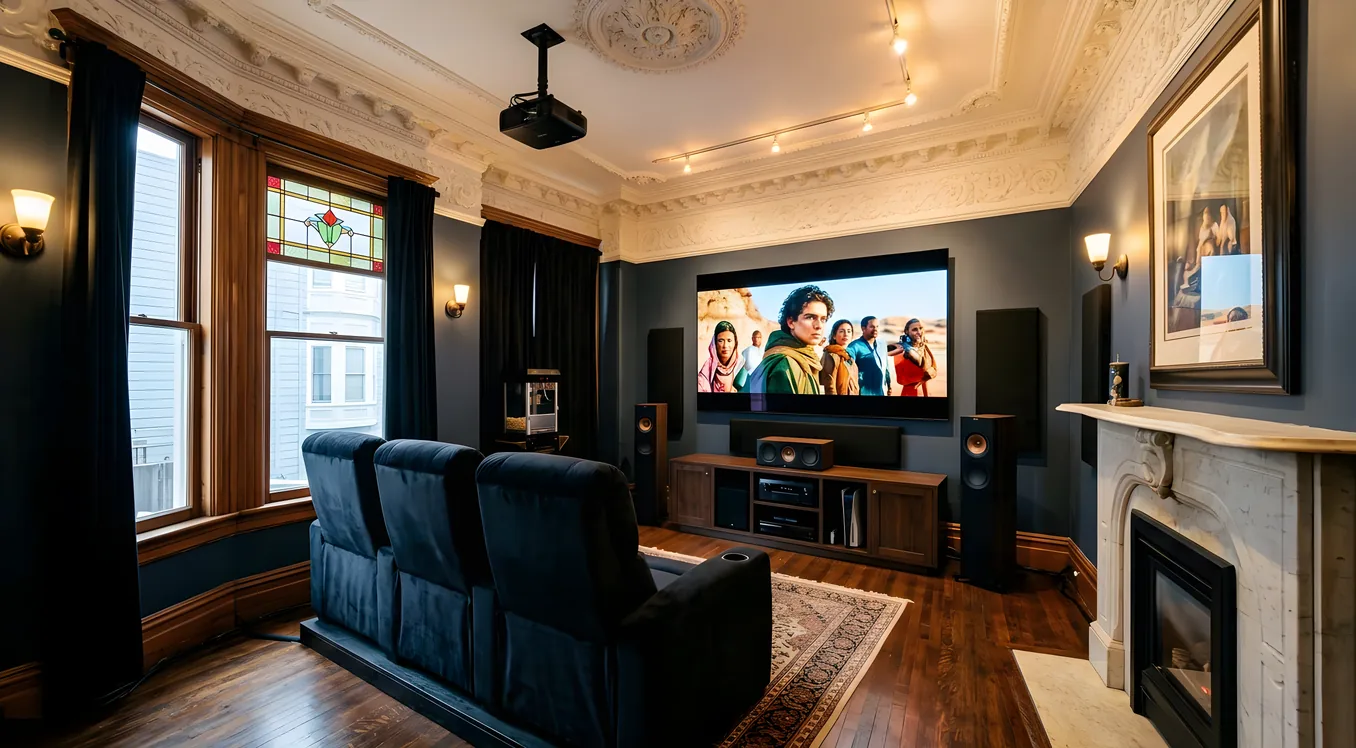
San Francisco’s housing stock is unlike anywhere else in the country, and that shapes every decision in a home theater installation. Most of the city’s residential buildings date from 1890 to the 1920s — Victorian and Edwardian flats, row houses, and multi-unit buildings constructed before modern electrical codes, before drywall, and before anyone thought about running HDMI cable through a wall cavity.
That doesn’t mean home theater installation in San Francisco is impossible. It means the installation looks different from what you’d find in a Dallas new-build or a Phoenix suburban ranch. Knowing what’s coming before you start saves money, time, and the specific frustration of discovering knob-and-tube wiring after you’ve already bought a projector.
The Victorian Housing Problem
The most common challenge in San Francisco home theater work is the wall construction. Victorian and Edwardian homes use plaster over wood lath, not drywall. The surface looks the same from the front, but the behavior is different in ways that matter for installation work.
Plaster is harder and heavier than drywall. Drilling into it without the right bit throws dust and can crack the surrounding plaster in a radius you won’t enjoy. Toggle bolts or heavy-duty anchors are required for any wall mounting because standard drywall anchors pull through at load. A 65-pound display bracket that would hold reliably with two toggle bolts in drywall may need four anchor points in plaster to get equivalent holding strength.
Fishing wire through lath-and-plaster walls is the bigger issue. Modern construction with drywall allows installers to cut small access holes, feed wire through open stud bays, and patch the holes in an afternoon. Plaster walls often have solid lath running horizontally with minimal air space, and some SF homes have interior plaster walls built around structural elements that block standard fishing paths entirely. The result is that wiring runs that take two hours in a new home can take a full day or require surface-mounted conduit in a Victorian. Factor that into your installation timeline and budget.
Knob-and-tube wiring is another variable. Homes built before the 1940s may still have original knob-and-tube circuits in portions of the house. Adding a dedicated 20-amp circuit for an AV rack or projector requires an electrician, and any work that touches knob-and-tube typically requires bringing that circuit up to current code as a condition of the permit. San Francisco’s Department of Building Inspection (SF DBI) requires permits for new electrical circuits. If your installer doesn’t mention the permit process for electrical work, ask directly.
No Basements: What That Changes
Most San Francisco homes were built on slab or have minimal crawlspace rather than true basements. That eliminates one of the most common dedicated theater room locations found elsewhere in the country. You’re working with what’s above grade.
The practical candidates in a typical San Francisco home, in order of how often they actually work:
Converted garage. Many San Francisco row houses have a street-level garage that was originally used for parking. Converting a garage to a dedicated theater room is the most common path to a proper dedicated space in SF. The concrete floor and walls provide natural sound isolation. The main downsides are loss of parking (meaningful in a city where street parking is consistently difficult) and the work required to bring the space up to conditioned living space standards, including insulation, moisture barrier, and HVAC.
Dedicated bedroom. In larger flats or single-family homes with an extra bedroom, converting that room to a theater is often the cleanest option. The room already has conditioned air, finished walls, and a door. The tradeoff is giving up a bedroom, which affects both daily living and property value.
Living room. Most SF home theaters end up here. Not a dedicated space, not purpose-built, but a living room that doubles as a media room in the evenings. This is a real constraint — furniture placement, ambient light control, and acoustic treatment all have to coexist with daytime function.
Attic space. Some SF Victorians have attic rooms that were originally servants’ quarters or have been finished over the years. The ceiling height is often low at the edges, and the room shape is irregular, but a well-configured attic theater is quieter than main-floor rooms and naturally separate from the rest of the house. Thermal management is the main challenge.
Small Room Theater Strategies
San Francisco rooms are small by national standards. A 10x12 or 12x14 room is typical for a bedroom or secondary living space in most SF housing stock. That puts you in small room theater territory for nearly every non-garage installation.
The implications for equipment choices are specific. Standard throw projectors need 10 to 14 feet of distance to project a 100” image. In a 12-foot room, that math doesn’t work unless you’re mounting at the very back wall and sitting almost against the screen. Ultra-short throw (UST) projectors sit 12 to 20 inches from the screen and project upward, which makes them the practical choice for rooms under 14 feet deep. A UST projector on a low cabinet or floor stand removes the ceiling-mount entirely and avoids drilling into plaster overhead.
For rooms where you want a flat panel instead of a projector, 75” to 85” is the realistic range for a 10x12 to 12x14 space. Larger panels at closer viewing distances create eye fatigue during long viewing sessions and are difficult to position correctly relative to seating in tight layouts.
Speaker configurations should match the room. A compact 5.1 or 5.1.2 system delivers real surround sound without requiring space you don’t have. A full 7.1.4 Atmos layout is physically impractical in a 10x14 room; the speakers would be too close together to create meaningful spatial separation, and the subwoofer placement options are limited by where you can physically fit one. Two height speakers for a 5.1.2 configuration give you the Atmos overhead experience without requiring in-ceiling installation at four positions.
Shared Walls and Soundproofing
San Francisco’s row houses and multi-unit buildings mean shared walls are the default, not the exception. This creates two distinct problems: sound you generate going to your neighbors, and sound from adjacent units coming into your theater.
True soundproofing requires mass and decoupling. Mass is added by layering drywall over existing plaster walls (drywall over plaster adds significant STC points). Decoupling means separating the new wall surface from the structure with resilient channel or isolation clips so vibrations don’t transfer directly. In a rental or condo, neither of these options is available without landlord permission and potentially HOA approval.
For owned properties, the investment in proper soundproofing for a shared-wall theater room pays off in neighbor relations and in-room acoustics. A common approach in SF installations is to build a floating interior room within the garage or dedicated room: a room-within-a-room construction where the inner walls, ceiling, and floor are isolated from the building structure. This is expensive but effective.
For situations where structural soundproofing isn’t possible, acoustic panels and bass traps manage in-room acoustic problems but don’t prevent sound transmission to adjacent units. Equipment volume limits and showtimes become a practical reality. A quality 5.1 system at reasonable volume in a carpeted room with acoustic panels is very different from the same system at full volume in a bare room.
Historic Preservation and Exterior Work
Some San Francisco neighborhoods carry historic preservation restrictions that affect what you can do to the exterior of a building. The Castro, Haight-Ashbury, and Alamo Square neighborhoods include properties under Article 10 landmark designation or in Article 11 conservation districts. The restrictions vary by property and district, but they typically govern exterior modifications.
For most home theater installations, this doesn’t matter directly. Running cables inside existing walls or mounting equipment in a garage doesn’t require exterior modification. Where it becomes relevant is in whole-house audio work, security camera mounting that requires exterior conduit, or any structural work on a garage conversion that changes the exterior facade. If your project involves exterior modifications, check with SF DBI and the Planning Department before starting.
Cost Premiums in San Francisco
Labor costs for home theater installation in San Francisco run 20 to 40 percent above national averages, consistent with the broader Bay Area trades premium. For a full breakdown of what that means in dollar terms, Bay Area home theater costs covers the current range for different project types.
One cost variable specific to San Francisco that doesn’t appear in national cost estimates: truck parking. Installers working in dense residential neighborhoods often can’t get a work vehicle within a reasonable distance of the job site. Parking fees, parking ticket risk, and extra time carrying equipment add real cost to urban installations. Some SF-based installers include a logistics surcharge for dense neighborhoods or plan installations to consolidate equipment-carrying trips. It’s worth asking about this explicitly when getting quotes from Bay Area installers.
Climate Advantages
One area where San Francisco genuinely works in your favor is the climate. SF’s famously mild weather means you’re not dealing with the HVAC requirements that complicate home theater installations in hot climates. A garage conversion in Phoenix needs serious cooling infrastructure to manage the heat generated by projectors, amplifiers, and receivers in an enclosed space during summer. In San Francisco, a well-ventilated equipment rack and a ceiling fan are typically sufficient. This isn’t nothing; thermal management is one of the recurring budget items in theater installations elsewhere, and SF projects can often skip it entirely.
Equipment Recommendations for SF Conditions
Given the constraints of older SF housing stock, a few equipment choices come up consistently in well-executed SF installations:
UST projectors or large flat panels over standard throw projectors, for the reasons covered above. UST eliminates ceiling-mount drilling in plaster and works in rooms too short for standard throw.
In-wall speakers require opening plaster walls, which is labor-intensive. Bookshelf speakers on stands or mounts avoid that entirely and can be placed and repositioned more easily. For ceiling Atmos speakers in a plaster ceiling, expect the installation to take longer and cost more than it would in new construction.
A clean equipment rack in a closet or dedicated cabinet reduces visible cable runs in a room where surface-mounted conduit might be the only alternative to exposed cables. Many SF living rooms don’t have ideal cable management paths, and a well-placed rack keeps the system organized without requiring extensive wall work.
For historic homes where preserving the original plaster is important, working with older homes covers non-destructive mounting approaches that avoid large holes in period walls while still achieving secure mounting for displays and speakers.
Getting the Most from an SF Theater Installation
San Francisco home theater installation rewards planning more than most markets. The combination of older construction, small rooms, shared walls, and high labor costs means that decisions made before any equipment is purchased have outsized impact on the final result. A room that’s been assessed correctly, with wire runs planned in advance, equipment chosen for the actual room dimensions, and acoustic considerations addressed at the design stage, delivers a better experience at lower total cost than an installation where problems are discovered mid-project.
The city’s housing stock is a genuine constraint. It’s also not unusual; tens of thousands of SF residents have built excellent home theaters in Victorian flats, converted garages, and compact living rooms. The installations just look different from what you’d find in newer construction, and the right approach accounts for that from the start.