Home Theater in a Small Room: Making Under 200 Square Feet Work
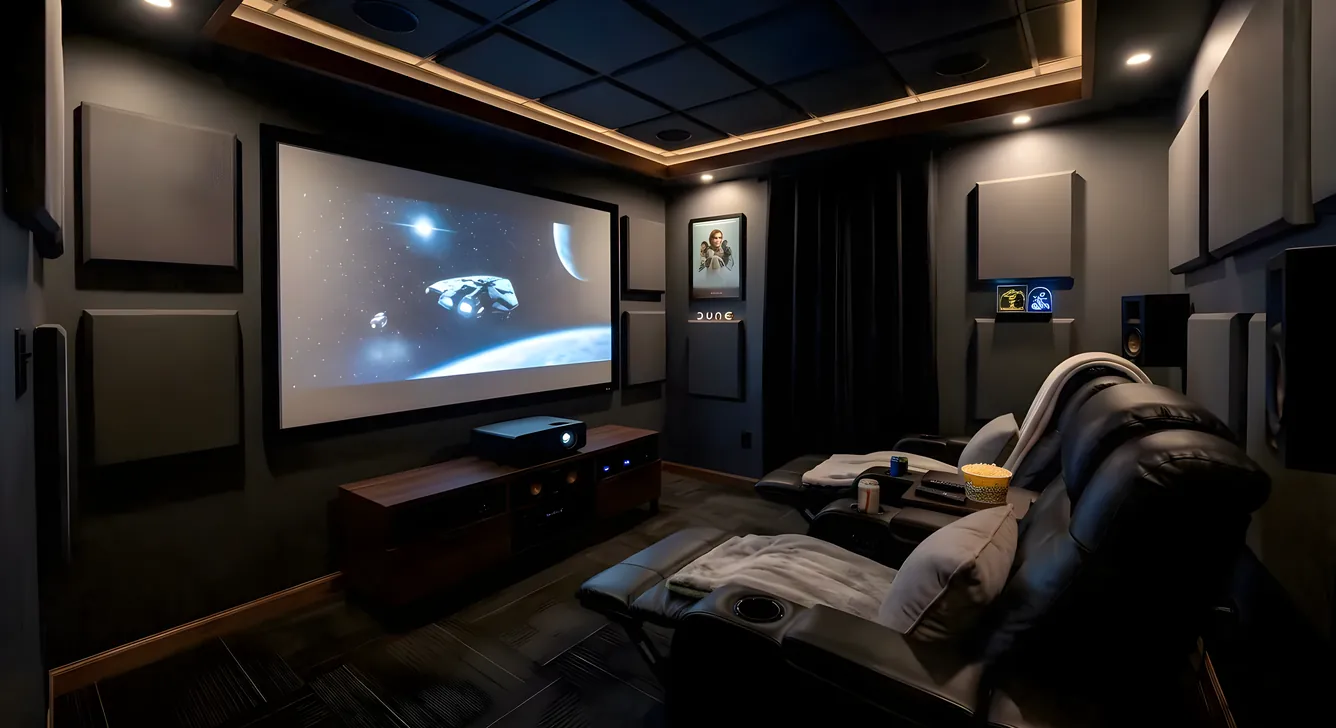
Most home theater guides assume you have a dedicated 15x20 space with room to spare. If you’re working with a 10x12 bedroom, a 10x15 spare room, or an 11x14 bonus space, those guides leave you with advice you can’t use.
Small rooms are genuinely workable for home theater, but the physics are different. Bass modes are more aggressive. Viewing distances are shorter. Speaker placement options are limited. The good news is that under 200 square feet, you need less acoustic treatment surface area, one row of seating, and a projector built for tight throws. None of that is a compromise — it’s just a different set of decisions.
This guide covers what actually changes in rooms between 120 and 200 square feet and how to make the right calls on screen, speakers, bass, seating, and thermal management.
Screen Size: What the Viewing Distance Actually Allows
The most common mistake in small rooms is buying too large a screen. The constraint isn’t budget or wall space; it’s minimum viewing distance.
For a 4K projector or display, the generally accepted minimum viewing distance is about 1.5 times the screen height. For a 16:9 screen, that works out to roughly 1.0 to 1.2 times the diagonal measurement. So a 100” diagonal screen (about 49” tall) puts your minimum comfortable seat distance at roughly 8 feet. A 110” screen pushes that to 9 feet.
Here’s how that maps to common small room dimensions:
| Room Length | Usable Seating Distance | Realistic Screen Size |
|---|---|---|
| 10 ft | 7–7.5 ft | 85–90” |
| 12 ft | 9–9.5 ft | 90–100” |
| 14 ft | 10.5–11 ft | 100–110” |
| 15 ft | 11–12 ft | 100–115” |
An 85” to 110” screen is realistic for most small rooms, and that range is excellent. It delivers a genuinely immersive experience without requiring you to sit uncomfortably close. Don’t let anyone convince you that under 120” is settling; for a 10x12 room, 90” at 7.5 feet is a better experience than 120” at 6 feet.
For room dimension planning that includes throw distance math, work through the projector placement before committing to a screen size.
Short Throw Projectors: The Right Tool for Limited Space
Standard throw projectors typically need 10–14 feet of distance to project a 100” image. In a 10x12 room, that’s not available. A short throw projector changes the math significantly.
Short throw projectors (throw ratio around 0.4–0.8:1) can produce a 100” image from 4–8 feet. Ultra-short throw models (0.15–0.25:1) sit 12–20 inches from the wall and project upward, often eliminating ceiling mounting entirely.
The tradeoffs to know before buying:
Short throw projectors are more sensitive to screen flatness. A slight bow or wrinkle in a screen that looks fine with a standard throw will show as image distortion at tighter angles. For UST models specifically, you’ll want a rigid ambient light rejection (ALR) screen designed for low-angle projection.
Lens shift and keystone correction matter more in tight rooms because small adjustments have big effects. Look for optical lens shift rather than digital keystone correction, which degrades image quality. For a detailed comparison of what to expect from each type, our short throw vs long throw projector guide covers the image quality tradeoffs in full.
Speaker Placement in Small Rooms
Tower speakers are off the table in a 10x15 room with a single row of seating. Between the screen, the seating row, and basic walkways, there simply isn’t floor space, and towers close to a front wall create boomy low-mid buildup that’s hard to fix with EQ.
Front left and right: Bookshelf speakers on stands, placed 2–3 feet from the front wall and angled slightly inward, are the standard solution. Stand height should put the tweeter at ear level when seated — typically 36–42 inches for a single low-profile seating row. Bookshelf speakers can be positioned more precisely than towers and perform better in limited space.
Center channel: A center channel speaker placed below or above the screen (below is preferred, above only if the screen angle accommodates it) is worth including. Dialogue intelligibility suffers noticeably without a dedicated center, and dialogue is where small room acoustics cause the most problems.
Surround channels: Small rooms rarely have ideal surround placement, but don’t skip them. The options in order of preference:
- Compact bookshelf speakers on side walls, mounted at or slightly above ear level
- In-ceiling speakers over or just behind the seating position
- Dipole/bipole surrounds on side walls for a diffuse effect
In-ceiling surrounds are often the cleanest option in rooms where wall mounting isn’t practical or where you’re going for a finished look. For a thorough treatment of surround configuration options in tight spaces, see our guide on surround sound in small rooms.
Rear surrounds: In 7.1 or Dolby Atmos 7.x configurations, rear surrounds behind a single seating row are often within 2–3 feet of the listeners. At that distance, rear speakers need to be at a lower volume than you’d expect from a typical configuration. Let your AVR’s room correction calibration (Audyssey, Dirac, YPAO) set the levels rather than estimating them manually.
Subwoofer Placement and Bass Modes
Bass management in small rooms is the part most people underestimate. Below approximately 300 Hz, sound behaves as a wave, not a ray — it reflects off walls, builds up at room boundaries, and creates pressure nodes (peaks) and nulls (dead spots) based on the room’s dimensions.
In a 10x12 room, the primary axial modes fall around 47 Hz (12-foot dimension) and 56 Hz (10-foot dimension). Those are exactly the frequencies that home theater content uses heavily. Standing waves at those frequencies mean that moving your seating position by two feet can change perceived bass by 6–10 dB.
A sealed subwoofer is the better choice for small rooms. Ported subwoofers extend lower but roll off faster below their tuning frequency and are harder to integrate in a room where placement is constrained. A sealed sub’s gentler rolloff is more forgiving in placement-limited situations.
For placement, start with the subwoofer crawl method: place the sub at your seating position, play a bass-heavy test tone or music, then walk the perimeter of the room while listening for where bass sounds tightest and most consistent. That location is where the sub belongs.
In a small room, the front corners are often the loudest spots but not always the flattest. Corner placement increases output significantly, which in a small room may make EQ correction necessary. A position along the front wall between the left speaker and the front corner is often a reasonable starting point.
Room correction software in your AVR or an outboard unit like a miniDSP will help flatten the response significantly. In small rooms, it’s not optional — it’s the difference between bass that works and bass that’s exhausting.
Seating: Single Row, Done Right
A room under 200 square feet accommodates one row of seating. That’s not a limitation to work around; it simplifies everything. No riser is needed. No need to calculate line-of-sight angles between rows. No staggered seating arrangement.
Standard home theater seating rows run 18–24 inches deep per seat, plus the seat’s recline clearance (usually 12–18 inches behind for full recline). In a 10-foot-wide room, two or three seats across is typical. Three seats at standard 22-inch widths requires about 66 inches of width — manageable if walkways on each side are tight but not uncommon in purpose-built theater rooms.
Leave at least 18 inches between the back of the seat (reclined) and the rear wall. Sitting immediately against a wall creates bass buildup and can make the room feel closed in.
Seat height matters for screen angle. With a floor-mounted or very low-mounted screen, the center of the image should be roughly at or slightly below eye level when seated. With a ceiling-mounted projector throwing to a screen above the floor, check that the angle from seated eye level to the top of the screen doesn’t exceed about 35 degrees.
Acoustic Treatment: More Effective Per Dollar in Small Rooms
Small rooms have an advantage in acoustic treatment: less surface area means less material required to hit a meaningful absorption coefficient. A 10x12 room needs far less panel square footage than a 20x15 space.
The priority order for treatment in a small room:
1. First reflection points. Find the points on side walls where a mirror placed flat against the wall would show you the left or right speaker while seated. Absorption panels at those points reduce flutter echo and improve imaging. In a 10x12 room, these reflection points may be close to the speakers themselves.
2. Front wall treatment. Behind or around the screen, absorption reduces early reflections from the front wall. Bass traps in the front corners address the low frequencies that accumulate there.
3. Rear wall. A mix of absorption and diffusion on the rear wall behind the seating position helps. Pure absorption makes the room dead; some diffusion maintains a sense of space.
4. Ceiling. In a low-ceiling room, ceiling treatment above the seating position reduces a significant reflection path. Cloud panels (suspended absorption panels) above the seating row are a practical approach.
A room that’s over-treated is possible in a very small space. If every surface is covered in dense absorption, you lose natural liveliness and voices can sound artificially dry. Aim for RT60 values around 0.3–0.4 seconds for a small home theater, not the 0.15–0.2 seconds you’d see in a professional studio.
Dark Colors Without Making the Room Feel Smaller
Dark wall colors reduce light reflection off surfaces and improve perceived contrast on screen. In a home theater, that’s the right call. The concern about making a small room feel “smaller” is mostly irrelevant in a dedicated theater space where you’re watching in near-darkness — the walls disappear anyway.
That said, there’s a sensible approach:
Paint the ceiling and the front wall (behind the screen) in your darkest shade: deep charcoal, matte black, or a very dark gray. These are the two surfaces most likely to pick up light from the screen and degrade image quality.
Side walls can go slightly lighter — a dark gray or deep brown rather than pure black — which reduces the cave effect slightly while still controlling reflection.
If the room doubles as a living space or media room, consider a treatment that separates the theater zone visually: dark acoustic panels on the front and side walls, lighter drywall behind them, so the space reads as a room with a dedicated screen wall rather than a black box.
Matte finishes are non-negotiable on all surfaces in the viewing area. Semi-gloss or eggshell reflects point sources and creates visible hot spots.
Equipment Placement and Ventilation
A sealed small room with electronics running generates significant heat. An AVR at moderate volume in a 10x12 room can raise ambient temperature 5–10 degrees over a two-hour session. That’s enough to cause thermal throttling in projectors and AVRs without adequate airflow.
Equipment rack or closet: If the room has a closet adjacent to the theater area, converting it to an equipment closet is the cleanest solution. Run cables through a port or conduit, and install a small ventilation fan to exhaust heat. A thermostatically controlled fan (one that triggers at 80°F and shuts off at 72°F) handles this automatically.
Wall-mounted receiver: For rooms without closet access, wall-mounting the AVR on the rear or side wall with at least 6 inches of clearance above and on the sides allows convection to do some work. Purpose-built AV furniture with open backs and ventilated shelves is better than a standard closed entertainment center.
Projector heat: Ceiling-mounted projectors exhaust heat upward and to the sides. Ensure the projector isn’t in a box or enclosure that traps that exhaust. Some projectors have rear or front exhaust ports that require specific clearances — check the manual before finalizing the mount position.
Dedicated cooling: In a sealed room under 150 square feet, a small through-wall mini split or a portable air conditioner with external exhaust is worth considering. Running a session without it and measuring room temperature at the two-hour mark will tell you whether passive ventilation is adequate.
What Small Room Home Theater Gets Right
The tradeoffs in a small room home theater are real, but so are the advantages. A single seating row means every seat is the best seat. The listening distance is short enough that even modestly powered bookshelf speakers produce room-filling volume without being pushed hard. Acoustic treatment achieves meaningful results with fewer panels. And the immersion of an 85–100” screen at 7–9 feet rivals much larger setups where you’re sitting 15 feet from a 130” screen.
The rooms that fail are the ones that try to replicate a large-room setup in a small space: towers competing for floor area, a subwoofer producing uncorrected peaks, seating too close to the screen. Work with the room’s dimensions rather than against them, and a 10x15 space is more than enough to build something genuinely good.