Short Throw vs Long Throw Projectors: Which Fits Your Room
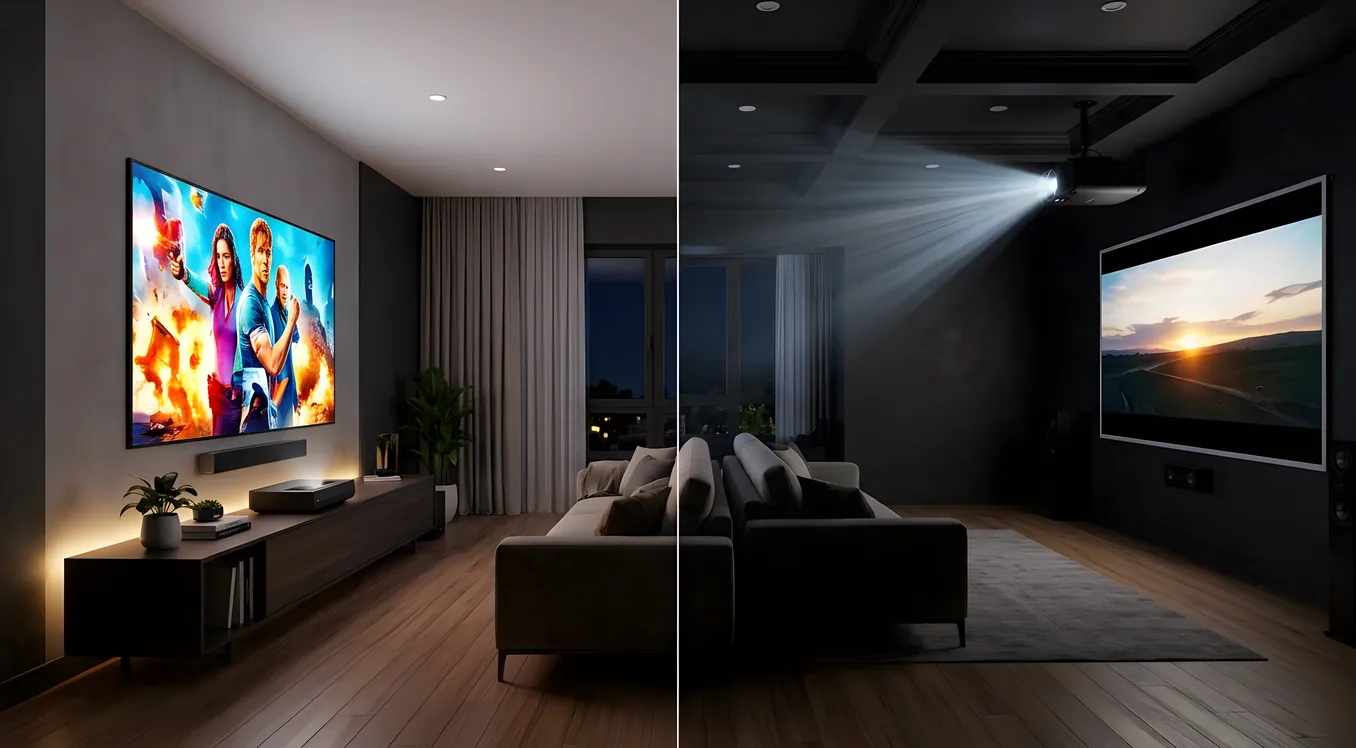
Throw ratio is the single number that determines whether a projector fits your room. It expresses the relationship between the projector’s distance from the screen and the image width it produces. A projector with a throw ratio of 2.0:1 needs 10 feet of distance to produce a 5-foot-wide image. That ratio is everything when you’re deciding between a standard throw, short throw, or ultra-short throw unit.
Understanding where each type sits on that spectrum, and what the numbers mean for your actual room, saves you from buying a projector that either clips your image against the back wall or sits so far back it blocks foot traffic. This guide covers the three categories with real specs, model examples, and the room-size math so you can match the hardware to the space.
Throw Ratio Categories: What the Numbers Mean
The projector industry uses three broadly recognized throw categories, each defined by its ratio range:
Standard (long throw): Throw ratio 1.5:1 to 2.5:1. These projectors need the most distance between lens and screen. A standard throw unit producing a 120-inch diagonal image (roughly 8.7 feet wide) requires 13 to 21.8 feet of throw distance. Purpose-built for dedicated theater rooms with 15 to 25 feet of depth.
Short throw: Throw ratio 0.4:1 to 1.0:1. These projectors get you a large image from 3.5 to 8 feet back. A 100-inch diagonal image (about 7.25 feet wide) from a 0.69:1 throw ratio projector only needs about 5 feet of distance. Living rooms and multipurpose spaces that can’t accommodate a projector mounted at the back of a 20-foot room.
Ultra-short throw (UST): Throw ratio under 0.4:1, typically 0.19:1 to 0.25:1. These units sit directly below the screen, often 6 to 18 inches from the wall, and project upward at an extreme angle. A 120-inch image from a 0.24:1 UST projector requires only about 2.1 feet of distance.
The image width calculation is always: distance divided by throw ratio equals image width. From there, use the Pythagorean theorem (or a projector calculator) to convert image width to diagonal screen size.
Standard Throw Projectors: Best Image Quality Per Dollar
Standard throw projectors dominate home theater installations because they’re optically simpler. A long light path through a conventional lens suffers less aberration and chromatic fringing than the extreme-angle optics required for short and ultra-short throw designs.
The Epson LS12000 is the benchmark in the $2,500 to $3,000 range. It uses laser-phosphor illumination, producing up to 2,700 lumens with a native 4K (3840x2160) panel via pixel-shift technology. Throw ratio runs 1.32:1 to 2.15:1 with a 2.55x power zoom lens. At 120 inches diagonal (87.6 inches wide), you need 9.7 to 15.8 feet of throw distance. The LS12000’s motorized lens shift (96% vertical, 47% horizontal) means you have flexibility in placement without keystone distortion.
The tradeoff with standard throw is installation complexity. You’re either ceiling-mounting behind seated viewers or placing the projector on a rear shelf. Both require proper projector mounting and positioning planning, cable management, and often an IR extender for the remote.
| Spec | Epson LS12000 |
|---|---|
| Throw ratio | 1.32:1 – 2.15:1 |
| Native resolution | 4K (pixel shift) |
| Brightness | 2,700 lumens |
| Light source | Laser phosphor |
| Lens shift | Yes (motorized) |
| Price range | ~$2,500–$3,000 |
Short Throw Projectors: More Placement Flexibility, Some Optical Compromises
Short throw units fill the gap between a ceiling-mounted standard throw and a UST laser TV. They work from a table or low shelf positioned 4 to 8 feet from the screen, which suits apartments and rooms where ceiling mounting is impractical.
The BenQ TH671ST illustrates the category. It has a 0.69:1 throw ratio, 3,000 lumens, and 1080p resolution via DLP. To produce a 100-inch diagonal image (87 inches wide), you need about 5 feet of throw distance. A shelf, coffee table, or short projector stand positioned a few feet in front of the seating area works. Price is typically $700 to $800.
The optical compromise at short throw ratios is barrel distortion and corner softness. DLP short throw projectors handle the optics reasonably well, but image quality at the extreme corners often degrades compared to a standard throw unit at the same price point. If critical picture quality matters more than placement flexibility, the standard throw alternative at the same budget typically wins on image.
Short throw projectors also face the shadow problem. Because the projector is close to the screen and at a lower angle, anyone walking between the lens and the screen casts a shadow. This is less disruptive in a dedicated space but genuinely annoying in a living room where people move around.
| Spec | BenQ TH671ST |
|---|---|
| Throw ratio | 0.69:1 |
| Native resolution | 1080p |
| Brightness | 3,000 lumens |
| Light source | Lamp |
| Lens shift | No |
| Price range | ~$700–$800 |
Ultra-Short Throw Projectors: The Apartment-Friendly Option With Real Limitations
Ultra-short throw projectors project from inches away, which makes them the only practical choice for rooms where there is simply nowhere to put a projector at distance. They sit on a credenza or dedicated stand below the screen, cables stay out of sight, and the installation looks like a TV setup.
The Hisense PX2-Pro and Samsung The Premiere LSP9T represent different tiers of the UST market.
The Hisense PX2-Pro uses triple-laser illumination and a 0.25:1 throw ratio to produce up to 2,000 lumens with native 4K resolution. At 120 inches, the unit sits roughly 16 to 18 inches from the wall. Rated at 25,000 hours of laser life. Price is around $3,000.
The Samsung LSP9T uses a triple-laser light source, 0.19:1 throw ratio, and delivers up to 2,800 lumens at native 4K. Samsung’s Tizen smart TV platform is built in, with no external streaming box required. It includes a 2.2.2-channel speaker array. Price runs $4,500 to $5,000 depending on retailer.
| Spec | Hisense PX2-Pro | Samsung LSP9T |
|---|---|---|
| Throw ratio | 0.25:1 | 0.19:1 |
| Native resolution | 4K | 4K |
| Brightness | 2,000 lumens | 2,800 lumens |
| Light source | Triple laser | Triple laser |
| Built-in audio | No | 2.2.2-ch |
| Price range | ~$3,000 | ~$4,500–$5,000 |
The ALR Screen Requirement for UST
This is the most important practical constraint for UST projectors, and it’s the one buyers most often overlook. Ultra-short throw projectors project at an extreme upward angle. A standard white gain screen reflects light in all directions, including back toward the ceiling and into ambient light sources. The result: washed-out, low-contrast images in any room with normal lighting.
UST projectors require an Ambient Light Rejecting (ALR) screen designed for steep projection angles. These screens use a micro-structure surface that reflects light toward the viewer while absorbing off-axis light from windows, overhead fixtures, and lamps. The result is a usable image in a lit room.
ALR screens for UST applications come from brands like Elite Screens (CLR3 series), Silver Ticket (STALT), and Stewart Filmscreen. A quality UST ALR screen in the 100 to 120-inch range adds $300 to $1,500 to the total system cost. A standard white screen will technically work with a UST projector in a completely dark room, but it defeats most of the practical advantages of the UST category. You can read more about screen selection in the ALR screens guide.
Room Size Calculations: Matching Projector Type to Space
Use these numbers to calculate whether a projector category fits your room. The formula: screen width = throw distance / throw ratio.
For a 100-inch diagonal screen (87.1 inches / 7.26 feet wide):
| Category | Throw ratio | Required distance |
|---|---|---|
| Standard throw | 1.5:1 | 10.9 feet |
| Standard throw | 2.5:1 | 18.1 feet |
| Short throw | 0.69:1 | 5.0 feet |
| Ultra-short throw | 0.25:1 | 1.8 feet |
For a 120-inch diagonal screen (104.7 inches / 8.7 feet wide):
| Category | Throw ratio | Required distance |
|---|---|---|
| Standard throw | 1.5:1 | 13.1 feet |
| Standard throw | 2.5:1 | 21.8 feet |
| Short throw | 0.69:1 | 6.0 feet |
| Ultra-short throw | 0.25:1 | 2.2 feet |
Add 2 to 3 feet behind the projector to the total room depth requirement for standard throw installations. The projector itself has physical depth, and you want air circulation clearance around the unit.
For ceiling-mounted standard throw setups, ceiling height also matters. A standard projector body hangs 4 to 6 inches below the mount, and the lens center needs to align with (or sit within the lens shift range of) the top edge of the screen. Low ceilings in a room under 8 feet can create installation problems even if the horizontal throw distance is adequate.
Pros and Cons: Side-by-Side
| Standard throw | Short throw | Ultra-short throw | |
|---|---|---|---|
| Image quality ceiling | Highest | Moderate | Moderate-high (varies by optics) |
| Ambient light tolerance | Low without ALR | Low without ALR | Moderate (with UST ALR screen) |
| Shadow interference | Low (rear/ceiling mount) | Moderate | None |
| Installation complexity | High | Low-medium | Low |
| ALR screen required | No | No | Yes (for any normal lighting) |
| 4K availability | Yes | Limited | Yes |
| Price floor | ~$1,000 | ~$500 | ~$1,500 |
| Best room type | Dedicated theater (15+ ft) | Multipurpose (10–15 ft) | Apartment / small living room |
When to Choose Each Type
Standard throw fits your situation if: you have a dedicated home theater room with 15 or more feet of depth, you can ceiling-mount a projector above and behind seated viewers, and picture quality is the priority over convenience. This is where the Epson LS12000 and similar units deliver results that UST projectors at the same price point cannot match, particularly in contrast and corner sharpness.
Short throw fits your situation if: you have a room between 10 and 15 feet deep where ceiling mounting isn’t practical, you’re working with a 1080p content library and don’t need 4K, and the budget is under $1,000. The placement flexibility is real. The picture quality ceiling is lower than standard throw at the same price, so go in knowing that tradeoff.
Ultra-short throw fits your situation if: the room doesn’t permit any throw distance, you want a TV-like installation footprint with projector screen size, you can budget for a dedicated UST ALR screen, and you accept that you’re paying a significant premium for that form factor. The Samsung LSP9T and Hisense PX2-Pro are genuinely impressive, but at $3,000 to $5,000 for the projector alone before the screen, they cost more than most standard throw setups at equivalent image quality.
The one scenario where UST projectors are clearly the correct tool: a small apartment living room with a short wall, no ceiling mounting option, and ambient light that can’t be controlled. In that room, a UST projector with an ALR screen is the only way to get a 100-inch image.
Getting the Setup Right
Projector category choice is the first decision, but not the last. The projectors guide covers screen gain matching, lumens-to-room-size ratios, and color calibration considerations that determine whether you get a great image from any of these units. Throw ratio gets the projector in the right position. Everything after that determines whether the image is actually worth watching.