ALR Screens: Ambient Light Rejecting Screens for Bright Rooms
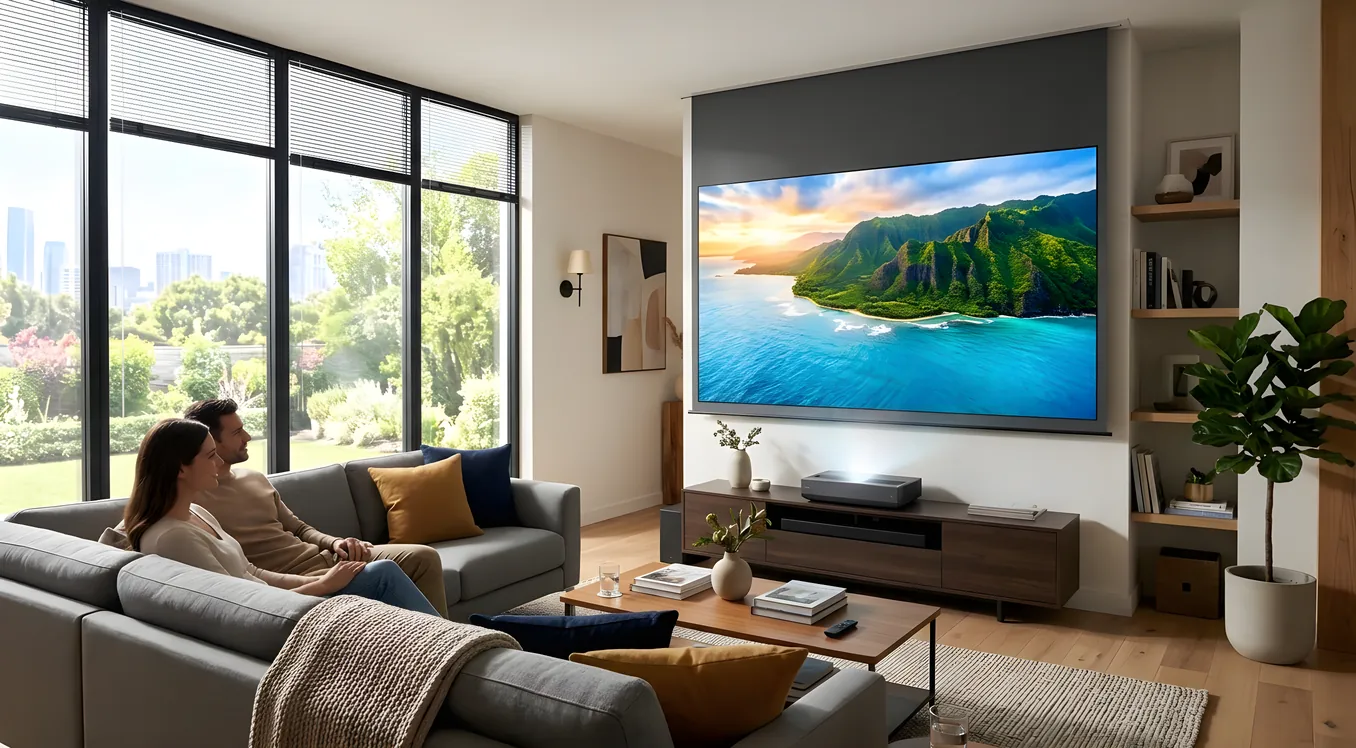
A projector image is beautiful in the dark. Put that same projector in a living room with afternoon sun coming through the windows and the picture washes out, contrast collapses, and colors go flat. This is the problem ambient light rejecting screens were built to solve, and they solve it through physics rather than software.
What an ALR Screen Actually Does
Standard projection screens are passive diffusers. They scatter reflected light in all directions equally, which means ambient light from windows, overhead fixtures, or lamps reflects back at the viewer with almost the same efficiency as the projected image. The signal-to-noise ratio suffers.
ALR screens break that symmetry. They are engineered to be directionally selective: they reflect light arriving from the projector’s throw angle and reject light arriving from other directions, primarily from above and to the sides. The result is that your projector’s light reaches your eyes while room light largely does not. Contrast improves dramatically without any change to the projector itself.
The key physical concept is angular reflectivity. A standard matte white screen has a wide reflectance cone and no directional preference. An ALR screen has a narrower, shaped reflectance profile that favors one incoming angle. How steeply that profile drops off determines how much ambient light the screen rejects, and also how much it narrows the usable viewing cone for viewers seated off-axis.
Two Types: CLR vs. Standard ALR
The ALR category splits into two meaningfully different products depending on where your projector sits.
Ceiling Light Rejecting (CLR) screens are designed specifically for ultra-short-throw projectors. A UST projector sits on furniture directly below the screen and fires its image upward at a very steep angle. CLR screens are engineered to accept that steep upward throw angle and reject the overhead ambient light that would otherwise kill contrast. The reflective geometry is tuned for a projector at near-zero throw distance.
Standard ALR screens work with conventional long-throw and short-throw projectors mounted on the ceiling or back wall. They are designed for incoming light at a moderate horizontal angle and reject ceiling and side ambient light that arrives at different angles from that throw path.
The distinction matters because the two types are not interchangeable. Pairing a CLR screen with a long-throw projector will produce poor results because the incoming throw angle does not match what the screen’s optical structure is designed to handle. Similarly, a UST projector paired with a standard ALR screen will perform below its potential.
For more context on projector placement geometry, see our guide on short throw vs long throw projectors.
How They’re Built: Lenticular and Micro-Layer Construction
Two main optical constructions account for most of the ALR market.
Lenticular construction uses a surface covered in tiny prism-shaped ridges oriented horizontally. The geometry of each ridge determines which incoming angles get reflected toward the viewer and which get deflected away. Most CLR screens use some form of lenticular or prismatic geometry because the steep UST throw angle is well-suited to this approach. The ridges are visible if you examine the screen closely at an angle, but from normal viewing distances the surface reads as uniform.
Multi-layer or micro-layer construction uses thin optical coatings, sometimes with a black absorber layer underneath a reflective layer. Ambient light that passes through the reflective layer gets absorbed by the black backing rather than scattered back. These screens can achieve a wide viewing angle with useful ambient light rejection, though typically at lower rejection ratios than lenticular designs. Screen Innovations’ Black Diamond product line uses a multi-layer approach that has become a reference point for living-room ALR performance.
The construction method affects not just rejection ratio but also texture, color accuracy, and sparkle (the grain-like artifact some lenticular screens show with certain projector optics at certain zoom settings).
Gain and Viewing Angle Tradeoffs
ALR screens almost always carry gain above 1.0, meaning they reflect more light toward the viewer per unit of projector output than a flat 1.0-gain matte white surface would. Gain specs of 0.8 to 1.4 are common for standard ALR; CLR screens aimed at high-brightness UST projectors sometimes push to 0.6 or lower in exchange for stronger rejection.
Higher gain concentrates brightness into a narrower viewing cone. A screen rated at 1.3 gain will look brighter than a 1.0-gain screen from the center seat, but viewers seated far off-axis will see brightness and color shift faster as they move away from the sweet spot. The tradeoff is inherent to the physics: the same optical shaping that rejects ambient light also concentrates reflected projector light directionally.
A reasonable rule of thumb: for rooms where most seating falls within 30 to 35 degrees off center, standard ALR gain specs work well. For very wide seating arrangements, look at lower-gain ALR options and check the manufacturer’s half-gain angle specification, which tells you the angle at which brightness drops to half of the on-axis measurement.
This tradeoff is worth understanding before shopping. The gain spec on the box tells only part of the story; the angular response curve tells you far more about how a screen will actually perform across a real room.
Brands Worth Knowing
Screen Innovations Black Diamond is probably the most widely referenced ALR screen in the enthusiast segment. The multi-layer construction delivers wide viewing angles with meaningful ambient light rejection, and the material is available in multiple gain levels (0.8 and higher) to match different projector brightness targets. It is expensive, but it has a long track record in installed environments.
Elite Screens StarBright CLR targets the UST pairing market at a significantly lower price point than premium competitors. Build quality and performance are appropriate for the price, and it has become a common recommendation for buyers getting into the UST category without wanting to spend as much on the screen as on the projector.
Vividstorm S Pro is a motorized floor-rising CLR screen designed specifically for UST projectors. The screen rises from a cabinet housing at the base, which keeps the optical surface protected when not in use. The combination of UST compatibility and motorized operation makes it well-suited to living rooms where the screen needs to disappear when not in use.
Other notable options include the Grandview Cyber ALR and Epson’s own UST-paired screen offerings. The category has grown considerably as UST projectors have moved into mainstream home theater and living-room installations.
When ALR Is Worth It
ALR screens are not the right choice for every installation. In a dedicated home theater with controlled lighting and blackout capability, a high-quality matte white screen will outperform most ALR materials for color accuracy, viewing angle, and texture neutrality. ALR materials have tradeoffs that a dark room makes unnecessary and sometimes counterproductive.
ALR makes sense when:
- The room has windows that cannot be fully covered during viewing periods
- Overhead recessed lighting or ceiling fixtures are present and difficult to control
- The space doubles as a living room, family room, or multipurpose area where full blackout is impractical
- A UST projector is part of the setup, making CLR a functional requirement rather than an optional upgrade
The right comparison is not “ALR vs. matte white.” It is “acceptable image with ALR vs. washed-out image with matte white in this specific room.” In a bright room, ALR usually wins that comparison by a significant margin.
For a broader look at how screen selection fits into room design, the projection screens guide covers material options, screen size formulas, and gain considerations across the full category. And for managing ambient light beyond just screen selection, see our coverage on ambient light management.
UST Projectors and CLR Screens as a System
The UST projector paired with a CLR screen has become a category of its own within home theater. Projectors from Sony, Samsung (The Premiere), LG, and others are purpose-built to project at extremely short distances, eliminating ceiling mount requirements and long cable runs. The projector sits on a credenza or AV furniture below the screen and fills a large image from inches away.
This works well with CLR screens because the steep upward throw angle is exactly what CLR optical geometry is designed for. The combination produces bright, high-contrast images in living rooms that previously had no good projector option. The image quality from a well-matched UST and CLR screen combination is genuinely competitive with large-format televisions, with the advantage of significantly larger diagonal sizes at comparable price points.
The system approach is worth emphasizing because CLR screens are not useful as standalone upgrades unless you also have a compatible UST projector. Buying a CLR screen to use with a ceiling-mounted long-throw projector is a mismatch that will perform poorly.
Price Premium and What You’re Paying For
Standard projection screen materials in common sizes run from under $100 for basic fixed-frame options to $300 to $600 for quality matte white options from established brands. ALR screens at equivalent sizes typically start at $400 to $800 and can run $2,000 to $4,000 or more for premium materials from Screen Innovations or similar.
The 3x to 5x price premium over comparable matte white screens reflects several things: the optical precision required for directional reflectivity, the multi-layer or lenticular manufacturing process, tighter quality tolerances on material uniformity, and relatively lower production volumes. ALR materials are still a specialty category even as they have grown in mainstream availability.
For many buyers, the premium is worth it precisely because it enables a projector setup in a space that would otherwise require a television. The cost comparison shifts when you frame it as: ALR screen plus UST projector versus a 100-inch television. At that comparison, the ALR system is often the more practical path to a large, bright image in a lit room.
Budget buyers should be cautious with very low-cost ALR materials from unknown brands. The optical precision that makes ALR work is not easily replicated cheaply, and low-cost options often deliver disappointing rejection ratios, uneven gain across the surface, or texture artifacts that become distracting at normal viewing distances.
Choosing the Right ALR Screen
Start with your projector. If you have or plan to have a UST projector, CLR is your category. If you have a standard long-throw or short-throw projector mounted at ceiling level or table level behind the seating, standard ALR is your category.
Then assess your actual ambient light situation. Measure where the light comes from: overhead fixtures, windows on the sides, windows facing the screen directly. ALR screens are most effective against overhead and side ambient light. Light arriving from directly in front of the screen (behind the viewer, facing the screen) is harder for ALR geometry to reject, and some screens handle this better than others.
Finally, set the screen size before settling on gain. A larger screen with lower gain often produces a better result than a smaller screen with higher gain. Work out the target image size first using your projector’s throw ratio, then find an ALR material in that size with appropriate gain for your projector’s lumen output and your target ambient light rejection. The manufacturer’s published gain curve is your best tool for making that match.
An ambient light rejecting screen is not a magic fix for an otherwise poorly planned room. Paired correctly with a projector whose throw angle matches the screen’s optical design, and installed in a room where the primary ambient light challenge is ceiling and side light rather than direct front-facing windows, it makes a large projected image viable in spaces where none of these compromises were previously worth accepting.