Home Theater in Older Bay Area Homes: Plaster Walls, Balloon Framing, and Knob-and-Tube
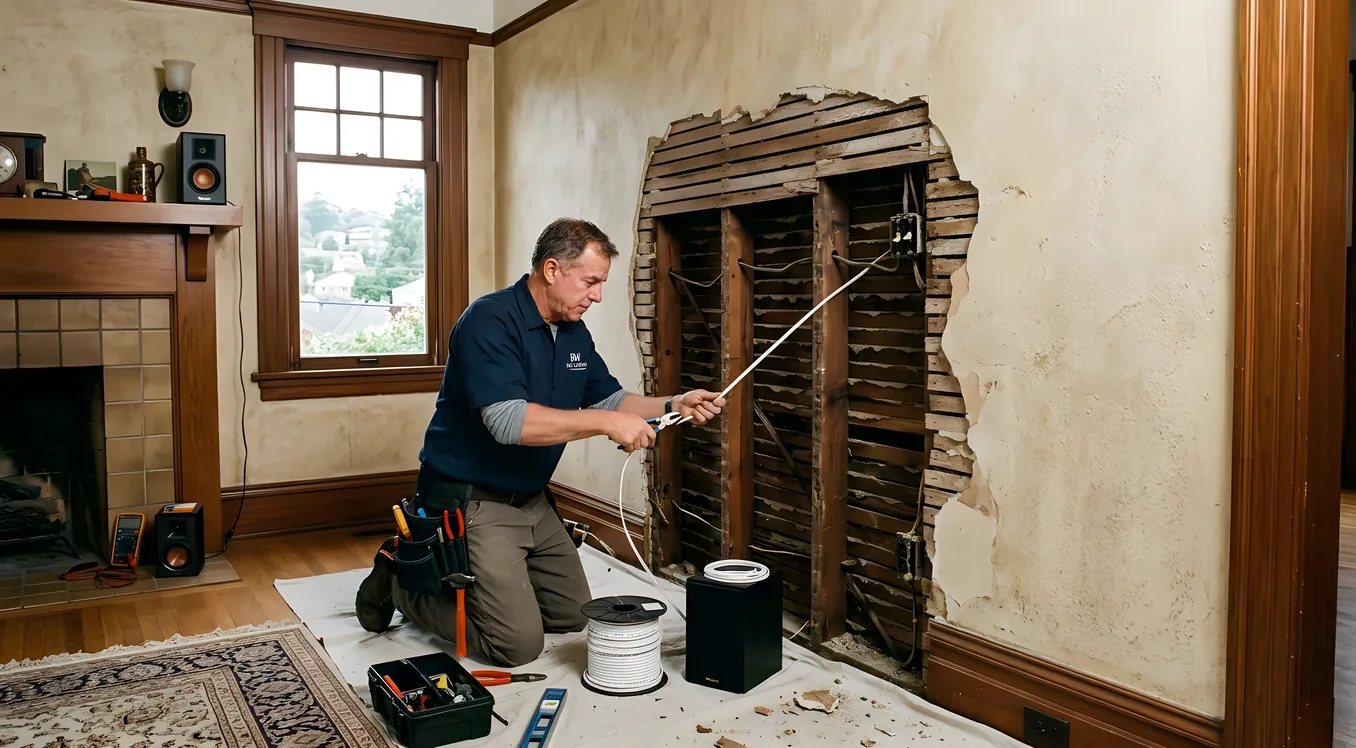
The Bay Area’s housing stock is one of the oldest in California. Walk through the East Bay, the Peninsula, or the older neighborhoods of San Francisco and you’ll find blocks of Craftsman bungalows, Victorian flats, and Spanish Colonial Revivals built long before the post-WWII construction boom standardized the methods modern contractors expect. Installing a home theater in one of these homes is entirely doable, but it requires a different approach from the ground up.
This isn’t about aesthetics or preference. The materials, structural systems, and electrical infrastructure in pre-1960 Bay Area homes are categorically different from modern construction, and several of those differences carry real implications for cost, code compliance, and what a home theater build actually involves.
The Walls Are Not Drywall
Most Bay Area homes built before 1955 have plaster walls, and plaster behaves nothing like drywall. It’s harder, denser, and significantly more brittle. Standard toggle anchors work differently in plaster than in drywall, and the wall surface cracks easily if you apply too much torque or put mechanical stress near the edges of a mount. For in-wall speaker installations or wall-mounted displays, you’re looking at skilled labor, not a standard weekend install.
Beneath the plaster is a substrate: either wood lath (thin horizontal strips nailed to studs) or metal wire lath. The distinction matters for cutting. Wood lath can be carefully cut with a reciprocating saw and controlled depth. Wire lath is harder on blades, takes longer, and the cut edges need to be treated before patching. Either way, cutting into a plaster wall for speaker bays, conduit runs, or recessed boxes requires a contractor who has done it before. Many AV integrators haven’t.
Stud spacing adds another layer of uncertainty. In post-1940 construction, 16-inch on-center stud placement is effectively standard. In pre-1940 Bay Area homes, you’ll find 16”, 20”, and 24” spacing in the same house, sometimes in the same wall. Stud finders behave unreliably in plaster (the density interferes with sensing), so tracing studs often means drilling small exploratory holes rather than relying on a tool reading.
Balloon Framing and What Lives Inside Your Walls
Homes built before approximately 1940 were almost universally built using balloon framing. This is a structural system where the exterior wall studs run continuously from the foundation sill all the way to the roof plate, often spanning two stories or more without interruption. It’s a fundamentally different approach from the platform framing used in virtually every home built after 1950.
The practical consequence for home theater work is what’s inside those wall cavities. In balloon-framed walls, there are no floor-level fire blocks to stop air (and sound) from moving freely up through the cavity. A hole at the bottom of the wall connects directly to the attic. This has two implications: first, any sound traveling through the wall structure finds an unobstructed path, which matters for acoustic isolation. Second, running wires vertically through an exterior wall is physically easy (no blocks to drill through), but it can create fire code issues without proper firestop materials installed at floor levels.
Interior walls in balloon-framed homes often have more variation. Some have blocking, some don’t. The only reliable way to know what’s inside is to probe before cutting. A good electrician or AV contractor working in pre-war Bay Area construction will expect this and factor it into their process.
Knob-and-Tube Wiring: The Hard Stop
Knob-and-tube (K&T) wiring was standard from roughly 1880 through the 1940s. Many Bay Area homes, particularly in Berkeley, Oakland, and older San Francisco neighborhoods, still have portions of original K&T active and connected. The wiring guide covers modern home theater electrical requirements in full, but the short version here is that K&T wiring in wall cavities creates two problems that directly affect a home theater build-out.
The first is insulation. K&T relies on open air circulation around the conductors to dissipate heat. California code (and the NEC) prohibit covering K&T with insulation because it traps heat around conductors that weren’t designed for it. If your home theater room needs acoustic treatment panels that include any wall insulation, or if the project involves spray foam or batt insulation in any cavity where K&T is present, the wiring needs to be upgraded before that work can happen.
The second is low-voltage proximity. Running HDMI, speaker wire, or ethernet in the same wall cavity as active K&T is a code violation in most Bay Area jurisdictions and a fire hazard regardless of code. K&T conductors are unsheathed, insulated only by ceramic knobs and cloth or rubber wrap that can be a century old. Low-voltage wiring needs to be routed separately, or the K&T needs to come out.
In practice, most AV contractors who do any due diligence will flag K&T and require electrical sign-off before running anything through those walls. If a contractor doesn’t ask, ask them. The electrical upgrade cost is real, but it’s also something that needed to happen anyway. Budget it as part of the project.
Lead Paint, Asbestos, and Pre-1978 Construction
Any Bay Area home built before 1978 may contain lead paint. Homes built before 1940 may also have asbestos in pipe insulation, floor tiles, or certain wall materials. Cutting into walls, ceilings, or floors in these homes without knowing what you’re working with is a health and legal risk.
California requires licensed contractors to follow specific abatement protocols when disturbing surfaces in pre-1978 construction. For a home theater build, this typically means getting a hazmat assessment before any cutting work begins. If the assessment finds lead or asbestos, remediation happens first, and the project timeline extends accordingly. This isn’t a cost to resent; it’s the actual scope of the project in older Bay Area homes.
The abatement step adds cost and time, typically a few thousand dollars and one to several weeks depending on what’s found and where. Factor it into the project budget from the start rather than discovering it mid-build. See Bay Area costs for a more detailed breakdown of how these pre-construction requirements affect overall project budgets.
Short Ceilings and Shallow Attics
A substantial portion of pre-war Bay Area residential construction landed at ceiling heights between 7’6” and 8’. That’s lower than the 9’ and 10’ ceilings in modern construction, and it narrows the options for projector placement considerably.
Projector throw ratios become tighter constraints at shorter distances. A ceiling-mounted projector in a room with 8’ ceilings has less vertical clearance to work with, and many standard mount systems extend the projector too low for a clean setup. Drop-ceiling mounts often aren’t viable because they’d bring the projector into head-height territory. Short-throw and ultra-short-throw projectors become more relevant in these rooms, though they trade off image size and brightness at typical viewing distances.
The shallow roof pitch common in older California homes also affects wire routing. Many Bay Area Craftsman and Victorian homes have minimal attic space, sometimes just a few feet of clearance or none at all in sections with flat or very low-slope roofs. Running AV cables through the attic, the standard approach in modern construction, may simply not be possible. This pushes wire runs to other paths: inside wall cavities, under raised floors (more common in older Bay Area homes than in slab construction), or via surface-mounted raceways.
Stucco Exteriors and Conduit Routing
A large share of Bay Area homes built in the first half of the 20th century have stucco exteriors. Stucco is difficult to patch invisibly, and exterior conduit runs are visually obvious. If a project requires bringing a coax drop, ethernet, or power to a new location on an exterior wall, running conduit on the outside of a stucco building is technically workable but aesthetically problematic.
The better approach in most cases is interior routing, even when it’s more labor-intensive. Raised floors common in older Bay Area construction (crawl space foundations are the norm in much of the East Bay and Peninsula) give access below the floor for running cables horizontally without cutting into walls at all. A crawl space route to a central point in the room, then vertical through an interior wall, is often the cleanest path.
For rooms with no crawl space access and tight wall constraints, surface-mounted raceways are a legitimate retrofit strategy. Modern raceway systems in paintable PVC are far less intrusive than they were a decade ago, and for an older home where invisible wire runs may require extensive remediation work, a well-placed raceway along a baseboard or corner can be a practical tradeoff.
Choosing the Right Room
Room selection is one of the most impactful decisions in a retrofit home theater project, and in older Bay Area homes it’s worth spending more time on this than you might expect. Ground-floor rooms are generally preferable when wire routing is constrained, because they sit above the crawl space that provides horizontal cable access. They also tend to have easier paths to the electrical panel.
Rooms with interior walls on all sides (away from stucco exteriors) simplify the routing problem. A room in the interior of the house with a hallway or closet adjacent to it gives options for wire runs that exterior-facing rooms don’t.
Acoustic isolation is harder to retrofit in balloon-framed homes than in platform-framed homes, but interior rooms also benefit from having more mass around them. Basement rooms, where the home has one, can be excellent candidates: they typically have concrete or block walls, easy subpanel access, and no ceiling height loss from the main living spaces.
Working with Contractors Who Know Older Construction
Not all AV integrators have experience with pre-war residential construction, and it shows quickly when they do. The questions an experienced contractor asks are different: whether the home has K&T, whether a hazmat assessment has been done, whether the attic is accessible, what the floor structure looks like. Contractors who have only worked in modern tract construction tend to underestimate the time and complexity of older-home work because their mental model of what’s behind the wall doesn’t apply.
Building codes in Bay Area jurisdictions also have specific requirements around work in older construction, particularly around electrical, plumbing, and hazardous materials. A contractor who understands local code will pull permits, require the right inspections, and won’t cut corners around K&T or lead-paint requirements. This matters for the project, and it matters for resale.
The Bay Area has a strong pool of contractors with older-home experience because the housing stock demands it. When vetting AV integrators for an older-home project, ask directly about their experience with plaster walls, balloon framing, and K&T wiring. Their answer tells you most of what you need to know.
Planning Realistic Timelines and Budgets
Home theater projects in pre-1960 Bay Area homes take longer and cost more than comparable projects in modern construction. That’s not a flaw in the planning; it’s the nature of the work. Plaster patching after in-wall work takes longer to cure than drywall compound. Electrical upgrades for K&T replacement add weeks to scheduling. Hazmat assessments and any required abatement work happen before construction starts, not during.
A realistic project timeline for a properly-permitted, fully-integrated home theater in an older Bay Area home might run four to six months from contract to final inspection. In modern construction with a clean existing electrical system, the same scope might be eight to twelve weeks. The difference is mostly in pre-construction preparation and coordination between trades.
Budget for the unexpected. Older homes contain surprises that don’t show up until walls are opened. A project that looks straightforward from the outside occasionally reveals mid-century modifications that don’t meet current code, or asbestos in a location nobody anticipated. A contingency of 15 to 20 percent above the base project budget is appropriate for pre-war construction. It may not get spent. But in Bay Area older homes, it often does.