Garage to Home Theater Conversion: Insulation, Permits, and Layout
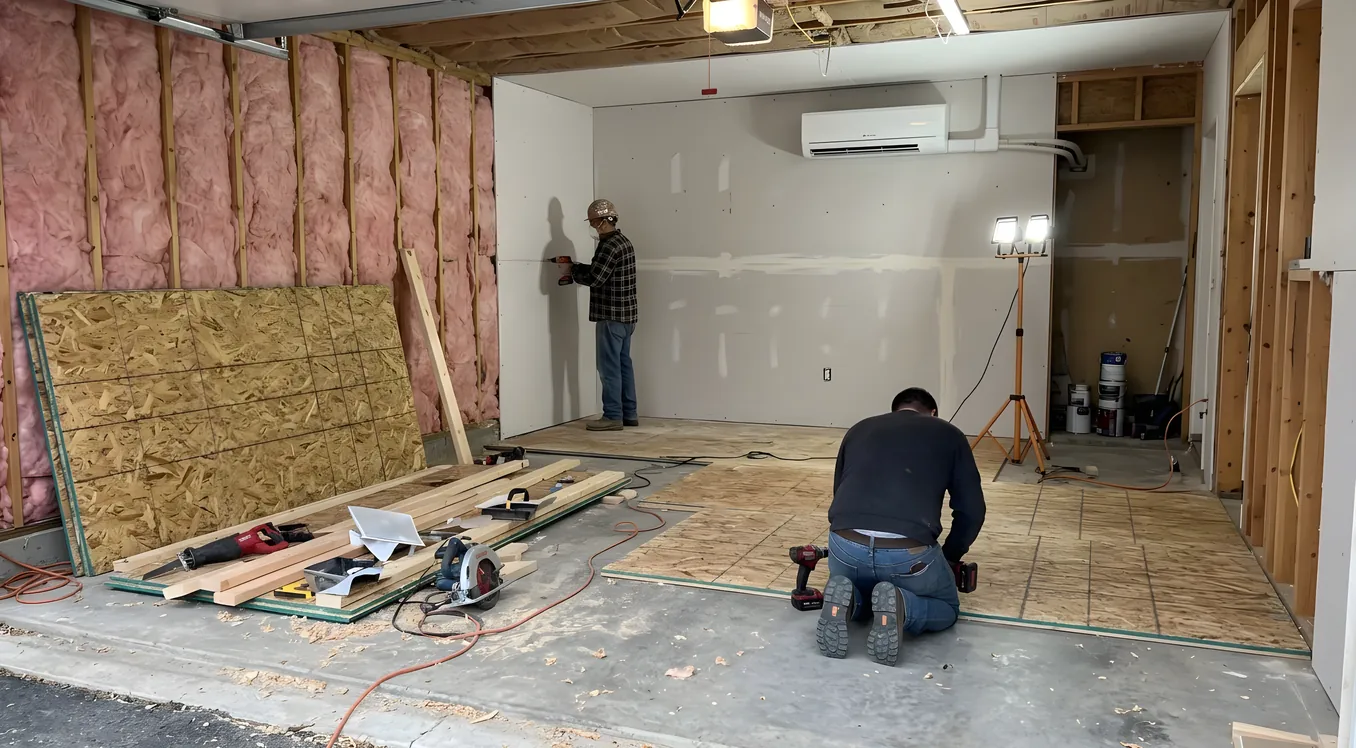
Converting a garage into a home theater gives you one of the most practical blank slates in residential construction. The space is already enclosed, has its own entry point, and sits outside the main living footprint where you can run audio at real volume without rattling the bedrooms. The tradeoffs are real, though: garage walls are typically uninsulated, the concrete slab is cold and often uneven, there is usually one electrical circuit serving the entire space, and jurisdictions treat garage conversions with more scrutiny than interior remodels. Getting from empty bay to finished theater requires working through a distinct sequence of code, construction, and technical decisions.
Permits and Local Restrictions
Most jurisdictions require a building permit for a garage-to-living-space conversion. The permit covers structural work, electrical upgrades, insulation, and any HVAC addition. Skipping it is not a shortcut. Unpermitted conversions surface during home sales, create insurance complications, and can require expensive demolition when flagged by an inspector.
Beyond the building permit, some municipalities restrict garage conversions specifically because they reduce on-site parking. Zoning codes in dense residential areas may prohibit a garage conversion outright if the lot does not have alternative parking. Others allow it with conditions: maintaining a parking pad, limiting the conversion to a portion of the garage, or requiring an ADU variance. Check your local zoning ordinance before drawing plans, not after.
California ADU law adds a layer of complexity. State law has overridden many local restrictions that previously blocked garage conversions, making it easier to convert an attached or detached garage into an Accessory Dwelling Unit. If you are in California and considering converting a garage to a home theater, you need to understand whether your project qualifies as an ADU or as an unpermitted conversion. An ADU requires kitchen and bathroom facilities; a theater-only space is a habitable room addition, not an ADU. The distinction matters because some California cities still require replacement parking for non-ADU garage conversions, while ADU projects are explicitly exempt from replacement parking under state law. Your local building department is the authority on how these rules apply to your specific lot.
Budget roughly $1,500 to $3,500 for permits on a typical garage conversion depending on project valuation and jurisdiction. Some areas calculate permit fees as a percentage of construction cost.
Insulation: Starting from Scratch
Garage walls and ceilings are almost never insulated in standard residential construction. The garage is treated as a semi-conditioned exterior space, which means your future theater walls are currently a thin wood frame against cold or hot exterior air with no thermal or acoustic buffer. You are starting from zero.
Walls: R-13 is the common minimum for 2x4 framed walls, which is what most garages have. If you are framing new interior walls or have room to add exterior batts, R-15 or a combination of batt plus rigid foam board will get you closer to what a standard conditioned room provides. The acoustic benefit of adding insulation is worth emphasizing: any batt insulation in the wall cavity also attenuates airborne sound transmission between the theater and adjacent spaces.
Ceiling: R-30 is a reasonable minimum for a theater ceiling, and R-38 to R-49 is achievable and worthwhile in climates with significant temperature swings. Garages often have attic space above them, which makes adding blown-in insulation relatively straightforward. For an attached garage sharing a ceiling with a room above, the insulation calculation changes, and you will also need to address the floor assembly for impact sound.
Garage door opening: If you are permanently sealing the garage door opening, frame it in with 2x6 lumber and insulate to R-19 or better. A framed-in wall can accommodate a standard entry door or a double door, which also provides emergency egress required by most building codes for habitable rooms. Some homeowners prefer to retain a functional garage door (an insulated, weather-stripped sectional door) to keep the space dual-purpose as an occasional drive-in or large equipment space. Insulated sectional garage doors carry ratings around R-10 to R-16, which is below what you would achieve with a framed wall, but they seal reasonably well and preserve flexibility.
Floor: Dealing with Concrete
The concrete slab requires more work than new homeowners usually expect. Three issues have to be addressed: moisture, temperature, and height.
Concrete slabs transmit moisture vapor even when they appear dry. Before installing any flooring system, test for moisture using the calcium chloride test or relative humidity probes per ASTM F2170. A Class I vapor barrier (6-mil poly or a better membrane product) goes down first regardless of test results.
A subfloor system adds an insulating break between the cold slab and the finished floor. The standard approach is a sleeper system: pressure-treated 2x4 sleepers laid flat on the vapor barrier, shimmed level, with plywood decking above. This gives you a nailable surface for finish flooring and creates a small air gap that reduces heat loss. The total system adds about 2 to 2.5 inches of height, which matters at the garage door threshold and at any interior door connection to the house.
Alternatively, DRIcore-style subfloor panels (a single-layer product with dimpled polyethylene on the bottom and OSB on top) give you a subfloor system in roughly 1.5 inches of added height. They cost more per square foot than a sleeper system but install faster.
Finish flooring options depend on what suits your theater design. Luxury vinyl plank is common (waterproof, comfortable underfoot, absorbs some impact sound). Carpet adds acoustic absorption and is worthwhile if your main goal is a pure screening room. Hardwood and engineered hardwood work over a proper subfloor but require careful acclimation given the slab below.
Ceiling Height
Standard attached garages run 8 to 9 feet from floor to the underside of the ceiling framing. Detached garages vary more, sometimes reaching 10 to 12 feet. This is workable for a home theater. You need clearance for a projector mount or screen installation, acoustic treatment panels, and ideally some exposed depth to run conduit or cable trays cleanly.
If you are adding a suspended ceiling for acoustic reasons (decoupled from the structure to reduce structure-borne vibration), plan to lose 4 to 8 inches depending on the isolation clip system you use. An 8-foot ceiling after decoupling gives you about 7.5 feet of usable height, which is sufficient but tight for larger theater seating risers.
HVAC: Adding Conditioning to an Unconditioned Space
A detached garage or a garage that shared no HVAC connection with the house needs a dedicated heating and cooling system. A mini-split heat pump is the standard solution for garage conversions because it does not require ductwork, conditions a defined zone independently, and handles both heating and cooling from a single system.
For a single-bay conversion (roughly 200 square feet), a 9,000 to 12,000 BTU single-zone mini-split is typically sufficient. A double-bay conversion (around 400 square feet) needs 18,000 BTU or two independent zones. Sizing matters: an oversized mini-split will short-cycle in cooling mode and fail to dehumidify adequately, which matters for protecting sensitive electronics.
The refrigerant line set for a mini-split typically runs through the exterior wall to an outdoor condenser unit. In an attached garage, you have more options for routing. Budget $2,500 to $5,000 installed for a quality single-zone mini-split system, with larger multi-zone systems running $5,000 to $10,000 installed.
If the garage is attached and the house HVAC system has capacity, extending the existing ductwork is possible but complicated. The garage zone will need its own thermostat, and the duct sizing must be calculated to handle the new load without starving existing rooms. Mini-split remains the cleaner approach for most conversions.
Electrical: Adding Capacity for AV Equipment
A typical garage has one 15-amp or 20-amp circuit. This is nowhere near adequate for a home theater. A projector, AV receiver, subwoofer, multiple power amplifiers, and a UPS system can draw 15 to 25 amps continuously under load, with surge draw during system startup.
The correct approach is running dedicated circuits from the main panel. For a serious home theater, plan for:
- One or two 20-amp dedicated circuits for the AV rack and amplifiers
- One 20-amp circuit for the projector
- One circuit for general-purpose outlets and convenience items
- One circuit for HVAC (mini-split systems require a dedicated circuit, typically 240V)
If your main panel is close to capacity, you may need a sub-panel in or near the garage. A 60-amp or 100-amp sub-panel gives you room to grow without returning to the main panel for every addition.
Running conduit at rough-in rather than Romex in the wall makes future cable management far easier. Home theaters accumulate cables over time; a 1-inch conduit from the panel location to the equipment rack is worth the small extra cost during construction.
For detailed guidance on circuit planning and load calculations, the electrical planning guide covers the full scope of what a theater-grade electrical installation requires.
Soundproofing: The Hardest Part of a Garage Conversion
Garages are acoustically challenging in both directions. You want to keep bass frequencies from migrating into the house or the neighborhood, and you want to control reflections inside the theater.
Shared walls: An attached garage typically shares at least one wall with the house. That wall is often a single layer of drywall (required by fire code but not designed for acoustic separation). Adding a second layer of drywall with resilient channel or isolation clips between layers significantly improves STC (Sound Transmission Class) ratings. Green Glue damping compound between two layers of drywall on the same framing is a cost-effective alternative where you cannot afford to lose wall depth.
Garage door or framed wall: A framed-in wall with double drywall and insulation will substantially outperform even the best insulated garage door for sound isolation. If you are choosing between door-in-place and framed conversion for acoustic reasons, framing it in is the right call.
Floor transmission: Bass frequencies transmit easily through the concrete slab. A decoupled floor system (subfloor on resilient pads or foam strips rather than direct-attached sleepers) reduces impact and low-frequency transmission, but no slab-on-grade floor will achieve full isolation from neighbors below in a multi-story building context.
Interior acoustics: The bare surfaces of a freshly converted garage will produce severe flutter echo and muddy bass buildup. Acoustic treatment is separate from soundproofing: absorption panels reduce reflections and control reverberation time, while bass traps in corners address low-frequency buildup. A dedicated home theater in a sealed room typically requires 20 to 30 percent of wall surface area covered with absorption to reach a useful RT60 target.
The soundproofing guide goes into construction methods and materials in detail, including STC rating comparisons for common assembly types.
Light Control: A Genuine Advantage
No windows is usually considered a liability in residential construction. For a home theater, it is an asset. Most garages have no windows in the side or rear walls, and the garage door opening is the only source of daylight. Once that opening is framed in with a solid wall or door, you have a naturally dark room with no light leak issues to solve.
If you retain the garage door, blackout solutions are limited: a double layer of heavy curtain behind the door can reduce, but not eliminate, light intrusion from gaps around the door panels. Framing in gives you a room that is as dark at noon as it is at midnight.
Layout by Bay Configuration
The room dimensions guide covers acoustic ratios and seat placement in depth, but garage conversions present three common configurations worth addressing specifically.
Single-bay (approximately 10 x 20 feet): This is a capable dedicated screening room. Place a 120-inch screen centered on the 10-foot wall with the projector at or near the rear wall. Two rows of seating fit comfortably with a riser for the rear row. The 10-foot width limits your speaker spread, but a well-calibrated 5.1 system at this scale performs well. Acoustic treatment is relatively straightforward because the room volume is modest.
Double-bay (approximately 20 x 20 feet): A near-square room creates bass buildup problems at the room modes that a rectangular room does not. If you have a double bay, consider framing a portion of one end as a mechanical room or equipment closet to change the effective dimension. A 20 x 22 or 20 x 18 interior dimension is acoustically better than a perfect square. This size supports 4 to 6 seats comfortably and can accommodate a large-format screen.
Tandem bay (approximately 10 x 40 feet): A tandem configuration is actually favorable for a theater. The long dimension lets you achieve real screen-to-seat distance, which matters for immersion on large screens. Place the screen on one of the 10-foot walls and you have 30 to 35 feet of depth for seating, equipment rack, and a rear equipment or projection booth alcove. The narrow width keeps the room relatively controlled acoustically.
Budget Expectations
Construction costs for a garage-to-theater conversion vary significantly by region, scope, and finish level. A realistic range for the construction phase alone (insulation, framing, drywall, electrical, HVAC, flooring, basic lighting) runs from $15,000 to $40,000 for a single or double bay.
On the lower end, you are doing some of the labor yourself, using mid-grade finishes, and keeping the layout straightforward. On the higher end, you are hiring specialists for acoustics, electrical, and HVAC, adding acoustic treatment panels and a decoupled room-within-a-room assembly, and finishing the space to the standard of a dedicated home theater rather than a functional media room.
Equipment costs are separate: a capable projector and screen, AV receiver, and speaker system start around $10,000 for a solid entry-level setup and can reach $30,000 or more for a premium installation. Plan both budgets together so the construction choices (screen wall placement, equipment rack location, conduit routing) support the AV installation from the start.
Making the Decision
A garage conversion makes sense when you have the permitting headroom, the electrical capacity in your panel, and the layout geometry to produce a room that actually works. The construction path is more involved than a basement conversion because you are adding systems (HVAC, waterproofing) rather than finishing them, but the end result is a purpose-built space with no acoustic compromises to adjacent bedrooms and no light intrusion to solve after the fact.
The main things to resolve before committing to a conversion: check with your building department on permits and zoning (especially parking replacement requirements), confirm your main electrical panel has capacity for a 60 to 100-amp sub-panel, and measure your slab for levelness and moisture before planning the floor system. Those three answers tell you whether the project is straightforward or whether there are complications worth pricing out before you start.