Soundproofing a Home Theater: Isolation, Decoupling, and Mass
Most home theater projects fail the soundproofing test not because the builder skipped a step, but because they solved the wrong problem. Foam panels on the walls, a thick rug on the floor, some heavy curtains: these reduce echo inside the room, but they do almost nothing to stop sound from traveling through the building structure into the room next door.
Soundproofing and acoustic treatment are separate disciplines. Acoustic treatment shapes how sound behaves inside a room, controlling reflection, flutter echo, and bass buildup. Soundproofing controls how much sound crosses a boundary: into adjacent rooms, up through the ceiling, down through the floor. A good home theater needs both. This guide covers soundproofing: the science of keeping sound in and keeping external noise out.
What STC Ratings Actually Tell You
Sound Transmission Class (STC) is the standard laboratory rating for how much a building assembly attenuates airborne sound. Higher numbers mean better isolation. The scale is weighted toward midrange speech frequencies, which matters when you understand what a home theater actually generates: deep bass from LFE tracks and subwoofers, which STC ratings systematically underrepresent.
A standard single layer of 1/2-inch drywall on wood studs rates around STC 33. A conversation at normal volume in the next room is clearly audible through that assembly. Adding a second layer of drywall on the same studs with standard construction methods raises performance to roughly STC 38. The improvement is real but modest, because the studs themselves vibrate and transmit energy through the structure.
For a dedicated home theater, the target range is STC 55 to STC 65. At STC 55, loud music is barely audible in an adjacent space. At STC 65, a movie at reference volume registers as a faint thump at worst. Getting into that range requires combining multiple principles, not just adding more drywall.
The rating system’s limitation is low frequency. STC uses a standardized curve that doesn’t capture how poorly most assemblies stop 40Hz or 80Hz energy. An assembly rated STC 60 might still let significant bass energy through. The OITC (Outdoor-Indoor Transmission Class) rating is more relevant for low-frequency content, but you’ll rarely see it on products. Build for the STC target and add decoupling to address the bass gap.
The Four Principles of Soundproofing
Every effective soundproofing assembly combines some mix of four mechanisms: mass, damping, decoupling, and sealing. None of them alone gets you to the performance levels a theater room needs. They work together.
Mass is the most intuitive principle. Heavier materials require more energy to vibrate, so they transmit less sound. Drywall, concrete, mass loaded vinyl, and brick all work on mass. Doubling the mass of an assembly adds roughly 6 dB of transmission loss. That sounds like a lot until you realize 6 dB is just barely perceptible to most listeners. Mass is necessary but not sufficient.
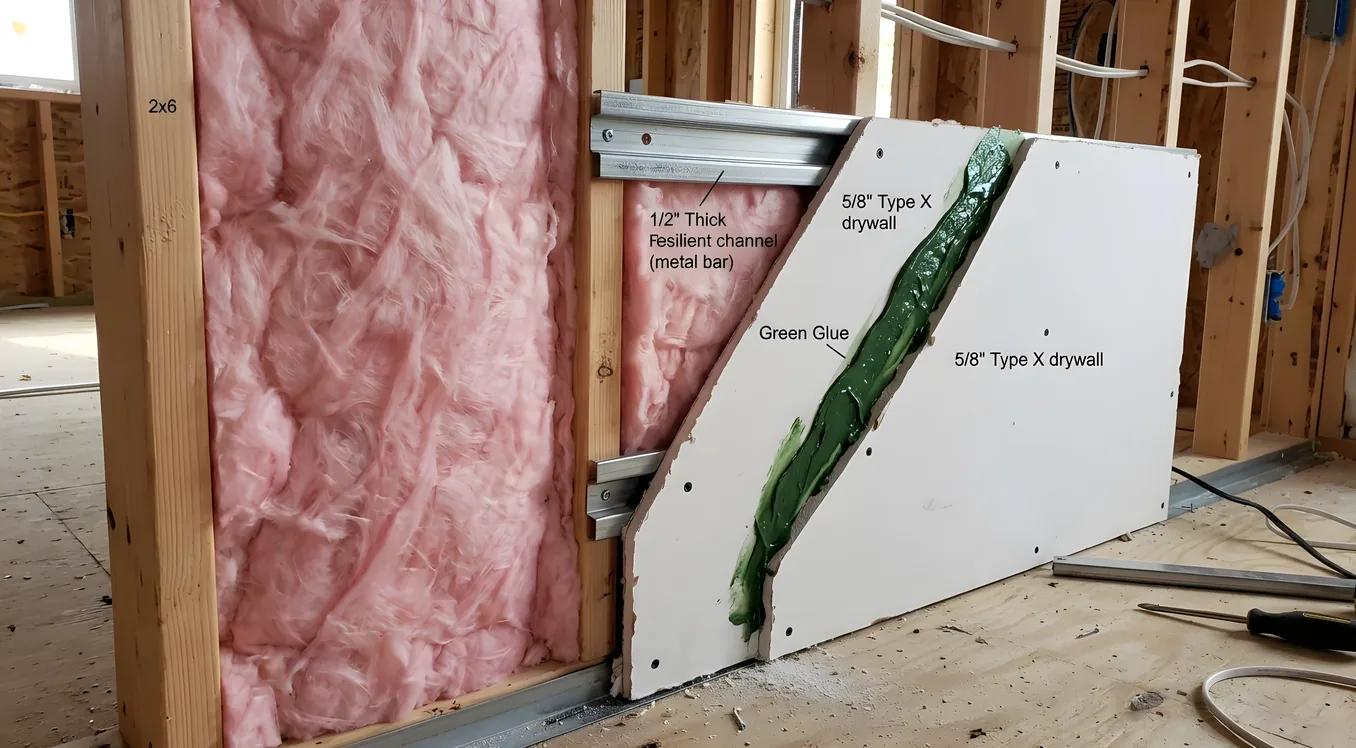
Damping converts vibrational energy into heat before it can radiate to the other side. Viscoelastic compounds like Green Glue, applied between two layers of drywall, accomplish this. The outer layer vibrates from incident sound, the compound shears and converts that motion to heat, and the inner layer stays relatively still. Damping is most effective in the mid and upper frequencies, which is exactly where STC testing is weighted.
Decoupling breaks the rigid structural path that sound travels most efficiently. When a stud connects both sides of a wall, vibration passes directly through it regardless of what’s nailed to each face. Decoupled assemblies interrupt that path using resilient channels, staggered studs, or double-stud walls with an air gap. This is the mechanism that pushes assemblies from STC 45 territory into STC 60+ territory. Decoupling is the highest-leverage change available in new construction or major renovation.
Sealing closes every air gap. Sound travels through air more easily than through building materials, so an unsealed gap around a pipe penetration, an electrical outlet, or a door frame undercuts every other improvement in the assembly. A perfect wall with a standard hollow-core door and a 1/4-inch gap at the threshold will perform like neither: the weakest link dominates.
Adding Mass: Your Material Options
The most common mass-adding materials in theater construction are additional drywall layers, mass loaded vinyl (MLV), and specialty products like QuietRock.
Double drywall is the baseline move. Two layers of 5/8-inch Type X drywall on each side of a wall assembly adds meaningful mass at low cost. The key is staggering the seams between layers so no gap runs continuous through both sheets. This prevents the seam from becoming a transmission path.
Mass loaded vinyl is a dense, limp material typically sold in 1 lb/sq ft or 2 lb/sq ft versions. It installs between drywall layers or as a standalone barrier over existing framing. MLV’s advantage is that it doesn’t stiffen the assembly the way a second layer of rigid drywall can, and limp mass (mass that doesn’t add structural rigidity) is acoustically more effective per pound than stiff mass. It’s also useful in retrofit situations where you can’t add framing depth.
QuietRock is a brand of constrained-layer damping drywall: two layers of gypsum bonded to a viscoelastic polymer core in a single panel. It adds both mass and damping in one product and performs significantly better than standard drywall at equal thickness. The trade-off is cost: QuietRock runs several times the price of standard drywall per sheet. For rooms where the budget permits, it’s an efficient way to get mass and damping without adding assembly depth.
These materials compound with each other. A wall built with two layers of 5/8-inch drywall plus MLV plus Green Glue plus decoupling isn’t just additive in performance; each mechanism addresses different frequency ranges and loss mechanisms, so combining them pushes performance further than the components would suggest in isolation.
Damping: How Green Glue Works
Green Glue is the most widely used damping compound in home theater construction. It applies as a bead across the back of a drywall sheet before it’s screwed in place, filling the space between drywall layers. As the first layer vibrates from sound striking it, the compound shears, converting kinetic energy to thermal energy. The second layer doesn’t receive that energy to radiate.
The material is specified for use between two rigid layers, which is why it only makes sense between drywall sheets, not applied to bare studs. Two tubes per 4x8 sheet is the standard application rate for the compound to function correctly. Under-applying leaves too little material to shear effectively.
Green Glue is most effective above 250Hz. Below that, its performance drops off, which is why rooms with heavy subwoofer use need decoupling in addition to damping. The compound cures to full performance in about 30 days, though it delivers most of its benefit within a week of application.
Decoupling: Breaking the Structural Path
A standard 2x4 stud wall connects both faces of the assembly rigidly. Sound hitting the exterior face vibrates the drywall, which vibrates the stud, which vibrates the interior drywall. The path is direct. Decoupling interrupts it.
Three approaches exist, roughly in order of effectiveness and cost:
Resilient channel is hat-shaped metal channel screwed horizontally to studs, with drywall screwed only to the channel (not through to the studs). The channel flexes slightly under vibration, breaking the rigid path. Resilient channel is the most affordable decoupling method and performs well when correctly installed. The installation failure mode is “short-circuiting”: if a drywall screw penetrates through the channel and makes contact with the stud beneath, or if the channel is fastened too rigidly at the ends, the resilient mount becomes a rigid one. Inspect screw depth carefully.
Isolation clips with hat channel (products like RSIC-1, GenieClip) are a more robust system. Rubber-and-metal isolation clips attach to the studs, and hat channel clips into them. Drywall attaches to the hat channel. The rubber isolators provide better vibration absorption than a simple resilient channel, and the two-point attachment is harder to accidentally short-circuit. These systems typically outperform standard resilient channel by several dB and are worth the additional cost in theater applications.
Staggered stud walls use a wider bottom plate (typically 2x6 or 2x8) with alternating 2x4 studs along each edge, so interior and exterior face studs never touch each other. The air space between the stud rows, combined with insulation fill, provides significant mass-air-mass resonance attenuation. No metal is required, and there’s no short-circuit risk. The trade-off is wall thickness: a staggered stud wall typically runs 7 to 9 inches thick versus 4.5 to 5.5 inches for a single-stud wall with channel.
For the best-performing assemblies, combine isolation clips with double drywall and damping compound. A wall assembly using RSIC-1 clips, hat channel, two layers of 5/8-inch drywall with Green Glue between them, and a continuous bead of acoustic caulk at all perimeter edges will test in the STC 60 to 65 range.
Sealing: Where Most Projects Fail
Sealing is unglamorous, inexpensive, and the most commonly skipped part of soundproofing. It is also where most well-constructed theater rooms give back half their performance.
Acoustic caulk (non-hardening sealant, typically marketed as acoustical sealant or “acoustic caulk”) goes at every perimeter joint: where drywall meets the floor, ceiling, and adjacent walls. Unlike regular caulk, acoustic caulk stays flexible permanently, accommodating building movement without cracking. A cracked seal is an open gap. Apply a continuous bead and tool it flat before the drywall is finished.
Electrical outlets and switches are hollow boxes punched through your completed wall assembly. Electrical boxes on opposite sides of a wall are a common flanking path. The fix is putty pads: acoustical putty that wraps around the box before it’s installed, sealing the penetration. Each outlet box should get its own pad; back-to-back boxes on opposite sides of a stud bay should be offset by at least one stud bay.
Doors are the single biggest weak point in most theater builds. A standard hollow-core interior door has an STC rating around 26. Even a solid-core wood door, which rates around STC 35, leaves a gap at the threshold and the frame-to-door perimeter. For a room targeting STC 60, the door assembly needs to match that performance, or the room doesn’t achieve it. Acoustic doors with compression seals, or a double-door vestibule (two doors with a small airlock between them), are the solutions. Door sweeps at the threshold, compression gaskets along the vertical and head jamb, and a solid-core slab are the minimum for serious isolation work. Many installations use a standard solid-core door with high-quality perimeter gaskets and an automatic door bottom sweep, which can approach STC 50 when carefully fitted.
Pipe and conduit penetrations get acoustical putty pads, mineral wool packing, and non-hardening sealant. Any gap larger than 1/16-inch defeats the adjacent wall performance.
The Room Within a Room
Maximum isolation, typically targeting STC 65 and above, requires building a floating room inside the existing structure. The concept is straightforward: the inner room’s walls, floor, and ceiling have no rigid connection to the building structure. Vibration has no physical path to travel.
In practice, this means the inner wall system is built on a floating floor (subfloor on neoprene pads or a rubber underlayment that isolates from the slab or joists), the inner wall framing is set on that floating floor without attachment to the host walls, and the ceiling of the inner room is either a floating ceiling or an independently framed lid with isolation hangers (resilient sound isolation clips used in ceiling applications). All penetrations for electrical, HVAC, and audio cabling enter through acoustically treated sleeves.
This approach adds roughly 4 to 6 inches to every wall surface and 8 to 12 inches of ceiling height loss. It also costs substantially more than single-wall construction. But it is the only reliable method for achieving the performance levels where a subwoofer running at high volume registers as nothing in the adjacent bedroom.
For most builds, a high-performance decoupled single wall with proper sealing delivers STC 55 to 60, which is sufficient for reference-level playback without disturbing the rest of the house during reasonable hours. The room-within-a-room approach is for situations where the theater shares a wall or floor with a bedroom, or where the homeowner wants no audible compromise at any playback level.
HVAC Isolation
HVAC is a frequently overlooked transmission path. Ductwork is essentially a tube designed to move air throughout a building, and air is the medium through which sound travels most easily. A shared duct run between the theater and an adjacent room creates a direct acoustic connection that bypasses every wall improvement.
The fixes operate at two levels. First, avoid shared duct runs between the theater room and adjacent occupied spaces. If the HVAC design puts a supply register in the theater and a return in the hallway on the same trunk line, sound will travel that path. A dedicated air handler for the theater space eliminates the problem entirely but adds cost.
Second, where shared runs are unavoidable or already existing, duct silencers (also called sound attenuators or duct baffles) insert into the duct run and absorb airborne sound as it travels through the duct. They are rated in dB of attenuation at various frequencies and add static pressure to the HVAC system, which means the system needs to be sized to accommodate them.
Flex duct transitions at the point where rigid ductwork connects to the theater room supply and return diffusers reduce structural vibration transmission from the air handler into the room through the ductwork itself. The flex section decouples the rigid duct from the register penetration into the isolated wall.
See the dedicated theater vs media room guide for how HVAC requirements differ between full isolation builds and more casual media room installations, and the HVAC ventilation page for equipment sizing and air exchange rate considerations specific to sealed theater rooms.
Common STC Benchmarks by Assembly Type
Understanding where standard assemblies land helps with planning:
A single layer of 1/2-inch drywall on 2x4 studs with no insulation: STC 33. Adding insulation to the stud cavity raises this to about STC 38. A second layer of 5/8-inch drywall on the same studs, screws only (no compound): STC 42 to 45 depending on insulation and sealing quality. The same assembly with Green Glue between layers: STC 50 to 52. Resilient channel added to that assembly: STC 54 to 58. Isolation clips with hat channel replacing resilient channel, double drywall with Green Glue on each face, sealed perimeter: STC 60 to 65.
These ranges assume good installation practice. Short-circuited resilient channel, unsealed perimeters, or back-to-back electrical boxes without putty pads can drop a well-specified wall 10 STC points.
What Doesn’t Work (and Why)
Acoustic foam, the type sold in wedge or pyramid panels, absorbs high-frequency reflections inside a room. It has essentially no effect on sound transmission through a wall. Its density is far too low to impede sound crossing a building assembly. Foam panels are a tool for acoustics 101, not for building isolation.
Carpeting and furniture add some mass and damping to floor and ceiling assemblies, and they help reduce flanking impact noise from footsteps above. They are not a substitute for proper isolation treatment, but they’re not worthless either. In an existing room where construction isn’t possible, heavy floor coverings, bookshelves filled with books against party walls, and heavy furniture near shared walls do measurably reduce sound transmission, just not to theater-grade levels.
The most common project mistake is treating acoustic problems as soundproofing problems and vice versa. A room with significant echo and flutter (an acoustic problem) needs absorption and diffusion inside the room. A room that disturbs neighbors (a soundproofing problem) needs mass, damping, decoupling, and sealing in the building assembly. Adding acoustic panels to a room that’s leaking sound to adjacent spaces accomplishes nothing for the neighbors. Treating the room interior for reflections does nothing for isolation.
Leaving gaps is the other recurring failure. A single gap around a door frame, an unsealed conduit penetration, or an outlet box without a putty pad creates what acousticians call a flanking path: a route for sound to bypass the primary isolation assembly. Flanking paths are disproportionately impactful because they exploit the inverse square law and the frequency-agnostic nature of air gaps. At low frequencies, even a small gap causes significant bleed because long-wavelength sound diffracts easily around small obstacles.
Planning Sequence for New Construction
For anyone building a dedicated theater from the ground up, soundproofing decisions integrate best at the framing stage. See new construction theater for the full sequence, but the soundproofing decisions that need to be made before drywall goes up are:
Room location within the house matters more than any individual material choice. Placing the theater against an exterior wall or in a basement slab-on-grade situation means one or two sides of the room don’t need isolation from adjacent living spaces, which reduces both cost and complexity.
Framing the floor for the floating platform, specifying the stud spacing and framing depth for decoupled wall assemblies, and planning duct routing before the MEP rough-in happen in a sequence that is very difficult to reverse after the fact. Deciding late means cutting into finished assemblies or accepting lower performance.
The acoustic caulk specification also belongs in the construction documents if you’re working with a contractor. “Seal all perimeter joints with acoustical sealant” needs to be in the scope of work explicitly, because standard trim and drywall finishing does not include it.
Getting to Reference Level Without the Neighbors Knowing
Soundproofing a home theater to the STC 60 range is achievable with standard construction materials and documented techniques. It requires combining mass, damping, decoupling, and sealing rather than relying on any one of them alone. It requires treating the room as a system and not leaving unsealed paths for sound to exploit.
The fundamental trade-off is between performance, space, and budget. Isolation clips and double drywall cost more than a single layer but perform substantially better. Staggered stud walls consume more floor area but eliminate short-circuit risk. A floating floor costs more to build but handles impact transmission that wall treatments ignore entirely. Each additional mechanism extends the performance ceiling.
For a basement theater or a first-floor room with nothing overhead, the assembly complexity reduces significantly because you’re isolating from fewer adjacent spaces. For a second-floor room above a bedroom, floor isolation becomes critical. The specific assembly choices follow from the room’s position in the building and what’s on the other side of each surface.