HVAC for Home Theaters: Cooling a Sealed Room Without the Noise
A sealed home theater is a heat trap. Projectors generate 200 to 400 watts of waste heat. Amplifiers and AV receivers add another 200 to 500 watts. Each person sitting in the room contributes roughly 100 watts of body heat. Add acoustic insulation that blocks airflow by design, and a two-hour movie can raise the room temperature by ten degrees or more if the HVAC system is not purpose-built for the space.
Getting the cooling right is only half the problem. A noisy HVAC system will undercut everything else you did to make the room sound good. Blower noise, turbulent airflow through undersized ducts, and whistling registers are real problems in dedicated theater rooms. The target noise floor for a home theater is NC-25 to NC-30 (roughly 30 to 35 dBA of background noise). Most residential systems run at NC-35 to NC-40 without any optimization. Hitting the theater noise standard requires deliberate choices at every step.
Calculating the Heat Load
Before sizing any equipment, calculate the room’s actual heat load in BTUs per hour. Work through each heat source:
Projector. Check the lamp or laser wattage in the spec sheet. A 300-watt projector produces approximately 1,000 BTU/hr of waste heat (roughly 3.41 BTU per watt is the conversion).
AV equipment. Add the wattage of your amplifier(s), AV receiver, streaming devices, and any other components left powered on during use. A modest two-channel setup might add 200 watts; a multichannel theater amp stack can exceed 1,000 watts under load.
Occupants. Each seated adult adds roughly 350 BTU/hr to the load. A six-seat theater has 2,100 BTU/hr just from people.
Envelope gain. Even with insulation, heat conducts through walls and ceiling from adjacent conditioned spaces. For a well-insulated interior room this is often small, but add 500 to 1,500 BTU/hr as a buffer depending on your climate and room location.
Sum those numbers, convert to tons (12,000 BTU/hr per ton), and you have your baseline. Most purpose-built home theaters in the 300 to 500 square foot range land between one and two tons of cooling. If you are on the edge between sizes, go larger. Undersized equipment runs constantly, creates more noise, and wears out faster.
Noise Standards: What NC-25 to NC-30 Actually Means
The Noise Criteria (NC) rating system measures background HVAC noise across a range of frequencies. NC-25 is the standard for recording studios and high-end dedicated theaters. NC-30 is acceptable for most home theaters and is the practical target if you are retrofitting into an existing HVAC system.
For reference, a normal conversation sits around NC-35 to NC-40. At NC-25, you can hear a pin drop. Every component in your HVAC chain, from the outdoor unit to the register cover, contributes to the final noise level in the room.
Ductwork Design for Quiet Airflow
Duct noise has two sources: vibration transmitted through rigid metal and turbulence from air moving too fast. Addressing both requires a few specific choices.
Flexible duct over rigid where possible. Flex duct attenuates vibration naturally. Use it for the final few feet of any run that enters the theater space, and transition back to rigid sheet metal before the air handler to avoid kinking.
Oversize the ducts. Turbulence noise increases sharply with velocity. Standard residential duct design allows up to 700 to 900 feet per minute (FPM) of air velocity. For a quiet theater zone, target 400 to 500 FPM. Achieving this means larger duct diameters. A run that would normally use 8-inch round duct should use 10-inch or 12-inch.
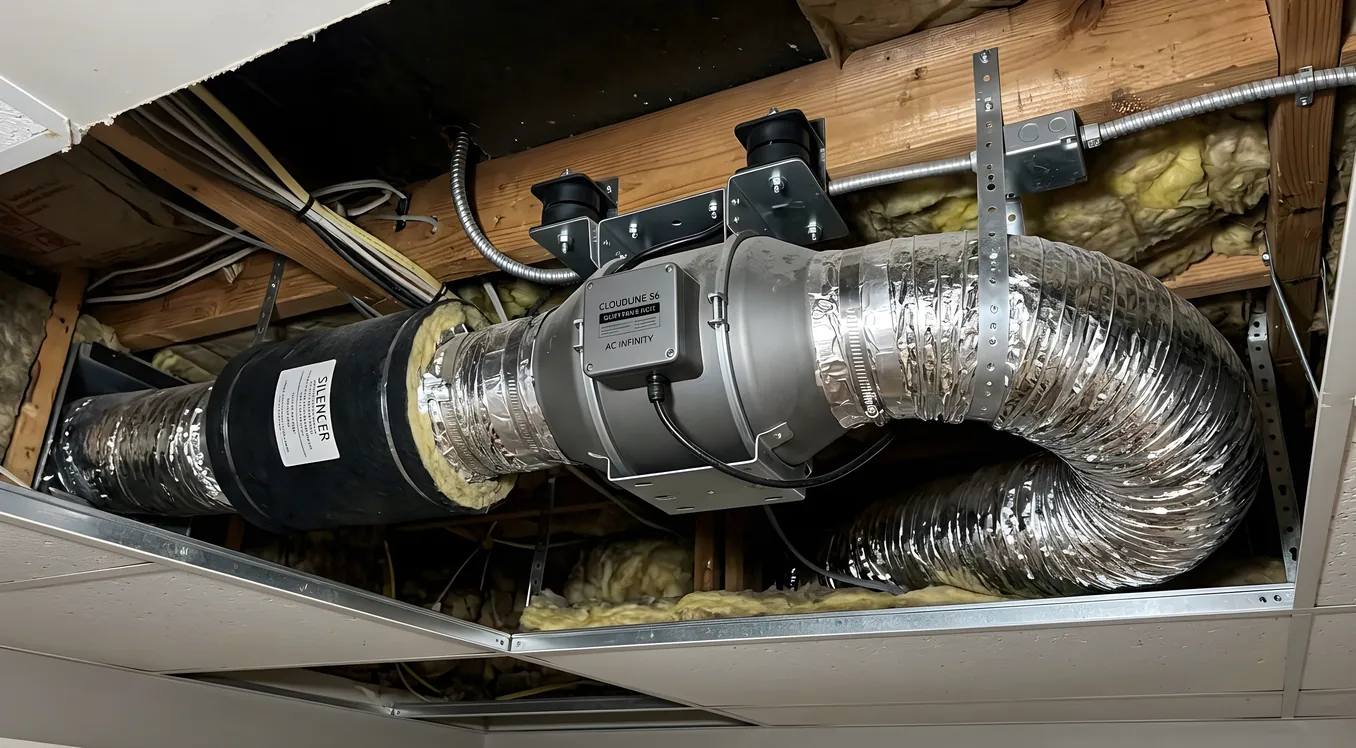
Inline duct silencers (attenuators). These are lined sheet metal chambers placed in the duct run before the supply register. A quality silencer can reduce airborne noise in the duct by 10 to 15 dB across mid-frequencies. Install one on both supply and return runs serving the theater.
Avoid shared duct runs. A duct shared between your theater and a hallway or adjacent room will transmit noise from the other space into the theater (and vice versa). Dedicate separate supply and return runs to the theater from the nearest branch point.
The full acoustic benefit of good ductwork pairs with the soundproofing work you do on walls and ceiling. Duct penetrations that bypass your decoupled walls are one of the most common places where flanking noise defeats an otherwise solid room.
Register and Grille Selection
The register cover is the last place air turbulence can generate noise before it enters the room. Most adjustable registers whistle at partial settings because the vanes create turbulent eddies as air passes through narrow gaps. In a theater room, avoid adjustable-vane registers entirely.
Bar-type supply registers (sometimes called linear bar grilles) have fixed, parallel bars at a gentle angle. Air passes through without the velocity concentration that causes whistling. Use the largest register that fits the space. Spreading the airflow across a larger face area drops the exit velocity, which directly reduces noise.
Size supply registers to keep face velocity at or below 300 FPM. Manufacturer spec sheets list the free area (in square feet) for each register size. Divide the CFM for that supply run by 300 to get the minimum free area you need, then find a register that meets or exceeds it.
Return grilles are less problematic for noise, but they still matter. Use a large, unobstructed return grille and keep it away from furniture or walls that would restrict airflow to the grille face.
Mini-Split Systems: The Quietest Option
A ductless mini-split is the most straightforward path to a quiet, dedicated theater climate zone. The indoor head unit contains no blower fan large enough to cause meaningful noise at theater-relevant volumes. Manufacturers rate many units at 18 to 22 dBA on their lowest fan speed, which is genuinely inaudible during movie playback.
Mitsubishi’s Hyper Heat line, Fujitsu’s slim-duct models, and Daikin’s wall-mount series are among the well-regarded options in this category. Look at the indoor unit’s noise spec at the lowest fan speed, not the “as low as X dBA” marketing range, which typically reflects the minimum under best-case conditions. Units with variable-speed compressors (inverter-driven) maintain temperature without the on/off cycling that disrupts quiet passages.
One consideration with wall-mount mini-splits is placement. The indoor head unit should not be on the front wall (behind the screen) or directly above seating. Both positions direct airflow toward listening positions and can cause thermal drafts that are physically distracting. Side walls, high on the wall nearest the projection side of the room, work well and keep the air distribution away from heads.
For rooms where a wall-mount unit would not work aesthetically or structurally, slim-duct mini-splits run a short duct run (typically five to fifteen feet) to one or two small registers. These retain most of the mini-split’s quiet operation while concealing the indoor unit in a ceiling cavity or closet.
Dedicated HVAC Zone: Why It Matters
Running your theater from the same thermostat zone as the main living area creates a reliability problem. The main living area may be unoccupied and comfortable at 72°F while four people and a projector are pushing the theater to 80°F. By the time the shared thermostat calls for cooling, the room is already uncomfortable.
A dedicated thermostat for the theater zone lets the system pre-cool the room 30 minutes before use and hold the set temperature regardless of what adjacent spaces are doing. If you are using a ducted system, add a zone damper controlled by a dedicated thermostat at the air handler rather than splitting off an undersized branch from an existing zone. Zone dampers introduce some airflow noise if not sized correctly, so treat the duct runs to the damper with the same oversizing and silencer approach as the rest of the theater’s duct system.
Supply and Return Placement
Where air enters and leaves the room affects both comfort and noise. Two principles apply:
Keep supply air away from the primary listening position. Air blowing directly on seated listeners causes distraction from noise and from the sensation of airflow itself. Front-wall supply at floor level (directed toward the screen wall) or side-wall supply high on the wall, aimed across the room rather than down at seats, are both workable locations.
Return air at the rear. Placing the return grille at the rear of the room or on the ceiling near the rear creates a front-to-back airflow pattern. Supply air is conditioned and delivered at the front, moves across the room, and is drawn back at the rear. This pattern avoids short-circuiting (where supply air immediately recirculates into the return without distributing through the room) and keeps the supply velocity at seating level low by the time air travels across the room.
Never place a supply register directly above the primary listening position. Downflow from directly overhead creates the most uncomfortable draft, and the register noise arrives at the most critical acoustic point in the room.
Soundproofing the HVAC System
HVAC penetrations are acoustic vulnerabilities. A sealed, decoupled wall provides excellent isolation until you cut a 10-inch hole through it for a supply duct. Protecting those penetrations involves a few practical steps:
Duct wrap. Fiberglass duct insulation wrap applied to the outside of duct runs reduces radiated noise from the duct vibrating. This matters most on metal duct in the first several feet out of the air handler.
Duct board lining. Sheet-metal ducts lined with fiberglass duct board on the inside reduce the noise that the duct radiates into adjacent spaces and also reduce airborne noise travelling down the duct toward the room. Use 1-inch duct board for standard runs and 2-inch for any straight section close to the air handler.
Penetration sealing. Where ducts pass through decoupled walls or ceiling assemblies, wrap the duct in foam backer rod and seal around it with acoustical caulk on both sides of the wall. Do not use standard silicone or latex caulk; use a non-hardening acoustical sealant that remains flexible and does not transmit vibration.
Avoid common duct shafts. If your theater shares a wall with a mechanical room, kitchen, or other noisy space, keep duct runs out of any shared shaft or wall cavity. Duct-borne noise travels easily through common cavities.
Equipment Ventilation: Rack and Closet Design
AV equipment in a sealed room generates heat that must go somewhere. An equipment rack sitting in the back of the theater will thermally throttle amplifiers and reduce their lifespan if airflow is not managed. Two common approaches work well.
Active rack ventilation. AC Infinity’s rack fan panels and drawer-style fan units are designed for exactly this use. They move air through the rack quietly (down to 21 dBA on low speed) and can be thermostat-controlled so they only run when equipment temperatures rise. Install a fan panel pulling air in at the bottom of the rack and exhausting from the top, which works with natural convection.
For a more complete treatment, route the exhausted hot air out of the theater through a small dedicated duct to an adjacent unconditioned space or back to the HVAC return. This removes the heat from the room’s load rather than recirculating it. The AV racks section covers rack configuration in more detail, including cable management that does not restrict airflow between components.
Equipment closet. Some theater designs place all the racks in an adjacent closet or utility space and run only HDMI, speaker cable, and control wiring through the wall. The closet gets its own ventilation (a through-wall exhaust fan or a small mini-split cassette), and the theater room benefits from having zero heat sources in the room other than the projector and occupants. This is the cleaner solution if the layout permits it, and it also simplifies access to equipment during a film without opening the theater door.
New Construction vs. Retrofit
If you are building a theater from scratch, all of the above choices are easy to implement. Duct runs can be sized correctly from the start, penetrations can be sealed before drywall, and the equipment closet can be placed adjacent to the projection equipment. See the new construction theater guide for the full mechanical rough-in sequence.
Retrofitting an existing room is harder but achievable. The mini-split approach is often the cleanest path because it avoids new duct penetrations entirely. The outdoor condenser connects to the indoor unit through a small line set that passes through a 3-inch core-drilled hole, which is far easier to seal acoustically than a large duct penetration. You lose some cooling efficiency compared to an optimally designed ducted system, but you gain simplicity and genuine quietness.
Getting the System Balanced
Once the system is installed, commissioning matters as much as the design. Have your HVAC contractor perform a duct blaster test to measure supply airflow at each register. Target CFM should be calculated from your original heat load calculation, not left to guesswork. Registers that are oversupplied create more noise; undersupplied zones produce hot spots.
With the system running at its lowest fan speed setting, measure room noise with an inexpensive sound level meter (an SPL app on a calibrated phone is good enough for this purpose). Measure at the primary listening position with no audio playing. If you are reading above 35 dBA, something in the chain is generating more noise than the design intended: check for kinked flex duct, registers set too close to minimum, or a damper that is only partially open.
A well-designed system running at NC-28 is invisible during playback. You will notice it only when you step back in from another room and realize you cannot hear it at all.