Home Theater in New Construction: Pre-Wire, Framing, and Builder Coordination
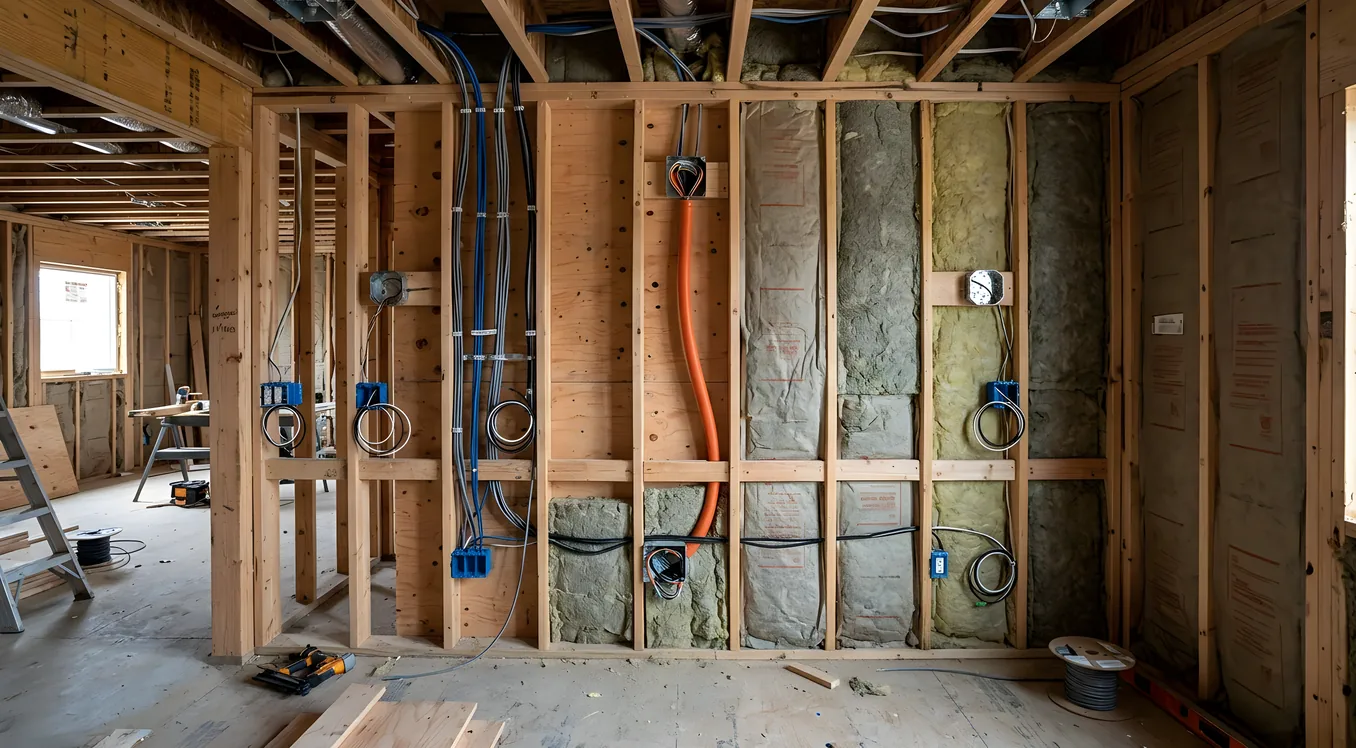
Building a home theater into new construction is a fundamentally different project than retrofitting one into an existing house. The walls are open, the ceiling is exposed, the subfloor is bare. Conduit runs that would cost several thousand dollars to add later cost a few hundred dollars now. Structural backing that would require drywall demolition to install gets screwed into open framing in an afternoon. The opportunity window is short, but the leverage it offers is unlike anything available at any other point in a home’s life.
The challenge is that most builders and general contractors treat low-voltage as an afterthought. It gets scheduled after mechanical, electrical, and plumbing rough-in, at a point when the framing crew has moved on and structural changes have become expensive. Getting ahead of that sequence is the entire job.
When to Bring in an AV Integrator
The right time to involve an AV integrator is before permit submission, ideally while the architectural drawings are still being revised. At that stage, a conversation with your integrator costs nothing structurally and potentially reshapes room dimensions, ceiling heights, and equipment room location before those decisions are locked into the slab or the framing plan.
The second-best window is before framing. A wall location can still move. A ceiling height can still change. The equipment alcove can still be sized correctly. After framing, those conversations become change orders.
What typically happens instead: a homeowner calls an integrator after drywall is hung to ask about mounting the TV and running speaker wire. At that point, getting in-wall wire from the equipment rack to the ceiling for overhead Atmos speakers requires cutting drywall, fishing wire through insulated cavities, and patching. What took two hours during rough-in becomes a two-day job.
Pre-Wire Checklist: What Goes in the Walls
The goal at rough-in is to install every cable and conduit that cannot be added without opening walls. A well-executed pre-wire job treats conduit as infrastructure and wire as a consumable. Run both.
HDMI conduit: HDMI cables change generations faster than walls get renovated. Run 1-inch or 1.25-inch flexible conduit from the equipment rack location to every display position and to the projector mounting point. Pull a mule tape or pull string through each conduit so future cable pulls are straightforward. Do not pull HDMI cable itself during rough-in unless the display and equipment are already selected and confirmed. The cable you pull today may be the wrong spec by the time the system is installed.
Speaker wire: Run 14-gauge or 16-gauge CL2-rated (or CL3-rated for in-ceiling applications) two-conductor wire to every speaker position: front left, center, front right, surround left, surround right, rear surround left, rear surround right, and all overhead channels. For a 7.1.4 Atmos configuration, that is 11 speaker wire runs from the amplifier location. Run an extra loop to each surround position to give the integrator flexibility. CL2 and CL3 ratings are fire-resistance classifications required by the NEC for in-wall speaker cable; non-rated cable cannot legally be installed in a wall cavity.
Cat6 to every room: Run two Cat6 home-runs from a central network closet to every room in the house, including the theater. Two runs per room is the minimum; run three to the theater and to any room where you anticipate a media cabinet. Cat6 handles 10-gigabit Ethernet to 55 meters, which covers any residential home-run distance. Use solid-core cable, not stranded, for in-wall runs.
Coax: Run RG6 quad-shield coax from the cable entry point to every television location. Even if you plan to stream exclusively, coax is inexpensive insurance during rough-in and impossible to add cleanly without opening walls.
Subwoofer cable: Run a dedicated shielded coaxial cable from the receiver/processor position to each planned subwoofer location. A pair of subwoofers in a large theater room is common; pre-wire for both positions. Standard RCA-terminated subwoofer cable is not designed for in-wall installation. Use CL2-rated coax and terminate it at the other end.
Control wiring: If you plan to use an IR distribution system, a central lighting control system, or a motorized screen, run the required low-voltage control cabling during rough-in. Four-conductor 22-gauge wire handles most IR and RS-232 control applications. Motorized screen manufacturers publish specific cable requirements; get those requirements before rough-in.
Conduit vs. Direct Wire
The general principle: run conduit wherever cables are likely to change, and direct wire where the cable type and routing are permanently fixed.
HDMI is the clearest case for conduit. The specification has gone from 1.4 to 2.0 to 2.1 in the last decade, with meaningful changes to bandwidth, refresh rate support, and feature sets at each step. A conduit run that lets you pull a new cable in 20 minutes protects the value of every other investment in the room. Running a single HDMI cable through drywall that is later painted, textured, and furnished means the cable you installed is the cable you have forever.
Speaker cable is a reasonable direct-wire candidate because the underlying connector type (binding post or bare wire) and signal type (passive, full-range audio) have been stable for decades. Pull it during rough-in, terminate it at the wall plates, and leave enough slack at each end for a clean connection.
For any location you are uncertain about, run conduit. The cost delta between conduit and direct wire is measured in dollars per foot; the cost of not having a pathway later is measured in drywall repair, painter fees, and schedule disruption.
Structural Considerations
Several structural modifications are easiest or only possible during framing. A conversation with your general contractor and your AV integrator before the framing crew arrives should cover all of them.
Equipment alcove: If the equipment rack will live in a dedicated closet or alcove adjacent to the theater, that space needs to be correctly sized. A standard 19-inch rack requires a minimum interior width of 24 inches with clearance for cable management; 30 inches is more workable. The ceiling height of the alcove needs to accommodate the rack height plus cable management at the top. Doors need to open fully for rack access. These are framing decisions.
TV mount backing: A 65-inch or larger television exerts significant leverage on a standard drywall installation, particularly if the mount tilts or swivels. The correct solution is a continuous piece of 3/4-inch plywood fastened to the studs behind the drywall. It can span the full wall section where the TV might be mounted, giving the installer any positioning choice. A blocking plate installed over a specific stud bay without plywood backing creates a situation where the TV mount installer is a few inches from a problem.
Projector mount reinforcement: Ceiling-mounted projectors weigh between 10 and 40 pounds, typically, and generate heat and vibration. The ceiling joist at the projector location needs blocking between joists if the mount point falls between them, and the mount itself needs to fasten into structural members. Identify the projector position before the ceiling is closed and mark the structural members. If the projector will hang from a raised section of ceiling or a soffit, that framing is part of this conversation.
Doubled headers for equipment closets and pass-throughs: Any opening framed into a load-bearing wall for a cable pass-through or equipment closet entry needs to be properly headered. Have your contractor confirm load-bearing status before any openings are modified.
Electrical Planning
A home theater’s electrical requirements differ from the rest of the house in ways that a standard electrician may not anticipate unless you specify them explicitly. Get an electrical plan to your AV integrator before the electrical rough-in, and get the integrator’s requirements back to the electrician before the panel is loaded.
Dedicated 20A circuits: The amplifier, the projector, and the equipment rack each benefit from dedicated 20A circuits on separate breakers, not shared circuits. Shared circuits introduce noise from other loads and create ground loop potential. A dedicated circuit for the main equipment rack, one for the projector, and one for a subwoofer amplifier if separate from the receiver is a reasonable minimum. For a larger system with separate power amplifiers, plan more.
Isolated ground: An isolated ground receptacle and circuit gives the audio electronics a reference that is not shared with lighting dimmers, appliance motors, or HVAC equipment. The difference is audible in sensitive analog audio chains. Specify IG (isolated ground) receptacles at the equipment rack position. This requires a green insulated ground conductor run directly to the panel, not bonded to the conduit at any point along the run. Electricians who have not wired audio installations sometimes treat this as unnecessary. It is not.
Outlet placement: The equipment rack needs outlets at the rack’s rear and at its top for patch panels and cable routing. The projector needs an outlet within reach of the projector’s power cable at its installed position (typically ceiling-mounted, so a ceiling outlet or a high-wall outlet behind a soffit). The subwoofer locations need floor-level outlets. Screen motor controllers need outlets. Get the integrator’s outlet location list before rough-in closes.
Lighting dimmers on separate circuits: LED dimmers generate electrical noise on the circuit they share. Keep theater lighting on circuits that do not share a panel space with audio equipment circuits where possible.
Soundproofing During Framing
New construction is the lowest-cost point to add meaningful soundproofing. The same assembly that costs $8 to $12 per square foot during framing might cost $40 to $60 per square foot after the room is finished, drywalled, and furnished.
A dedicated home theater should target STC 55 to STC 65 for walls, floor, and ceiling assemblies. Standard single-layer drywall on standard studs runs around STC 33. Reaching STC 55 to 60 requires combining at least two of the following three strategies. See the full soundproofing guide for assembly details and STC rating comparisons.
Staggered stud walls: Two rows of studs on a single wide plate, alternating so that no stud touches both faces of the wall. The drywall on each face attaches only to its own row of studs, breaking the direct vibration path. This is the highest-leverage framing change available during new construction and adds roughly 3 to 4 inches to the wall thickness. For a dedicated theater room on an interior wall, this is worth every inch.
Resilient channel: Steel channels fastened to standard studs at 24-inch intervals, with drywall screwed only to the channels and not to the studs behind them. The channel decouples the drywall layer from the structure. Resilient channel is less effective than staggered stud construction and is sensitive to installation errors (a screw that inadvertently contacts the stud behind the channel creates a short-circuit in the decoupling), but it adds meaningful performance with minimal wall thickness increase.
Insulation selection: A 3.5-inch stud bay filled with mineral wool insulation (Rockwool or equivalent) rather than fiberglass batts improves the mass, damping, and absorption properties of the wall cavity. Mineral wool is denser than fiberglass, easier to cut precisely, and adds roughly 1 to 2 STC points to a given assembly. It is also fire-resistant and does not support mold growth.
Floor and ceiling: The floor-ceiling assembly between a basement theater and a living space above is often the most acoustically problematic surface. Double subfloor with damping compound between layers, resilient ceiling channel below the joists in the theater, and insulation in the joist bays together can achieve meaningful improvement. Floating floors (where the finished floor surface is on rubber isolation pads, not glued or fastened directly to the subfloor) handle impact transmission that STC ratings do not capture.
HVAC Coordination
HVAC noise in a quiet home theater is immediately audible. At reference listening levels, a movie soundtrack occupies a dynamic range from near silence to peak levels above 100 dB. During a quiet scene, the HVAC system competes directly with the content.
Dedicated return air: A dedicated return air path for the theater room prevents pressure equalization through door gaps when doors are closed. Without a return, closing the theater door can cause a pressure differential that makes the door hard to close and forces air through whatever path it can find.
Register selection: The throw pattern, face velocity, and self-noise of the supply registers matter in a dedicated theater room in ways they do not in a living room. Low-face-velocity registers (designed to move the same volume of air through a larger opening) are available from manufacturers who serve the theater market. Specify these explicitly or accept that your HVAC contractor will install standard residential registers that generate audible turbulence noise at normal duct pressures.
Duct routing: Keep supply and return ducts routed around the perimeter of the room rather than overhead between the listening position and the screen. Cross-duct talk (where sound from other rooms travels through the duct system into the theater) is addressed with lined duct sections or sound-attenuating duct bends in the main runs. The theater’s duct take-offs should be at least several feet from the return opening of any adjacent room to reduce flanking.
Duct lining: Line the first 6 to 8 feet of duct from the take-off with 1-inch acoustic lining. This absorbs airborne sound that would otherwise travel through the duct network and reduces mechanical noise from the air handler that would otherwise radiate down the supply duct.
Lighting Pre-Wire
Theater lighting serves multiple functions that residential lighting controls do not always accommodate well. A well-planned pre-wire keeps all the options open.
Dimmer circuits: All theater seating-area lighting should be on low-voltage dimmer circuits, with the dimmer switches accessible from the main entry and, ideally, from the primary seating position. LED-compatible dimmers rated for the fixture load are available from multiple manufacturers. Run the circuits separately so each lighting zone (seating area, aisle, screen surround) can be controlled independently.
Sconce pre-wire: Wall sconces on either side of the screen and along the side walls are common in dedicated theater rooms. Their positions are architectural decisions that become expensive to change after drywall. Run 14-gauge wire from the dimmer switch location to each sconce position during rough-in, capping the wire at the wall and marking the location for the finish electrician.
Step light pre-wire: Step lights at the front edge of riser steps are both a safety feature and an aesthetic element that signals dedicated-theater intent. Most step light fixtures require a single gang box inset into the riser face. Frame the risers before closing the floor system, install the boxes, and run wire from the nearest dimmer circuit during rough-in.
Aisle light conduit: Low-voltage LED strip lighting along the base of side walls or under seat risers requires wire runs that are difficult to add cleanly after flooring and millwork are installed. Run 1/2-inch conduit or a dedicated home-run low-voltage wire from the control location to each aisle position during rough-in.
Builder Coordination: Who Does What and When
The coordination problem in new construction home theater is that the work crosses trade lines. The electrician handles line-voltage circuits. The low-voltage contractor handles speaker wire, Cat6, and HDMI conduit. The framing crew handles backing plates, blocking, and structural modifications. The HVAC contractor handles duct routing and register selection. A general contractor who has coordinated these trades before knows the sequencing. One who has not will default to standard residential scheduling, which typically leaves low-voltage last.
During design/permit phase: Get your AV integrator’s room layout to the architect. Confirm ceiling height, room dimensions, equipment closet location, and projector throw distance. Get electrical requirements from the integrator to the electrical engineer.
Before framing: Walk the job with your framing contractor and mark structural backing locations, equipment alcove dimensions, riser positions, and any partition modifications. Mark the projector beam path on the floor so the framing crew can see what the ceiling needs to accommodate.
During framing: Install all structural backing (TV mount plywood, projector blocking), frame risers, and verify equipment closet dimensions. This is also the time to confirm the HVAC duct routing plan so mechanical rough-in can proceed without conflicts.
During rough-in (before insulation): The low-voltage contractor runs all speaker wire, Cat6, coax, subwoofer cable, and HDMI conduit. The electrician installs dedicated circuits, IG receptacles, and dimmer circuit wiring. Structural modifications need to be complete before insulation so the insulation contractor can fill all cavities.
Common builder mistakes to flag before they happen:
Insufficient circuits is the most common electrical issue. A builder who is not briefed on AV requirements will install one duplex outlet per wall, shared with adjacent rooms or lighting circuits. Get the integrator’s circuit list to the electrician in writing before rough-in.
Wrong outlet placement is the second most common issue. Outlets installed at standard height on the wall where the TV will mount are hidden behind the display and inaccessible without pulling the TV. Outlets installed at the equipment rack location need to be at rack height, not floor height. The projector outlet needs to be at the ceiling.
Shared HVAC runs are the third issue. A single supply duct serving both the theater and an adjacent room means that the HVAC system will be audible in the theater whenever the adjacent room needs conditioning. Give the theater its own supply branch and dedicated return.
Getting the Most Out of the Opportunity
The practical test for whether a new construction home theater pre-wire is complete: stand in the unfinished room and ask whether there is any wire, conduit, or structural work that could not be added without opening walls. If the answer is yes, something is missing.
The conduit runs, the structural backing, the dedicated circuits, and the isolated HVAC path cost a fraction of their retrofit price during construction. The decisions that cannot be added at any price after the room is complete are the structural ones: room dimensions, ceiling heights, wall locations. Those are architectural decisions made in the design phase, which is another argument for getting the AV integrator involved before permits are pulled.
For the wiring details that apply after rough-in is complete, including how to plan runs in existing homes, see the wiring guide. For a full treatment of electrical circuit planning and load calculations, see the electrical planning guide. HVAC design specifics, including register sizing and noise calculations, are covered in the HVAC ventilation guide.