Dedicated Theater Room vs Media Room: Choosing the Right Approach
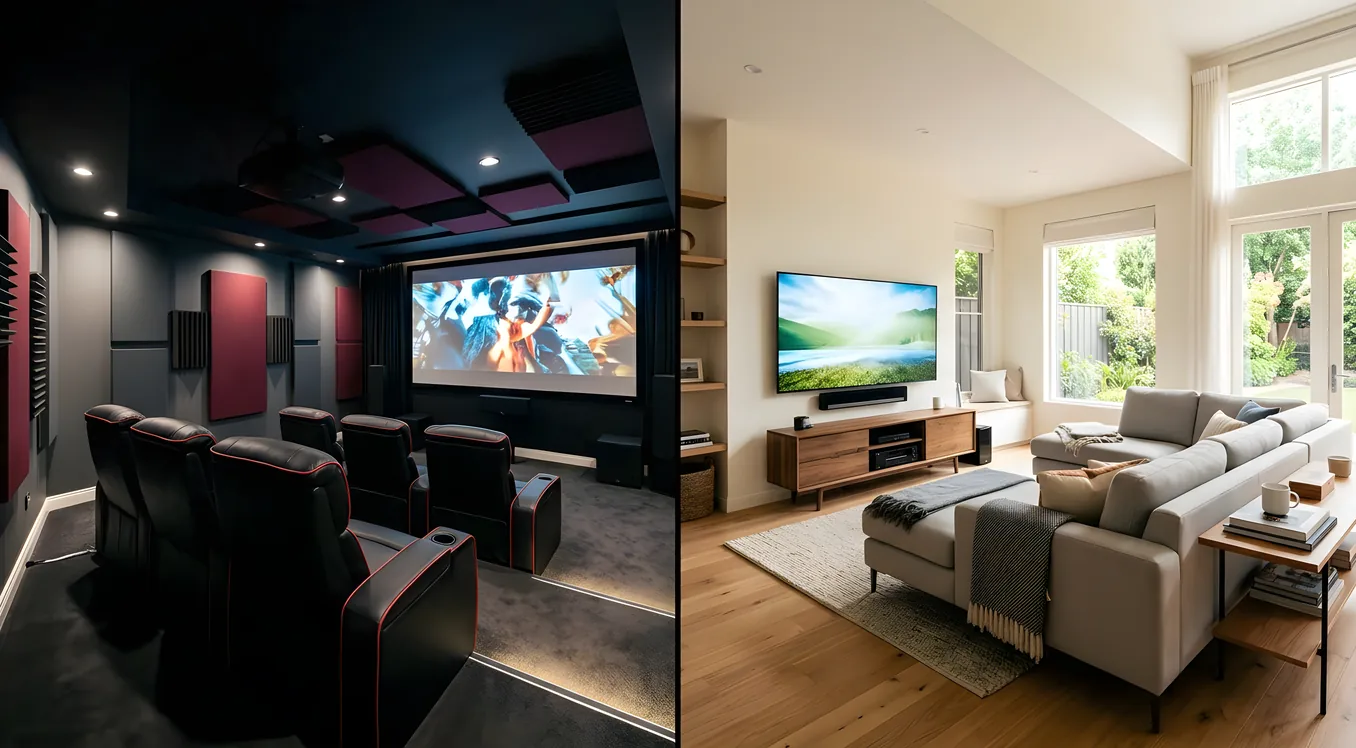
The terms “theater room” and “media room” get used interchangeably in contractor conversations and product listings. They describe genuinely different things, and conflating them leads to costly decisions. A room designed as one type rarely works well repurposed as the other without significant reconstruction.
The core difference is scope. A dedicated theater room is a single-purpose space built around one activity: watching video and listening to audio at the highest possible quality, with every design choice subordinated to that goal. A media room is a multipurpose space that happens to have a large screen and good speakers, but also functions as a living room, game room, or family hangout. Neither approach is superior in the abstract. The right choice depends on your space, household, budget, and what you actually want the room to do every day.
What a Dedicated Theater Room Requires
A dedicated theater room shares its design philosophy with commercial cinemas: the room is the product. Light, sound, and geometry are controlled from the floor up, not added after the fact.
Light control in a dedicated theater means full blackout, not “dim.” Blackout curtains are a media room solution. A proper dedicated theater uses sealed walls with no windows, or windows covered with blackout shades backed by light-seal channels around every seam. Entry doors get light-blocking sweeps and threshold seals. Even standby indicator LEDs on equipment get taped over during screening. The goal is a room that achieves zero-footcandle darkness when the projector is off. This level of control is what allows projectors to perform at their specified contrast ratios, which are measured under near-black conditions.
Acoustic treatment in a dedicated theater goes further than most homeowners expect. Untreated rooms have two acoustic problems: reflections that smear imaging and timing, and low-frequency buildup in corners that turns clean bass into a muddy, one-note thump. First-order reflections (the sound paths from speakers that bounce off side walls and ceilings before reaching your ears) require absorption panels at specific points: the first reflection on each side wall, the ceiling directly above the primary seating position, and the front wall around the screen. Bass management requires either bass traps in the corners or room correction software calibrated with a measurement microphone, and often both.
Soundproofing is a separate problem from acoustic treatment. Treatment shapes how sound behaves inside the room. Soundproofing prevents it from leaving (or entering). A real soundproofed room uses decoupled construction: staggered or double stud walls with resilient channel, mass-loaded vinyl, acoustic sealant at every penetration point, and solid-core doors with proper seals. This is construction-level work. Retrofitting soundproofing into a finished room is significantly more expensive and less effective than building it in from the start.
The geometry of a dedicated theater is fixed by design. Typical layouts place the screen on the short wall, with seating at a distance of 1.2 to 1.5 times the screen width for THX-optimal viewing angle. Two rows of seating are common, with the second row elevated on a riser (typically 8 to 12 inches) to maintain sightlines over the front row. The room does not serve any other function. No ping-pong table. No secondary seating arrangement. No play area for children. The entire floor plan is organized around the screen and the speaker positions.
What a Media Room Trades Away
A media room accepts certain limitations in exchange for flexibility. It coexists with the rest of the household rather than being isolated from it.
Light control in a media room typically means good curtains or cellular shades, paired with the right display technology. A 1,000-nit QLED or OLED television handles ambient light much better than a projector can, because it generates its own luminance rather than reflecting a projected beam. For rooms that cannot achieve full blackout, a large television (85- to 100-inch class) or an ultra-short-throw projector paired with an ambient-light-rejecting (ALR) screen is the practical answer. ALR screens are engineered to reject off-axis light while maintaining gain from the on-axis projector beam. They perform meaningfully better than standard gray screens in rooms with light sources, but they require precise placement relative to both the projector and the windows, and they cost more than standard projection materials.
Acoustic treatment in a media room has to work within the aesthetic constraints of a shared living space. No one wants their family room covered in gray foam wedges. The practical compromise is furniture-integrated treatment: thick upholstered seating, rugs over hard flooring, and bookshelf content (actual books, decor) along the side walls that functions as irregular diffusion. These measures reduce the worst reflections without requiring visible acoustic panels, but they will not approach the performance of a properly treated dedicated room. Bass buildup in corners is the hardest problem to address aesthetically; discreet corner bass traps with fabric coverings matching the room’s palette are available and used by installers who specialize in this work.
The seating arrangement in a media room reflects its dual purpose. A sectional sofa, loveseat, or mixed seating configuration works for movie night and everyday use alike. The tradeoff is that sectionals place viewers at varying distances and angles from the screen, with some positions inevitably off-axis. For television this is a moderate problem (OLED panels have better off-axis performance than LED-backlit LCD), but for projectors with standard screens, the off-axis positions can show color shift and gain drop.
Equipment Choices Follow Room Type
Equipment selection is driven by the room type, not the other way around. Choosing equipment before committing to a room type is how buyers end up with a high-performance projector in a room that can never be dark enough to use it at full potential.
Dedicated theater rooms are built around projectors. A 2.35:1 or 1.78:1 aspect ratio fixed frame screen in the 110- to 150-inch range, paired with a 4K laser projector, is the standard configuration. Laser light sources (both single-chip DLP with phosphor wheel and 3LCD/LCoS laser designs) have replaced lamp-based projectors in most serious dedicated rooms because they provide consistent color output over their lifespan, reach higher sustained brightness, and start instantly without the lamp warm-up period. The projector versus television question largely resolves itself in a dedicated room: the room was designed for a projector, and the image size possible at that viewing distance is simply not achievable with a television.
Media rooms work best with large televisions or ultra-short-throw (UST) projectors. 85-inch and 98-inch televisions have dropped in price significantly and offer brightness levels (1,000 to 2,000 nits on top models) that hold up in lit rooms. UST projectors, which sit on a low stand 6 to 15 inches from the wall, pair with ALR screens and avoid the cabling and ceiling-mount challenges of traditional throw projectors. The tradeoff is image size: most UST projectors top out at 120 inches before brightness becomes marginal, and a dedicated theater with a proper throw projector can reach 150 inches or larger with more controlled light output.
Speaker placement in a dedicated theater follows the Dolby Atmos or DTS:X layout that the room was designed for. A 7.1.4 configuration (seven surround speakers, one subwoofer, four height channels in the ceiling) requires placing ceiling speakers at specific angular positions relative to the primary seating row, which in turn requires those positions to be available during construction. A media room more commonly runs a 5.1 or 7.1 configuration with speakers integrated into cabinetry or mounted in less-than-ideal positions, then corrected with room measurement software like Audyssey or Dirac Live.
Cost Ranges and Construction Reality
Budget is often the deciding factor, and the cost gap between these two room types is substantial.
A basement home theater converted into a dedicated screening room represents one of the more cost-efficient paths to a dedicated space, since the foundation walls provide some natural sound isolation and the below-grade location means no windows to manage. Even with that advantage, a properly executed dedicated theater, including acoustic treatment, soundproofing, custom seating with risers, projector and screen, processor and amplification, and speaker system, typically runs $15,000 to $50,000 for a mid-tier installation. High-end builds with premium projectors, custom millwork, Dolby Atmos-certified speaker systems, and acoustically engineered walls reach $100,000 and above. That budget does not include the room itself if new construction is involved.
A media room with serious equipment is achievable in the $5,000 to $15,000 range. An 85-inch or 98-inch QLED television, a quality AV receiver, a 5.1 or 7.1 speaker package with an in-wall option, and purpose-selected furniture with integrated acoustic benefit lands in this range. A media room upgrade that adds a UST projector and ALR screen in place of the television, with a 7.1.2 overhead speaker system, can push toward $20,000 while still remaining significantly below the cost of a true dedicated theater.
The construction component is what separates the categories in practice. A media room requires equipment and installation. A dedicated theater requires architectural decisions made before the walls go up.
Convertible Spaces and the Hybrid Option
Some homeowners want a room that performs like a dedicated theater when needed but functions as normal living space otherwise. This is achievable, but it requires specific planning decisions made during construction.
Motorized screens that retract into a ceiling cassette are the key mechanism. A 120-inch motorized screen stored in a flush ceiling cassette is invisible when retracted. Paired with a projector in a ceiling mount with a motorized lens cover, and automated lighting on a control system, the room can transition from “living room with art on the wall” to “screening room” with a scene trigger. The Lutron shading system, with motorized blackout shades at any windows, integrates into the same scene.
The acoustic compromise in this hybrid approach is where most people make concessions. You cannot hide bass traps behind a sofa. Panels that flip out from the wall on motorized mounts exist and are used in high-end installations, but they add cost and complexity. The more practical hybrid approach uses heavy fixed furnishings in positions that coincide with first reflection points, and accepts that the acoustic performance will fall between a true media room and a true dedicated theater.
Seating in a convertible space typically uses a sectional that can be rearranged, rather than fixed theater recliners on a riser. A riser in a hybrid room creates a permanent architectural feature that announces “this is a theater,” which defeats the point.
Resale Value Considerations
The resale value question depends heavily on the buyer pool for your home. In a market where the typical buyer has a household income that supports a $600,000 to $1,000,000 home price, a well-executed dedicated theater is a genuine selling point and can support a higher asking price.
Below that market tier, a dedicated theater room can actually be a liability. Buyers see a single-purpose room that a family with young children cannot easily repurpose. A five-bedroom home that sacrifices one bedroom to a theater has four bedrooms; that reduces the pool of buyers relative to five-bedroom comparables. Sellers of homes with dedicated theaters frequently receive offers below their investment in the space.
A media room presents differently. Because it reads as an enhanced living space rather than a purpose-built specialty room, it tends to be valued more neutrally. Buyers see a room with a large television, good speakers, and comfortable furniture, and they can picture their own use of it more easily.
The practical implication: if resale value in a broad buyer market is a priority, a high-quality media room presents better than a dedicated theater. If you intend to stay in the home long enough to enjoy the space fully, the calculus shifts toward the room type that delivers the experience you actually want.
Making the Decision
The right framework for this decision is not “which is better” but “which constraints am I willing to accept.”
A dedicated theater asks you to give up a room to a single function, spend significantly more on construction and equipment, and make permanent architectural decisions that cannot easily be reversed. In return, it delivers an experience that no media room can match: a calibrated image at 130+ inches in a room that is actually dark, with a speaker system properly positioned and acoustically supported.
A media room asks you to accept compromises in image size, light control, and acoustic performance. In return, you get a room that serves the household every day, not just on movie night, and that costs far less to build and equip.
For most households with one room to dedicate to entertainment, and a budget below $20,000, the media room is the honest answer. For a household that has the room and the budget, and for whom the quality of the viewing experience is the primary goal, the dedicated theater is the one you will not regret.