Basement Home Theater: Layout, Moisture, and Finishing Considerations
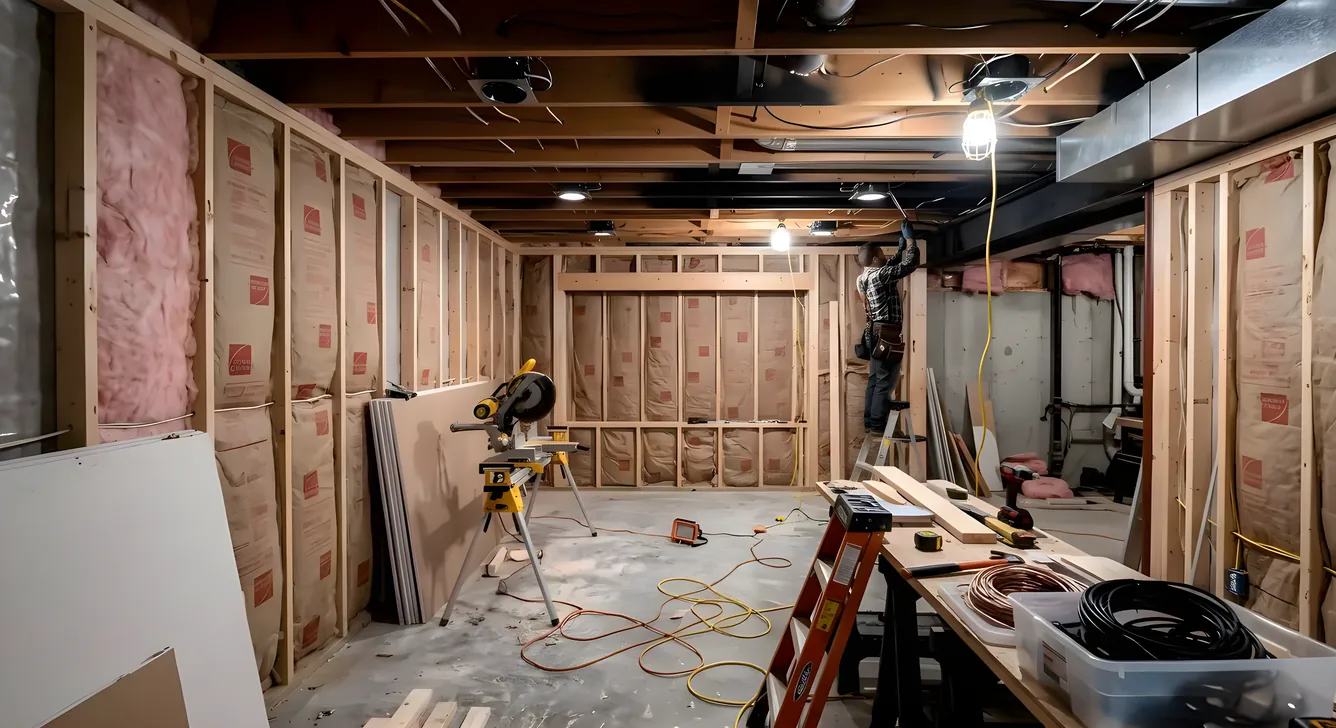
A basement is one of the best structural arguments for a home theater. Below-grade construction gives you concrete walls with significant mass, minimal ambient light from exterior sources, and natural separation from the living spaces above. You have an acoustic head start before you hang a single panel. The building code requirements, moisture physics, and mechanical realities of belowground construction, though, introduce a set of decisions that don’t apply to above-grade rooms. Work through them in the right order and the basement becomes an asset. Skip them or address them late and you’ll be tearing out finished walls.
Why Below Grade Works in Your Favor
Concrete walls do for free what a theater builder above grade has to construct: mass. A poured concrete foundation wall at 8 inches thick has substantial transmission loss before any additional treatment. The below-grade thermal mass also moderates temperature swings, which means HVAC demands are lower and the space holds a stable ambient temperature through most of the year.
Ambient light is the other structural advantage. A basement with small or no windows eliminates the single biggest obstacle to daytime projector performance. Light from windows behind viewers or from sidelights reflecting off the screen is the main reason above-grade theaters require blackout curtains, offset windows, and careful sight line planning. In a windowless basement, you start with a light-controlled environment.
The separation from living spaces reduces flanking paths for sound. Sound traveling up through the floor structure still needs to be addressed, but the basement isn’t sharing a wall with a bedroom on three sides the way a first-floor room might. That said, sound traveling through the concrete slab into an adjoining neighbor’s living space is a real concern in townhomes and semi-detached construction. Soundproofing treatment is still necessary; the concrete just means you’re starting from a better baseline than wood-frame construction.
Moisture: Address This Before Anything Else
Moisture is the constraint that overrides every other planning consideration. Before framing begins, before the subfloor goes down, before any decision about layout or finishes, you need to establish that the basement is dry and that it will stay dry.
The distinction between water intrusion and vapor diffusion matters. Active water intrusion means water is finding a path through a crack, a joint, or from hydrostatic pressure through the foundation wall. This requires waterproofing: exterior membrane, interior drainage systems, sump pump if not already installed, and crack repair. Interior waterproofing systems (drain tile, dimple mat, sump) manage intrusion after the fact by routing water to a collection point rather than letting it pool. Exterior waterproofing addresses the source, but it requires excavation and is substantially more expensive.
Vapor diffusion is separate. Concrete is porous and moisture moves through it from the soil side even when there’s no active intrusion. A finished wall framed directly against a concrete wall traps that moisture between the concrete and the drywall, which creates conditions for mold behind the finish materials. The fix is a vapor barrier or closed-cell spray foam applied to the concrete before framing. Closed-cell spray foam at 2 inches accomplishes two things simultaneously: it blocks vapor diffusion and provides thermal insulation. Vapor barrier sheeting (6 mil poly) is a lower-cost alternative but requires careful attention to seams and to the floor-wall transition.
Dehumidification is a long-term management tool, not a substitute for addressing the underlying moisture paths. A dedicated basement dehumidifier with a drain line (rather than a bucket that needs manual emptying) maintains low relative humidity after the construction phase. Relative humidity above 60% in a finished space creates conditions for mold and material degradation. Below 50% is the target range for both the equipment in the room and the structural materials.
Run the space empty with a dehumidifier for a full rainy season before committing to finish materials. If the dehumidifier is running continuously at high output and the humidity is still climbing, you have a moisture intrusion problem that requires waterproofing, not more dehumidification.
Ceiling Height: the Hard Constraint
Ceiling height affects almost every downstream decision: projector throw distance, speaker mounting for Dolby Atmos height channels, structural soffit placement, and the quality of the finished environment.
Most jurisdictions require a minimum finished ceiling height of 7 feet for a habitable basement space, with some allowing 6 feet 8 inches in portions of the room. For a theater specifically, 7 feet is a cramped working height. You lose inches to the subfloor system (1.5 to 3 inches depending on method), more to the ceiling assembly (drywall on resilient channel, for example, drops another 1.5 to 2 inches), and potentially more to acoustic panels and speaker mounting hardware.
Eight feet is a more comfortable working height for a theater. It allows overhead Atmos speaker mounting with appropriate vertical separation from the listening position, lets you run ductwork within a soffit rather than dropping a beam into the middle of the room, and gives the space enough volume that bass modes are less pronounced. Nine feet is better still, particularly for projector mounting. A projector mounted at the ceiling needs adequate throw distance to reach the screen at the correct image size, and higher mounting allows longer throw without the projector hanging at eye level in the seating area.
Measure the actual unfinished ceiling height to the underside of the floor joists before designing anything. The finished height will be lower, and every inch matters.
Structural Obstacles: Columns and Ductwork
Older homes frequently have steel columns or concrete pillars at regular intervals along the basement floor supporting the main beam above. These are load-bearing and cannot be removed without a structural engineer, a temporary support system, and a steel replacement beam. For most basement theater projects, working around them is the only practical path.
Columns in poor locations for the theater layout often become built-in elements: a column on the side wall becomes an anchor for a rack cabinet or a speaker niche. A column near the front of the room can be wrapped to become a screen wall support element. The approach depends on column placement relative to the seating layout.
Ductwork is a different kind of obstacle. Supply and return air ducts running through the basement ceiling are often the primary reason ceiling heights are tight. Routing ductwork in a new configuration is possible but expensive and requires HVAC engineering. The more practical approach is to frame around it using soffits. A soffit is a built-out ceiling section that contains the ductwork above a finished surface. Soffits at the perimeter of a room are less intrusive than a center-room beam, and they create a natural location for recessed lighting, speaker wire runs, and in some designs, the top boundary of acoustic treatment.
Map every obstruction in the basement before designing the room. Take measurements to the center of every beam, column, and duct run. The layout plan needs to account for them before framing starts, not after.
Egress Windows: the Code Requirement Most Builders Miss
Building codes in most jurisdictions require emergency egress from a finished basement bedroom or habitable sleeping room. If your theater is a dedicated room with a door that could be used for sleeping, or if it’s being permitted as a bedroom, egress is required. The typical requirement is a window with a minimum opening of 5.7 square feet, a minimum opening height of 24 inches, a minimum opening width of 20 inches, and a sill no more than 44 inches above the floor.
A dedicated theater labeled a theater in the permit drawings is often not treated as a sleeping room and may not require egress. But this is jurisdiction-specific and permit-specific. Check with your local building department before designing the room as fully enclosed. If egress is required, a window well cut into the foundation and an egress window installed is a significant concrete-cutting and grading project, but it’s far less expensive than failing inspection after the room is framed.
Subfloor Systems: Getting Off the Slab
Concrete slab floors are cold, hard, and in contact with the ground. Framing directly to the slab and installing flooring over bare concrete traps moisture between the concrete and the finished floor, and it transmits cold from the slab through to the room. Subfloor systems address this.
DRIcore and Barricade are two common dimple-mat panel systems. They’re engineered subfloor panels with a molded plastic underside that sits on the concrete, creating a small air gap between the slab and the panel. The gap allows vapor to dissipate rather than accumulate, and the insulated panel surface adds some thermal resistance. These systems raise the floor height by approximately 1.5 inches. They install by clicking together and do not require adhesive or fasteners to the slab, which is important for moisture management.
Sleeper systems use pressure-treated 2x4s laid flat on the slab with rigid foam insulation between them and plywood or subfloor panels nailed to the sleepers. This method adds more thermal resistance and creates a structural surface suitable for any finish flooring. The floor height increase is larger, typically 2.5 to 3 inches, which matters for ceiling height.
For a theater room specifically, cork or foam underlayment over a dimple panel system is often the right balance: it keeps the floor height increase modest, controls moisture, adds thermal comfort, and provides some acoustic damping between the floor and the concrete slab. This is particularly relevant in multi-story buildings where impact noise from the theater floor is a concern for spaces below.
Framing: Floating Walls for Soundproofing
A standard framed wall is anchored at the bottom plate to the slab and at the top plate to the ceiling framing. In a basement theater, framing directly to the concrete at every point creates a rigid connection between the theater and the structure. Sound from the room travels through the frame into the slab and the foundation, and from there through the structure.
The solution is the same decoupling approach used in above-grade theater construction, adapted for the concrete contact points. Floating walls are framed independently of the foundation walls. Instead of framing against the concrete and attaching to it, the stud wall is built with a gap between it and the foundation wall. The gap can be as small as an inch. The wall is anchored to the floor and ceiling, but the concrete wall is not in the load path. Mineral wool insulation fills the gap. Moisture vapor from the concrete has a path to dissipate rather than being trapped in a sealed cavity.
The bottom plate should be isolated from the slab using a rubber sill gasket (a foam or EPDM strip) to break the direct rigid contact. This is a small detail that matters at low frequencies, where vibration traveling through the plate into the concrete is a real transmission path.
For a full treatment of the decoupling methods, mass-loaded vinyl, and Green Glue systems that go on top of the framing, see soundproofing.
HVAC: Basement Airflow Is Usually Inadequate
Basements are typically at the end of the HVAC duct run. The supply air has traveled the longest distance from the air handler, which means it arrives with less velocity and volume than the upstairs registers. Adding a finished room with high equipment heat loads (amplifiers, receivers, processors, and projectors generate significant heat) to a zone that is already undersupplied is a setup for thermal management problems.
The first step is measuring airflow at the existing basement registers. Consult with an HVAC contractor about whether the existing system can deliver adequate cooling to a finished room with equipment heat loads. The answer is often no. Extending existing duct runs and adding register capacity sometimes helps. More reliably, a dedicated mini-split handles the basement theater zone independently. Mini-splits allow precise temperature control of the theater space without competing with the rest of the house, and they handle cooling and supplemental heating. A properly sized mini-split for the theater room also eliminates the noise contribution from forced-air registers, which is a real issue in a room where background noise levels matter.
Duct runs in the theater should be lined with acoustic duct liner and should avoid running through the theater ceiling where possible. Supply registers located in the listening position are a noise source during quiet passages. Position them at the perimeter. For a detailed treatment of this topic, see HVAC and ventilation for home theaters.
Electrical: the One Advantage of Basement Panel Access
Most basements have the electrical panel nearby, and running dedicated circuits in a basement is often far simpler than in an above-grade room with finished walls. This is one of the genuine construction advantages of a basement theater.
A proper theater requires dedicated circuits: at minimum, one 20-amp circuit for the audio/video equipment rack, another for the projector, and a third for general lighting and convenience outlets. High-power amplifier setups may require 30-amp circuits or multiple 20-amp runs to prevent shared-circuit voltage drop from affecting amp performance. Running these circuits in an unfinished or partially finished basement before walls go up is straightforward compared to fishing wire through finished framing.
The panel access also makes it practical to run conduit for future changes. Running 1-inch or larger conduit from the panel to the equipment rack location and to the screen wall allows future wire pulls without opening walls. For a complete treatment of theater wiring and conduit planning, see the wiring guide.
Layout Options for Basement Spaces
Basement layout decisions depend on the physical space: column locations, staircase placement, the position of the mechanical room, and whether the entire basement is being finished or only a portion.
A fully enclosed dedicated theater is the highest-performance option. It means every wall surface is controlled acoustically, the room can be darkened completely, and the door seals against sound intrusion from the rest of the house. For the best acoustic result, the room should not be square, and length-to-width ratios around 1.6:1 reduce parallel surface flutter and bass mode clustering. The dedicated theater vs. media room article covers the trade-offs between full enclosure and open-concept designs.
An L-shaped basement layout often develops organically: the theater occupies the main basement footprint, and the mechanical room, storage, and utilities occupy the L. This natural separation puts the mechanicals behind the screen wall or in a room adjacent to the theater with an insulated party wall between them. Mechanical noise from the water heater, furnace, or sump pump is substantial, and distance plus an insulated wall reduces it to a manageable level.
Open-concept layouts with a defined theater zone treat the basement as a multi-function space with the theater at one end. These work well for households that want the basement to function as a family room with sports viewing as well as a proper theater. The acoustic compromise is significant: without walls, bass builds up unpredictably, and the listening position doesn’t benefit from rear-wall reflection control. If this is the direction, invest in acoustic treatment at the screen wall and at the primary listening position, and accept that performance will be lower than a dedicated room.
Cost Range and Budget Allocation
A basement home theater buildout runs from roughly $20,000 to $60,000 for construction and equipment combined, with wide variation depending on square footage, finish level, and equipment tier. The construction scope (subfloor, framing, insulation, drywall, HVAC, electrical, acoustic treatment, and lighting) typically runs $10,000 to $30,000 for a mid-size room. Equipment (projector or display, screen, audio components, seating) accounts for the remainder.
Moisture remediation, if the basement isn’t already dry, is a variable that can shift costs significantly. A minor crack repair and vapor barrier is a few hundred dollars. A full perimeter interior drain tile system with a sump pump runs $5,000 to $15,000 depending on basement perimeter length. Budget for it before committing to finish materials.
The cost distribution to prioritize, in order: moisture control first, then the structural shell (subfloor, framing, sound isolation), then HVAC and electrical, then acoustic treatment, then equipment, then finish materials. Cutting the shell budget to spend more on equipment is a common mistake. A projector can be upgraded; a wall you have to tear out because of mold behind the vapor barrier is an unbudgeted demolition project.
Getting the Order Right
Basement theater projects fail in predictable ways: moisture found after drywall is hung, insufficient ceiling height after the subfloor and ceiling assembly eat available headroom, column locations that force a bad seating arrangement, and HVAC that can’t keep the room cool under equipment load. Each of these problems is either eliminated or made manageable with a construction sequence that builds from the foundation up.
Confirm the space is dry. Measure everything. Establish ceiling height with subfloor and ceiling assembly taken into account before finalizing screen and seating locations. Run electrical and HVAC rough-in before closing walls. The basement’s structural advantages reward a builder who takes the time to work within its physical constraints rather than fighting them after the fact.