Peninsula Home Theater: Palo Alto, San Mateo, and the South Bay
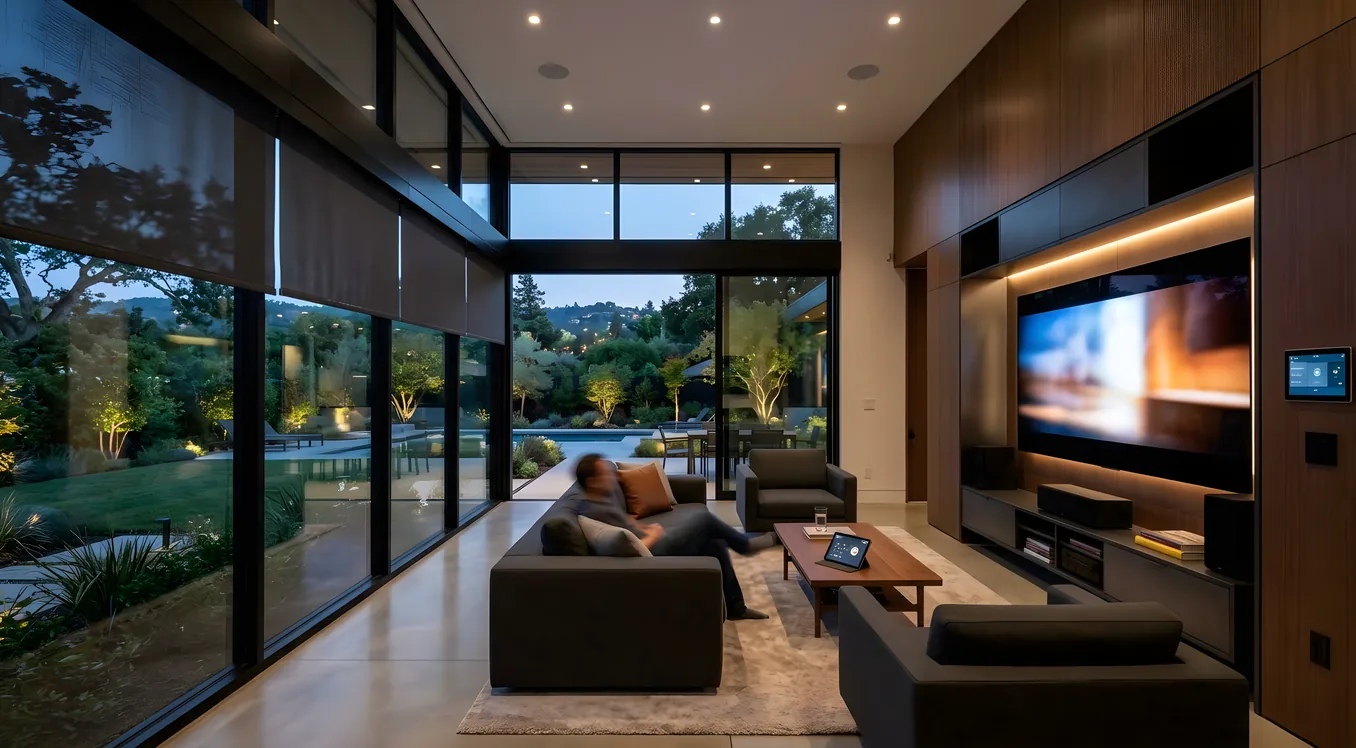
The Peninsula is one of the more varied home theater markets in the country. A two-mile drive can take you from a 1950s Eichler flat-roof in Palo Alto with radiant floor heating and zero attic clearance to a 12,000-square-foot new build in Atherton with a dedicated theater wing already framed in the architectural plans. Both owners want a great home theater. The installation approach, the budget conversation, and the technical constraints are almost entirely different.
This guide maps those differences by geography and construction type, so you go into a project with accurate expectations about what the Peninsula’s housing stock makes straightforward and what it genuinely complicates.
What Peninsula Demographics Mean for Home Theater Budgets
The Peninsula corridor from San Mateo down through Palo Alto and into Los Altos Hills has the highest concentration of technology industry wealth in the country. Median household income in Atherton, Los Altos Hills, and Hillsborough consistently rank among the top ten nationally. Home values in those cities run $3M to $10M and above.
That wealth concentration shapes the home theater market in specific ways. First, it raises the floor on what most homeowners consider worth spending. An installer quoting $15,000 for a well-specified media room system in Daly City might present the same quote in Hillsborough to someone who had already budgeted $75,000. The reference class for what a good theater costs is different here than in most metro areas.
Second, Peninsula homeowners often already have layer one of a smart home infrastructure in place. Lutron RadioRA or Caseta systems handle lighting in many homes built or remodeled since 2010. Sonos or similar multiroom audio is already running. There may be a Nest or Ecobee HVAC system with an app. A home theater installation on the Peninsula frequently means integrating into existing infrastructure rather than building from scratch, which changes both the scope of work and the required installer expertise. For the integration layer, professional processors like Control4 handle the coordination between these subsystems, but only an installer with actual familiarity with the existing hardware in the home can estimate that work accurately.
Third, the project scale in the upper tier of the market is substantial. Dedicated theater rooms in Atherton and Hillsborough estates with JVC or Sony laser projectors, acoustic wall treatments, tiered seating, and full Dolby Atmos speaker arrays routinely run $80,000 to $200,000. Those projects are not outliers. They reflect what the market considers appropriate for homes at this price point. A complete breakdown of what drives cost at each tier is in the Bay Area home theater cost guide.
Eichler Homes: The Peninsula’s Distinctive Installation Challenge
No discussion of home theater on the Peninsula is complete without addressing Eichler homes, because they present a set of structural constraints that do not exist in any other construction type in the region.
Joseph Eichler built roughly 11,000 homes in California between the late 1940s and 1966. The Peninsula received a significant share: Palo Alto, Sunnyvale, and Cupertino have the largest concentrations. Eichler built to a post-and-beam structural system with open interior plans, flat or low-sloped roofs, and full-perimeter glass. The aesthetic hold they have on the mid-century architecture market is justified. The installation challenges they create are real.
No attic space. Eichler flat roofs have minimal or no attic clearance. Running speaker wire, HDMI, or conduit through the ceiling typically means routing through interior walls or exposing conduit, neither of which suits the aesthetic. Some installers use the mechanical chases or crawlspace routes where available, but this requires careful survey of each specific home before any scope can be quoted.
Radiant floor heating. Many Eichlers use copper pipe radiant heating embedded in the concrete slab. Drilling through the slab for conduit or speaker wire runs the risk of puncturing heating pipes, which are difficult and expensive to repair. Any installer proposing to run wire through the floor of an Eichler should be surveying the slab for pipe location, or the quote should explicitly exclude any slab penetration.
Post-and-beam construction. Interior walls in Eichlers are often non-structural partition walls, which can simplify some routing work. However, the exposed beam ceilings that define the aesthetic typically cannot be modified without compromising the architectural character. In-ceiling speaker installation that is straightforward in a framed tract home becomes an aesthetic and structural problem in an Eichler.
No crawlspace in many configurations. Depending on whether the home sits on a slab or has a perimeter foundation, access to wall cavities from below may not exist. Combined with the attic constraint, this can make a Peninsula Eichler one of the harder retrofit scenarios for audio/video rough-in that an installer will encounter.
None of this makes a great home theater impossible in an Eichler. It makes wireless audio distribution, surface-mounted conduit in period-appropriate finishes, and careful pre-planning essential. The right installer will spend time walking the specific home before putting any numbers on paper.
Atherton and Hillsborough: Estate Theaters
At the other end of the spectrum, Atherton and Hillsborough represent the clearest opportunity for purpose-built dedicated theaters in the Bay Area. Homes in these cities routinely exceed 5,000 square feet, and major remodels typically incorporate media or theater rooms into the architectural program from the beginning.
Purpose-built theaters in new construction or substantial remodels start with correctly sized rooms. A proper acoustically designed home theater needs a room volume that avoids problematic bass resonance modes, wall-to-wall dimensions that don’t produce flutter echo, and ceiling heights that accommodate overhead speakers for Atmos playback. In a purpose-built room, the architect and the AV designer can collaborate on dimensions before the framing goes up. That coordination saves money and produces better results than retrofitting an acoustically problematic room later.
Pre-wire during construction is the single highest-value investment a Peninsula homeowner can make in a future theater installation. Running conduit, speaker wire, HDMI infrastructure, and power to a future theater room during framing costs a fraction of what post-construction rough-in costs in a finished home. An AV consultation with an installer before the walls close is worth scheduling even if the theater itself is 18 months away from being furnished. The Bay Area installer directory includes firms that offer pre-construction consultation specifically for this reason.
For furnished systems in this tier, the reference-class options are well-established. Projectors from JVC’s NZ or RS series or Sony’s VPL-XW line deliver the native black levels and color accuracy that dedicated dark rooms justify. Screen sizes of 140 to 180 inches are common. Seating for 8 to 12 with tiered platforms, acoustic panels, perforated screen with front-channel speakers behind the screen, and full Dolby Atmos overhead speaker layouts are standard at this price point. For what the full system specification looks like, the high-end home theater planning guide covers the component decisions in that tier in detail.
Palo Alto and Menlo Park: Mixed Stock
Palo Alto and Menlo Park have more varied housing stock than either Atherton or the Eichler-heavy neighborhoods to the south. Ranches, colonials, updated craftsmans, and 1990s-era construction exist alongside Eichlers and new construction. The approach for each is different enough that generalizing is not useful. What matters is an accurate assessment of what is inside the walls and above the ceiling.
The tech professional demographic in both cities tends to have specific expectations about smart home integration that influence theater installation scope. A homeowner who has spent time with a Lutron system for lighting, a Savant or Control4 installation elsewhere in the house, or even just a well-configured Apple HomeKit setup is not looking for a standalone projector and receiver they need to operate independently. They want the theater integrated into whatever control system governs the rest of the house, or they want to agree on what the right unified control approach should be before equipment is ordered.
That conversation about control architecture, held before anything is purchased, is one of the higher-value things an experienced installer brings to a Peninsula project.
San Mateo, Burlingame, and San Carlos: Media Rooms in Suburban Stock
The San Mateo corridor offers a more typical suburban installation environment. Homes are largely post-WWII ranch construction, California contemporary from the 1970s and 1980s, and older craftsman-era homes in central San Mateo and Burlingame. Attic access is generally available, walls can be opened more predictably, and the structural constraints that complicate Eichler work are absent.
This is media room territory more than dedicated theater territory, not because the budgets are necessarily lower, but because the rooms available tend to be multi-use: a family room, a bonus room, a finished basement where one exists. A well-specified media room in a San Mateo home can deliver an excellent result with a large flat panel or a short-throw projector, a quality soundbar with separate subwoofer, or a 5.1 speaker system configured for the room. The constraint is usually room size and the need to function as a general-purpose living space during the day.
Burlingame homes, particularly in the older neighborhoods near the downtown corridor, share characteristics with San Francisco’s housing stock: narrower lots, two-story structures, and attics that may have been converted or that have constrained access. San Carlos further south tends toward more intact mid-century construction with better access conditions than Burlingame’s older inventory.
Foster City: Tract Home Installations
Foster City represents a distinct pocket within the Peninsula market: it was built largely in the 1960s and 1970s as a planned community on filled marshland, and its housing stock is unusually uniform. Tract homes with consistent construction mean that an installer who has done a dozen Foster City projects has reliable knowledge about what is inside the walls before the survey visit. That reduces uncertainty on scope and cost.
The challenge in Foster City and similar tract home environments is room acoustic performance. Rooms sized identically across hundreds of units produce predictable acoustic problems: the bass modal behavior in a 14x20 foot room with 8-foot ceilings is calculable in advance. An installer who understands room acoustics can identify those problems before equipment is chosen, which prevents the common outcome of spending $8,000 on a speaker system that sounds worse than expected in a room that was never addressed acoustically.
Los Gatos, Saratoga, and Los Altos Hills: South Peninsula Luxury
The cities at the south end of the Peninsula market, Los Gatos, Saratoga, and Los Altos Hills, combine the wealth levels of Atherton with more varied topography and a higher proportion of new construction and major remodels built in the past two decades. These markets see a significant volume of purpose-built theaters similar to what Atherton produces.
Los Gatos in particular has a strong new construction segment in the hills above town where lot sizes and homes are large enough to support dedicated theater rooms as a standard feature rather than a special project. Saratoga’s estate homes on larger lots similarly present opportunities for purpose-built installations. Los Altos Hills, with its five-acre minimum lot requirements and custom home stock, is architecturally diverse enough that each project is essentially unique.
For installers, the south Peninsula cities represent some of the most technically demanding and financially substantial projects available in the Bay Area market. The homeowners in these cities expect experienced project management, proper acoustic design, and finished results that match the quality of the surrounding construction.
Cupertino and Sunnyvale: The Tech Home Market
Cupertino and Sunnyvale have the heaviest concentration of technology industry employees in the region, and it shows in the installation priorities that come up in these markets. Smart home integration is not a luxury add-on here; it is the baseline expectation. Homeowners in these cities are frequently power users of whatever consumer home automation they already have, and they have specific opinions about how a home theater should interface with it.
The practical consequence for installation scope is that the control system conversation happens earlier and matters more than in other markets. A homeowner who has spent years in a well-organized Apple HomeKit or Google Home setup may want to stay within that ecosystem, which has implications for which AV receivers, smart projectors, and streaming sources are compatible at the level of integration they expect. Alternatively, moving to a professional control platform is the decision point where a clear explanation of what each option actually delivers in practice makes the difference between a satisfied client and a frustrated one.
Construction in Cupertino and Sunnyvale is a mix of post-war tract homes, 1970s and 1980s suburban construction, and newer development. Attic access is generally available in most of the housing stock, which makes speaker wire and conduit routing more straightforward than in Eichler territory nearby.
Climate Considerations and Dedicated HVAC
The Peninsula has one of the most temperate climates in the country. Year-round temperatures in most Peninsula cities range from the mid-40s in winter nights to the low 80s on hot summer days, with persistent coastal influence keeping extremes rare. It is easy to assume that a climate this mild does not require attention to HVAC in a theater room.
That assumption produces uncomfortable theaters. The issue is heat generation, not outdoor temperature. A projector running at 2,000 lumens generates substantial heat. An AV rack with a receiver, two or three amplifier channels, a media player, and a network switch generates more. Seating for six humans adds several hundred more watts of metabolic heat. A sealed, well-insulated room designed to be dark accumulates that heat quickly. Even in Palo Alto’s mild climate, a theater room without dedicated cooling becomes uncomfortable within 90 minutes of use.
The correct specification for a dedicated theater is a mini-split heat pump sized for the room’s actual heat load, including equipment, occupancy, and lighting. The mini-split serves double duty: cooling in summer, heating in winter, and year-round humidity management. The Peninsula’s afternoon coastal fog and marine influence means humidity management is not irrelevant even in a temperate climate. A well-integrated installation addresses HVAC as part of the project scope, not as an afterthought.
Permit Requirements by City
Building permits for home theater work on the Peninsula vary more than most homeowners expect. The general rule is that low-voltage work (speaker wire, HDMI, control wiring) does not require a permit in most Peninsula cities. Work that involves power (dedicated 20-amp circuits for projectors or rack equipment), structural modifications (for acoustic panels or ceiling speakers), or HVAC installation (mini-split) requires permits in almost every Peninsula city.
Atherton has a reputation among contractors for thorough plan checking on any permitted work. Palo Alto’s building department has been active in residential enforcement. San Mateo and Burlingame follow standard California building code with typical permit timelines. Saratoga and Los Gatos require permits for structural work and electrical but are generally manageable to work with.
The practical advice is to ask your installer how they handle permits before signing a contract. An installer who skips required permits is creating liability for the homeowner, not saving time. Unpermitted electrical work in a home theater that later causes a fire is a coverage issue with the homeowner’s insurance carrier, not just a code violation.
Building on Existing Smart Home Infrastructure
The Peninsula homeowner who already has Lutron lighting, a networked HVAC system, and streaming audio throughout the house is in a better starting position for a home theater than most. The infrastructure investment is already made. The theater integration question becomes: does the existing control system scale to manage the theater, or does the theater need to operate on a separate platform that eventually gets unified?
Lutron’s RadioRA 3 system integrates directly with most professional home theater control platforms. A theater scene that dims the lights, closes motorized shades, powers on the projector, and selects the correct input can be triggered from a single button on a Lutron keypad already installed in the room. That integration works reliably because both systems are designed for professional installation and long-term stability.
Where existing infrastructure creates friction is when the homeowner has a consumer-grade system (a smart speaker as the hub, Z-Wave devices from multiple manufacturers, or a deprecated platform) and wants it to serve as the backbone for a professional theater installation. Consumer platforms work well for their intended scope. They are not designed to handle the input routing, source management, and display handshaking that a theater system requires. An honest conversation about what the existing infrastructure can actually do, and where a professional platform adds value that the consumer ecosystem cannot replicate, is part of what distinguishes experienced Peninsula installers.
Finding the Right Installer
The Peninsula’s geographic range, from Daly City to Los Gatos, spans enough construction diversity and market positioning that installer fit matters. An installer whose experience is primarily with new construction custom homes in Saratoga is not necessarily the right choice for an Eichler retrofit in Sunnyvale. An installer who does excellent media room work in San Mateo may not be the right fit for a reference-tier project in Hillsborough.
The questions to ask before hiring matter more than brand relationships or equipment lineup. How many Peninsula projects have they done in homes with comparable construction? What does their process look like for acoustic design? Do they have an in-house project manager or are they subcontracting installation to crews who did not bid the project? How do they handle permits? The Peninsula and Bay Area installer selection guide expands on these questions with a full framework for evaluating candidates before committing.
The Peninsula market rewards careful installer selection more than most Bay Area submarkets, because the range of project types is wider and the consequences of choosing a firm that cannot handle the specific constraints of your home or your system scope are more expensive to correct.