Home Theater Cables: HDMI, Optical, Speaker Wire, and What Actually Matters
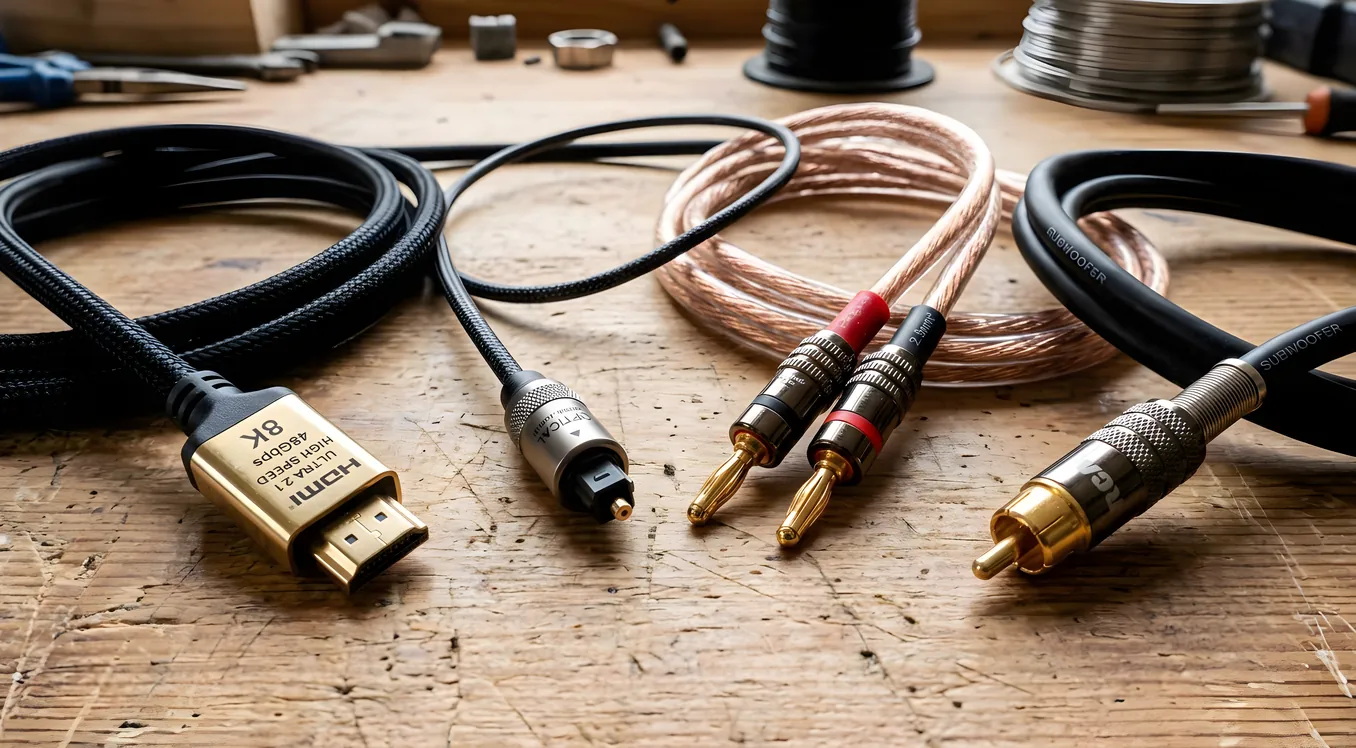
Cable marketing runs on manufactured anxiety. The pitch is simple: your $3,000 receiver is only as good as the cables connecting it, so spend accordingly. The reality is more nuanced. Some cable decisions matter a great deal. Others are pure margin extraction. Knowing the difference saves money and removes one of the more persistent sources of confusion in home theater planning.
HDMI: Specification Tiers That Actually Mean Something
HDMI cables are certified against bandwidth categories, and the category determines what signals the cable can carry. The two categories that matter for current home theater are:
Premium High Speed HDMI is rated for 18 Gbps of bandwidth. That covers 4K at 60Hz with HDR (HDR10, Dolby Vision, HLG) and 1080p at 120Hz. If your source equipment and display are not doing 4K/120Hz or 8K, a Premium High Speed cable is all you need. The certification program includes a QR code on the packaging that can be verified against the HDMI Licensing Administrator database.
Ultra High Speed HDMI is rated for 48 Gbps. This is the cable required for 4K at 120Hz (which HDMI 2.1 sources and displays use), 8K at 60Hz, and uncompressed audio formats that demand higher bandwidth. If you have a PlayStation 5, Xbox Series X, or a graphics card running to a 4K/120Hz-capable television, Ultra High Speed is the specification you need. The HDMI 2.1 port standard specifically requires 48 Gbps bandwidth, and a cable bottlenecked at 18 Gbps will prevent those features from working regardless of how premium the connectors look.
The HDMI Licensing Administrator runs a certification program for Ultra High Speed cables. Certified cables carry a label with a QR code. Uncertified cables marketed as “HDMI 2.1” or “8K HDMI” are not verified to meet the specification and frequently fail at 4K/120Hz under real-world signal conditions.
Expensive HDMI cables do not improve picture quality beyond meeting the bandwidth specification. HDMI carries a digital signal. The display either decodes the full signal or it drops frames, flickers, or refuses to handshake. There is no middle ground where a premium cable produces “better colors” or “sharper edges.” Monoprice Certified Ultra High Speed HDMI cables are indistinguishable in performance from cables costing ten times more because they carry the same bits at the same bandwidth.
HDMI Cable Length: Where Physics Actually Constrains You
Passive copper HDMI cables have a practical length limit. Cables under 3 meters (roughly 10 feet) are reliable across the market, including budget options, provided they carry the appropriate certification. From 3 to 5 meters, quality variation increases and you should buy certified cables rather than generic. Beyond 5 meters, passive copper becomes unreliable for Ultra High Speed signals, even with premium cable.
For runs from 10 to 30 meters (33 to 100 feet), active optical cables (AOC) are the right solution. Active optical HDMI cables replace the copper conductors with fiber optic strands and include active chipsets at each end to convert signals. They carry the full 48 Gbps bandwidth over long distances and are no heavier than passive cables. They are directional (the source and display ends are labeled), and they cannot carry power over the cable, which matters for products like HDMI ARC-powered devices.
Runs beyond 30 meters call for fiber HDMI extenders, which can reach 50 meters or more, or HDMI-over-HDBaseT transmitter/receiver pairs, which can run 100 meters over Cat6 Ethernet cable. HDBaseT setups introduce latency and require powered transmitter and receiver units, but they are the standard approach for custom installation in large rooms or whole-house video distribution.
Pre-wiring a conduit run during construction with our wiring guide is far easier than retrofitting long cable runs after walls are finished.
Speaker Wire: Gauge, Copper, and Real-World Considerations
Speaker wire carries an analog audio signal, which means wire quality and gauge do affect performance, unlike HDMI. But the effect is primarily about resistance over distance, not about audiophile magic.
16 AWG wire (approximately 13 milliohms per foot of loop resistance) is adequate for runs up to about 50 feet to speakers with 8-ohm nominal impedance. For most living room and smaller dedicated theater setups where the receiver is within 25 to 30 feet of the speakers, 16 AWG is the practical choice. It is affordable, flexible enough to route through tight spaces, and sufficient for the application.
14 AWG wire reduces resistance by approximately 40% compared to 16 AWG. It is the right choice for runs of 50 to 100 feet, or for amplifiers driving 4-ohm speakers where the lower resistance load makes wire resistance a larger fraction of the total circuit. Bi-wire configurations (where separate wire runs connect to separate binding posts on the speaker) benefit from 14 AWG because total wire length doubles.
12 AWG wire has roughly half the resistance of 16 AWG. It is appropriate for runs exceeding 100 feet or for high-current amplifiers paired with low-impedance or high-sensitivity speakers in larger rooms. It is stiffer and harder to route than thinner wire, and there is no practical benefit to using it at typical home theater run lengths under 50 feet.
The copper question matters more than the AWG debate for many buyers. OFC (Oxygen-Free Copper) is drawn and processed to remove dissolved oxygen, which reduces oxidation over time and keeps conductivity stable. For in-wall installations where the wire will be sealed behind drywall for years, OFC is the sensible choice because accessibility for replacement is difficult. For exposed runs that can be replaced, the difference between OFC and standard copper wire is not audible.
CCA (Copper-Clad Aluminum) is aluminum wire with a copper coating. It is lighter and substantially cheaper than solid copper wire. It also has higher resistance per gauge and is brittle at connection points, where aluminum fatigues under repeated flex. CCA wire can overheat at connection terminals. Avoid it for home theater applications.
Termination: Bare Wire, Banana Plugs, and Spade Connectors
How the wire terminates at the speaker and receiver binding posts affects ease of connection and long-term reliability.
Bare wire (stripped, twisted conductors inserted directly into binding post holes or under clamp terminals) is the most direct connection and has no electrical penalty. The practical problem is that copper oxidizes at exposed ends over time, which increases contact resistance. Bare wire connections that are accessed infrequently benefit from occasional re-stripping to expose fresh copper.
Banana plugs insert into the standard 4mm holes in binding posts, which are found on the vast majority of receivers and speakers. They make reconnection fast and clean. Gold-plated banana plugs from Monoprice or similar sources are reliable. The banana plug specification is not controversial: a properly inserted 4mm banana plug in good contact with a binding post conducts as well as a bare wire connection.
Spade connectors wrap around the binding post shaft and are tightened under the post cap. They provide the most secure mechanical connection and are less likely to loosen from vibration. They are the choice for fixed installations where connections are made once and left permanently. The spade lug should match the post size, typically 5mm to 8mm across.
Optical (TOSLINK): Where It Works and Where It Falls Short
Optical digital audio cables carry audio via infrared light pulses through a glass or plastic fiber. They are completely immune to ground loops and electrical interference, which makes them useful in setups where hum problems have been an issue.
The limitation is bandwidth. Optical connections max out at approximately 1.5 Mbps in the consumer standard, which supports PCM stereo up to 24-bit/96kHz and compressed multichannel audio (Dolby Digital 5.1, DTS 5.1). They do not carry Dolby TrueHD, DTS-HD Master Audio, Dolby Atmos, or DTS:X. Those formats require HDMI ARC/eARC or coaxial digital.
Optical connections remain useful for connecting a television to a soundbar or amplifier when the television lacks eARC. They are also common on game consoles, Blu-ray players, and older source equipment where they provide a clean digital output path for compressed audio. If your setup involves anything beyond 5.1 compressed audio, optical is a constraint, not a solution.
Coaxial Digital: Same Ceiling, Different Connector
Coaxial digital audio uses an RCA connector and 75-ohm impedance cable to carry the same S/PDIF signal as optical. The bandwidth ceiling is identical to optical. It does not carry object-based audio formats.
Coaxial digital is slightly more tolerant of cable length than optical (practical runs up to 10 meters versus approximately 5 meters for optical before signal degradation can appear), and it does not require the optical cable’s characteristic fragility at the plug. Either coaxial or optical serves the same purpose for the formats they both support. The right choice is usually whichever connector your source and receiver both have available.
Subwoofer Cable: A Shielded RCA Cable
Subwoofer connections run at line level, carrying a low-frequency analog signal from the receiver’s subwoofer output to the subwoofer’s amplifier input. The cable is a single-conductor shielded RCA cable, typically with a thicker outer jacket to resist interference pickup. Most subwoofer runs are 15 to 25 feet.
Marketing in this category becomes creative: cables with names implying sub-bass enhancement or “impact” are ordinary shielded RCA cables at elevated prices. A Monoprice sub cable at $10 performs identically to a $150 brand-name cable because both carry the same analog signal from the same output to the same input.
If your subwoofer connection is picking up hum, the problem is almost certainly a ground loop between components, not cable quality. A ground loop isolator inserted inline ($15 to $30) solves this cleanly. An expensive cable does not.
In-Wall Rated Cable: CL2 and CL3 Requirements
Any cable installed inside walls or ceilings must meet building code fire safety requirements. The National Electrical Code specifies:
CL2 (Class 2) cables can be installed in walls and ceilings in most residential applications. They carry a 150-volt rating and are constructed with jacket materials that self-extinguish and minimize flame spread.
CL3 (Class 3) cables carry a higher 300-volt rating and provide additional margin for longer or higher-power runs. CL3 is backward compatible: CL3-rated cable can be used anywhere CL2 is specified.
In-wall speaker wire with CL2 or CL3 ratings is available from Monoprice and similar sources at prices comparable to non-rated wire. The rating applies to the jacket material and construction, not to any performance enhancement. A 14 AWG CL2 cable carries audio identically to 14 AWG standard cable. The rating is for insurance compliance and building inspection, not for audio quality.
HDMI cables installed in walls similarly need CL2 or CL3 ratings. Standard HDMI cables run through conduit or wall cavities do not meet code in most jurisdictions. In-wall rated HDMI is not exotic; it is available in certified form from the same suppliers.
Brands Worth Buying
Monoprice certifies its HDMI cables against the HDMI Licensing Administrator program and prices them at approximately $10 to $30 for most residential applications. Its speaker wire and RCA cables are similarly straightforward at reasonable prices. Blue Jeans Cable manufactures speaker cables, HDMI, and coaxial cables with documented specs, in-house testing, and genuine technical support. For HDMI specifically, AmazonBasics Certified cables have passed third-party bandwidth verification and represent a reasonable alternative.
These brands are reliably good because they compete on specification compliance rather than on marketing claims. A cable either passes bandwidth verification or it does not. The suppliers above are transparent about testing; many premium cable brands are not.
Where to Spend and Where Not To
The decisions worth spending on in a home theater cable context are: Ultra High Speed HDMI certification for sources that output 4K/120Hz, OFC copper for in-wall speaker runs that will not be accessible for replacement, and active optical HDMI for any run over 5 meters. Those are cases where the specification or material directly affects whether the system functions correctly.
The decisions that are not worth a premium: HDMI cables beyond certified specification for any given bandwidth tier, speaker wire beyond the gauge appropriate for the run length, and subwoofer cables at any price point above a quality shielded RCA.
The AV receiver at the center of your system determines what audio and video formats are possible. Cable selection determines whether those formats reach the display and speakers intact. That is the full scope of what cables do, and that scope is narrow enough to make most cable purchasing decisions straightforward.