Home Theater Warranty and Service Plans: What's Worth Paying For
Most home theater buyers spend weeks comparing receivers, projectors, and subwoofers. Warranties get a quick glance, if that. Then something breaks eighteen months in, and the fine print suddenly matters a great deal.
Not every warranty is worth the paper it’s printed on, and not every service plan makes financial sense for every component. The goal here is to help you decide where coverage actually earns its keep, and where you’re better off self-insuring and budgeting for repairs as needed.
What Manufacturer Warranties Actually Cover
Standard manufacturer warranties run the spectrum. Entry-level receivers and subwoofers often come with one-year coverage on parts and labor. Step up to mid-range and high-end gear, and two to three years is common. Some companies have made warranty length a selling point.
SVS, for example, backs its subwoofers with a five-year standard warranty, which is unusually long for the category and reflects the company’s confidence in its build quality. That kind of coverage has real value for a component with a powered amplifier and moving parts that can fail.
Passive speakers (no amplifier, no electronics) often carry warranties of just one year, sometimes less. That reflects the reality that a passive speaker has few failure modes. The warranty exists mainly to cover manufacturing defects in the crossover or driver, which are rare.
Projectors sit in their own category and deserve separate attention.
Projector Lamp Warranties: Read Before You Buy
Traditional lamp-based projectors have always carried short lamp warranties, and for good reason. Lamp life varies dramatically based on how often you use the projector and at what brightness setting. Manufacturers typically cover bulbs for 90 days to one year, or cap coverage at 1,000 to 2,000 hours of use, whichever comes first.
The practical implication: if you buy a projector in October and run it heavily through football season and holidays, your lamp warranty may already be expired by spring. Replacement bulbs for mid-range projectors typically run $100 to $250. Budget for it.
Laser projectors change this picture significantly. A solid-state laser light source carries a rated lifespan of 20,000 hours or more, and most manufacturers back them with multi-year warranties that cover the light engine. If you’re buying a projector that will see heavy use, the total cost of ownership math increasingly favors laser, even at higher upfront cost.
Manufacturer Extended Warranties: Worth It on Receivers
Extended warranties from the manufacturer (not a third-party retailer) are generally the most straightforward. They extend your original coverage period without adding complicated exclusions. For receivers, this can be a smart buy.
A modern AV receiver is dense with electronics. It processes audio decoding, manages HDMI switching, handles room correction DSP, and may handle network streaming. Denon, Marantz, and similar brands have offered extended warranty programs that push coverage out to three or four years total. The failure rate on receivers goes up as they age, and repair costs are significant.
For a $1,500 to $3,000 receiver, a $150 to $250 extended warranty that covers labor and parts to year four often makes sense. Calculate the rough cost of a service call plus parts (often $400 to $700 at an authorized service center), and the math usually favors coverage.
Subwoofer extended warranties are less pressing if the manufacturer already offers an extended standard warranty like SVS. Check what you already have before buying more.
Integrator Service Plans: What They Include and Why They Exist
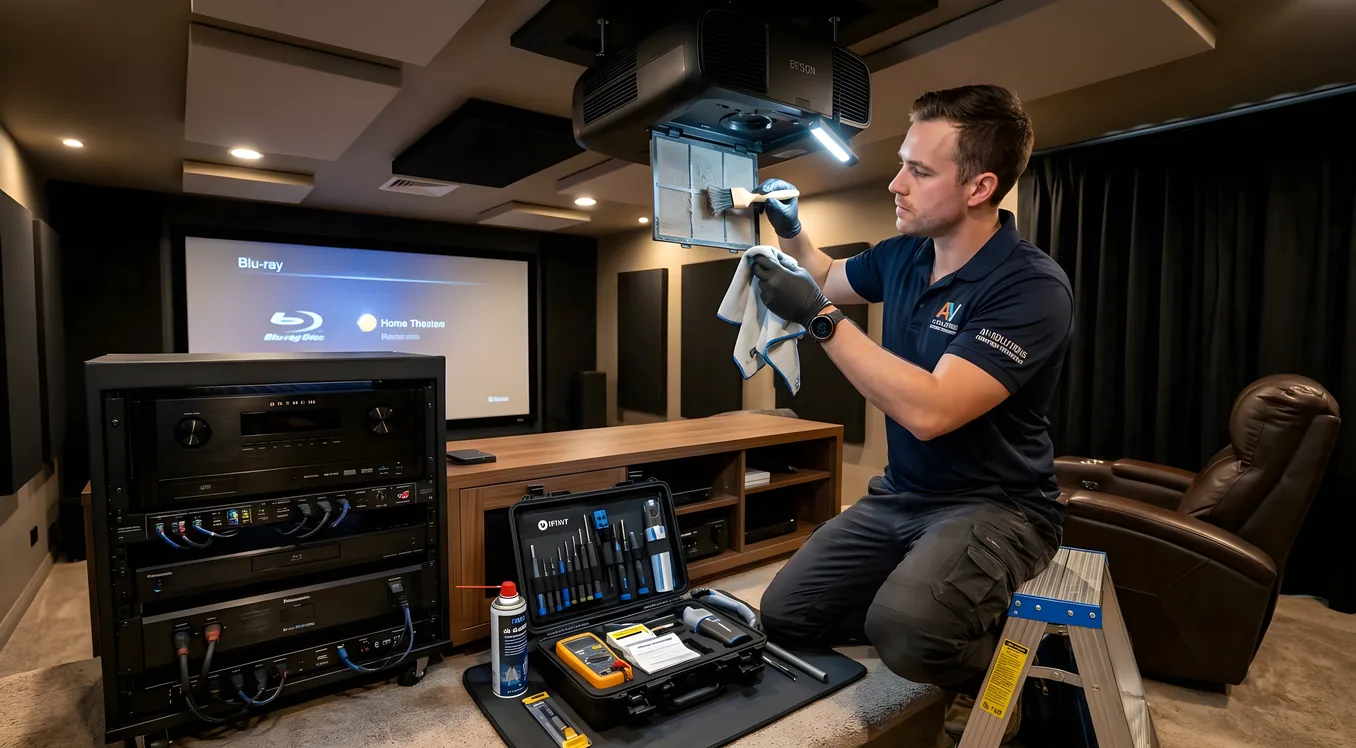
If your home theater was designed and installed by a custom integrator, you’ve likely been offered a service plan. The scope of these plans varies, but good ones include several things that have genuine value: annual system calibration, firmware updates across all components, priority scheduling for service calls, and remote diagnostics.
The remote diagnostics piece is worth unpacking. Platforms like OvrC and Domotz allow your integrator to monitor your system remotely and catch issues before you notice them. A processor that’s showing irregular behavior in its logs might get flagged and resolved during routine monitoring, before it affects a movie night. That proactive visibility has real worth in complex systems.
Annual calibration also matters more than many owners realize. Room acoustics don’t stay static. Furniture moves, acoustic panels get added or removed, and HVAC systems affect humidity in ways that change speaker performance over time. A properly calibrated system every twelve months sounds better than one that was only calibrated at install.
For a typical residential system, integrator service plans run $50 to $150 per month depending on system complexity and what’s included. That covers what would otherwise be $150 to $300 per service call, billed at least once or twice a year for most active users.
Where Service Plans Are Worth Every Dollar
Automation systems are where service plans pay for themselves fastest. Control4 and Crestron systems require periodic software updates and sometimes programming changes when hardware gets added or replaced. These are not DIY tasks. A Control4 dealer charges for every hour of programming time, and a moderately complex update can easily run $300 to $500.
If your integrator’s service plan includes programming updates and software maintenance, you’ll likely recoup the annual cost in the first update cycle. These systems also have interdependencies: a firmware update on one device can break integration with another, and having a service relationship in place means that gets caught and fixed quickly rather than leaving you troubleshooting for days.
For integrated systems with multiple subsystems (lighting control, motorized shades, whole-home audio, security integration), a service plan is less a luxury and more a maintenance agreement. The system is too complex to manage without professional support.
Where Extended Coverage Is Not Worth It
Passive components don’t need extended warranties. A passive speaker has no electronics. Its failure modes are limited to physical damage (cone tears, surround rot, terminal failures) and manufacturing defects. The first category isn’t covered by any warranty anyway. The second is rare and usually appears within the original warranty period.
Cables, connectors, and screens are similarly low-risk from a defect standpoint. Speaker wire doesn’t fail. HDMI cables either work or they don’t, and a failed cable costs $15 to replace. Motorized projection screens have more moving parts, so the manufacturer’s standard warranty has value there, but extended coverage is rarely worth the premium.
Simple passive components have long service lives and predictable failure patterns. Extended coverage on them is pure margin for whoever sold it to you.
Before You Sign a Service Plan: Questions to Ask
Not all service plans are equal. Before committing, get specific answers on the following:
Labor and parts, or parts only? Some plans cover parts but bill you for the technician’s time. A compressor replacement at $200 in parts but $350 in labor is not the same as fully covered.
On-site service or ship to the manufacturer? On-site service is worth significantly more. Shipping a 90-pound subwoofer or receiver for depot repair means two to four weeks without your system, plus risk of shipping damage.
Is the warranty transferable? If you sell your home or the theater equipment, a transferable warranty adds resale value. Some manufacturers offer this; many don’t. Ask before you buy.
Who performs the service? Manufacturer-authorized service centers follow documented repair procedures and use OEM parts. Third-party shops may not. The difference matters for complex electronics.
Documenting Your System: The Underrated Protection
The most overlooked “warranty” is your own documentation. Keep a record of every component: purchase date, serial number, retailer, and the installer who commissioned it. This information is required for every warranty claim, and it’s surprisingly easy to lose track of when you have a dozen components across multiple equipment racks.
Store photos of each unit’s serial number sticker in a folder on your phone or a cloud drive. Scan or photograph receipts and save them. If your integrator provided a system runbook (a document listing every device, IP address, and login), keep a copy outside the integrator’s system so you have it if you ever change service providers.
Good documentation shortens every service call and eliminates disputes about when equipment was purchased. It also helps if you ever need to make an insurance claim after a power surge or other event.
For complex systems, knowing who installed and programmed your system matters as much as knowing who made it. Keep your integrator’s contact information in a place you can find it quickly, separate from your phone contacts where it can be lost or synced away. If you chose your installer carefully, that relationship is worth maintaining.
Putting the Numbers Together
A home theater has a significant upfront cost, and protecting that investment takes some thought about where risk actually lives. A receiver or projector that fails outside warranty can cost $400 to $800 to repair, sometimes more. A Control4 programming session runs $150 to $300 per hour. One missed firmware update that breaks device integration on a complex system can exceed what an annual service plan would have cost.
The right coverage matches complexity. Passive components need almost nothing beyond basic care. Active electronics with processors, amplifiers, and network connectivity have real failure risk and benefit from extended coverage or service agreements. Automation platforms almost always benefit from ongoing service relationships.
If you’re working with a custom installer and managing a system with multiple integrated subsystems, an AV consultation before purchase is the right place to talk through service plan options in the context of your specific build. What makes sense depends entirely on what you’re installing, how heavily you’ll use it, and how much risk tolerance you have when something stops working on a Saturday night.