Blackout Solutions for Home Theaters: Shades, Curtains, and Light Traps
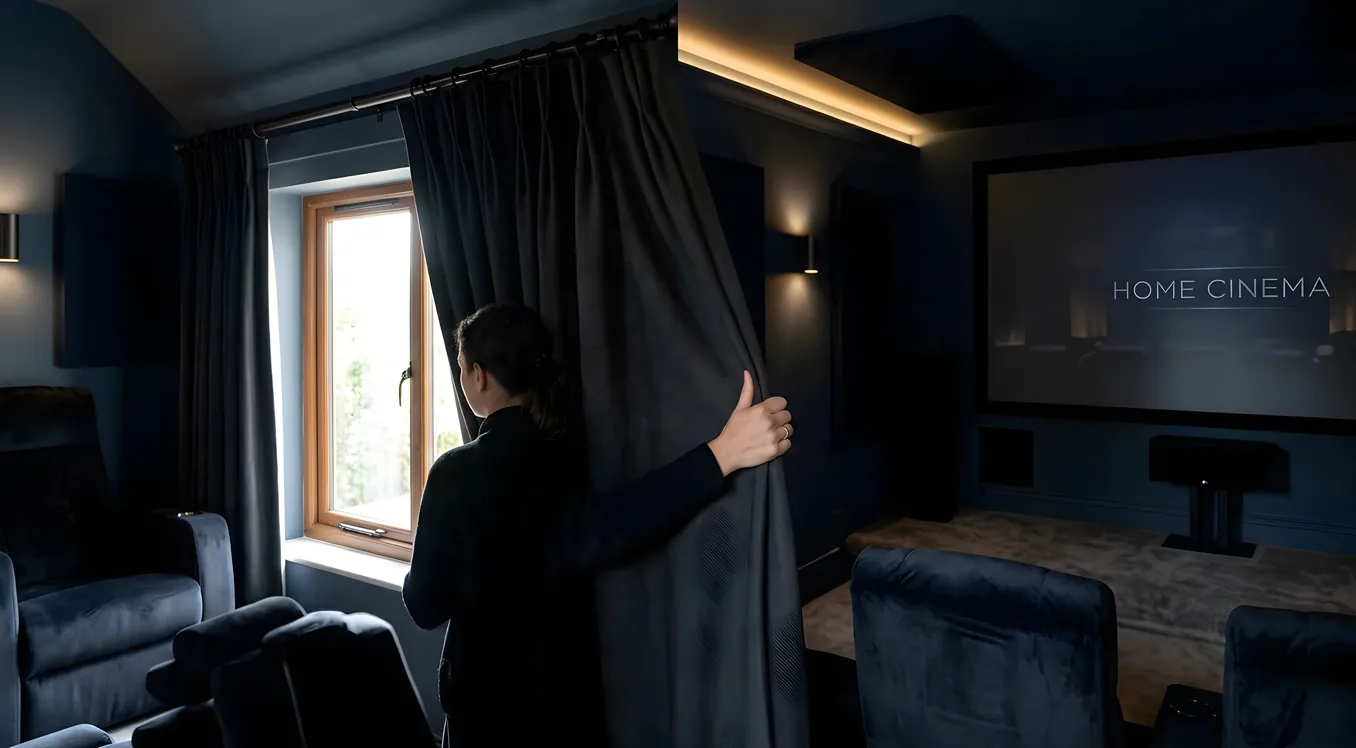
Even a small light leak can ruin a projector image. A crack of daylight under a door, an indicator LED reflecting off the back wall, a gap between a roller shade and its window frame: any of these raises the room’s ambient floor enough to wash out shadow detail in dark scenes. Projectors specify their contrast ratios under near-zero ambient conditions. If your room cannot reach those conditions, the spec sheet is irrelevant to what you actually see on screen.
Full home theater blackout is not one product. It is a system of layered decisions covering windows, doorways, equipment, HVAC, and control integration. This guide works through each layer in the order you should address them.
Why Projectors Are Unforgiving About Light
A flat-panel television generates its own luminance and can fight back against ambient light with sheer brightness. A projector cannot. It produces color by modulating a light beam and projecting it onto a reflective surface. That same surface reflects everything else in the room too: daylight from a window, the glow from a dimmer-controlled sconce left on, the blue standby LED on an AV receiver. Every photon that reaches the screen from a source other than the projector raises the effective black floor and compresses the image’s contrast range.
Projector manufacturers specify contrast as high as 1,000,000:1. In a room with even modest ambient light, real-world contrast often falls below 300:1. The difference between those numbers is the difference between a scene with visible shadow texture and detail versus a scene where dark areas look uniformly gray. Read the full analysis of how room light interacts with display performance in the ambient light management guide.
The implication is that blackout investment has a higher return for projector owners than for flat-panel owners. That said, even television users in dedicated rooms benefit from full blackout. A darkened room reduces eye fatigue over long viewing sessions and improves perceived contrast on any display type.
Blackout Roller Shades: Products and Light Gaps
Roller shades are the most common window treatment in purpose-built home theaters, and for good reason. They install cleanly, retract out of sight when not in use, and motorize well. The tradeoff is that a standard roller shade leaves light gaps at the sides, top, and bottom of the window frame.
A shade fabric rated “blackout” blocks light through the material itself. The fabric is not the problem. The edges are. Light wraps around the shade fabric at the sides between the shade and the window frame, and enters at the top and bottom where the fabric does not contact the wall or sill. In a dark room, these gaps create streaks of light visible from the seating position, and they contribute meaningfully to the room’s ambient floor even when they are not directly visible.
Side channels (also called side tracks or cassette tracks) solve the gap problem. A roller shade installed in a side channel system uses a U-shaped aluminum or plastic track on each side of the window, into which the shade edges slide. The fabric is captured in the track across its full height, eliminating the side gap. Top cassettes hide the roller mechanism and close the gap at the head of the window. Bottom rail seals that contact the sill when the shade is fully lowered close the bottom. A properly specified cassette-and-channel system can achieve near-total blackout without curtains.
Several manufacturers offer quality motorized roller shades with cassette and side-channel options:
Lutron Serena shades are a well-supported option for rooms already using Lutron lighting control. The Serena system integrates with Lutron RadioRA and Caseeta ecosystems, meaning shade position can be included in lighting scenes and triggered alongside dimming commands. Fabric options include several true blackout materials. The side channel option is available but not bundled; installers need to specify it explicitly.
Hunter Douglas PowerView motorized shades run on a proprietary RF protocol and include a dedicated app and hub. PowerView’s blackout roller line (the “Blackout Roller” collection) offers side seals on certain models. The PowerView hub integrates with Control4, Crestron, Savant, and Amazon Alexa, giving home automation users multiple path options for triggering shades from a scene.
Budget Blinds is a national dealer network that installs shades from multiple manufacturers. For a home theater application, specifying a true blackout fabric with a fascia (decorative cassette) and side channels is achievable through Budget Blinds, often at lower installed cost than buying direct from Lutron or Hunter Douglas. The key is specifying the right components rather than accepting a standard install package.
For cost-sensitive builds, cellular blackout shades mounted in an inside-mount position with a separate set of blackout curtains covering the full window opening (including the frame perimeter) is an effective combination that avoids the premium of cassette-and-channel systems.
Blackout Curtains: Fabric, Track, and Seal
Blackout curtains are the accessible, retrofittable alternative to cassette roller shades. They work well when specified and hung correctly. The most common error is hanging curtains too close to the window frame, which allows light to wrap around the sides and top.
Effective blackout curtain installations extend the rod or track 8 to 12 inches past the window frame on each side and mount the rod at least 4 to 6 inches above the top of the frame. This eliminates the wrap-around light path at the top and sides. The curtain panels should overlap at the center by at least 4 inches to prevent a light streak at the join.
Double-layer construction is more effective than any single-layer product. An inner blackout liner paired with a face fabric gives full light blocking from the liner and aesthetic finish from the face fabric. This approach also provides better thermal insulation, which matters in rooms with significant window area.
Velvet curtains are the traditional choice for cinemas and for home theaters that want maximum light absorption with no light transmission. Velvet is woven densely enough that light cannot pass through the fabric, and its matte pile surface absorbs scattered light rather than reflecting it. The drawback is weight: velvet curtains on large windows require heavy-duty hardware.
Grommet-top curtains hang from rings punched into the fabric itself. The grommets slide over a rod, which is convenient but creates a series of slight folds or channels that allow small amounts of light to pass between the fabric and the rod. For critical home theater applications, grommet-top curtains should be paired with a ceiling-mounted track that holds the fabric against the ceiling, closing the gap at the top.
Track-mounted curtains are the preferred method for home theaters. A ceiling-mounted track (SL or H-channel track systems from commercial manufacturers like Silent Gliss or Modinex) allows the curtain to travel completely flat against the wall with minimal gap. Hospital-style curtain tracks also work well and are significantly less expensive. Track mounting eliminates the gap at the top that rod-mounted curtains always have to some degree.
The rod-pocket style (fabric sewn in a sleeve that fits over the rod) produces the tightest seal at the top of a rod-hung curtain, better than grommet or clip-ring installations. For the best possible seal from a curtain without switching to a track, combine rod-pocket mounting with a deep valance that covers the rod and closes the top gap, and use magnetic curtain weights at the bottom hem.
Light Traps for Doorways
The room’s entry is the most commonly overlooked light leak in home theaters. A blackout shade on every window, dark walls, sealed equipment: all of it is undone by the 1-inch gap at the bottom of a hollow-core door with a hallway light on the other side.
Door light leaks have several sources:
- The gap under the door (threshold gap)
- The gap around the door frame (perimeter gap)
- Light transmission through hollow-core doors
- A clear line of sight from the hallway through the doorway when the door opens
Blackout door sweeps attach to the bottom of the door and seal the threshold gap. Automatic door bottoms (common in commercial acoustical doors) drop a seal against the threshold when the door is in the closed position and lift when the door opens. Surface-mounted sweeps made from brush seal or rubber blade material are less elegant but less expensive. Either solves the bottom gap.
Perimeter seals are foam, rubber, or brush gaskets applied around the door frame. Combined with a door sweep, perimeter sealing eliminates the gap around the entire door perimeter. Acoustic door seal kits (the same products used for sound isolation) include both door sweep and perimeter gasket in a coordinated set.
Solid-core doors block more light than hollow-core doors. Hollow-core interior doors have an air space inside that scatters light sideways through any gap in the veneer or face panel. A solid-core door with a good perimeter seal and automatic door bottom provides meaningful light reduction versus a hollow-core door even with the same seals applied.
Vestibule entries (light traps) are the highest-performance doorway solution. A light trap is a short corridor with two doors, sized so neither door can be open simultaneously with a clear line of sight into the room. Commercial cinemas use this configuration for their entry corridors, and serious dedicated home theaters do as well. The doors are typically offset so they do not face each other directly, which ensures that when one is open, the other blocks any light path. A vestibule requires additional space (a minimum of about 4 feet of depth) and is most practical in new construction or full renovation.
For existing rooms without space for a vestibule, a heavy blackout curtain on a ceiling track mounted inside the room at the doorway provides a workable alternative. A double-layer curtain on a track can reduce hallway light intrusion by 90% or more while requiring no structural changes. The curtain is pulled aside when the door is opened and settles back against the wall when the door closes.
Window Blocking: Permanent, Semi-Permanent, and Flexible
In some home theaters, particularly basement rooms or rooms where the windows were part of a code requirement rather than a design feature, blocking the windows entirely is the most practical solution. The options depend on how permanent you want the modification.
Permanent blocking means framing over the window opening and installing drywall flush with the surrounding wall. This is the right choice when the window cannot be used anyway (a below-grade window well that receives no meaningful ventilation or egress use) and when you want zero ongoing maintenance. The window is gone from both inside and outside, which has implications for home resale value but eliminates the light leak problem completely.
Removable panels are a semi-permanent option: rigid foam board or MDF cut to fit the window opening precisely, covered in black fabric or painted flat black, and held in place with friction, magnets, or small turn-locks. These panels block light completely when in place and can be removed if the room is ever repurposed. They require storage space when removed and look unfinished, so they are more appropriate in utility or equipment rooms than in finished home theaters.
Motorized blackout shades with cassette and side channels (as described above) are the flexible option. They provide near-complete blackout when deployed and disappear when retracted. For a finished home theater that may also need to function as a guest room or exercise room, motorized shades are the only solution that provides both full blackout and the option to open the windows for light and ventilation.
Equipment Light Leaks
A room that achieves full architectural blackout can still have a visible ambient problem from equipment. AV receivers, processors, Blu-ray players, and streaming devices typically have blue or white power indicator LEDs, display readouts, and sometimes illuminated control panels. In a dark room, these add up.
The straightforward fix is black electrical tape over the LEDs. Matte black gaffer tape (not glossy electrical tape) absorbs light better and does not leave adhesive residue on equipment panels. Cover any LED indicator that is visible from the seating position when the room is dark. For equipment with number displays or alphanumeric readouts, the display brightness can often be reduced or disabled through the setup menu; read the manual for the specific unit.
IR remote controls require line of sight to the equipment’s IR receiver. Covering an IR receiver with opaque tape will block remote control function. The correct approach is to use IR-transparent tape (available from home theater suppliers) over IR windows specifically. IR-transparent tape blocks visible light while passing the 850nm to 950nm infrared range that remotes operate on. It is available in black and does not visually distinguish itself from opaque tape from the seating position. Most equipment IR receivers are small windows, not LEDs, so a small piece of IR-transparent tape over the receiver window preserves remote function while blocking the scattered ambient from room light entering the equipment area.
For equipment rooms or equipment cabinets (rack gear, cable boxes, networking hardware), a simple cabinet door with a light seal around the perimeter solves the equipment light problem wholesale. If equipment must be out in the open, a rack curtain (black fabric on a ceiling-mounted track around the rack) can be deployed during viewing and opened for access.
HVAC Register Light Leaks
Supply air registers in home theater ceilings or walls can be unexpected light paths. In rooms with ductwork that runs past or through areas with ambient light (a mechanical room, an attic with daylight penetration, or a return air duct that connects to a lit plenum space), the register can glow faintly or even cast a visible patch of light on the ceiling when the room is dark.
The fix is simple: attach a piece of flat black felt or black foam board to the inside face of the register backing, sized to cover the duct opening while leaving the fins or grille free to direct airflow. The backing absorbs light traveling through the duct before it reaches the room. This modification does not restrict airflow in any meaningful way since the grille fins themselves restrict far more than the backing material.
For return air registers, which typically have large open grille areas without fins, the same approach works: a black backing panel with a center cutout that allows air to flow through while covering the duct interior from view. The backing should be slightly recessed behind the grille face so it is not visible from the seating position during normal room lighting conditions.
Motorized Shade Integration: Triggering from Movie Mode
Blackout shades that you have to manually lower before each viewing session will eventually not get lowered. The practical solution is automation: shades that respond to a “movie mode” trigger and lower themselves as part of starting a screening.
Three common integration paths:
RS-485 control is used by professional shade systems (Somfy, QMotion, and some Hunter Douglas commercial lines). RS-485 is a serial protocol that connects to control systems from Crestron, AMX, and Control4. A processor with an RS-485 port sends shade position commands as part of a control system macro. This is the standard method for high-end dedicated theaters with full AV control systems.
Dry contact closure is the simplest trigger method. Many shade motors include a dry contact input that will move the shade to a preset position when the two contacts are closed by an external relay or switch. A projector with a 12V trigger output can drive a relay that closes the dry contact. When the projector powers on, the trigger fires the relay, which closes the contact, which tells the shade to lower. No hub, no protocol, no programming: the projector’s own power state controls the shades.
Zigbee and Z-Wave are wireless mesh protocols used by IKEA Fyrtur shades, Aqara roller blinds, and several other consumer-grade smart shade motors. These integrate into Hubitat, Home Assistant, or SmartThings for scene-based control. A “movie mode” scene in Home Assistant, triggered by a virtual switch or a projector power event detected by a smart plug, can lower all shades simultaneously. The latency on Zigbee shade commands is typically 1 to 3 seconds, which is adequate for a scene that fires when pressing the “movie” button.
For a more complete look at how shades, lighting, and source selection can be combined into a single triggered scene, the automation scenes guide covers the control system logic in detail.
The Layered Approach
Home theater blackout is not something you address once and forget. It is the cumulative result of decisions made about every surface and opening in the room. Windows get cassette roller shades with side channels, or blackout curtains on a ceiling track with proper extension past the frame. Doors get solid-core construction, automatic door bottoms, and perimeter seals, or a curtain light trap for existing rooms. Equipment gets its indicators taped and its IR windows covered with IR-transparent tape. HVAC registers get black felt backing. Automation ties the shades into a scene so the system deploys without a manual step.
The payoff is proportional to the investment. A projector that costs $2,000 to $5,000 will deliver noticeably better performance in a properly darkened room than a $10,000 projector in a room with uncontrolled ambient light. Blackout is the efficiency multiplier that makes every dollar spent on display hardware perform at its rated potential.
Planning a dedicated room from scratch also means thinking through how lighting design coordinates with blackout infrastructure: where fixtures go, what zones they belong to, and how they interact with the scenes that control your shades and projector.