Matter and Thread: What These Protocols Mean for Home Theater
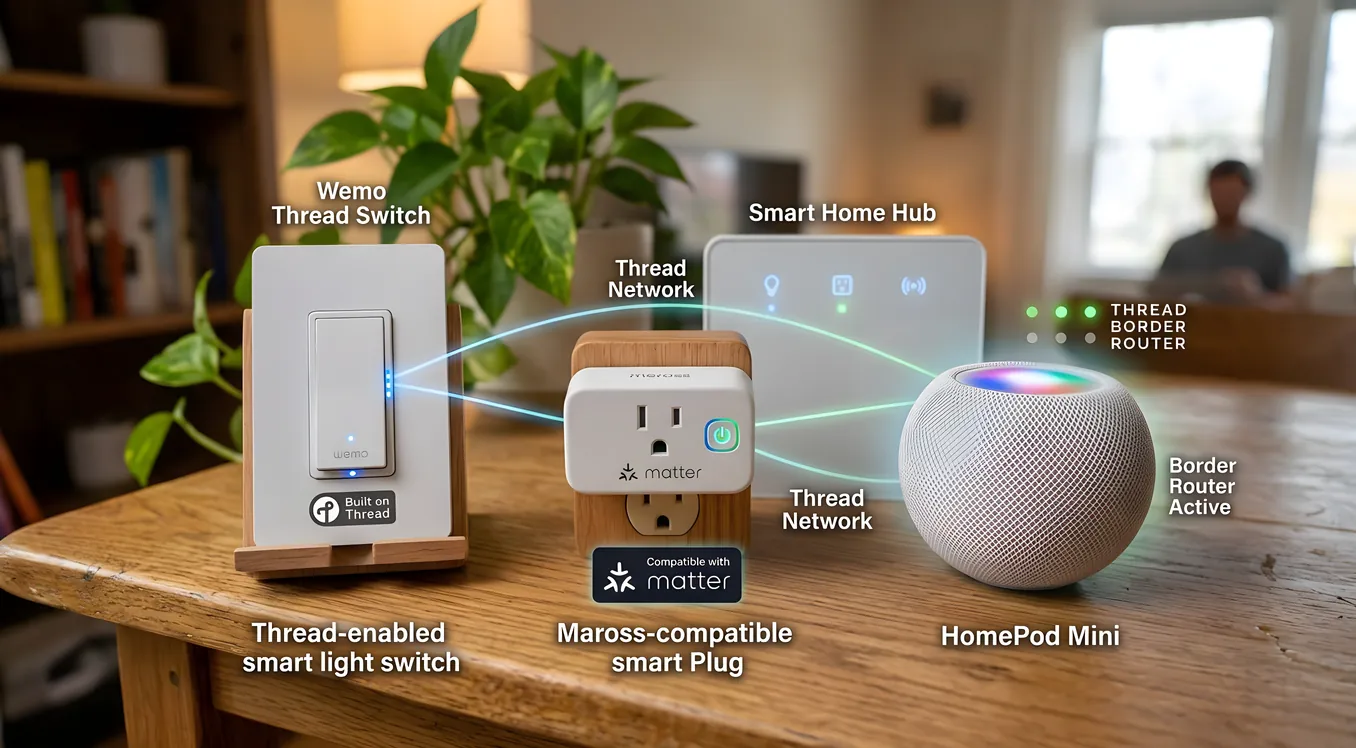
Two protocol names keep appearing in smart home coverage: Matter and Thread. They’re often mentioned together, and sometimes conflated. They are related but they solve different problems, and understanding the distinction helps set realistic expectations for what they can and cannot do in a home theater today.
The short version: Matter is a universal smart home application standard that lets devices from different manufacturers work together under a single control layer. Thread is a low-power mesh networking protocol that many Matter devices use to communicate. Matter tells devices what to do and how to be discovered. Thread is one of the radio technologies they use to receive those instructions.
What Matter Actually Is
Matter is an open-source connectivity standard maintained by the Connectivity Standards Alliance (CSA), a consortium that includes Apple, Google, Amazon, and Samsung among its core members. Before Matter, a smart plug made by one company might not work with a hub made by another. You needed to track which ecosystem each device belonged to, and mixing brands often meant juggling separate apps or accepting incomplete functionality.
Matter creates a common language. A Matter-certified light switch is designed to work with Apple Home, Google Home, Amazon Alexa, and Samsung SmartThings without requiring any translation layer or workaround. The device speaks Matter; every major platform understands Matter.
The multi-admin feature is one of the more useful aspects of the standard. A single Matter device can be paired with multiple controllers at the same time. If your household uses both Apple Home and Google Home, a Matter smart plug works with both simultaneously, rather than having to choose one ecosystem and stick with it.
Matter runs over IP (Internet Protocol), which means it can operate over WiFi, Thread, or even Ethernet. The application layer is consistent regardless of the underlying radio.
What Thread Is
Thread is a mesh networking protocol specifically designed for low-power, battery-operated smart home devices. It operates in the same 2.4 GHz radio band as Zigbee and uses a similar mesh topology, but unlike Zigbee, it is IP-based from the ground up.
The mesh architecture matters practically. In a Thread network, each mains-powered device acts as a router, passing messages along to devices that are farther away. A light switch in your hallway can relay a signal to a sensor in a distant room without that sensor needing its own direct WiFi connection. The network becomes more reliable and has wider range as you add more devices to it.
Battery life is a central design priority for Thread. A Thread sensor can run for years on a single battery because the protocol is built around sleeping states and low-duty-cycle communication. Compare that to WiFi devices, which maintain a persistent connection and drain batteries far faster.
Thread requires a border router to bridge the Thread network to your home’s IP network. The border router translates between the Thread mesh and your regular Ethernet and WiFi infrastructure, allowing Thread devices to be controlled from your phone or home hub. Several common devices already include Thread border routers: the Apple TV 4K, HomePod mini, HomePod (2nd generation), Google Nest Hub (2nd gen), and Amazon Echo (4th generation) all serve this role.
Why Matter Chose Thread for Many Devices
WiFi is ubiquitous and fast, but it is power-hungry and requires each device to maintain its own connection to the router. For sensors, switches, and other devices that rarely send large amounts of data, WiFi is overkill and hard on batteries.
Zigbee and Z-Wave solved this problem for years and remain widely deployed. But both are proprietary at the networking layer, which created fragmentation. Thread offers similar power efficiency and mesh reliability with an open, IP-based architecture, making it a natural fit for the Matter standard. The CSA formally adopted Thread as one of Matter’s supported transport layers.
This means that for battery-powered devices, keypad switches, and sensors, Thread is often the better underlying radio. For devices that are already plugged in and benefit from high bandwidth (like streaming devices or NAS units), WiFi makes more sense.
What Matter Supports in 2025 and 2026
The honest answer is that Matter’s device support is broader than it was at launch in 2022, but it still covers a relatively limited category set. Current certified device types include lighting and switches, electrical plugs and outlets, thermostats, door locks, window shades and blinds, smoke and CO detectors, air quality sensors, contact sensors, occupancy sensors, and media streaming TV devices.
That last category is the one most relevant to home theater. The Matter specification includes a media device class that covers streaming devices, and Apple TV is a good example of how this plays out. The Apple TV 4K functions as both a Thread border router and a Matter controller, meaning it can control other Matter devices in your home directly from the Apple Home app without requiring any additional hub. It also acts as a hub for HomeKit devices.
For lighting control in a theater context, Matter is genuinely useful today. If you have Matter-compatible smart bulbs, light strips, or switches, they can be controlled from any Matter controller and included in automation routines without being locked to a single app.
The AV Gap: What Matter Does Not Yet Control
This is where the realistic picture diverges from the marketing narrative. Complex AV devices are not yet part of the Matter specification in any meaningful way.
Receivers and preamplifiers, projectors, TVs beyond basic power and input commands, video processors, streaming servers, and multi-zone audio distribution systems are not Matter-certified device categories in the 2025-2026 timeframe. The specification has a working group focused on media and entertainment devices, but the path from working group to ratified standard to widely certified products is measured in years, not months.
Camera feeds are another gap. Matter does not currently include a standardized way to view camera streams across platforms. Each platform still handles cameras through its own proprietary layer. Google Home, Apple Home, and Alexa each treat camera video differently, and Matter has not yet unified this.
What this means in practice: Matter and Thread significantly simplify the smart home devices around your theater (lighting, climate, door locks, window shades, sensors) but they do not replace or extend your AV control system. The rack full of equipment still requires a different solution.
Matter and Professional AV Control: What Stays the Same
Control4, Savant, and Crestron are not being displaced by Matter for the foreseeable future. These platforms control AV equipment over IP, RS-232, and IR, using drivers that manufacturers write for specific devices. They handle complex sequencing, two-way feedback from equipment, and the kind of granular control that home theater demands. None of that exists in the Matter specification.
What is changing is that Control4 and similar platforms are adding Matter support for the periphery. A Control4 system can function as a Matter controller, which means it can directly control Matter-certified devices like smart lights and thermostats without needing a separate hub. The AV core of the system stays the same; the smart home integration around it becomes simpler.
For a home theater build, this creates a cleaner architecture. Your theater control system handles the projector, receiver, screen, and media sources. Matter handles the room’s lighting (including the bias lighting and sconces that you want dimmed for viewing), the thermostat, and potentially the motorized shades, all controlled natively by the same platform without requiring third-party lighting bridges or custom programming.
Lighting Control and Matter: A Practical Note
One of the most immediate benefits of Matter for home theater is simplified lighting integration. Dedicated lighting systems like Lutron lighting continue to be the premier choice for serious home theater installations because of their reliability, fade quality, and the precision of their dimming curves. Lutron’s RadioRA and Caseta lines are not Matter devices in the traditional sense, though Lutron has added Matter bridges that make Caseta devices appear as Matter devices to other controllers.
For installations where a dedicated lighting system is not in the budget, Matter-compatible switches and dimmers from mainstream brands now provide a reasonable alternative that works with any major platform and does not require proprietary hubs. The quality of dimming is not equivalent to Lutron, but the interoperability story is genuinely improved compared to the Zigbee or WiFi alternatives from a few years ago.
Voice Control and Matter
The voice control integration with Matter works well for the device types that Matter currently supports. Asking Siri, Alexa, or Google Assistant to dim the lights to 20%, adjust the thermostat, or lower the shades works reliably when the underlying devices are Matter-certified.
The same gap applies here: voice commands for complex AV functions still go through platform-specific integrations rather than Matter. “Alexa, play the living room TV” uses Alexa’s own entertainment protocols, not Matter. This may change as the media device specification matures, but for now, voice control of your actual AV equipment runs in parallel with, rather than on top of, the Matter layer.
The Multi-Admin Advantage for Mixed Households
One practical benefit that matters more as installations grow: a single Matter device can be enrolled in multiple ecosystems simultaneously. In a household where one person relies on Siri and another prefers Google Assistant, the same light switch, thermostat, or sensor responds to both without any configuration gymnastics. Neither user has to switch apps or accept a degraded experience.
This was not possible with earlier smart home protocols. A Zigbee device belonged to one hub. A Wink device worked with Wink. Moving ecosystems meant re-pairing every device. Matter changes that assumption at the specification level, and the multi-admin capability is baked into the standard rather than bolted on by individual manufacturers.
What to Watch For
The Matter working groups are actively expanding the specification. The entertainment device category is a documented area of development, and manufacturers that build AV equipment have been joining the CSA. The timeline for certified AV devices is genuinely uncertain, but the direction is clear: the specification will eventually cover more of what sits in a home theater rack.
Thread border router proliferation is also accelerating. As Apple TV units, HomePods, and competing devices continue to ship with built-in Thread radios, the network infrastructure for Thread devices is becoming something most households already have without realizing it.
Putting It Together
Matter and Thread are meaningful infrastructure improvements for the smart home ecosystem around a home theater. Lighting, climate, sensors, locks, and shades are all better supported than they were two years ago, and the multi-admin feature removes the lock-in that made earlier smart home investments feel risky.
For the theater itself, the control picture has not changed. A serious home theater still runs on dedicated AV control, and Matter does not yet extend into the rack. The benefit today is that Matter simplifies what surrounds the theater: the room automation that sets the stage before the screen comes up and restores it when you’re done. That is genuinely useful, even if it is not the full story that some coverage of these protocols suggests.