Savant Home Theater Integration: Apple-Native Automation for AV
Savant occupies a specific position in the home automation market: premium, Apple-aligned, and built around the idea that controlling your home should feel like using an iPhone. For homeowners deeply invested in the Apple ecosystem, it is one of the few automation platforms where that philosophy carries through consistently from the app to the remote to the hardware itself.
This guide covers how Savant works, what its major components do, where it excels in theater applications, and how it compares to the alternatives at similar price points.
The Savant Pro App: Scene-Based Control From Any iOS Device
The Savant Pro app is the primary control interface for the system, and it is designed exclusively for Apple devices. Unlike some competing platforms that offer iOS and Android parity as an afterthought, Savant built Pro around Apple’s interaction model from the start. The result is an interface that feels native rather than cross-platform.
The core organizing principle is scenes. Rather than presenting a list of devices to control individually, Savant groups actions into named experiences: “Watch Movie,” “Good Morning,” “Listen to Music,” “Goodnight.” Activating a scene triggers a coordinated sequence across every subsystem involved. For a home theater, Watch Movie might lower motorized shades, dim the overhead lighting to 15%, power on the projector and AV processor, switch inputs to the media server, and set the thermostat back two degrees. One tap.
This scene-based approach is meaningfully different from how Control4 handles automation. Control4 builds scenes through programming triggers and conditional logic that runs on the controller. Savant’s interface presents those same capabilities, but with a visual design and interaction flow that most iOS users find intuitive without training.
The Pro app also handles status monitoring, so users can see what is on, what state each room is in, and make adjustments without navigating through menus designed for a dealer’s programming workflow.
Savant Pro Remote: Hardware Control for Dedicated Theater Rooms
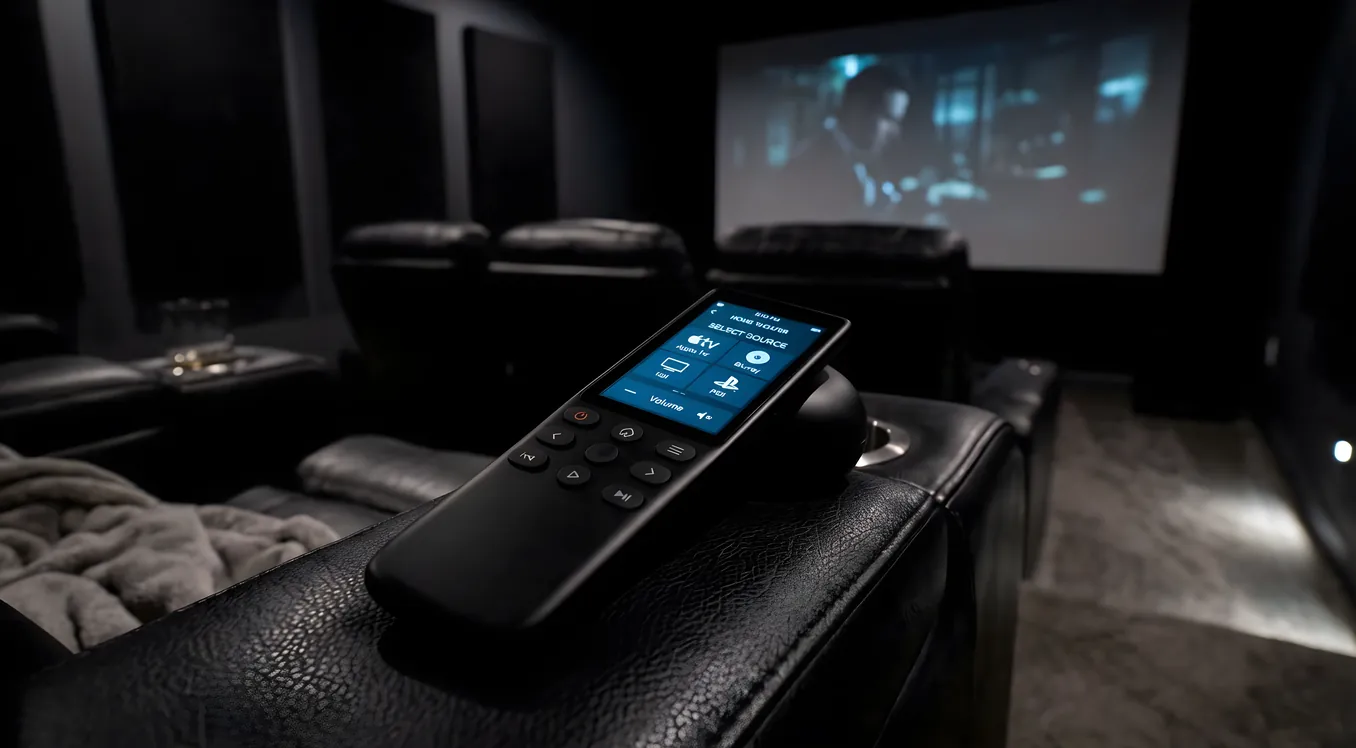
For dedicated home theater spaces where a phone-based interface is not ideal during a film, Savant offers the Pro Remote. It is a high-end universal remote with an OLED touchscreen paired with physical haptic buttons along the sides and bottom.
The OLED display shows contextual controls that change based on what is active. During playback, it shows transport controls. In a menu-navigation context, it shows directional inputs. The physical buttons give haptic feedback and can be pressed without looking at the remote, which matters in a dark room.
The Pro Remote communicates with the Savant system over Wi-Fi, so it is not limited to IR line-of-sight. It also handles IR blasting for legacy equipment that does not support IP or RS-232 control, which covers most older AV gear. For theater rooms with installed equipment behind rack doors, this matters considerably.
The remote handles everything the Pro app does: scene activation, source selection, playback control, lighting adjustment, and climate control. It is an optional component, but in purpose-built theater rooms with seating rows and rack-mounted equipment, it is frequently specified.
Savant Studio: Dealer Programming Software
Savant is a dealer-installed platform. Every Savant system requires programming through Savant Studio, the company’s professional configuration software, by an authorized integrator. This is not a limitation unique to Savant. Crestron and Control4 follow the same model, and the reasons are similar: the programming complexity required to make a sophisticated whole-home system behave reliably across hundreds of devices and scenarios is not something a homeowner should attempt to configure from scratch.
Savant Studio allows the integrator to define every device, every scene, every trigger condition, and every behavior. It includes a library of pre-built drivers for major AV manufacturers, which accelerates configuration. After the initial installation, small adjustments (renaming a scene, changing a lighting level within a scene) can sometimes be made by the homeowner through the app, but structural changes require dealer access.
The relationship with a Savant dealer is ongoing. Budget for programming time when making significant changes to a system, adding new equipment, or adding rooms. This is true across all dealer-installed platforms, and Savant is not more restrictive than average on this point.
Apple Ecosystem Integration: HomeKit, Siri, and Apple TV
Savant includes a HomeKit bridge, which means the entire system appears in Apple’s Home app and responds to Siri commands. In practice, this means you can say “Hey Siri, movie time” and trigger the Watch Movie scene if it is configured to respond to that phrase. You can also ask Siri about status: “Is the living room light on?” pulls from the HomeKit-bridged device state.
The bridge is bidirectional. Actions taken in the Home app propagate through Savant’s controller, so you are not managing two separate systems. Savant remains the authoritative controller; HomeKit is an additional control layer sitting on top.
Apple TV integration goes further than the HomeKit bridge. Savant can use Apple TV as a media endpoint within its system, controlling it through IP commands rather than IR. This allows the Savant interface to select Apple TV as a source, control playback, and report status back without the IR reliability issues that affect older control methods. For households where Apple TV is the primary streaming device, this tight integration removes a common friction point.
Voice control through Siri works reliably for the commands HomeKit exposes. Savant does not natively support Alexa or Google Assistant without additional configuration, which reflects the platform’s Apple-first positioning.
Savant Music: Whole-Home Audio Distribution
Savant Music is the company’s multi-room audio platform. It handles distribution of streaming services and local library sources across zones throughout the home, with the Pro app serving as the unified control interface for all of it.
Streaming service support includes Spotify, Tidal, Apple Music, TuneIn, and others through HEOS-compatible architecture. Local music libraries stored on a NAS or dedicated server can be indexed and played through the Savant interface as well, which matters for households with large ripped CD collections or high-resolution audio files.
Each zone can play different sources independently, or zones can be grouped to play the same source in sync. Volume control, source selection, and zone grouping are all handled within the Pro app rather than requiring a separate audio app.
For theater applications, Savant Music integrates with the room’s scene structure. The “Enjoy Music” scene for a listening room activates the appropriate amp, selects the source, sets the zone volume, and adjusts lighting, just as the Watch Movie scene does for a theater configuration.
Savant Power: Smart Breaker Panel
Savant Power extends the system’s control to the electrical infrastructure of the home. It replaces or supplements the main electrical panel with smart circuit breakers that can be monitored and controlled through the Savant system.
The energy monitoring component reports real-time consumption by circuit, which allows homeowners to see what is drawing power and identify equipment left on. The control component allows circuits to be switched from the app or from scenes. A “Leave Home” scene can cut power to circuits that should be off while the house is empty.
For home theaters specifically, Savant Power can be configured to cut power to AV equipment in a single action rather than requiring devices to be shut down individually. It can also prevent surge events from reaching sensitive AV equipment by coordinating with the scene system.
Savant Power requires professional electrical work for installation and represents a meaningful addition to system cost. It is not a standard component of every Savant installation, but it is increasingly common in new construction projects where the electrical and automation work happens simultaneously.
Lighting: Native Fixtures or Lutron Integration
Savant has its own line of keypads and lighting control hardware, but the company’s closer and more commonly deployed integration is with Lutron. Savant and Lutron have maintained a deep integration partnership, and in most whole-home projects, Lutron handles the dimming and switching while Savant handles the control layer on top of it.
The practical result is that lighting scenes defined in Savant activate Lutron zones through a native protocol integration rather than through IR or RS-232 commands. Status is bidirectional: if someone presses a Lutron keypad, Savant sees the state change and updates accordingly. This matters for scenarios like a family member pressing the keypad on the way out of the theater, which should reflect in the app without requiring a refresh.
Savant’s own keypads are designed to match the aesthetic of Apple hardware, with clean lines and minimal labeling. They work within the Savant system directly, without Lutron in the middle, and are specified in projects where clients prefer a fully integrated Savant installation.
What Savant Costs
A Savant system typically runs 20 to 40 percent more than a comparable Control4 installation, before accounting for hardware differences. The reasons are the premium associated with the Apple-first positioning, the higher-end industrial design of Savant’s hardware components, and dealer margins that reflect the more limited authorized dealer network.
For a single home theater room with scene control, AV switching, lighting, and climate integration, a Savant installation commonly runs between $8,000 and $20,000. Whole-home projects covering multiple zones, distributed audio, motorized shading, and Savant Power can reach $30,000 to $60,000 or more depending on the number of subsystems and the scope of AV hardware involved.
These figures assume a competent local integrator. Dealer pricing varies considerably by market, and a dealer in a major metropolitan area will typically charge more for programming time than one in a smaller market.
The recurring cost picture is cleaner than some alternatives. Savant does not charge monthly subscription fees for basic system operation, though some add-on services may carry annual fees. The primary ongoing cost is programming time when changes are needed.
Savant vs Control4: The Comparison That Matters Most
Savant and Control4 compete directly in the dealer-installed premium automation market. The technical capabilities overlap considerably. Both handle whole-home AV control, lighting, climate, shading, and security integration. Both require authorized dealers. Both produce reliable, professionally installed systems.
The differences that actually drive purchasing decisions are narrower than the marketing suggests.
Savant’s interface genuinely feels more Apple-native. The Pro app’s design language, its scene-based organization, and its iOS integration are tighter than Control4’s app across comparable configurations. For households where everyone uses iPhones and Apple TV, Savant’s friction reduction is real and daily.
Control4 has a larger authorized dealer network, which means more competitive pricing in most markets and easier access to programming support when issues arise. It also has broader compatibility with third-party devices and integrations, which matters in homes with unusual equipment or specific requirements that Savant’s driver library does not cover.
The summary: Apple households leaning toward a premium experience, and willing to pay the associated price differential, tend to find Savant the better fit. Households prioritizing dealer availability, integration breadth, or lower total cost of ownership typically choose Control4.
Neither system is wrong. The right answer depends on which ecosystem a household already lives in and how much the interface experience is worth as a line item in the project budget.
Working With a Savant Dealer
Finding a Savant authorized dealer is the first step for any serious project. Savant maintains a dealer locator that shows authorized integrators by region. The authorized network is smaller than Control4’s, which means some markets have limited options and pricing competition is lower.
Before any design or proposal work, the integrator will conduct a site visit to understand the project scope, existing infrastructure, and equipment to be controlled. The quality of this discovery process predicts the quality of the installation. Dealers who ask detailed questions about how the household actually uses each room produce better programming than those who apply a templated approach.
Get programming included in the project contract, not billed by the hour after installation. Most reputable Savant dealers include initial programming as part of the project price, with a defined number of revision hours. Scope what you need carefully in advance. Changes after installation cost real money, and the more specific you can be about scenes and behaviors during the design phase, the fewer revisions you will need.