AV Over IP: Network-Based Video Distribution for Homes
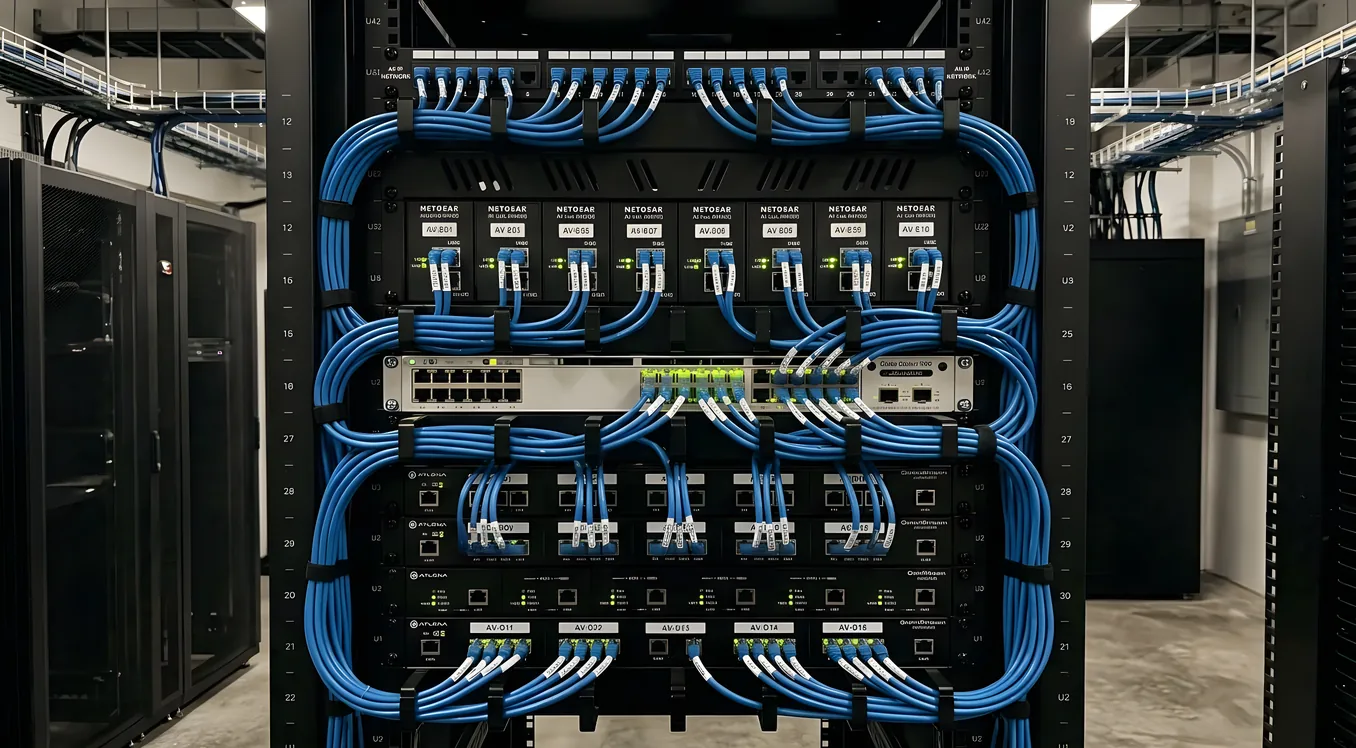
Video distribution used to be a hardware problem. You bought a matrix switch sized for your system, ran HDMI cables through walls, and hoped you never wanted to add another display. AV over IP rewrites those constraints by treating video and audio the same way your network treats everything else: as data packets traveling over standard Ethernet.
The practical result is a distribution architecture that scales independently of your source count, reaches any room without fighting cable physics, and integrates with the IP infrastructure already present in most modern homes.
What AV Over IP Actually Does
Every AV-over-IP system consists of two types of devices: encoders and decoders. An encoder connects to a source (a media player, cable box, Blu-ray player, PC) and converts its output into a network-compatible data stream. A decoder connects to a display and converts that stream back into video and audio signals the TV can use.
You install one encoder per source, one decoder per display. The network in between handles routing, meaning sources and displays never need to be physically adjacent or wired directly to each other. Adding a display anywhere on the network means adding a decoder, not replanning cable runs or upgrading a central matrix.
This is the fundamental difference from traditional matrix switching, where the hardware itself defines the maximum number of inputs and outputs. A 16x16 matrix handles sixteen sources and sixteen displays, period. An AV-over-IP system handles whatever the network and your switch infrastructure can support.
Protocols: SDVoE, NDI, Dante AV, and Just Add Power
Not all AV-over-IP systems speak the same language. The protocol determines bandwidth requirements, latency characteristics, and how the system is managed.
SDVoE (Software Defined Video over Ethernet) transmits uncompressed video over 10 Gigabit Ethernet. Because the signal is uncompressed, latency is effectively zero, measured in microseconds rather than frames. SDVoE systems are favored for applications where timing matters at a pixel level: gaming, live switching between sources, and video wall installations where multiple panels must display in perfect sync. The tradeoff is network cost; 10GbE switches are more expensive than standard 1GbE switches, and every encoder and decoder needs that bandwidth headroom.
NDI (Network Device Interface) takes a software-first approach. It was designed by NewTek for broadcast production workflows but has found substantial adoption in AV integration. NDI uses compression to reduce bandwidth demands, making it compatible with existing 1GbE networks in many scenarios. The tradeoff is latency, typically 16 to 50 milliseconds depending on compression settings, which rules it out for gaming but is imperceptible for most video content. NDI’s software architecture means sources and destinations can be managed through IP-based control systems, and it integrates well with IT teams already managing network infrastructure.
Dante AV extends Audinate’s Dante audio network to carry video. Organizations with existing Dante audio infrastructure can add video routing to the same network fabric. Dante AV is particularly common in installations where audio distribution is already Dante-based and video needs to follow.
Just Add Power is a proprietary protocol built on standard network infrastructure that has become a popular choice in residential integrations. It runs over 1GbE and uses HDMI over IP with VLAN-based routing, and it has extensive compatibility with control systems like Control4. The platform’s straightforward setup and mid-range pricing have made it one of the more common choices for custom home installations.
Network Requirements
The network is not a passive participant in an AV-over-IP system. It is the switching matrix. Getting it wrong means dropped frames, sync issues, or streams that simply refuse to appear on certain displays.
The foundational requirement is a managed switch with IGMP snooping enabled. IGMP (Internet Group Management Protocol) snooping allows the switch to deliver multicast video streams only to decoders that have subscribed to a given source, rather than flooding every port with every stream simultaneously. On an unmanaged switch or a managed switch with IGMP snooping disabled, a single 4K stream would saturate every port on the network.
Bandwidth requirements depend directly on the protocol and compression level. Compressed systems like NDI and Just Add Power generally run comfortably over 1GbE infrastructure, provided the switch fabric has enough headroom for simultaneous streams. Uncompressed systems like SDVoE require 10GbE from encoder to switch to decoder with no exceptions. A 4K uncompressed stream consumes roughly 10 Gbps on its own.
For residential installations with multiple simultaneous 4K streams, network planning should account for aggregate bandwidth across all active streams, not just peak single-stream requirements. A home with eight displays potentially streaming eight different 4K sources simultaneously is an 8x bandwidth scenario. Most residential integrators address this by segmenting AV traffic onto a dedicated VLAN separate from general home network traffic, which also simplifies troubleshooting and reduces interference from other devices.
Residential Systems
Several manufacturers have developed AV-over-IP platforms specifically targeted at residential and light commercial integration.
Atlona OmniStream offers both 1GbE compressed and 10GbE uncompressed variants, giving integrators flexibility to right-size for the installation. OmniStream units include features common in high-end residential work: 4K60 with HDR, HDCP 2.2 compliance, and control via REST API for integration with major automation platforms.
Crestron NVX is the company’s enterprise-grade AV-over-IP line, built on SDVoE. NVX runs over 10GbE, delivers zero-latency 4K video, and integrates natively with Crestron control systems. It is positioned toward larger installations where budget is less constraining than performance and integration capability.
Control4 HDMI over IP targets the mid-market residential segment with a system designed to work within the Control4 ecosystem. Setup and management occur through the Control4 platform, which reduces the expertise required from installers working in existing Control4 homes.
Snap One Binary is commonly specified in custom installations where the integrator is already in the Snap One ecosystem. Binary’s AV-over-IP products are priced for residential projects and pair with OvrC remote management for monitoring and troubleshooting after installation.
Video Walls and Multi-Zone Routing
One capability AV over IP introduces that traditional matrix switches cannot easily replicate is flexible video wall configuration. Because encoders and decoders communicate via software-controlled routing, a single source can be distributed to multiple decoders simultaneously. Those decoders can be arranged in a grid, with bezel correction applied, to display one image across several panels.
A matrix switch requires dedicated outputs wired to each display in a video wall, and the wall configuration is fixed by the wiring. An AV-over-IP video wall can be reconfigured in software: change which decoders participate, adjust the grid layout, or switch the content source without touching a cable.
This same multicast capability applies to standard multi-zone distribution. A single source broadcast to twenty rooms requires one encoder, not twenty outputs from a matrix.
Latency Comparison
Latency is the primary technical consideration when choosing between distribution approaches for specific applications.
A traditional HDMI matrix switch operates in sub-millisecond territory, essentially passing through the signal with negligible processing delay. SDVoE matches this, delivering sub-millisecond latency over 10GbE. Compressed AV-over-IP systems introduce encoding and decoding delays: Just Add Power and NDI typically land in the 16 to 50ms range, with higher compression settings pushing latency higher.
For most content, 16 to 50ms is undetectable. Streaming video, broadcast TV, and movies at this latency level look and sound normal. The scenario where it matters is gaming. A 50ms display lag on top of TV processing lag creates a combined input-to-display delay that serious players will feel. For gaming sources distributed to displays where gaming will actually occur, low-latency or lossless distribution is worth the additional network infrastructure cost.
When Matrix Hardware Still Makes Sense
AV over IP is not the right choice for every installation. For systems under six zones, a traditional HDMI matrix switch is often simpler to install, simpler to support, and less expensive overall. The managed switch requirement, VLAN configuration, and encoder/decoder overhead add complexity that small systems do not benefit from.
Gaming rooms with high-performance displays and latency-sensitive titles are another case where matrix hardware is worth reconsidering, unless the budget supports SDVoE at 10GbE. A mid-range AV-over-IP system with 30ms latency in a dedicated gaming setup is a noticeable compromise.
The cost structure also deserves honest evaluation. Per-endpoint cost in AV-over-IP systems is generally higher than in matrix switching for the same number of zones. The economic crossover where AV over IP becomes cost-competitive typically occurs around eight to twelve zones, where the cost of a large matrix switch plus long HDMI cable runs with active extenders or fiber converters exceeds the cost of encoders, decoders, and an additional managed switch.
Fitting AV Over IP Into the Broader System
AV over IP does not operate in isolation. The network requirements for an AV-over-IP installation are more demanding than a standard home network, and they need to be addressed at the infrastructure design stage rather than retrofitted after the AV system is installed. A consumer-grade router with a built-in unmanaged switch cannot support the multicast routing an AV-over-IP system requires.
Within the context of whole-home AV distribution, AV over IP is the architecture that removes the ceiling on what a distributed system can do. Traditional approaches hit limits at HDMI cable distances, matrix output counts, and the difficulty of adding zones after initial installation. AV over IP replaces all of those constraints with network bandwidth, which is far easier to scale.
Planning an AV Over IP System
The decision points for a residential AV-over-IP installation are: protocol (which determines bandwidth and latency), switch infrastructure (1GbE or 10GbE, managed with IGMP snooping), and encoder/decoder pairing (the manufacturer and product line determine compatibility and control system integration).
Protocol selection drives everything downstream. If gaming distribution matters, SDVoE is the answer and 10GbE infrastructure is the cost of that choice. If the installation is primarily streaming media, broadcast TV, and movie playback distributed across eight or more zones, a quality compressed system over 1GbE delivers the scalability benefits at a lower infrastructure cost.
Integrators with experience in both traditional and IP-based distribution will know where each approach makes sense for the specific home, the specific client, and the specific use cases that system needs to serve.