OLED vs LED vs Mini-LED vs QLED: Display Technology Compared
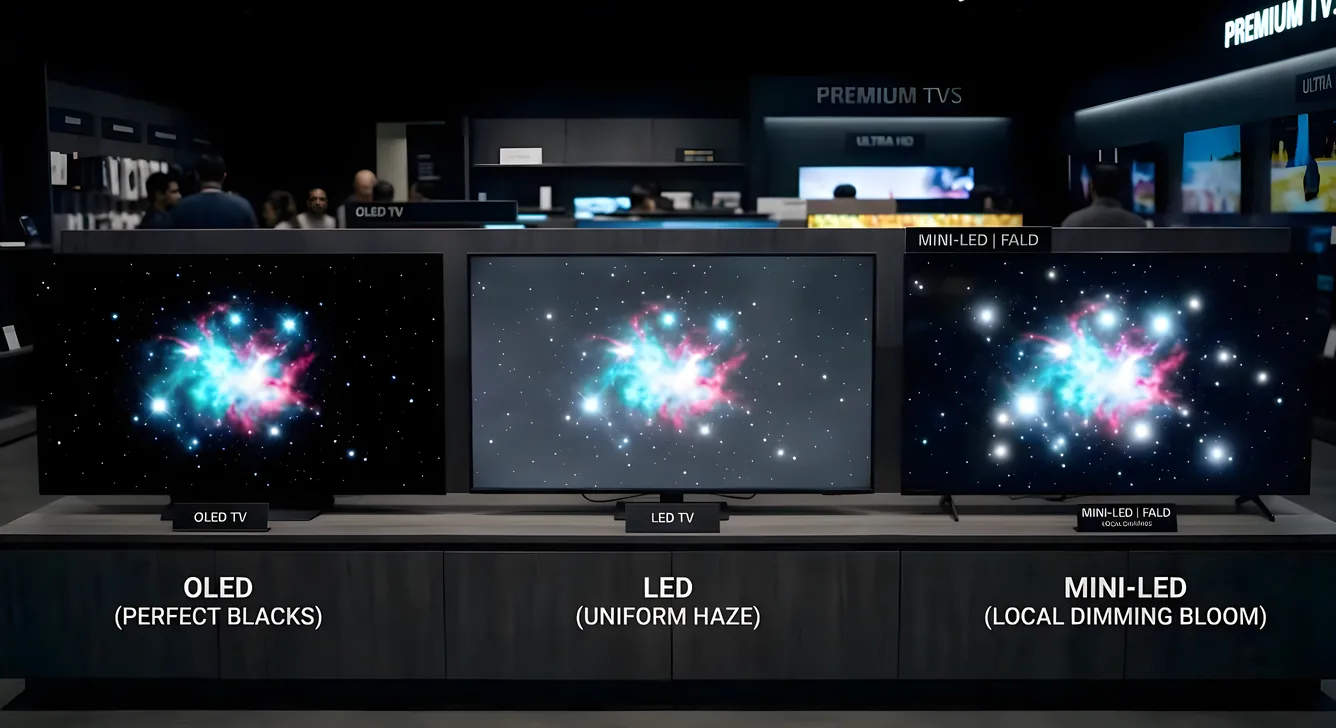
The four display technologies marketed today, LED LCD, QLED, Mini-LED, and OLED, do not form a clean hierarchy where one is simply “better” than the others. Each represents a different engineering approach to the same problem: producing a bright, high-contrast image from a flat panel. The right choice depends on your room’s light conditions, how you use the screen, and which picture quality attributes you weight most heavily. This guide works through the underlying technology first, then maps it to real buying decisions.
LED LCD: The Baseline Architecture
Every flat-panel television sold outside of OLED falls into some variant of the LCD category. Liquid crystal displays work by passing light from a backlight through a polarizer, then through liquid crystal cells that act as individually controllable shutters, then through color filters (red, green, and blue sub-pixels), and finally through a second polarizer. The image you see is entirely the result of controlling how much backlight passes through each sub-pixel.
The backlight itself varies by configuration. Edge-lit panels place LEDs along one or more edges of the display and use light-guide panels to spread illumination across the screen. Edge-lit designs allow for very thin chassis, which is why many 65-inch TVs can be mounted flush against a wall. The tradeoff is uniformity: edge-lit screens tend to show “blooming” or glow in corners and edges, and local dimming (selectively darkening regions of the backlight) is limited because the dimming zones cover large areas.
Direct-lit (also called full-array) panels place LEDs across the entire back of the panel in a grid. This allows more precise local dimming because zones can be addressed independently. A direct-lit panel might have 40 to 200 local dimming zones. When a dark scene with a bright highlight plays, the zones around the bright element stay active while adjacent zones dim down. The result is meaningfully better contrast than edge-lit, though bright halos can still appear around objects on dark backgrounds if the zone count is low.
Panel type also matters. VA (Vertical Alignment) panels produce higher native contrast ratios (typically 3,000:1 to 6,000:1) but have narrower viewing angles: color and contrast shift noticeably beyond about 30 degrees off-center. IPS (In-Plane Switching) panels produce lower native contrast (typically 700:1 to 1,200:1) but maintain color accuracy at wide angles, making them a better fit for rooms where viewers sit off to the sides.
QLED: Quantum Dots on an LCD Foundation
QLED is a Samsung marketing term, and understanding what it actually means prevents a common misconception. QLED panels are LCD panels with a quantum dot enhancement layer in the backlight path. Quantum dots are semiconductor nanocrystals that emit specific wavelengths of light when excited by the blue LED backlight. The practical effect is a broader, more precisely tuned color gamut and higher peak brightness than standard LED LCD.
The key fact: QLED is not self-emissive. Individual pixels do not produce their own light. The backlight still illuminates from behind, still uses local dimming zones, and still produces the same contrast ratio limitations as any other LCD panel. A QLED TV from Samsung’s consumer lineup is still an LCD television at its core, with all the strengths and constraints that implies. High brightness (many QLED sets reach 1,500 to 2,000 nits peak), excellent color volume, and competitive prices are the genuine advantages. Deep blacks in dark scenes are not.
Hisense uses the term “ULED” for a similar configuration. TCL’s terminology varies by product line. The underlying technology is comparable.
Mini-LED: More Zones, Better Contrast
Mini-LED represents a direct response to the zone-count limitation of standard full-array local dimming. Rather than backlit by a few hundred standard-sized LEDs, a Mini-LED panel uses thousands of smaller LEDs (typically 100 to 300 micrometers across) packed into the same backlight space. The TCL QM8, Samsung QN90D, and Hisense U8N all use Mini-LED backlights.
The practical effect is a dramatic increase in local dimming precision. A 65-inch Mini-LED set might use 1,000 to 5,000+ dimming zones versus 100 to 300 in a comparable standard direct-lit set. Tighter zones mean halos around bright objects shrink considerably. Black levels in dark scenes improve. Peak brightness in HDR highlights can reach 2,000 to 3,000 nits on the best implementations, well above what OLED panels currently sustain.
Mini-LED still cannot match OLED pixel-level precision because zones, even small ones, cover multiple pixels. A single star in a night-sky scene still causes its local zone to illuminate slightly, raising the black floor in that area. In a properly darkened room with careful reference content, this remains visible on close inspection. In typical mixed-ambient-light viewing, it is rarely noticeable.
Mini-LED extends the practical size ceiling for high-performance displays. OLED manufacturing becomes progressively more expensive at larger sizes, limiting the format primarily to 42 to 97 inches. Mini-LED panels scale more economically, with TCL and Samsung offering 85 to 115-inch models at price points that would be impossible in OLED.
OLED: Per-Pixel Light Control
OLED (Organic Light Emitting Diode) eliminates the backlight entirely. Each sub-pixel in an OLED panel produces its own light by passing current through an organic compound layer that emits photons directly. When a pixel needs to display black, it turns off completely. The result is a true zero-black-level that no backlit technology can replicate.
The contrast ratio of an OLED display is effectively infinite: a fully black pixel outputs no measurable light, while a fully white pixel produces peak brightness. In practice, manufacturers measure “contrast ratio” differently for OLED (often comparing peak white to near-black rather than absolute black), but the subjective impact is immediate. Dark scenes with bright highlights, shadow detail in dimly lit scenes, and any content with night imagery look fundamentally different on OLED than on any LCD variant.
There are two dominant OLED panel architectures in the current market. WOLED (White OLED with color filter), used by LG in the C4, G4, and their full panel lineup, starts with a white OLED emission layer and adds a color filter array plus a separate white sub-pixel for brightness. LG manufactures these panels and also supplies them to Sony for the Bravia series. The LG C4 and G4 represent the mainstream and high-performance tiers of WOLED, respectively, with the G4 adding a higher-brightness MLA (Micro Lens Array) panel enhancement.
QD-OLED (Quantum Dot OLED) is Samsung Display’s architecture, used in Samsung’s S95D and Sony’s A95L. QD-OLED places a quantum dot conversion layer directly over blue OLED emitters instead of using a color filter. This produces richer color saturation and higher peak brightness than first-generation WOLED, with less of the color shifting at extreme brightness that earlier WOLED panels exhibited. The Sony A95L is widely regarded as the best overall QD-OLED implementation to date, combining Samsung Display’s panel with Sony’s processing.
OLED viewing angles are excellent: color accuracy and contrast ratio are largely maintained even beyond 60 degrees off-center, a fundamental advantage of self-emissive technology where no backlight is being filtered or directed.
MicroLED: Next-Generation Self-Emissive
MicroLED is architecturally similar to OLED in that each pixel generates its own light, but the emitters are inorganic semiconductor LEDs rather than organic compounds. The benefits are substantial: MicroLED produces no burn-in risk, exceeds OLED in peak brightness by a large margin, and is potentially longer-lived. Samsung’s The Wall installation product uses MicroLED technology and can be assembled in modular sections at any size.
The practical limitation in 2024 through 2026 is cost. Consumer MicroLED television products start above $100,000 for a 110-inch panel. The manufacturing challenge of placing millions of microscopic individual LEDs with the sub-pixel precision required at television scale is not yet solved at price points accessible to the consumer market. MicroLED warrants attention as the likely long-term successor to both LCD and OLED technologies, but it is not a practical purchase decision for home theaters today.
Technology Comparison at a Glance
| Attribute | LED LCD | QLED | Mini-LED | OLED | MicroLED |
|---|---|---|---|---|---|
| Contrast ratio | Good (zone-based) | Good (zone-based) | Very good (fine zones) | Infinite (per-pixel) | Infinite (per-pixel) |
| Peak brightness | 400-1,000 nits | 800-2,000 nits | 1,500-3,000 nits | 700-2,000 nits | 5,000+ nits |
| Viewing angle | Fair (VA) / Good (IPS) | Fair to Good | Good | Excellent | Excellent |
| Burn-in risk | None | None | None | Low (modern use) | None |
| Price range | $300-$3,000 | $500-$4,000 | $600-$5,000 | $800-$25,000 | $100,000+ |
| Max size available | 100 in+ | 100 in+ | 115 in | 97 in | Modular |
| Best use case | Bright rooms, budget | Bright rooms, HDR | Bright or mixed rooms | Dark rooms, cinema | Not yet consumer |
Burn-In in 2024-2026: Honest Assessment
OLED burn-in occupied considerable discussion in the technology press through 2019 to 2022, often in ways that overstated the practical risk for typical home theater users. The current picture is more nuanced.
OLED panels can develop permanent image retention when static elements (a news ticker, a channel logo, a HUD in a video game) remain on screen at high brightness for extended periods. The organic emitters in those sub-pixels degrade faster than the surrounding area, leaving a ghost image visible when content changes.
For a dedicated home theater used primarily for film and television content, burn-in risk in modern OLED panels is low. LG and Samsung have implemented pixel shift, screen savers, brightness management, and logo detection into their current panel firmware. Reviews of the LG C4 and G4 and the Samsung S95D from 2024 consistently show that burn-in does not manifest under normal viewing conditions.
The risk remains real for two specific use cases: gaming with heads-up displays that show static elements at full brightness for hundreds of hours, and commercial or professional displays that run the same content on a loop. For these, Mini-LED is the safer long-term choice. For a home theater audience, the burn-in conversation is largely settled in OLED’s favor.
OLED and HDR: Why Infinite Black Changes Everything
High dynamic range content, whether Dolby Vision or HDR10 formatted, is designed around the relationship between the darkest black and the brightest highlight in a scene. A night sky with a full moon, a campfire in a dark forest, the transition from a lit interior to a bright window: these are the moments HDR was engineered to reproduce.
On a backlit display, a dark scene with one small bright element forces a compromise. If the dimming zone containing the bright highlight stays bright, it raises the black floor in adjacent zones. If the zones around it dim aggressively, the bright element loses the surrounding context. Mini-LED minimizes this compromise with finer zones. OLED eliminates it by turning off every pixel that should be black while the bright pixel operates independently.
The subjective impact of this on properly mastered film content is significant. Shadow detail in night scenes becomes visible in a way that requires a careful test on an OLED display to fully appreciate. This is the defining advantage for a dark-room home theater.
Room Conditions Drive the Decision
The most important variable is not the display itself but the room it operates in.
Dedicated dark room home theater: OLED is the clear choice. The LG C4 at 65 or 77 inches represents the best value ratio in this category. The LG G4 or Sony A95L are appropriate if maximum picture quality matters more than price. The self-emissive advantage is most visible in the low-average-picture-level (APL) content that defines serious cinematic viewing: dark scenes, shadow detail, and the transition between lit and unlit areas.
Bright or mixed-light living room: Mini-LED wins here. The TCL QM8, Samsung QN90D, and Hisense U8N all produce the peak brightness needed to compete with ambient light while delivering local dimming performance far beyond standard LED LCD. At 65 inches, the QM8 in particular offers Mini-LED performance at a price that makes OLED look expensive relative to what you actually see under normal living room conditions.
Large screen requirements (85 inches and above): Mini-LED or standard LED LCD. OLED in sizes above 77 inches carries a significant price premium. The LG G4 97-inch model is a genuinely extraordinary display, but it costs substantially more than a 98-inch TCL QM8 that will likely look better in a bright room.
Gaming: Either OLED or Mini-LED, depending on the burn-in calculus. OLED delivers lower input lag and better pixel response (no trailing on fast motion), and the LG C4 in particular includes all major gaming features. If the gaming library runs heavily toward titles with static HUDs for hundreds of hours at high brightness, Mini-LED is the prudent choice.
For a fuller comparison of fixed-panel displays against large-screen projection, the projector vs TV guide covers that decision in detail. And if display resolution is part of your evaluation, the 4K vs 8K comparison addresses whether 8K content and panels are relevant to current purchasing decisions.
What the Specifications Leave Out
Panel measurements like peak brightness, color gamut coverage, and stated contrast ratios tell part of the story. They do not capture processing quality, which varies significantly among manufacturers. Sony’s image processing, applied to both its WOLED (Bravia A80L family) and QD-OLED (A95L) panels, is widely regarded as superior to LG’s native processing at a comparable panel grade. LG compensates with better gaming feature integration and lower prices at equivalent sizes.
Motion handling varies among OLED implementations. QD-OLED (Samsung S95D, Sony A95L) has historically shown slightly better motion clarity than WOLED in fast-motion content, though recent firmware updates have narrowed this gap.
Calibration also matters more than many buyers account for. Factory modes on most televisions are optimized for showroom brightness, not accurate home theater reproduction. A properly calibrated OLED in Cinema or Filmmaker mode will outperform an uncalibrated Mini-LED set that someone left in Vivid mode. The best practice for any display above $800 is a professional calibration or at minimum the application of a community-calibrated settings profile once the set is in its permanent location.
Choosing Without Overthinking It
The decision tree is straightforward if you start with the room:
If you have a dedicated dark room and watch primarily film content, get an OLED. The LG C4 at 65 or 77 inches is the reference point for value in this category.
If your room has windows or ambient light you cannot fully control, or if you need a screen above 85 inches, get a Mini-LED. The TCL QM8 and Samsung QN90D are the current benchmarks.
If your budget is under $600 and screen size is more important than black-level performance, a quality LED LCD panel (Samsung TU8300, Hisense A6H series) delivers strong performance for its price tier.
QLED as a category deserves attention when it appears in Samsung’s higher-tier Neo QLED lineup (which pairs the quantum dot layer with Mini-LED backlighting) rather than in entry-level models where the quantum dot benefit is present but local dimming is minimal. The marketing term QLED alone tells you very little; the backlight configuration tells you almost everything.